

Two Fifth Seeds Fell in Dubai. Garrido and Velasco Shook Up Both Draws.
GOATIFYDubai's Premier Padel P1 was supposed to become clearer when the round of 16 removed the last outsiders. Instead, Thursday's matches made both draws harder to predict. The fifth seeds in the men's and women's competitions went out, one lower-ranked team claimed a first career quarterfinal, and another established pairing escaped a match that had looked gone.
Juani De Pascual and Javi Garrido delivered the men's marquee upset, edging Mike Yanguas and Coki Nieto 7-6, 3-6, 7-6 after two tiebreaks. Jimena Velasco and Raquel Eugenio provided the women's counterpart, coming from a set down against Marta Ortega and Sofia Araújo. Beyond those headline results, Franco Dal Bianco's breakthrough alongside Flavio Abbate and a dramatic recovery by Jairo Bautista and Lucas Bergamini changed the shape of Friday's last eight.
The setting makes those results more meaningful. The Emaar Dubai P1 runs from November 8 to 15 at the Hamdan Sports Complex, with a published total prize fund of €479,068. The quarterfinals are scheduled for Friday, November 13, and the finalists will be decided over the weekend. Here is where Thursday's upsets came from and which matches now carry the biggest consequences.
Two tiebreaks turned Yanguas–Nieto's expected run into Garrido's biggest Dubai win

The score tells a much closer story than the seed numbers. De Pascual and Garrido, the No. 14 seeds, took a first-set tiebreak from the fifth-seeded Yanguas and Nieto, were pushed back 3-6 in the second set, then held together through another breaker to seal a 7-6, 3-6, 7-6 victory. A third-set tiebreak leaves almost no room for an error: one missed return, one rushed volley or one successful change of direction can undo two hours of sound work. That is why the victory is more significant than merely advancing one round.
Yanguas and Nieto were not casual outsiders promoted above their level. They entered as one of the men's higher-seeded combinations and had represented Spain successfully at the recent world championship. Their elimination removes a partnership that had legitimate expectations of surviving deep into the Dubai weekend. For the lower seeds, it also changes the route: an opponent pencilled in as a likely fixture in the latter rounds has disappeared before the quarterfinals.
The winners were not beginning from scratch, either. De Pascual and Garrido had already reached a quarterfinal together at the Milano P1, where they eliminated Martín Di Nenno and Paquito Navarro in the round of 16. That earlier run makes Thursday's result look less like a one-match curiosity and more like evidence of a pairing capable of maintaining composure against established names. It does not guarantee the same output in every event, but it raises the level of respect their next opponents must give them.
GOATIFY
GOATIFY Padel
From a pair of deciding tiebreaks to Friday's quarterfinal spotlight, explore GOATIFY's padel collection for fans of the sport.


The critical difference was how little the match offered either pair in the deciding passages. De Pascual and Garrido had to win both breakers while accepting that their opponents had taken the middle set. That combination requires a reset after losing momentum rather than a comfortable front-running performance. Their final-set result was a demonstration of resilience in the scoreline; claiming any particular winning tactical adjustment would require shot-level data that the score itself does not supply.
The next test, however, is specific. Friday's official draw places De Pascual and Garrido against Franco Stupaczuk and Jon Sanz, the third seeds. The new opponents came through the round of 16, while the No. 14 seeds arrive having survived a far longer and more stressful battle. It is a classic question of whether momentum from an upset can compensate for a potentially heavier physical and emotional workload.
This men's bracket was already unusually open because Arturo Coello and Agustín Tapia, as well as Alejandro Galán and Federico Chingotto, were absent. Those withdrawals had given the remaining seeded pairs a bigger opportunity. Thursday supplied a reminder that opportunity does not automatically favour the next names on the list: someone still has to manage the decisive points. De Pascual and Garrido did, twice.
Dal Bianco reaches uncharted territory as two more men's ties swing

The other men's breakthrough came from a less glamorous corner of the draw. No. 30 Flavio Abbate and Franco Dal Bianco defeated Manuel Aragón and Albert Roglán 7-6, 6-3 in an hour and 25 minutes. It was Dal Bianco's first appearance in a Premier Padel quarterfinal, the sort of landmark that can shift a player's season even if the next round becomes tougher.
The context of the opposition matters. Aragón and Roglán had started in qualifying, then eliminated the highly regarded Navarro–Di Nenno partnership to make themselves one of the tournament's stories. Reaching the round of 16 from that position showed how dangerous they could be. But a victory over a big name can also turn an unseeded pair into the target of the next challenger, and Abbate and Dal Bianco were the team ready to take advantage.
The opening set went to a tiebreak. Abbate and Dal Bianco won it and finished the match in two, rather than allowing the contest to become another three-set test of nerves. The 7-6, 6-3 result suggests a pair able to stay patient through the tight phase and then create separation, though it does not establish a particular tactical pattern. For Dal Bianco, the important measurable fact is the round reached. For Abbate, it is his second quarterfinal of 2026 after making the last eight at the Madrid P1 with a different partner, Álvaro Montiel.
Friday brings a harder benchmark: No. 7 Momo González and Lucas Campagnolo. The matchup also carries a late-season urgency for the higher seeds as they look towards the season-ending Finals. Dal Bianco and Abbate have already beaten the pair that upset Navarro and Di Nenno; now they must prove their breakthrough can survive a team more accustomed to the business end of a major tour event.
GOATIFY
GOATIFY Padel
Breakthrough runs and difficult comebacks make the Dubai draw compelling. See padel-inspired styles in the GOATIFY collection.
The men's day also produced a comeback of a different kind. Eleventh seeds Jairo Bautista and Lucas Bergamini lost the first set 1-6 to sixth seeds Fran Guerrero and Javi Leal. They then trailed 2-4 in the second before finding a route back, taking that set 7-5 and the decider 6-3. A scoreboard reading 1-6, 2-4 often resembles the early stages of an exit, not a launchpad for a quarterfinal. The turnaround is therefore as revealing as the final winning margin.
That recovery has direct bracket consequences. Bautista and Bergamini move on to meet Tino Libaak and Gonzalo Alfonso, who had reached this phase again, while the sixth seeds leave without converting their commanding position. It is not the same kind of upset as De Pascual and Garrido's double-tiebreak win: here the decisive narrative is how abruptly the competitive balance changed after one team had controlled so much of the opening contest.
Elsewhere, Juan Tello and Maxi Arce came back from a set down to beat Eduardo Alonso and Aimar Goñi 3-6, 6-3, 6-2. They are now due to meet Juan Lebrón and Leo Augsburger. The four men's quarterfinals consequently offer contrasting types of intrigue: a pair's career first, a stunning escape, an upset against a higher seed and a confrontation between teams capable of winning the whole week.
Velasco and Eugenio join the last eight while the women's top four stay alive
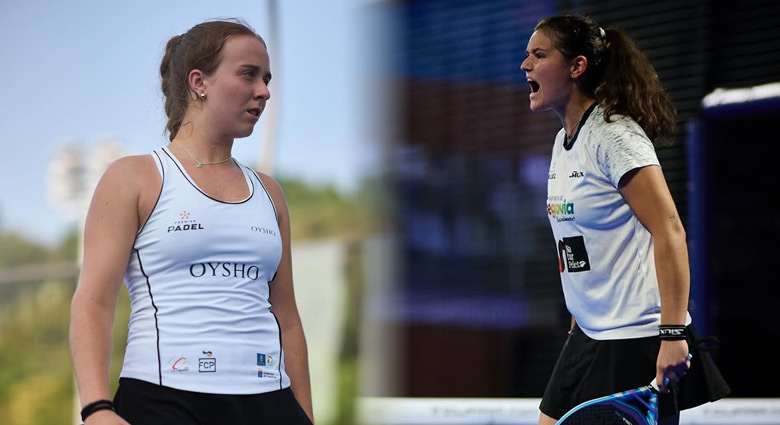
The women's fifth seeds also left Dubai on Thursday, but their match unfolded differently from the men's biggest surprise. Thirteenth seeds Jimena Velasco and Raquel Eugenio lost the opening set 4-6 to Marta Ortega and Sofia Araújo, then reversed the trajectory with 6-4 and 6-3 sets. The match lasted two hours and eight minutes, the longest women's contest of the day according to the tour's round-of-16 report.
Ortega and Araújo had teamed up in late July and had not previously been knocked out before the quarterfinal stage. That made the result more consequential than a simple five-versus-thirteen ranking comparison. Velasco and Eugenio were confronting a partnership whose recent floor had been the last eight; by turning the match around, they broke that pattern and supplied the first conspicuous crack in the women's seeded order.
The winning team brought youth but not complete unfamiliarity to the occasion. Velasco and Eugenio have a combined age of just 40. Their partnership began in 2025, and the pair had already appeared in a Milano P1 quarterfinal. That history is useful context for a comeback against seasoned opponents: they have competed together for long enough to recognise a difficult moment without treating it as the end of the match. The score shows the ability to recover, not an absence of pressure.
GOATIFY
GOATIFY Padel
The women's last eight now mixes established favourites and fearless challengers. Browse GOATIFY padel clothing and accessories.
The sequence matters. After Ortega and Araújo's 6-4 opener, the lower-ranked team needed to win two consecutive competitive sets. They did so 6-4 and 6-3, finding a higher level as the match progressed rather than benefiting from an early lead. Two hours and eight minutes of competition also means there is a physical element to the next challenge; an underdog can earn a major win on Thursday yet have little recovery time before meeting another formidable team on Friday.
That next team is Ari Sánchez and Andrea Ustero, the No. 3 seeds. Sánchez and Ustero required only one hour to defeat Letizia Manquillo and Lucía Sainz 6-0, 6-4. The contrast is stark: Velasco and Eugenio survived the day's longest women's match, while their next opponents emerged from its fastest. Fatigue is not a certain predictor of results, but the difference in time on court and the ease of the top seeds' previous victory gives the quarterfinal an obvious tactical and conditioning dimension.
The other favourites advanced as well. World No. 1s Gemma Triay and Delfi Brea beat Marta Talaván and Sofía Saiz 6-3, 6-1. The second-seeded Paula Josemaría and Bea González were similarly efficient against Verónica Virseda and Martina Fassio, winning 6-3, 6-1. Fourth seeds Claudia Fernández and Martina Calvo met tougher resistance but survived Jessica Castelló and Laia Rodríguez 7-6, 6-4. With all four of those teams still in the bracket, the fifth seeds' departure does not mean the women's tournament has become a free-for-all.
The ranking stakes are sharpest near the top. Triay and Brea entered the Dubai week seeking to protect their lead, while Sánchez and Ustero needed a title run to make a meaningful move towards them. The latter pair cannot look ahead to a possible final, however: Velasco and Eugenio have just shown what can happen when an established seeded partnership assumes the expected result will arrive. For the young Spanish duo, reaching the last eight is already a statement. Turning that into a semifinal would be another scale of surprise.
Thursday's results leave Dubai with two distinct stories running at once. The men's bracket is crowded with openings: De Pascual and Garrido can follow up a win over the fifth seeds, Dal Bianco can extend a career-best run, and Bautista and Bergamini can test whether their comeback has built momentum. The women's field still contains all four leading seeded teams, yet Velasco and Eugenio have proved that one seeded upset can redraw an entire quarter.
The quarterfinals on Friday, November 13, will reveal which performances were one-day flashes and which pairs can sustain them against an even higher standard. At this point, the confirmed outcome is not who will lift the Dubai P1 trophy on Sunday. It is that the road to the trophy is more open, and less predictable, than it looked before Thursday.
GOATIFY
GOATIFY Padel
Shop GOATIFY padel products from the Padel-filtered collection scope.



















