

McLaren’s Vegas Upgrade Is More Than a Fix. It’s a 2027 Test.
GOATIFYMcLaren is arriving at the 2026 Las Vegas Grand Prix with a problem that an impressive win in Brazil has not entirely solved. Lando Norris took pole position and victory at Interlagos, ending a five-race podium drought and giving the team proof that its late-season development still delivers. Yet Las Vegas demands almost the opposite of what Brazil offered: prolonged flat-out running, heavy braking, low drag and the ability to keep the tyres operating on a cold street circuit.
Team principal Andrea Stella has confirmed that more parts are due for the MCL40 in Nevada. Those changes will complement a development package introduced in São Paulo, including a front-wing direction the team regards as a starting point for its 2027 car. That makes the November 20–22 weekend more than a conventional upgrade test. It is a difficult circuit at which to assess whether performance gained in one set of conditions translates into a broader competitive platform.
The attraction is obvious, but so is the risk. A new part can make the car easier to drive without overcoming a fundamental top-speed deficit. McLaren has recent evidence of both its potential and its weaknesses. Understanding the difference is the story of its Las Vegas weekend.
What the new McLaren package is supposed to change
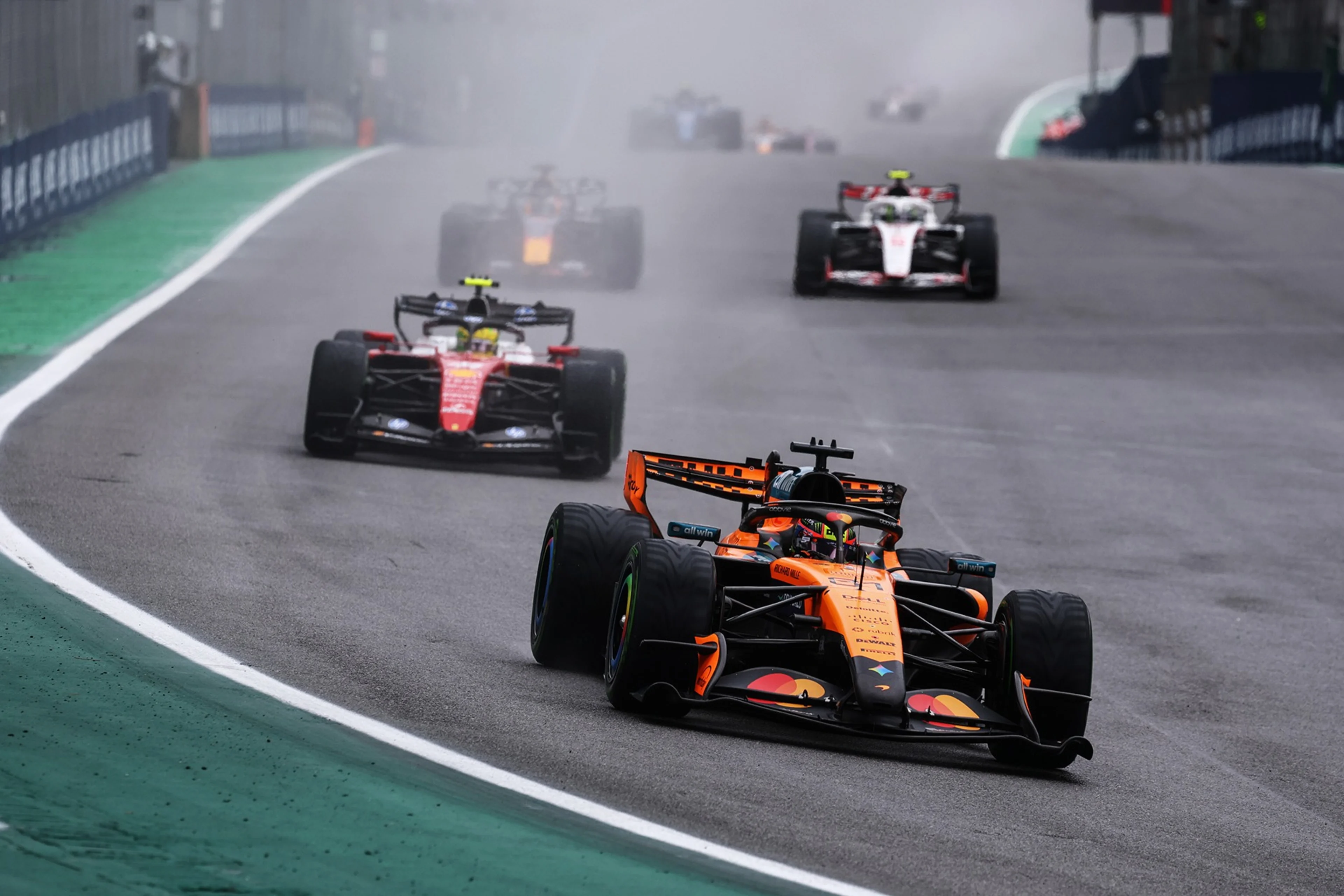
The significant word in McLaren's description of its latest developments is foundation. The team is not merely bolting on parts in the hope of rescuing a difficult weekend. It is testing aerodynamic ideas and behaviour that it intends to carry into next season. A revised front-wing concept appeared in Brazil alongside changes to floor furniture and rear- and beam-wing arrangements. Further pieces are planned for Las Vegas. Their precise performance contribution has not yet been quantified publicly, and nobody outside the garage should pretend that a new package automatically delivers a fixed number of tenths.
Stella's central emphasis has been a car that responds more predictably and gives its drivers a dependable platform. That is an important distinction. An aerodynamic update can generate theoretical downforce while also narrowing the conditions in which the balance feels manageable. Conversely, a package that offers a more consistent front end or a gentler response across different corners can help a driver extract more of the available performance without spectacular headline numbers. Norris and Oscar Piastri have to live with the car during braking, turn-in, traction and changing tyre temperatures, not merely on a simulation graph.
The Brazil specification offered an encouraging first examination because Interlagos required confidence through a sequence of changing conditions. But a wet-to-dry race is unusually difficult to treat as a laboratory. Grip levels moved throughout the afternoon, the timing of tyre changes mattered, and rivals faced their own setup compromises. It would be premature to conclude from one win that every new component works equally well at every circuit.
Vegas offers a different laboratory. If the car remains stable over the long straights, brakes confidently after heavy deceleration and avoids needing excessive wing to protect the rear tyres, McLaren will learn something valuable. If the upgrade improves mid-corner balance yet the speed traps remain uncompetitive, that is useful information too. The immediate objective is a stronger Grand Prix; the long-term objective is a clearer design direction for a complete 2027 machine.
GOATIFY
GOATIFY Formula 1
Browse GOATIFY Formula 1 designs as McLaren tests a more predictable MCL40 package and lays the groundwork for 2027.


Just as importantly, the team must compare Norris's and Piastri's feedback rather than assume one setup choice represents the whole car. Different driving preferences can expose where an update is genuinely versatile and where its advantage depends on one driver's technique. The final three weekends of the year give McLaren a limited but meaningful opportunity to separate those effects before winter design decisions become far more expensive to reverse.
Brazil showed McLaren's ceiling—and why it still needs another test
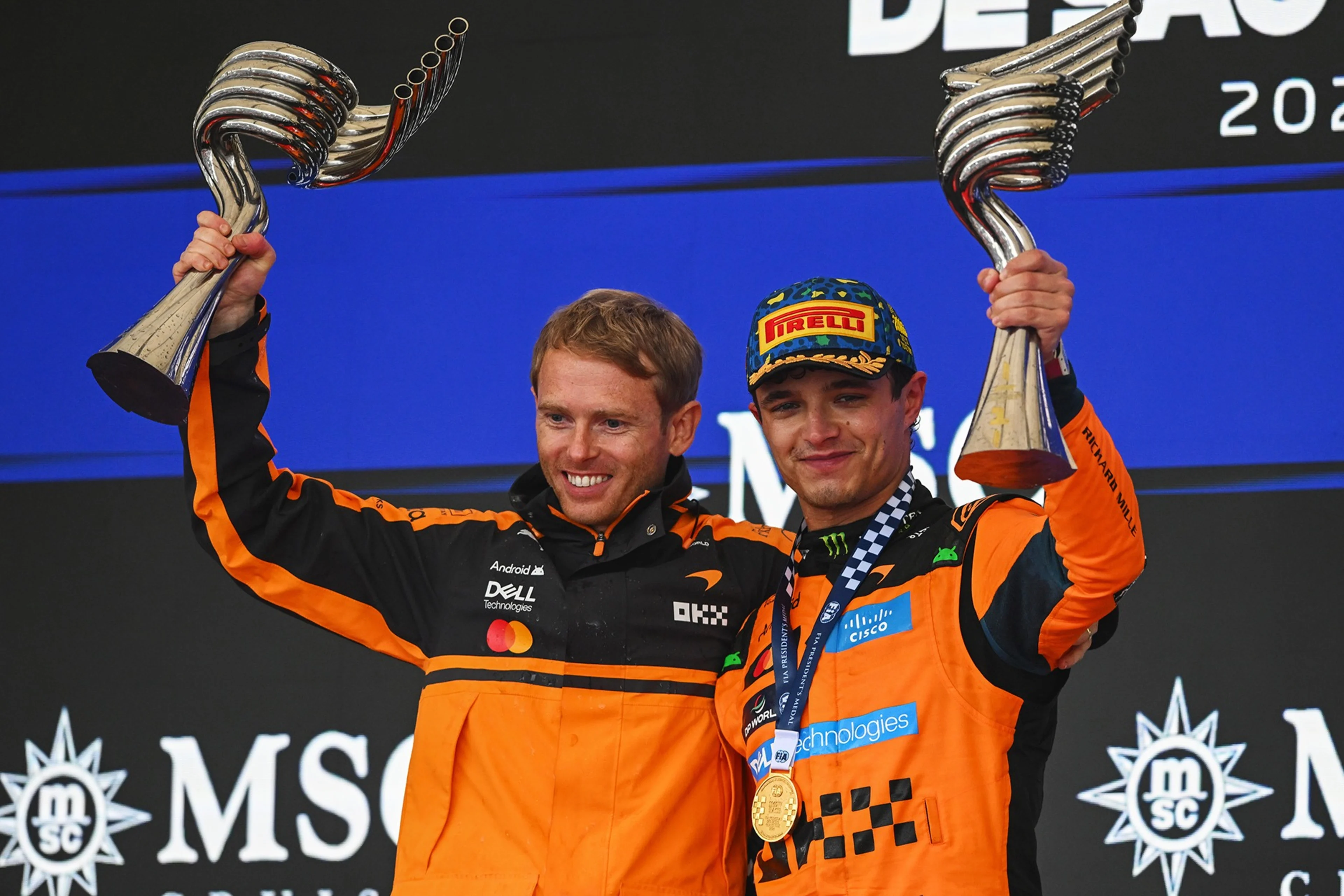
Norris's São Paulo victory mattered because it came after a sustained spell without a McLaren podium. The team had spent much of the year searching for a competitive window while Mercedes and other rivals continued to advance their own packages. Stella has pointed to an earlier step in Hungary and a missed opportunity in Madrid, where the timing of a Virtual Safety Car disrupted a realistic chance of victory. A poor sequence of qualifying sessions at Austin and Mexico then limited what McLaren could do even when the car showed encouraging race pace.
Interlagos changed the argument, but not by providing a clean, one-variable experiment. Norris started from pole and initially lost places in the wet. The track then developed a dry line, prompting teams to switch away from intermediate tyres. McLaren stopped both cars on lap 16. Norris recovered the lead on lap 20, built an advantage on slick tyres and ultimately converted the changing conditions into victory. Piastri, who began tenth, finished sixth after making progress through traffic and navigating the strategic calls.
That sequence showed several strengths acting together. The revised car was competitive on intermediates and slicks. The pit wall read the conditions well enough to commit to key tyre changes. The mechanics executed demanding stops, while Norris had the pace to exploit the clear air when it became available. Stella was pleased not only with the technical package but also with the standard of operations after less convincing execution at some earlier races. Those details should not be stripped out to tell a simplistic story about a miraculous new front wing.
There is a broader competitive reality as well. Mercedes had already secured the constructors' championship, ending McLaren's two-season run at the top of that classification. McLaren's Brazil win did not undo the season's hierarchy or erase the momentum its competitors had built. It demonstrated that the team could still develop toward victory rather than drift into winter. That is a meaningful achievement, but championship-standard consistency requires repeating it when the weather and circuit layout are less accommodating.
Nor should Piastri's sixth place be interpreted as proof that the package worked only for Norris. Piastri spent much of the race recovering from his starting position, fighting traffic and taking a different path through the evolving strategy. Their respective results carried very different amounts of clean running. A more revealing comparison would involve qualifying gaps, tyre behaviour and race pace at Las Vegas under closely matched conditions. That is the sort of evidence McLaren needs before deciding which development choices deserve to define its next car.
GOATIFY
GOATIFY Formula 1
Explore F1-inspired apparel and fan accessories after Norris's Interlagos win puts McLaren's late-season development back in focus.


Why Las Vegas has repeatedly exposed McLaren's weak points
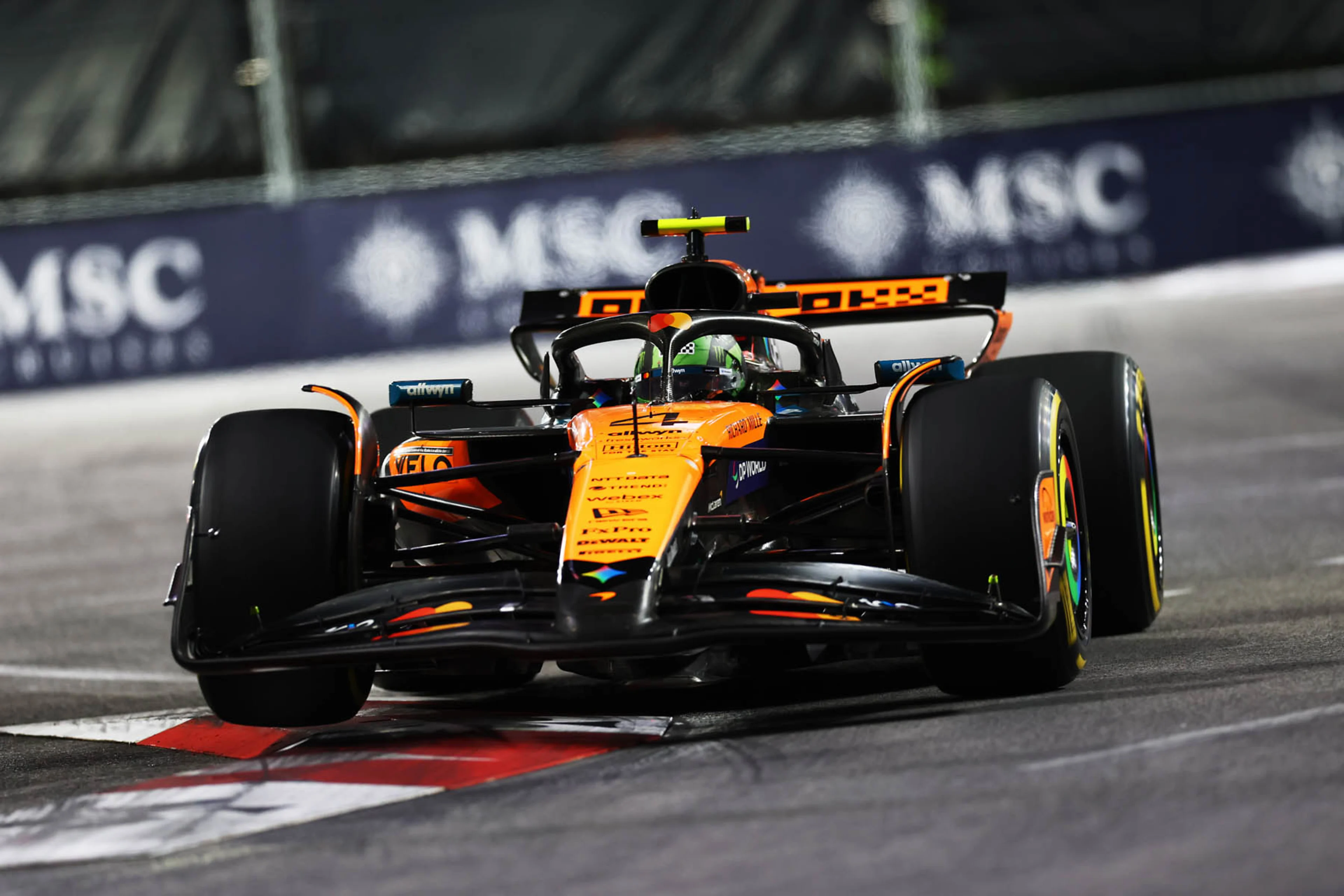
The Las Vegas record is unusually blunt. In 2023, despite McLaren's recovery elsewhere that year, both cars were eliminated in the first qualifying segment. Norris crashed early in the race after bottoming out, while Piastri salvaged a point. In 2024, the team qualified sixth and eighth and finished sixth and seventh, around 27 seconds behind the group ahead. For a squad capable of fighting for major honours at other venues, that was an uncomfortable measure of how circuit-specific competitiveness can be.
The 2025 edition initially appeared to break the pattern. Norris took pole, and on the road the two McLarens finished second and fourth. But their results disappeared after post-race inspections found excessive wear on the rear skid blocks. Both cars were disqualified. This is not a minor historical footnote: achieving pace on a bumpy, high-speed street circuit is only part of the assignment. A competitive ride-height choice must also keep the car legal over an entire race distance.
The layout explains why Las Vegas can punish an otherwise excellent design. The Strip includes a near-two-kilometre full-throttle stretch, creating an unusually high premium on top speed and efficient drag. Stella has acknowledged that the MCL40 has struggled at venues such as Monza and Baku when absolute velocity matters. He has also pointed to relatively short gear ratios as a possible handicap once speeds climb above a certain level. No front-wing change can be assumed to eliminate a gearing compromise.
There is a balancing act in both directions. Less wing can improve straight-line speed but leave a driver short of stability in slower turns and heavy-braking zones. More wing can help protect tyres and make the car easier to place, while carrying a measurable cost on the Strip. Cold track temperatures complicate warm-up and can turn one tidy qualifying lap into a misleading indicator of full-distance pace. The right choice is not simply whichever setup posts the fastest single speed-trap figure.
That is why McLaren cannot declare the Las Vegas upgrade a success on Friday afternoon. Qualifying will reveal whether Norris and Piastri can put the car high enough on the grid to stay out of traffic. The race will test tyre preparation, tyre degradation, braking balance and the legal margin on the floor. If all those elements improve together, the venue that has punished McLaren most often could become a genuine demonstration of progress. If only one improves, the team must resist confusing a partial fix with a solved problem.
The more important prize may be a better 2027 starting point
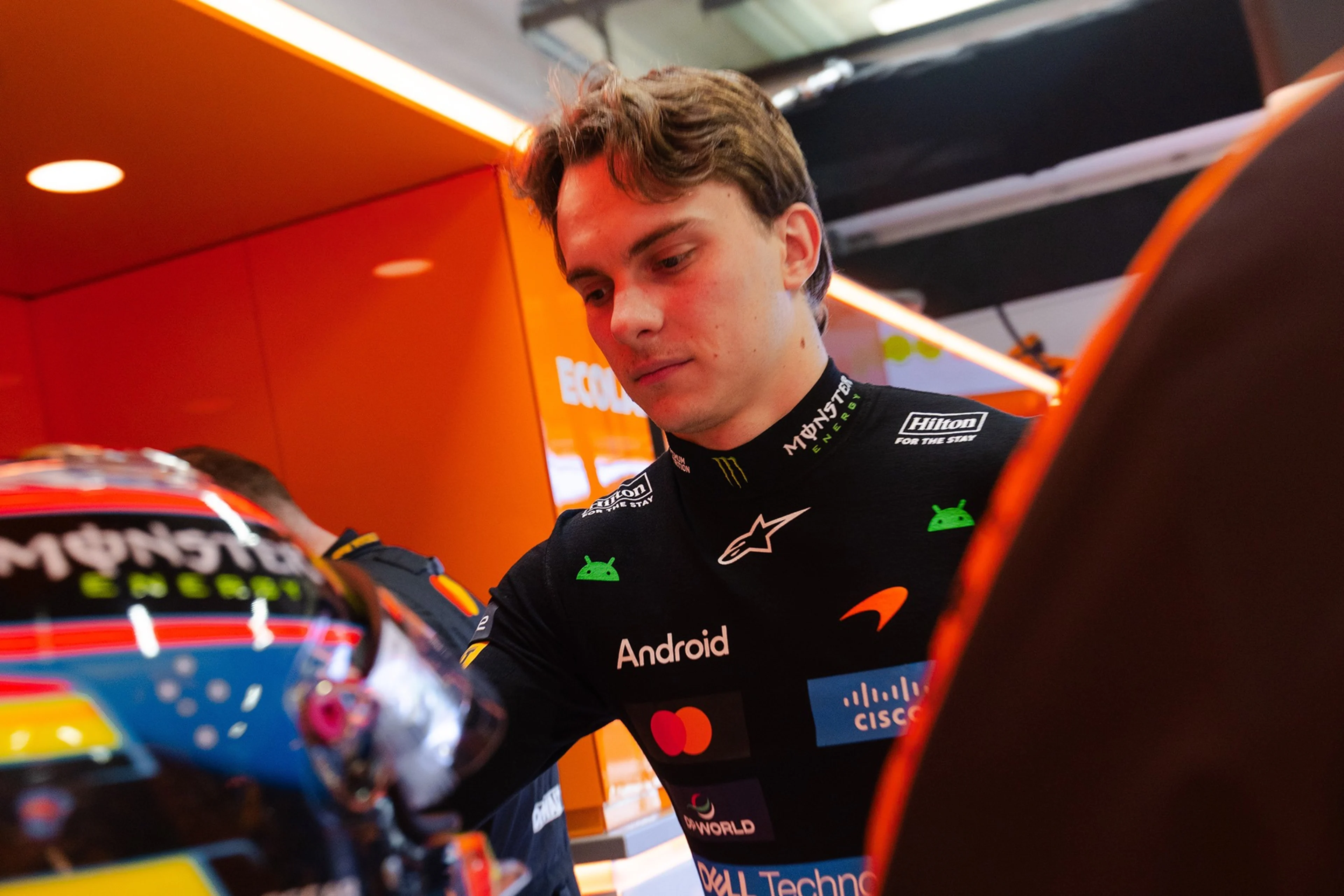
The immediate temptation is to frame this upgrade as a verdict on whether McLaren can win again before the season closes. Stella has given it a longer horizon. By treating the new front-wing direction and subsequent components as a foundation for the 2027 project, the team is using live competitive weekends to learn how its next design philosophy might behave. That is a more useful description than suggesting an extra part in November already guarantees a front-running car in March.
GOATIFY
GOATIFY Formula 1
Find GOATIFY racing designs as Las Vegas challenges McLaren's straight-line speed, setup and tyre management.


The calendar makes the exercise particularly interesting. Las Vegas runs from November 20 to 22, followed by Qatar on November 27–29 and the season finale in Abu Dhabi on December 4–6. These venues have different aerodynamic and tyre demands. A balanced car that performs acceptably across all three provides stronger evidence of design versatility than a single spectacular result at one favoured track. McLaren can also gather driver feedback under pressure rather than relying exclusively on simulation and test conditions.
That does not mean every development decision should be optimized for next year at the expense of present safety or competitiveness. A component carried into 2027 will interact with other bodywork, setup choices and regulations. Teams can transfer concepts and lessons without transferring each physical part unchanged. Moreover, a promising front wing cannot compensate on its own for a loss of power-unit efficiency, poor mechanical balance or difficulties making the tyres work in one-lap conditions.
There is a human side to this transition. Norris has just reminded everyone that he can win when McLaren gives him the opportunity. Piastri has a different but equally important interest: a consistently competitive platform that lets him fight from the front rather than spend races climbing through the order. The drivers' combined data will be more persuasive than either one's post-race enthusiasm. Strong feedback from both would support a development path the whole team can trust.
Mercedes' championship success also sharpens the stakes. McLaren does not simply need to recover one good weekend; it must close a season-long competitive gap while protecting the ability to challenge again. If Las Vegas exposes the same high-speed weakness despite the update, accepting that diagnosis early could be valuable for its 2027 programme. If the car is competitive there, McLaren will have demonstrated a breadth of performance that was missing in its earlier development trajectory. Either result supplies useful evidence, provided the team measures it honestly.
The fairest assessment will therefore wait until the new package has completed qualifying and a legal race distance. McLaren's ambition is straightforward: convert promising design work into a car that can fight everywhere, not just on its favourite afternoons. Las Vegas is the harshest remaining examination of whether that ambition is moving from engineering meetings into reality.
One wet Brazilian victory restored McLaren's confidence, but Las Vegas can tell it something more demanding: whether its improvements survive a track built around speed, traction and uncomfortable compromises. Stella has acknowledged the historical weaknesses rather than hiding them. The new parts may narrow those gaps, but there is no confirmed performance gain yet.
The clearest signs to watch are qualifying position, straight-line competitiveness without sacrificing corner stability, tyre control over a stint and a trouble-free technical inspection. A strong weekend would help close 2026 on an upward curve. A weak one could still reveal exactly what the 2027 car needs to fix. For McLaren, both answers matter.
GOATIFY
GOATIFY Formula 1
Shop GOATIFY Formula 1 shirts, hoodies and racing stickers.


















