Pulisic Returned With Two Goals. Pochettino's USMNT Goodbye Began 6–0.
GOATIFYThe United States did not just win a Nations League quarterfinal on November 14. It scored six times in a match framed by a coaching departure, brought two major attackers back into the fold and gave an 18-year-old striker a competitive goal that could matter long after the competition ends. The 6–0 result against Haiti in Miami gave the Americans a commanding first-leg advantage before Tuesday's return in Cincinnati. But the score conceals a more complicated night: it was only 1–0 at halftime, Haiti had a stadium full of supporters behind it, and the U.S. needed a sudden second-half acceleration to turn control into a rout.
Christian Pulisic delivered two goals in less than two minutes; Julian Hall, Auston Trusty, Weston McKennie and Folarin Balogun supplied the other four. Mauricio Pochettino, meanwhile, stood on the touchline knowing this two-leg tie is expected to be his last assignment with the national team before taking charge at Manchester United. Those intersecting stories make the performance both an emphatic result and a handover document. The next U.S. coach inherits a team capable of scoring in different ways, but also inherits the unresolved question of how to sustain that threat against opponents who can resist the first wave.
The first half was a reminder that 6–0 was not inevitable
A six-goal final margin encourages the neat conclusion that the favorite simply overwhelmed its opponent from the start. The actual progression was less comfortable. The U.S. found an early breakthrough when Sebastian Berhalter delivered a free kick that Auston Trusty converted around the tenth minute. One dead-ball sequence had altered the match, but it did not immediately produce a second or third goal. Haiti remained within one until the interval, leaving a meaningful question about whether the American possession and territorial advantage would become a more decisive lead.
Set pieces offer a particularly useful way of separating organization from individual brilliance. A well-delivered ball can manufacture a high-value chance even when normal attacking patterns are failing to generate clear looks. Berhalter's service and Trusty's finish therefore mattered beyond the opening entry on the scoresheet. They showed that the U.S. had another route through the defense rather than having to rely exclusively on a winger beating two players. The same variety later surfaced in quick transitions, direct running, a penalty and a late pass through the center. Good attacks need more than one solution, especially in two-leg ties.
The context made this a genuinely unusual home assignment for Haiti. Continuing security problems have forced the national team to stage matches away from its own country. Miami served as the nominal home venue, and the crowd was largely supportive of Haiti. That emotional setting mattered. For the Haitian players, it was an opportunity to perform before a significant diaspora audience rather than a conventional away game in an empty neutral venue. For the Americans, it meant the first-leg location was familiar geographically without guaranteeing the usual home support.
Haiti also had moments that remind us why a clean sheet should be analyzed instead of simply celebrated. Diego Kochen had work to do, and Lenny Joseph's apparent goal after Josue Casimir's delivery drew an enormous reaction before an offside decision ruled it out. The U.S. had protected its advantage on the scoreboard, yet the opponent's ability to create those situations prevents an honest reading from treating the result as flawless defensive evidence. A better description is that the Americans eventually punished the difference in quality across the whole ninety minutes.
GOATIFY
GOATIFY Soccer
Pulisic's national-team return will get fans talking; browse GOATIFY's original football and soccer fan shirts, hoodies and stickers inspired by the sport.

Kylian Mbappe – El Dictator Football Decal Sticker
Add football personality to your favourite gear.
Shop Now ↗


Bottlers FC Tottenham Hotspur Parody , Spursy Hoodie
A football fan design for everyday wear.
Shop Now ↗
Stop The Glazers From Ruining Manchester Mug
Add football personality to your coffee break.
Shop Now ↗
Kylian Mbappe Ninja Turtle Football Euro 2024 Tank
A football fan design for everyday wear.
Shop Now ↗The decisive change came after halftime. Once Julian Hall scored, Haiti had to make a choice between continuing to defend a narrow deficit and accepting more space as it tried to recover the tie. The subsequent American goals arrived in an environment where that risk-reward balance had shifted sharply. The outcome was still thoroughly deserved, but the halftime score is an important safeguard against exaggerated conclusions about how easily the first hour unfolded.
Pulisic turned a cautious comeback into two decisive minutes

Christian Pulisic's return was already one of the stories of the international window before he touched the scoresheet. The forward had been absent from the exhibition wins against Peru, Chile, Mexico and Canada while recovering from a right-leg injury suffered in the summer World Cup defeat by Belgium. A player returning from a tibia and fibula microfracture can be judged by several standards: availability, comfort in contact, the ability to accelerate repeatedly and whether attacking decisions remain instinctive rather than tentative. A match report can confirm the goals; it cannot by itself certify that every physical concern has disappeared.
His first goal against Haiti came from the penalty spot in the 62nd minute, moving the U.S. into a three-goal lead. A penalty is an important execution task but not a full demonstration of open-play creativity. The next goal, less than two minutes later, supplied a different answer. Alex Freeman helped move the attack into a shooting position, and Pulisic finished from outside the area. That sequence showcased the quickness of his decision and the willingness to take a shot rather than delay an opportunity until a defender recovered.
The combination matters because national teams often struggle when their best attackers are available only intermittently. Supporting roles change from camp to camp, combinations take time to return and the opposition can prepare for a side missing its principal source of individual separation. With Pulisic involved again, an opponent must account for both his movement toward the box and the threat that he will attack a half-open space before the defense is organized. That pressure can create room for a central striker or an arriving midfielder even when Pulisic does not provide the final touch.
The two finishes did not happen in isolation. Haiti was already chasing the tie after Hall's goal, and gaps between the lines had begun to appear. The useful tactical question for future opponents is how often the Americans can build those openings when the score is level and the defending team has no reason to take risks. Against Haiti, the U.S. showed it could accelerate once ahead. The next step is to reproduce that timing against a stronger defensive block, where a premature shot or missed final pass might end the only clear chance of a half.
There is also a sensible medical restraint to keep in the story. Two goals are outstanding evidence of competitive effectiveness on one night, not a guarantee that the recovery process is complete or that workloads can immediately rise without limits. The most encouraging sign for supporters is that Pulisic contributed with actions requiring different kinds of confidence: the composure to take a spot kick and the spontaneous choice to strike from distance. Both will be important when the schedule becomes more demanding.
GOATIFY
GOATIFY Soccer
From emerging strikers to favorite midfielders, explore GOATIFY Soccer's meme and football culture apparel alongside this look at the next USMNT generation.

Christian Pulisic – Captain America GOAT Decal Sticker
Add football personality to your favourite gear.
Shop Now ↗
Make United Great Again Manchester United Sweatshirt
A football fan design for everyday wear.
Shop Now ↗
Christian Pulisic – USMNT GOAT Muscle Shirt Tank
A football fan design for everyday wear.
Shop Now ↗

Christian Pulisic – Captain America Football Hoodie
A football fan design for everyday wear.
Shop Now ↗
Open Heart Surgery Manchester United Ralf Mug
Add football personality to your coffee break.
Shop Now ↗Hall's competitive breakthrough is bigger than a single goal

Julian Hall's goal in the 52nd minute was the moment the contest began moving from manageable to punishing for Haiti. Antonee Robinson supplied the low ball, and Hall converted to double the advantage. For a teenager, the finishing action was only part of the occasion. His appearance in this competitive Nations League tie also tied his senior international future to the United States, adding a longer-term consequence to the evening. The 18-year-old has already found the net repeatedly in his earliest national-team opportunities, but his significance lies in the possibility of an additional attacking profile becoming available to the next coach.
It is important not to confuse a productive small sample with an established international hierarchy. Goals in early appearances should earn further chances, not a permanent place above experienced players. Hall still needs to show how he handles physical defenders, a deep compact line and a spell when service is limited. The most encouraging part of Saturday's performance was less the raw number of goals and more the quality of the movement that brought him into the scoring position. He ran into an area where the wide delivery could hurt Haiti, made himself available at the decisive moment and completed the finish.
The rest of the scorers gave the U.S. attack a notably broad distribution. Trusty is a defender who contributed from a restart. Hall is a young forward who attacked the penalty area. Pulisic supplied individual finishing. Weston McKennie arrived to score from midfield, while Balogun added the sixth from a forward's movement. A team with that range is harder to reduce to one scouting instruction. Stopping the leading winger will not necessarily eliminate the threat if the center backs and midfielders can also contribute.
Berhalter's part in the opener deserves attention too. Delivery from a dead ball is a specialist skill, and the quality of the ball can change the expected value of a chance before the receiver's action begins. The U.S. should not need a set-piece goal in every match, but a reliable source of well-placed service can be particularly valuable in tournaments when the opposition has little interest in giving up transition space. Saturday's early breakthrough offered a clear example of that marginal advantage.
The other side of having so many scorers is the need to make attacking roles coherent. A side can collect individual talents without becoming a coordinated attack. Pochettino's departure places extra responsibility on the federation and successor to decide which runs, pressures and spacing habits are worth retaining. Hall's rise is a benefit only if it can fit with Balogun, Pulisic, McKennie and the wide players rather than simply forcing a choice between them before the chemistry has been tested.
Balogun scored late, but the coaching handover is the larger test
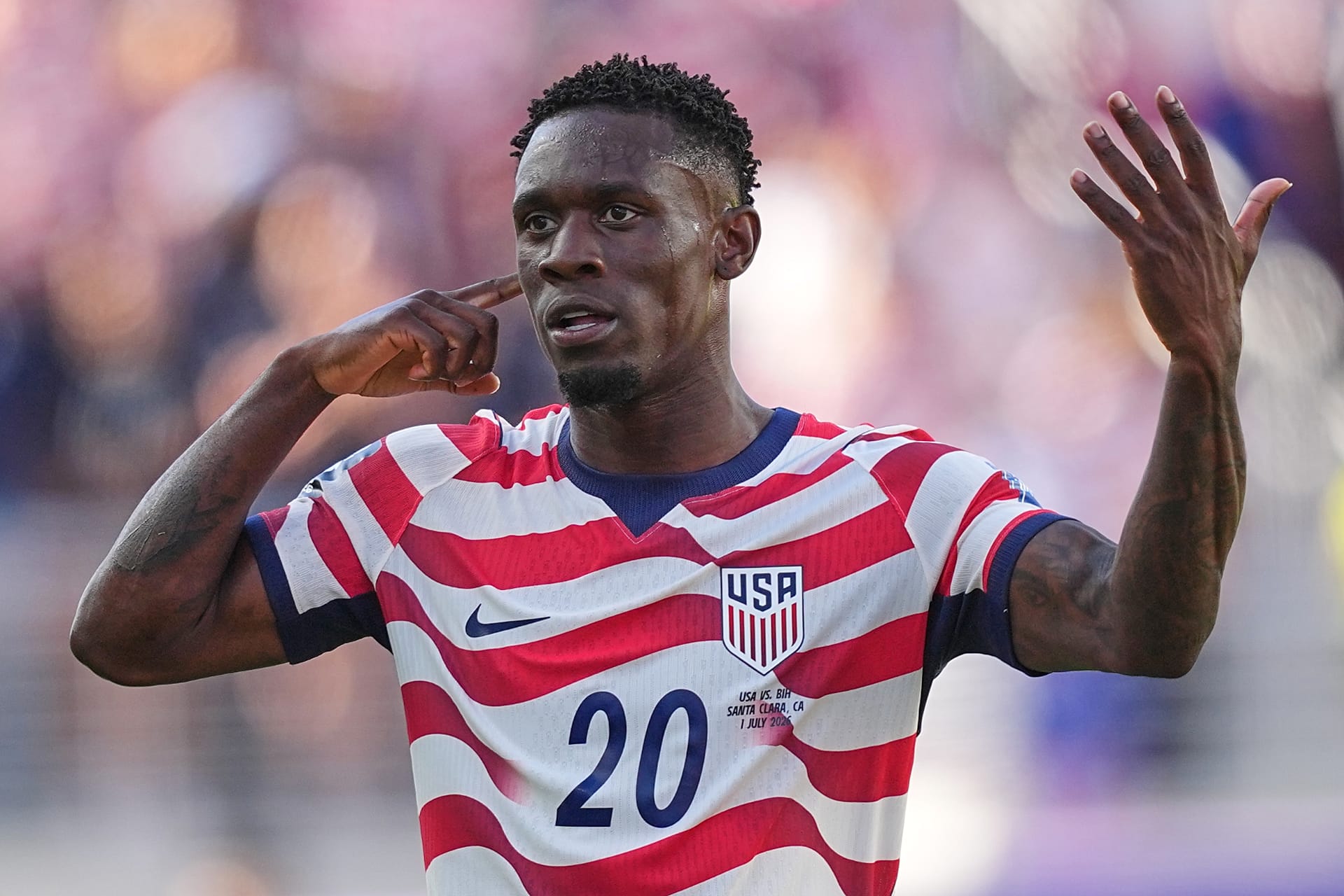
Folarin Balogun's return added another note of restoration to the night. Like Pulisic, he had been missing from recent U.S. fixtures, though for different reasons related to his club situation and earlier availability. Against Haiti he provided the final goal in the 82nd minute, beating goalkeeper Alexandre Pierre after a move through the middle. His clock-pointing celebration sent an uncomplicated message: he wanted his presence noticed again. For a striker, a goal can reset the conversation quickly after a period away from the squad, but the more useful next step will be demonstrating repeatable partnership play.
GOATIFY
GOATIFY Soccer
Football coaching changes and international drama are part of the fan experience; browse GOATIFY's Soccer collection for original football-themed designs.


Glazers Out Manchester United / Cup with Mug
Add football personality to your coffee break.
Shop Now ↗
Trashford Marcus Rashford Manchester United Sweatshirt
A football fan design for everyday wear.
Shop Now ↗

Stop INEOS, OUTEOS Manchester United Sticker
Add football personality to your favourite gear.
Shop Now ↗
Balogun is not interchangeable with Hall simply because both can score. The two forwards are at different stages and can bring different movement patterns. How a coach links the center forward to Pulisic and the midfield will help determine whether Saturday's open spaces can be recreated against more disciplined opposition. Sometimes the key action is not the finish but the run that occupies a defender and clears a lane for the next man. A successor evaluating this match should study those off-ball exchanges as carefully as the six goals themselves.
That successor will be inheriting a program in a strange moment. Pochettino spent two years with the U.S. and only months ago was publicly linked to a longer-term commitment. Instead, he is now preparing to join Manchester United, leaving a national side that has just delivered its most prolific match of his tenure. From a club perspective, Manchester United is buying a manager with elite-level experience and an unusually recent view of American internationals. From the federation's perspective, the timing creates a continuity problem: a major tactical voice departs while the competitive schedule carries on.
The Cincinnati second leg on November 17 should not be treated as a ceremonial walk. A six-goal aggregate advantage makes an American semifinal appearance overwhelmingly likely, but the match is still a competitive international and a chance to evaluate combinations in a different setting. The staff has decisions about minutes for players returning from absence, opportunities for younger performers and how aggressively to protect a lead that is already enormous. Those choices can be as revealing as the need to score another goal.
The emotional element is real, but it should not be confused with a finished project. Players spoke warmly about Pochettino after the win, and the score suggests a group motivated to deliver a strong farewell. Yet the future identity of the side cannot depend on the departure of one manager. The next appointment needs a clear view of what is already working: threat from wide areas, useful dead-ball delivery, attacking runs from midfield and a developing cast of young forwards. It also needs a frank view of what Saturday did not prove, including how the defense would cope under extended pressure and how the offense would function without the cushion of an early set-piece goal.
Haiti's unusual hosting situation should not disappear beneath the larger U.S. story. A national team unable to play in its own country brought a passionate audience to a nominal home game abroad. The disallowed second-half finish briefly gave those supporters a moment to celebrate. The aggregate score is unambiguous, but the setting reminds us that there was more at stake for the visitors' opponents than a routine defeat in a familiar stadium.
The most important number is six, but there are three different stories inside it. The United States took a commanding lead in a Nations League knockout tie, Pulisic and Balogun converted their returns into tangible contributions, and Julian Hall offered another sign that the attacking pipeline is not standing still. Those are legitimate positives, even after allowing for a first half that remained close and a Haiti team forced to play its home fixture away from home.
For Pochettino, Cincinnati now looks like an opportunity for a controlled handover rather than a desperate rescue. For his successor, the lesson is to preserve the variety without mistaking one brilliant scoreline for an automatically solved tactical system. The U.S. has enough individual talent to dismantle an opponent when momentum turns its way. The harder and more valuable achievement will be making that collective threat reliable when the next result is not so generous.
GOATIFY
GOATIFY Soccer
Shop GOATIFY soccer and football shirts, hoodies and stickers.

Make United Great Again Manchester United Mug
Add football personality to your coffee break.
Shop Now ↗
Manchester United Is Not A Cashcow Glazers Sticker
Add football personality to your favourite gear.
Shop Now ↗

Championshit Tottenham Hotspur Parody , Sweatshirt
A football fan design for everyday wear.
Shop Now ↗
Manchester United Ratcliffe Out, Glazers Out Hoodie
A football fan design for everyday wear.
Shop Now ↗