

McKinney Missed by 4.2 Pounds. He Says His Lightweight Run Is Over.
GOATIFYTerrance McKinney arrived at the UFC 334 scale with a scheduled lightweight fight against Jim Miller. He left with a very different message about his future. On Friday, November 13, McKinney weighed 160.2 pounds, exceeding the 156-pound allowance for a non-title lightweight bout by 4.2 pounds. Soon afterward he apologized publicly and said this would be his last fight at 155 pounds.
The number matters immediately to Saturday's bout, but the declaration could matter far longer. McKinney is a dangerous fast starter whose UFC career has repeatedly swung between spectacular finishes and damaging reversals. Moving to welterweight may change the demands of fight week, yet it also means confronting a new set of opponents in a heavier division. Those are two separate questions, and one cannot answer the other in advance.
His opponent supplied the contrast. Miller registered 155.6 pounds, inside the limit, and the matchup remained listed on the UFC 334 preliminary card in live weigh-in coverage. With the New York event approaching, the story is not a completed move or a result from the cage. It is a weight miss, a stated intention and a fight that still has to take place.
The scale exposed a problem McKinney says he will not repeat at 155

The figures are not ambiguous. McKinney stepped on the official scale at 160.2 pounds, while a fighter in a non-title lightweight bout can weigh as much as 156. The difference was 4.2 pounds. The extra pound allowed in non-title fights is already included in that ceiling; comparing 160.2 with the championship limit of 155 would give the wrong margin for this particular booking.
On social media, McKinney apologized to supporters and the promotion, described the miss as a first for him and explained that he considered his time at lightweight over. He presented welterweight as the destination he intends to pursue. The first-time-miss claim is his own account, not a separately verified review of every prior weigh-in. More importantly, the message was not an announcement that the UFC had booked him a welterweight opponent.
That distinction is central to the story. A fighter can decide to change divisions without knowing the matchup, date or terms that would follow. A successful transition depends on the roster's needs and the athlete's preparation, not solely on what was written in an apology. The public statement signals a clear personal direction; formal scheduling remains a later decision.
Live reporting following the weigh-ins indicated that McKinney would lose 30 percent of his purse because of the miss. That figure should be treated as a reported penalty rather than a publicly released full contract. It says nothing by itself about how his next bout will be contracted. Nor does a subsequent ceremonial appearance change the official reading recorded on Friday morning.
The bout remained on the preliminary card in the weigh-in results. That is not identical to declaring every issue resolved: promotions and commissions can handle overweight fights through agreements, conditions and medical decisions. What was publicly established at this stage was that McKinney had missed, Miller had made the limit and the fight had not been removed from the published lineup.
GOATIFY
GOATIFY UFC & MMA
McKinney's scale setback reshaped the UFC 334 conversation. Explore GOATIFY UFC & MMA designs while following the latest fight-week developments.

UFC GOAT Gold Middle Finger Fight Decal Sticker
Add MMA personality to your favourite gear.
Shop Now ↗


MMA GOAT Gold Middle Finger Fight Crewneck Sweatshirt
A MMA fan design for everyday wear.
Shop Now ↗The timing also complicates the sporting conversation. McKinney made his announcement while people were preparing to watch Gane and Hokit headline the event and Harrison face Nunes in the co-main event. Weight problems on a large card are not rare as a category, but the fighter's explicit statement that he will leave the class gives this one a potentially lasting effect. His next fight would not simply be another chance to hit 155; it could be a test of whether a different division is the right home.
A move upward might reduce pressure to reach the old limit, but it would not guarantee a gentler competition environment. The welterweight division presents different physical and tactical demands. A cut-related decision should be kept distinct from any claim about future performance, particularly when a fighter's recent results make the balance between his offense and opponents' responses so important.
Miller made 155.6 and has his own unfinished career goals
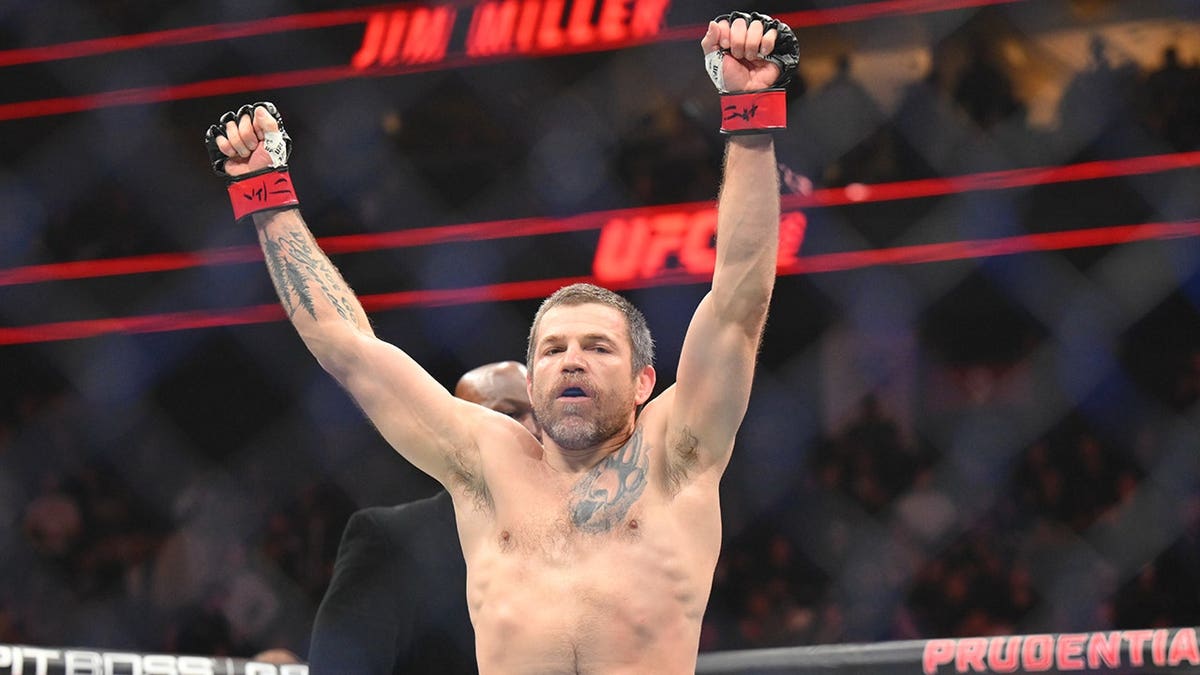
Jim Miller provided the straightforward half of Friday's weigh-in pairing. He weighed 155.6 pounds, comfortably within the non-title lightweight allowance, while McKinney registered 160.2. The distinction matters because it affects the bout's circumstances without automatically supplying an answer to what the fighters will do once the cage door closes.
Miller is not an opponent whose significance can be reduced to a weigh-in figure. He has spent years accumulating experience across several eras of UFC lightweight competition, adapting as the division changed around him. His willingness to keep competing has made routine-looking preliminary assignments unusually meaningful: each one adds to a career already defined by longevity and a long record of appearances.
He has discussed a personal ambition to make 50 UFC appearances before eventually walking away, provided his health and circumstances allow it. The planned McKinney matchup would be his 48th, according to the career timetable described before the event. That does not mean a 50th appearance is guaranteed. It means Miller has a milestone in mind while still approaching a real opponent who can punish any slow start.
Miller's May 2026 appearance against Jared Gordon is a useful reminder of why that distinction matters. He finished Gordon by submission in the first round at UFC 328, a performance that underlined how dangerous veteran positioning and timing can remain even after an extraordinarily long career. Age and mileage provide context, not a substitute for evaluating present ability.
McKinney, by comparison, creates pressure immediately with striking and aggressive grappling. He has a history of extremely rapid finishes and the confidence to pursue them as soon as he sees an opening. An experienced fighter such as Miller brings a different kind of pressure: forcing opponents to make good decisions when an early rush does not produce the finish, and remaining effective in the scrambles or transitions that follow.
GOATIFY
GOATIFY UFC & MMA
Miller's long career and McKinney's fast-start threat make this a compelling lightweight matchup. Browse GOATIFY UFC & MMA fan gear.


Rogainz Joe Rogan UFC MMA Martial Arts Sticker
Add MMA personality to your favourite gear.
Shop Now ↗

The weight difference recorded on Friday is real, yet it is not enough information to forecast a technical advantage. The athletes do not enter the cage at their official scale weight, and published weigh-in numbers do not reveal the full rehydration, conditioning or training circumstances. Treating four pounds on the scale as a ready-made result would confuse a regulatory issue with a sporting prediction.
There is also a wider career contrast. McKinney's announcement points toward a new division and a possible reset. Miller's horizon is about extending an already historic run without committing himself to a specific farewell date. Both have reasons to care about the next contest beyond its billing on the card, and neither interest erases the need to perform inside the cage.
The official Friday figures establish who made weight and who did not. Saturday's matchup, if it proceeds as listed, will test something else: whether McKinney can turn explosive opportunities into sustained control against an opponent who has built an unusually long career by finding answers of his own.
Two rapid reversals explain why welterweight is not a simple reset
The proposed move to welterweight arrives at an especially interesting point in McKinney's career. His finishing ability has never been in doubt. The official UFC fighter profile credits him with nine knockout victories, nine submission victories and 17 first-round finishes. That variety is important: he has not been a one-dimensional puncher who only threatens opponents while standing.
The same profile lists a seven-second knockout among the landmarks of his lightweight run. Few fighters can turn the first exchange into a stoppage that quickly. The ability to finish suddenly changes how opponents prepare for him, and it also sets up the central challenge of his fights. Early dominance is a powerful weapon, but it is not a guarantee that the contest will be over before the pace, tactics or physical demands change.
His July 2026 fight with King Green at UFC 329 showed the danger of confusing one with the other. McKinney rushed into the action, hurt Green and spent substantial time in favorable grappling positions. Green survived, got back to his feet and then reversed the momentum. The stoppage came with one second remaining in Round 1, turning a promising opening for McKinney into a painful defeat.
That sequence matters for reasons beyond a single loss. McKinney demonstrated that his early offense could challenge an experienced fighter. Green demonstrated that an opponent who withstands that phase can still create an entirely different fight. Analysts can debate the timing and circumstances of a stoppage, but the durable tactical point is that McKinney's first burst and the closing moments of the round produced very different outcomes.
December 2025 offered another example, this time against Chris Duncan at UFC 323. McKinney came out aggressively but Duncan reversed the momentum, dropped him and finished an anaconda choke at 2:30 of the opening round. Two defeats in two different sequences should not be treated as the same performance. They do, however, illustrate a recurring risk: an early advantage is valuable only if it survives the opponent's adjustments.
GOATIFY
GOATIFY UFC & MMA
McKinney's next chapter could take him from lightweight to welterweight. Explore GOATIFY UFC & MMA apparel for fans tracking the division's changing stories.

MMA GOAT Gold Middle Finger Fight Crewneck Sweatshirt
A MMA fan design for everyday wear.
Shop Now ↗There have been emphatic successes in the same period. McKinney stopped Kyle Nelson in 24 seconds in March 2026, a result that reinforced his reputation for making fights dangerous immediately. His rapid submissions and knockouts are not hypothetical skills. The more useful question is how reliably he can choose the right pace and transitions when the opening does not lead directly to a finish.
Against Miller, those choices acquire extra weight. The veteran has encountered many forms of aggression, and McKinney cannot rely solely on surprising an opponent with intensity. He may need to preserve his best weapons without spending everything in the initial exchanges. That is an assessment of the matchup, not a prediction that either man has already solved it.
Welterweight would change the context again. If McKinney no longer had to prepare for the same lightweight limit, he could potentially structure portions of camp differently. But that possibility needs to be discussed carefully. No public plan for his next welterweight camp, opponents or medical approach accompanied Friday's statement, and cutting less weight does not guarantee superior cardio or more resilient decision-making.
The division's athletes are also generally larger at competition time, with different reach, strength and grappling dynamics across matchups. McKinney's speed and fast-start threat might remain effective; opponents might also respond to his attacks differently. Neither outcome follows automatically from Friday's scale reading, and one proposed move cannot erase the tactical lessons of the Green and Duncan bouts.
That is what makes his announcement more than a short weigh-in controversy. He is trying to close a chapter in which the highs were spectacular and the reversals abrupt. The next chapter, if formally booked, will be judged by the quality of his decisions and results as much as by whether he arrives at a less punishing number on the scale.
McKinney's Friday statement is more consequential than a routine promise to improve his next weight cut. He is saying that the lightweight chapter itself is finished. Whether the UFC ultimately matches him at welterweight, and when, remains to be seen; no future opponent or debut date was announced with the apology.
For now, the verified numbers are straightforward: 160.2 pounds for McKinney, 155.6 for Miller, and a scheduled meeting on the UFC 334 prelims. The uncertain parts are equally important: the final implications of the reported purse penalty, how Saturday's fight plays out and how McKinney would handle the bigger welterweight roster. Those questions should be answered by subsequent official developments, not treated as settled before the opening bell.
If the move does happen, the defining challenge will be broader than the scale. McKinney has already proved he can make a fight explosive in seconds. His next step is showing that his offense, choices and composure can hold together across the different kinds of resistance that an established UFC division presents.
GOATIFY
GOATIFY UFC & MMA
Shop GOATIFY UFC and MMA shirts, hoodies and fight fan gear.
UFC GOAT Gold Middle Finger Fight Decal Sticker
Add MMA personality to your favourite gear.
Shop Now ↗



















