

Top 10 NHL Players of the 1980s, Ranked: Gretzky to Roy
GOATIFYAsk which NHL star owned the 1980s and one name ends the argument: Wayne Gretzky. Ask for the other nine and the exercise gets deliciously difficult. An Islanders dynasty sniper had a shorter window but collected four championships. Pittsburgh produced a giant who could threaten Gretzky at his absolute peak. Edmonton built a remarkable amount of its offense around several future Hall of Famers, while Boston, Quebec and Montreal supplied brilliant exceptions to the dynasty story.
This is a ranking of NHL performance during the 1980s, not of entire careers. Our statistical comparison uses the ten NHL seasons from 1979–80 through 1988–89, meaning the ten championship seasons that ended in 1980 through 1989. That convention includes the opening months of 1979–80 but excludes 1989–90; it is not a literal January-to-December calendar-year tally. When discussing a player's all-time accomplishments, we separate later achievements from what the player had already done by spring 1989.
We weigh elite peak and consistency first, then postseason impact, honors, two-way influence, positional difficulty and the degree to which a player drove a team's success. Championship rings matter, but a strong supporting cast cannot turn a very good player into the decade's best by itself. The resulting order is intentionally an editorial judgment, not a claim that regular-season point totals alone settle the case.
The list begins with the goaltender who changed Montreal's direction and ends with a center whose record book still looks like a printing error.
Nos. 10–8: Roy, Trottier and Šťastný
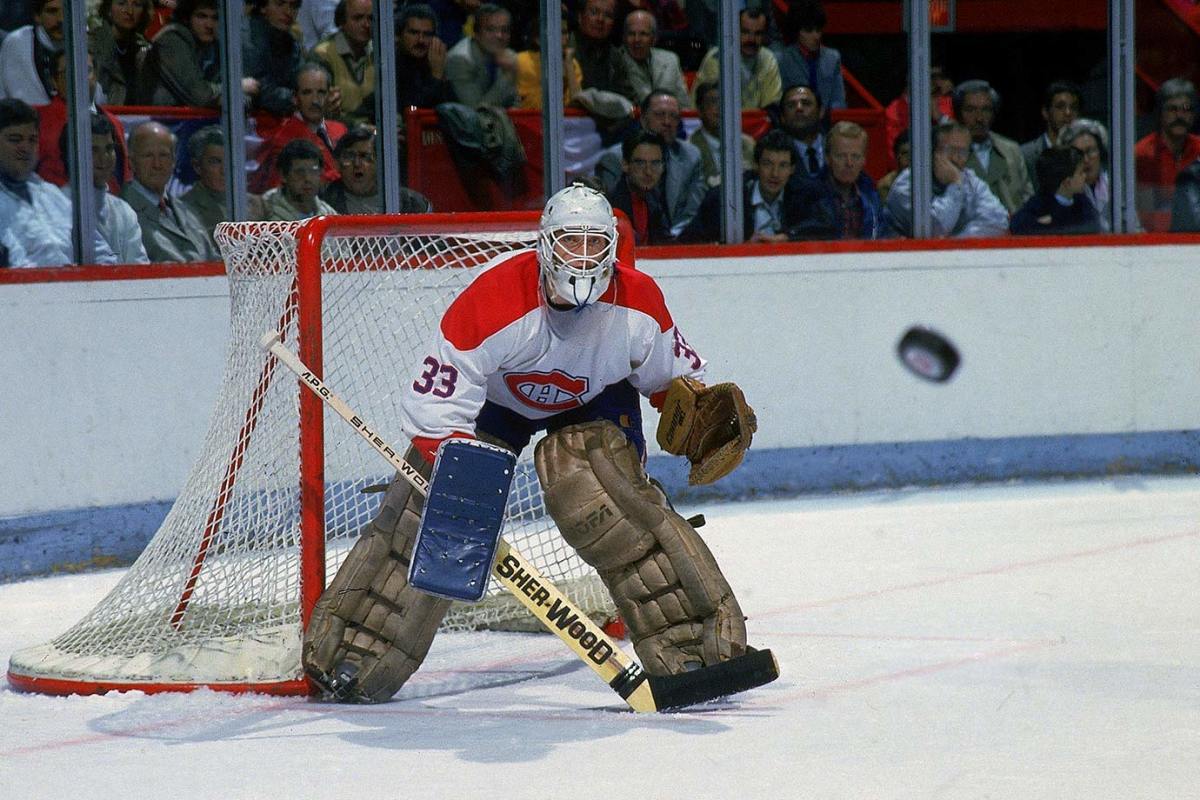
10. Patrick Roy — Montreal's playoff shockwave
Patrick Roy is the first player on this list precisely because his 1980s case is more concentrated than the careers of the skaters above him. Roy entered the NHL in the middle of the decade. By spring 1986, at age 20, he had transformed Montreal's postseason ceiling and won the Conn Smythe Trophy as the most valuable player of the Stanley Cup Playoffs. The Canadiens captured the championship with a rookie goalie who looked calmer than opponents with a decade more experience.
His regular season was not an uninterrupted reign: in 1985–86 he posted a .875 save percentage, then raised it to .923 in 20 playoff games. The difference matters. This ranking credits what Roy did in that postseason, not the four Stanley Cups he eventually won across his full career or the 1993 playoff run that made him a legend all over again. His 1989 Vezina Trophy added evidence that the breakthrough was not merely a four-week hot streak.
One elite goalie can distort a series more than a single goal scorer can. Roy's technique, anticipation and refusal to give up the low net changed how shooters approached their chances. There is a strong argument for Grant Fuhr's deeper dynasty-era résumé or Billy Smith's four Islanders Cups instead. Roy takes No. 10 because his individual postseason impact and the emerging goaltending blueprint were exceptional, even though his decade-long sample was shorter.
9. Bryan Trottier — the Islanders' complete center
The Islanders did not win four straight Stanley Cups between 1980 and 1983 because Mike Bossy simply shot the puck harder than everybody else. Bryan Trottier joined that finishing with elite passing, physical strength and the defensive judgment required of a first-line center. When New York's system needed a clean zone exit, a faceoff, a supporting defender or a play that opened the ice for Bossy, Trottier delivered.
GOATIFY
GOATIFY Hockey
A rookie goalie, a dynasty center and a Quebec playmaker define hockey greatness beyond raw goals. Browse GOATIFY Hockey fan designs.


He led the 1980 playoffs with 29 points and earned the Conn Smythe Trophy that spring. Across the dynasty years he could tilt the tempo without dominating every highlight. That is why he belongs above several more spectacular regular-season scorers: he was a foundational engine of four consecutive championship teams. Do not confuse him with a passenger riding a talented roster. His instincts helped make the roster's strengths fit together.
8. Peter Šťastný — elite production outside a dynasty
Peter Šťastný defected from Czechoslovakia to play for the Quebec Nordiques in 1980 and immediately became one of the NHL's most productive centers. He was not a familiar name attached to an Edmonton or Islanders championship parade, which makes him surprisingly easy to overlook. For our ten-season comparison, his 986 regular-season points are second only to Gretzky among players in the examined window.
Šťastný's strength was the combination of speed of thought and sustained output. He created offense for Quebec with passing vision, timing and a relentless appetite for the puck. Unlike short-lived scoring flashes, this was a repeatable engine that survived changing opponents and enormous nightly responsibility. The main reason he stops at eighth is comparative postseason influence: the players immediately above him added more defining deep-run moments or a greater positional edge. On pure regular-season decade value, he has a credible case to climb several positions.
Nos. 7–5: Kurri, Messier and Bourque
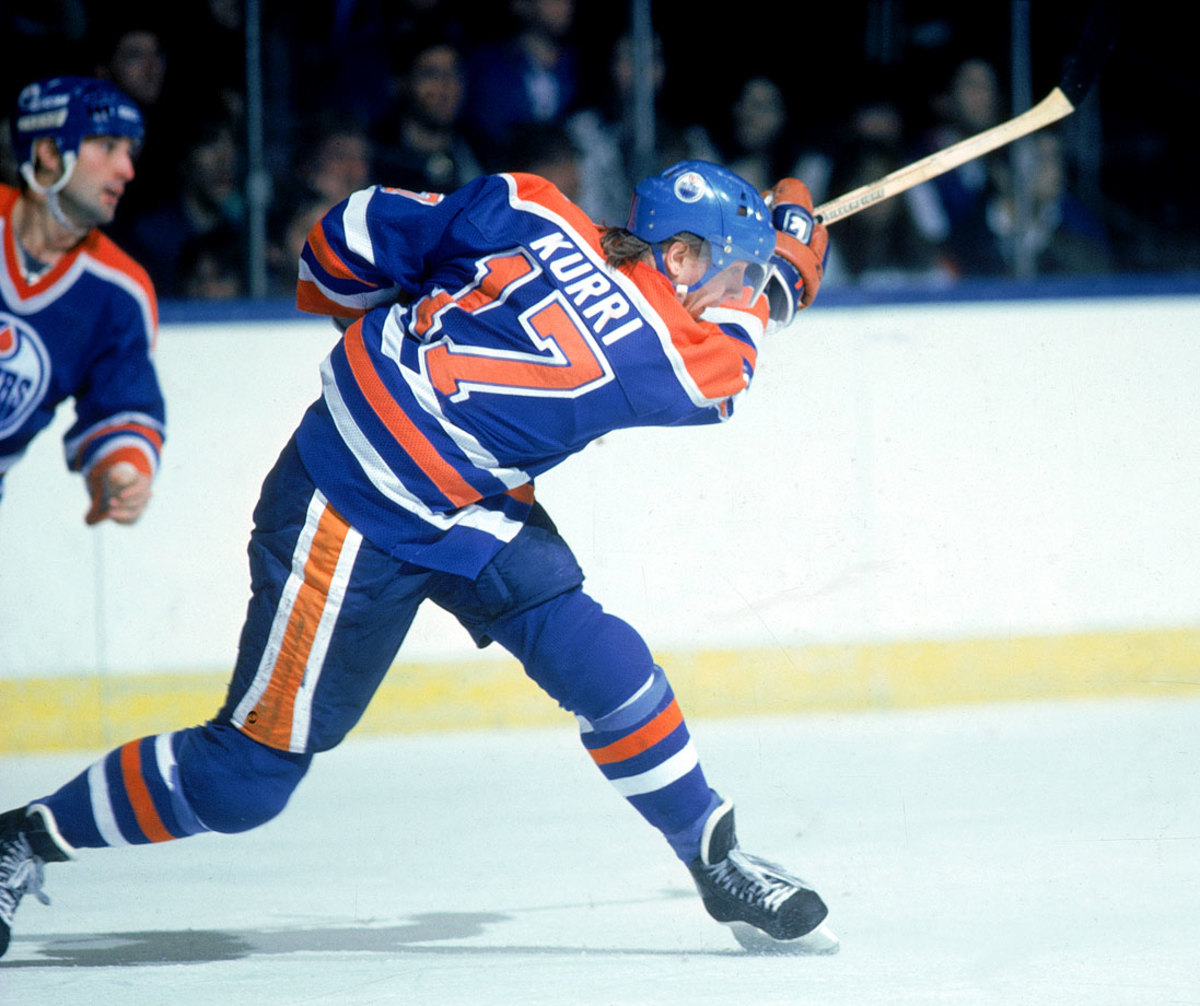
7. Jari Kurri — the perfect partner was also a superstar
Playing on Wayne Gretzky's wing was a statistical advantage, but it was not a guarantee of greatness. Jari Kurri was one of the few wingers capable of translating Gretzky's impossible reads into equally quick finishes while doing the demanding work away from the puck. His release was fast, his movement across the offensive zone was anticipatory rather than decorative, and he understood when to disappear into space so the next pass could be decisive.
From 1979–80 through 1988–89 Kurri scored 441 goals and collected 950 points. Those are huge figures in their own right, regardless of who fed him. He contributed to all four of Edmonton's Stanley Cup championships before 1990, and in the 1985 playoffs scored 19 goals in just 18 games. That is hardly the profile of an ordinary winger generously helped by a generational center.
His defensive awareness is easy to lose in all the scoring footage. Kurri's two-way timing helped Edmonton survive the moments when its aggressive defenders joined the rush. He ranks seventh because his offense was elite, his partnership transformative and his postseason finishing proven. The legitimate question is how much of his production would have survived without Gretzky; there is no rigorous way to isolate that counterfactual fully, and it should not erase his own brilliance.
6. Mark Messier — the center who made the dynasty tougher
Mark Messier's 1980s story is not merely a prequel to the famous 1994 Rangers championship. Judge only the years here and he already owns a staggering Edmonton résumé: four Stanley Cups, driving physical play and a Conn Smythe Trophy in 1984. That year's 26 playoff points came with the exhausting assignments and direct, confrontational style that turned the Oilers' attack into a more complete threat.
Gretzky could break an opponent with imagination. Messier could do it with pace, force and repeated pressure through the middle. He was dangerous in transition, relentless around the net and not afraid to wear down the same defenseman over an entire series. It is tempting to rank every Oilers superstar by points, but that misses how different their jobs were.
GOATIFY
GOATIFY Hockey
From Edmonton's finishing and grit to Boston's blue-line brilliance, celebrate your favorite NHL legends with GOATIFY Hockey gear.
Messier edges Kurri for the diversity of his assignments and his unmistakable leadership in the 1984 title run. His late-career accomplishments matter to his all-time standing, but they earn him exactly zero extra points on a 1980s-only list. This is enough of a career before 1990 to stand on its own.
5. Ray Bourque — elite defense without a ring
Ray Bourque is the antidote to ranking greatness by team trophies. Boston did not lift the Stanley Cup during this decade, yet Bourque was an elite defenseman whose skating, positioning and passing could redirect a game from either end. He led attacks from the back without turning his own zone into an afterthought, and was consistently trusted to play the hardest minutes against the best forwards in hockey.
His Norris Trophy wins in 1987 and 1988 established that his defensive reputation was more than nostalgia for a later, longer career. Bourque could carry the puck through pressure, recover quickly when an attack failed and make a simple pass look like a tactical advantage. The Oilers had a brilliant rushing defender in Coffey, but Bourque supplied a different form of control: a blend of offense and territorial security that didn't demand the same degree of team-wide risk.
One missing Cup is not a negative contribution. This ranking values what a player personally controlled rather than treating roster outcomes as a perfect measuring stick. If the list leaned more heavily toward even-strength defensive responsibility, Bourque might leap past two of the names above him.
Nos. 4–3: Coffey and Bossy rewrote their positions

4. Paul Coffey — defense played at forward speed
Paul Coffey's numbers are absurd even before remembering the D next to his name. In 1985–86 he amassed 48 goals and 138 points, setting the single-season NHL record for goals by a defenseman and producing the highest point total ever by a defenseman other than Bobby Orr. Both benchmarks happened during a period when Coffey moved the puck at a pace that repeatedly caught supposedly organized teams scrambling backward.
One of Coffey's gifts was not his stride alone. It was choosing exactly when to accelerate, pull a forechecker out of line and use that space to create an odd-man rush. Edmonton's firepower made his attacking license possible, but it did not invent his vision or the nerve required to play that way. He won Norris Trophies in 1985 and 1986 and was vital to three Oilers Cup winners in 1984, 1985 and 1987 before his trade to Pittsburgh.
That trade matters in a decade-specific appraisal. Coffey did not cease being a remarkable puck-moving defenseman when he stopped sharing a dressing room with Gretzky. His influence on how teams thought about transition and joining the rush carried into Pittsburgh. He never played risk-free hockey: when a defender pushes that far forward, his teammates need spacing, back pressure and good judgment behind the play. Bourque offers a sturdier defensive balance; Coffey gets fourth for a level of offensive transformation rarely seen from his position.
3. Mike Bossy — the dynasty's ruthless finisher
There are plenty of great NHL scorers, then there is the almost mechanical efficiency of Mike Bossy. He scored at least 50 goals in nine consecutive NHL seasons, with the final streak season falling in the mid-1980s. Five times in his career he reached 60. Crucially, those totals were not produced by a player whose impact evaporated when the playoffs tightened. Bossy scored 85 career postseason goals in 129 games, winning four Cups with the Islanders and the Conn Smythe Trophy in 1982.
GOATIFY
GOATIFY Hockey
Great hockey is about perfect timing, whether a flying defenseman or a sniper in the slot. Explore GOATIFY Hockey styles.
The 1982 Final against Vancouver is an especially useful snapshot. Bossy found the net in situations where defenders were already expecting him to be the target. His talent was not simply shooting accuracy: he arrived at dangerous ice early, changed the angle quickly and gave his center a reliable destination for passes under pressure. The Islanders' disciplined structure made him difficult to isolate and his finishing turned many close games into wins.
Bossy's chronically injured back ended his NHL playing days after the 1986–87 season. That shortens his opportunity to pad the late-decade statistics, but should not erase how completely he dominated his available window. We rank him above Coffey because his sustained goal-scoring excellence and decisive role in four consecutive championships add up to something the league has rarely replicated.
Compare Bossy with the other scorer in the top three and the tension becomes interesting. Mario Lemieux reached an even more breathtaking individual peak but arrived later and did not win a Cup during the 1980s. Bossy had the titles and the years of production. Ranking them is a test of whether you prioritize the strongest five-year stretch or the most lethal combination of offense and playoff success.
Nos. 2–1: Lemieux challenged the impossible; Gretzky owned it

2. Mario Lemieux — a terrifying peak, compressed into five seasons
Mario Lemieux entered the NHL in 1984 and by the end of the decade had become the only player who could make Gretzky's scoring records look less completely untouchable. At 6-foot-4, with unusually soft hands and the ability to slow the game around him, he was a different kind of offensive threat. Defenders could not simply take away speed or shooting lanes; he could keep the puck through contact, delay a pass and create a scoring chance after the obvious opening had disappeared.
His 1988–89 season is the argument for ranking him this high: 85 goals, 114 assists, 199 points. On December 31, 1988, he scored five goals five different ways in a single game—at even strength, on the power play, shorthanded, on a penalty shot and into an empty net. It reads like a skills challenge scripted for television. It actually happened against New Jersey. His 1988 Hart Trophy was a clear indication that peers and voters already regarded him as much more than the next promising scorer.
The obvious complication is timing. Lemieux's first five NHL seasons supplied a breathtaking peak, but his Penguins were not yet Stanley Cup champions. Their titles came in 1991 and 1992 and do not count toward this list. He also did not have Gretzky's full-decade availability or his volume of elite playoff production. A case for putting Bossy second rests on those exact factors: four championship runs and consistent finishing over a longer portion of the window.
We nevertheless give Lemieux the edge because of how much offensive responsibility he carried while elevating a less formidable Pittsburgh team. The 1988–89 output sits on the same historical shelf as Gretzky's best work, and the power to create almost every type of goal offers a useful counterweight to simply counting rings. Few players have ever made their opponents look so short of answers.
GOATIFY
GOATIFY Hockey
Gretzky and Lemieux made the impossible routine. Show your love for the sport's legends with the GOATIFY Hockey collection.
1. Wayne Gretzky — the separation is the statistic
Every serious argument about the 1980s begins with Gretzky and then proceeds to the distance between him and everybody else. Across the ten seasons in our comparison window, he amassed 1,837 regular-season points, including 1,200 assists. Peter Šťastný, second in that window, had 986 points. Gretzky produced more assists than his closest competitor produced total points. It is a gap so large that even in an era of higher scoring it demands a special explanation.
Part of it was Gretzky's imagination. He read passing lanes before they appeared, drew defenders behind the goal line and created easy finishes for teammates who were themselves world-class players. He was not the strongest skater or the most physical center. He was the one who knew where opponents were going a moment before they did. In 1981–82 he scored a record 92 regular-season goals. In 1985–86 he collected 215 points. He routinely made a 100-point season—the benchmark for most stars—look like a midseason checkpoint.
The playoff résumé is just as punishing. Gretzky was at the heart of Edmonton's Stanley Cup wins in 1984, 1985, 1987 and 1988, scoring a then-record 47 points during the 1985 postseason and earning the Conn Smythe Trophy in both 1985 and 1988. He had already won eight consecutive Hart Trophies from 1980 through 1987, an individual dynasty to match the team one.
When he joined Los Angeles in 1988, the decade's final chapter also demonstrated that his influence was not a product of one club's unique conditions. His vision, passing and superstar gravity traveled with him. The 1989 Hart Trophy belonged to Gretzky too. It is reasonable to argue that a teammate helped his numbers or that Lemieux's single most astonishing season rivaled anything he ever did. Neither theory explains away a ten-year gulf this enormous.
That is why Gretzky finishes first without a photo-finish debate. He leads the decade in sustained offensive creation, owns defining playoff performances, changed how opponents had to defend an entire zone and remained elite on both sides of a franchise-altering trade. The only question is not whether he was the greatest of the 1980s, but how anyone else was supposed to catch him.
The 1980s did not belong to one type of player. Gretzky made impossible point totals seem routine. Lemieux turned a struggling Pittsburgh franchise into must-watch hockey before its 1990s championships ever arrived. Bossy made elite finishing look automatic, Coffey played defense at attack speed, and Roy announced a new generation of goaltending before he had even established a full NHL career.
The closest calls come from comparing an astonishing shorter peak with the value of playing the whole decade. Bossy's abbreviated finish, Lemieux's 1984 entrance and Roy's mid-decade emergence keep them from matching every longevity metric. Meanwhile, Šťastný's extraordinary production without an Oilers-style dynasty and Bourque's complete defense deserve more respect than a ring-count ranking would give them.
Just outside our ten are Denis Savard, Dale Hawerchuk, Steve Yzerman, Denis Potvin, Billy Smith, Grant Fuhr and Al MacInnis. Each has a serious argument depending on whether scoring, championships, defense or goaltending defines greatness. Some built even larger legacies in the 1990s, which is precisely why this list stops at 1989. Debate the order, but keep the decade boundary consistent: would you move a goaltender into the top five, or make room for another extraordinary scorer?
GOATIFY
GOATIFY Hockey
The 1980s made hockey history. Explore GOATIFY Hockey shirts, hoodies, stickers and more in our fan collection.


















