

Bedard Left Chicago's 6–3 Win. The Injury Matters More Than the Score.
GOATIFYChicago got the result it wanted on its hundredth birthday. The Blackhawks beat Toronto 6–3, produced six goals against a struggling opponent and watched several young players do exactly what a rebuilding team needs: seize responsibility. None of that prevented the evening from ending with a much bigger question. Connor Bedard, the captain and the franchise's most consequential player, had gone straight to the dressing room after an awkward faceoff.
The incident came just 54 seconds into the third period on November 17. Bedard was setting up against Maple Leafs forward Nick Paul when Paul's stick contacted his right hand. Bedard reacted in obvious pain, left the ice and did not return. Earlier, his seventh goal of the season had put Chicago ahead 3–2 late in the second. One moment illustrated what Bedard can make happen; the other illustrated how quickly a team that depends on him can be forced to imagine its next game without him.
No confirmed diagnosis or recovery timetable was available after the game. Coach Jeff Blashill said further testing was planned for Wednesday. That distinction matters: it is possible to take the injury seriously without pretending that video footage can tell everyone exactly what was damaged. The immediate story is simultaneously a convincing win, an alarming exit and a test of how much Chicago's improved supporting cast can really carry.
A goal, a faceoff, then the one question nobody could answer
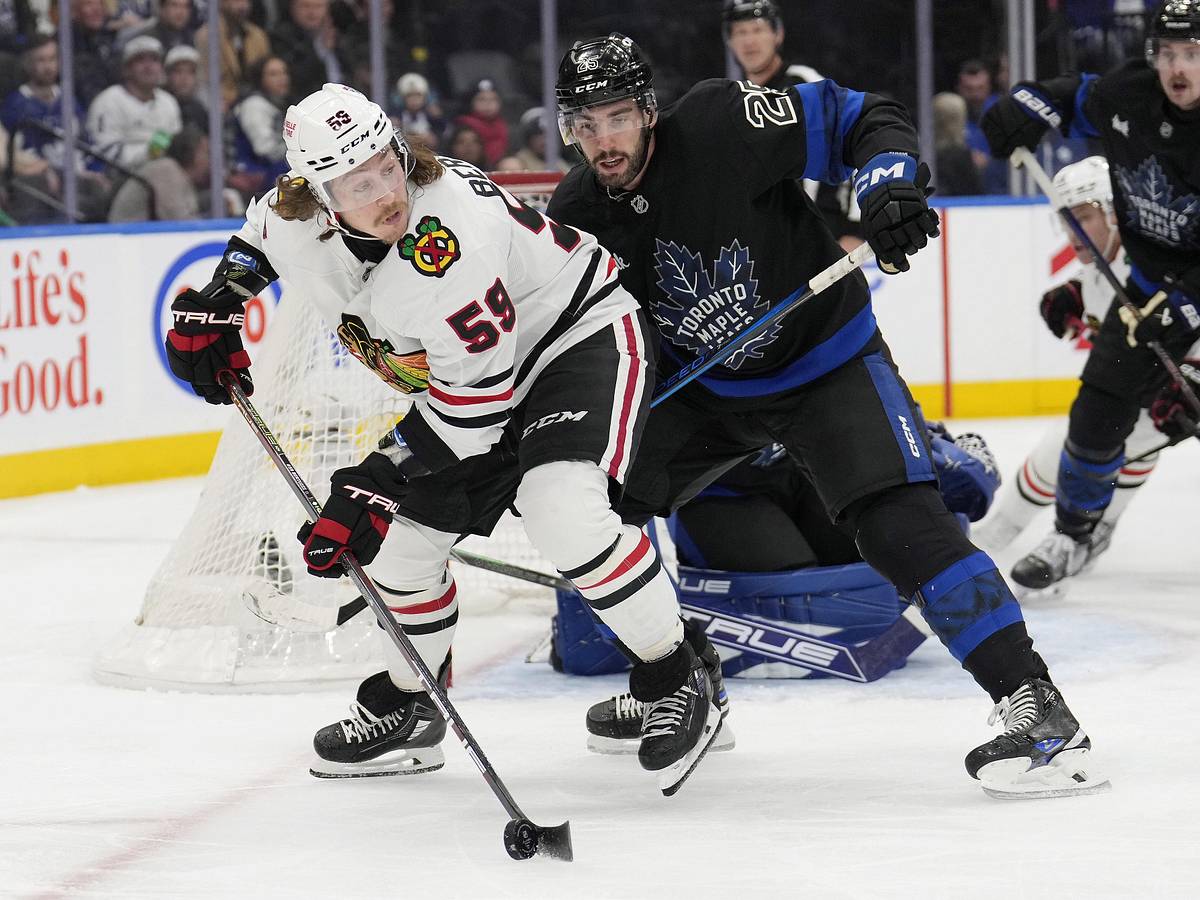
Bedard's night had reached a highlight before it became an injury headline. Toronto had just drawn level late in the second period after an unusual delayed scoring review. Chicago needed an answer quickly, and its captain supplied one. At 18:51 he attacked from the left circle and beat Sergei Bobrovsky to restore a 3–2 lead. It was his seventh goal of the season and another example of how readily the Blackhawks lean on his shot whenever the game becomes unstable.
Less than a minute into the third, that same player was hunched over after a routine-looking restart. Paul and Bedard were preparing for a draw in Chicago's zone when a stick made contact with Bedard's right hand. He was visibly distressed, moved away and went directly toward the dressing room. A photograph from the second period is not evidence of what happened during that faceoff; the event itself, and the way he left, are what the reporting establishes.
The temptation after a dramatic television replay is to turn a visible reaction into a medical conclusion. That would be irresponsible here. The team described an upper-body injury, and the coach made clear that additional assessment was required. A sore hand, an aggravated shoulder and several other possibilities would lead to different decisions for the medical staff. No public observation from the stands is a substitute for imaging, examination and a clear team update.
Blashill's restraint deserves more attention than the most alarming social-media interpretation. He acknowledged what observers saw while refusing to assign a diagnosis before Wednesday's testing. For Chicago, the meaningful next information is whether Bedard can handle normal hockey movements comfortably, whether any imaging changes the prognosis and how the team plans its next lineup. Until those answers exist, attaching a return date would be guesswork.
GOATIFY
GOATIFY Hockey
Hockey fans understand the uncertainty that comes with every hard shift.


The stakes are unusually concentrated in Bedard. He entered this game as Chicago's offensive leader, with 18 points in 15 appearances, and had been entrusted with the captaincy in September. That responsibility is not only about points. Chicago has built its current identity around his ability to generate offense and model the habits of a young core. His exit changed the atmosphere even as his teammates kept the scoreboard moving.
Nick Paul's involvement should also be described precisely. A stick contacted Bedard during a faceoff; the available reporting does not establish an intentional attempt to injure him. Assigning motive to an opponent would add heat without adding evidence. The important issue is the consequence for the Blackhawks and the clarity of the medical update. Chicago won the game. It did not leave the rink with certainty about its captain.
Nazar and Bertuzzi turned a frightening third period into six goals

Frank Nazar and Tyler Bertuzzi made sure the night did not become a collapse. Nazar scored twice in the second period, first converting a power play chance and then striking again from the right side after a transition into the attacking zone. Chicago briefly thought Oliver Moore had also scored, only for a review to establish that Toronto's Teddy Blueger had actually tied the game earlier in the play. The sequence was chaotic, but Bedard's late goal restored the lead and the Blackhawks never gave it back.
With Bedard gone, the third-period scoreboard still favored Chicago. Bertuzzi redirected a Sam Rinzel puck for a power-play goal to make it 4–2. John Tavares answered for Toronto, and for a moment a one-goal game could have pulled every available nerve tight. Instead, Moore found a rebound almost immediately, and Bertuzzi followed with another close-range finish. Three Chicago goals arrived inside a little more than three minutes, giving the team a decisive 6–3 advantage.
That burst mattered beyond the final score. It showed Chicago finding offense from more than its designated star. Nazar's movement and release created danger, Bertuzzi worked in the difficult areas around the crease, and Moore responded after the previous scoring review had erased what he thought was a goal. Those are different kinds of contributions. A healthy attack requires them all, especially when the puck carrier most likely to make something out of nothing suddenly disappears.
Rinzel contributed three assists, the first three-point game of his NHL career. His involvement from the blue line is important because it makes the power play less predictable. Chicago entered the contest with a 14.3 percent power-play conversion rate, among the league's weakest, but scored twice in three opportunities. A burst of one-game efficiency does not erase a wider problem. It does show a route to useful goals if the team can repeatedly manufacture screens, tips and second chances rather than depending on a perfect Bedard shot.
Spencer Knight made 31 saves. The figure is a reminder that six goals do not necessarily mean Chicago dominated the puck for all sixty minutes. Toronto generated enough attempts to keep its opponent's goaltender busy, and a defensive breakdown opened the slot for Tavares in the third. Chicago must still handle sustained pressure cleanly. A team cannot treat every three-goal burst as a reliable exit from its own zone.
Still, there is something healthy in the way Nazar spoke about teammates having to step up when Bedard went out. Chicago's young players are growing into NHL responsibility in public, not inside a controlled development lab. One game will not prove that the roster can replace its captain. It can prove the teammates did not stop competing when the situation changed. On a night of genuine uncertainty, that was the best evidence Chicago could produce.
GOATIFY
GOATIFY Hockey
Celebrate the grit and scoring depth that make NHL nights unforgettable.
Bedard's injury history makes patience more important than predictions
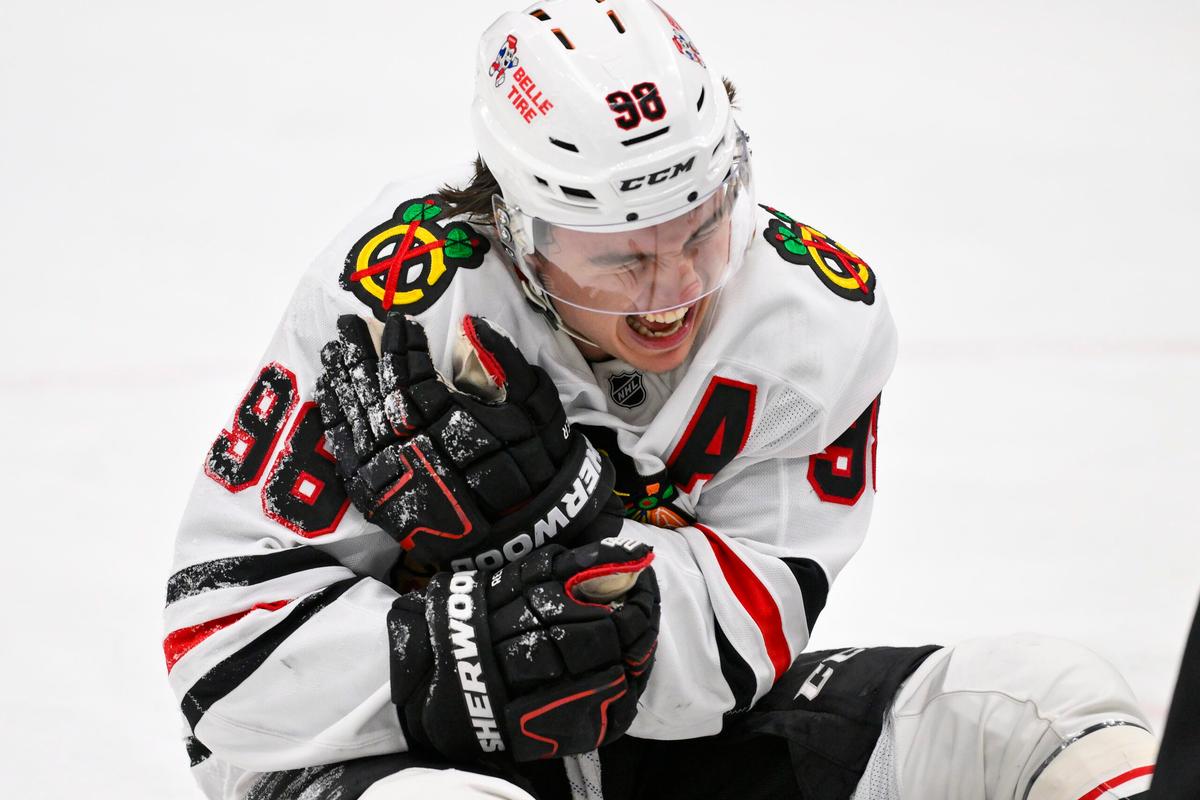
The concern surrounding this incident is amplified by what Bedard has already dealt with, not by any confirmed new diagnosis. In December 2025, he was hurt at a faceoff against St. Louis and later returned to the lineup in January. He did not immediately resume taking regular game faceoffs. That history is relevant because the new incident also occurred at a draw, but two plays that look superficially similar need not create the same medical outcome.
A separate setback came during offseason training in Vancouver on July 2, 2026, when Bedard injured his left shoulder and underwent surgery shortly afterward. Chicago initially expected his rehabilitation to run into November. He worked back sooner, making his season debut on October 13 against Pittsburgh after missing the first six games. The fact he made an early return then demonstrates hard work and medical clearance at that time; it says nothing definitive about the new injury today.
Bedard also missed roughly six weeks as a rookie following a fractured jaw in January 2024. Placing every episode in one ominous row can make a career appear defined by injury. That is not a useful way to assess a 21-year-old hockey player. Those episodes involved different events and body areas, and there is no confirmed evidence that the latest problem should be treated as an extension of one specific previous injury.
The wider reason fans are anxious is that Chicago has already invested its next era in him. The former first overall pick won the Calder Trophy, improved his totals as he matured and was named the 37th captain in franchise history in September. The captaincy arrived with the expectation that his example would elevate the players around him. When he is available, an opponent must constantly account for his shot and passing choices. Without him, everyone else's assignments become more exposed.
That does not mean Chicago should force a quick return to satisfy a calendar. The club's position near the bottom of the standings is another reason to separate medical decisions from the pressure to win the next game. It would be a mistake to describe the situation as a choice between toughness and caution. A healthy Bedard for the longer horizon is worth more than a premature appearance that leaves the underlying issue unresolved.
The practical hockey questions will come only after the medical information: who takes his usual offensive situations, how are faceoffs redistributed, what happens to the power play and which winger combinations give Nazar or other centers the best chance to create offense? Chicago's depth had a good night against Toronto, but the whole system has been constructed with Bedard as an engine. The organization needs a plan for uncertainty without pretending it knows its length.
Toronto's seventh straight loss gave Chicago a warning as well as a victory
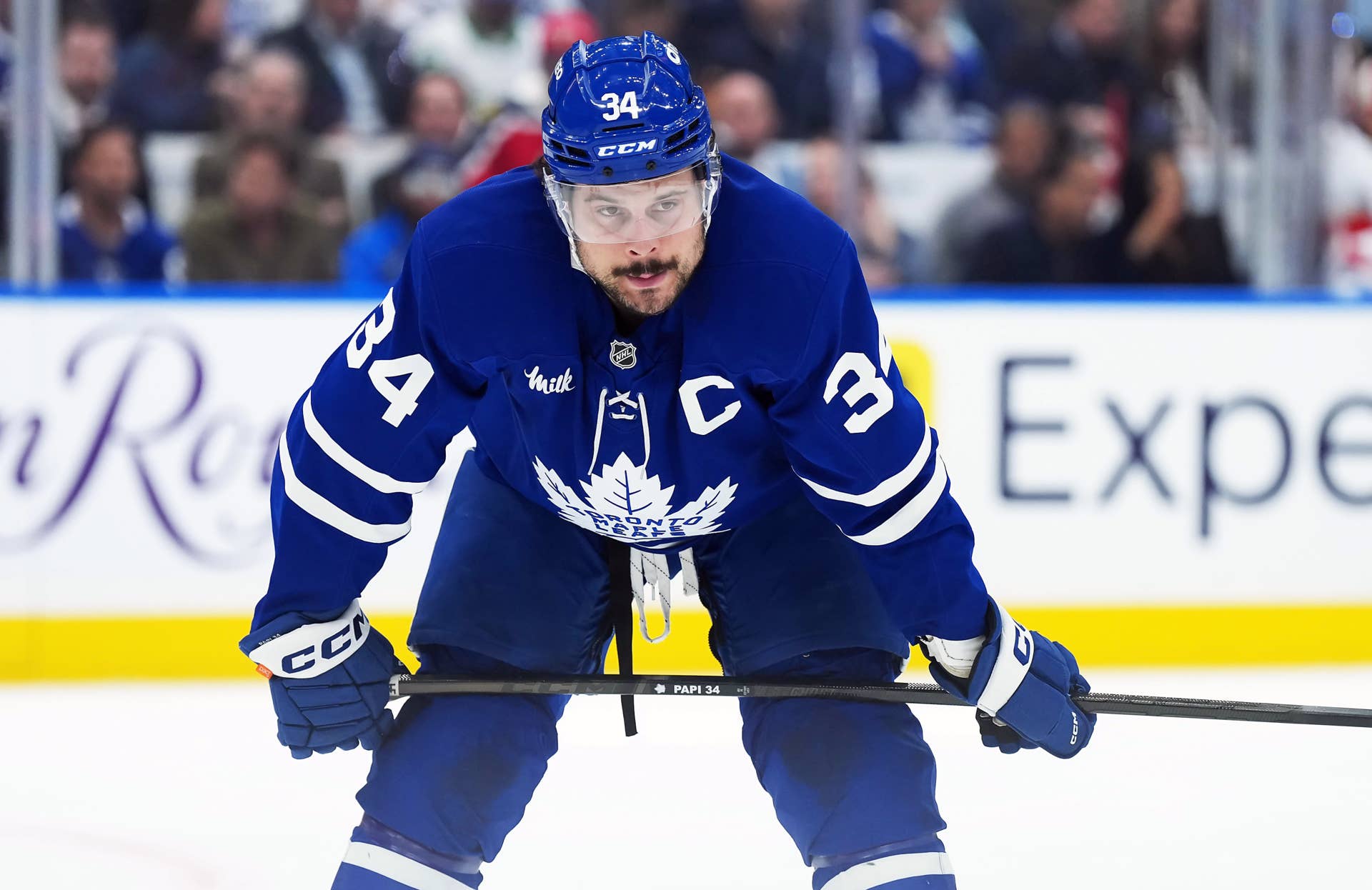
Toronto's role in the story should not disappear behind the injury. The Maple Leafs entered Chicago in poor form and left with a seventh consecutive defeat, their longest skid since March 2015. They had opportunities to make the game uncomfortable. Easton Cowan opened the scoring in the first period; Blueger's unusual reviewed goal tied the game late in the second; Tavares reduced the margin to one in the third. Each response suggested Toronto could still create chances. None was followed by enough defensive control to build a comeback.
GOATIFY
GOATIFY Hockey
Bring a little hockey loyalty to the everyday routine.
That is the problem hidden by individual scoring sequences. A team can work hard to tie a game and lose the advantage almost immediately. Toronto drew level at 2–2, then watched Bedard restore Chicago's lead. Later, Tavares made it 4–3, and the Blackhawks scored again in the next sequence. An opponent that keeps being offered clean second attempts, screens and rebounds does not need to hold the puck for most of a period to punish you.
Auston Matthews extended his season-opening road point streak to nine games, a meaningful individual note inside a brutal team run. But stars collecting points cannot compensate for a whole team failing to protect crucial shifts after goals. Toronto's seven losses are not merely a case of one bad goaltending night, even though Bobrovsky finished with 19 saves on 25 Chicago shots. The run raises larger questions about defensive assignments, puck management and the fragile response to adversity.
Toronto's 8–13–2 record after the loss also exposes a difference between reputation and present performance. A famous lineup and familiar names do not deliver standings points on memory alone. When a team repeatedly falls behind or concedes shortly after recovering, the solution is more than a spirited pregame speech. The Maple Leafs need to win the small contests: clears, net-front body position, decisions with the puck under pressure and the next shift after a goal.
For Chicago, the centennial celebration was an unusually fitting backdrop. The franchise first played Toronto's predecessor, the St. Patricks, on November 17, 1926. One hundred years later the Blackhawks beat Toronto again, and their younger players supplied much of the finish. But Chicago was just 6–13–2 after the win, hardly in a position to confuse one memorable evening with a completed rebuild. Toronto's struggles are not proof that Chicago has solved its own weaknesses.
The Blackhawks host Columbus next, while Toronto heads to Los Angeles. The near-term storyline for Chicago is whether the scoring contributions from Nazar, Bertuzzi, Moore and the defense can become repeatable even if Bedard is unavailable. For Toronto, it is whether the team can stop treating every successful offensive answer as the beginning of another defensive crisis. Both have urgent work. Chicago simply left the rink with two points and a much more consequential medical question.
The easiest takeaway is that Chicago beat a sliding Toronto team 6–3 on a historic night. That is true but incomplete. The Blackhawks also discovered how quickly a productive evening can turn into an examination of depth, leadership and medical patience. Nazar and Bertuzzi answered immediately. Rinzel and Knight supplied necessary support. None of them can answer what Wednesday's testing will reveal.
Until Chicago provides an actual diagnosis and plan, there is no sound basis for declaring how many games Bedard will miss, or whether he will miss any. The responsible reading of the night holds two facts together: Chicago's supporting cast delivered a genuine win, and the status of its captain remains uncertain. The score will stay 6–3. What it means for the Blackhawks' next month depends on information the team does not yet have.
GOATIFY
GOATIFY Hockey
Explore GOATIFY hockey tees, hoodies, hats and more gifts for NHL fans.


















