

Wolff Has Nine F1 Constructors' Titles. The First Man He Matched Gave Him His Start.
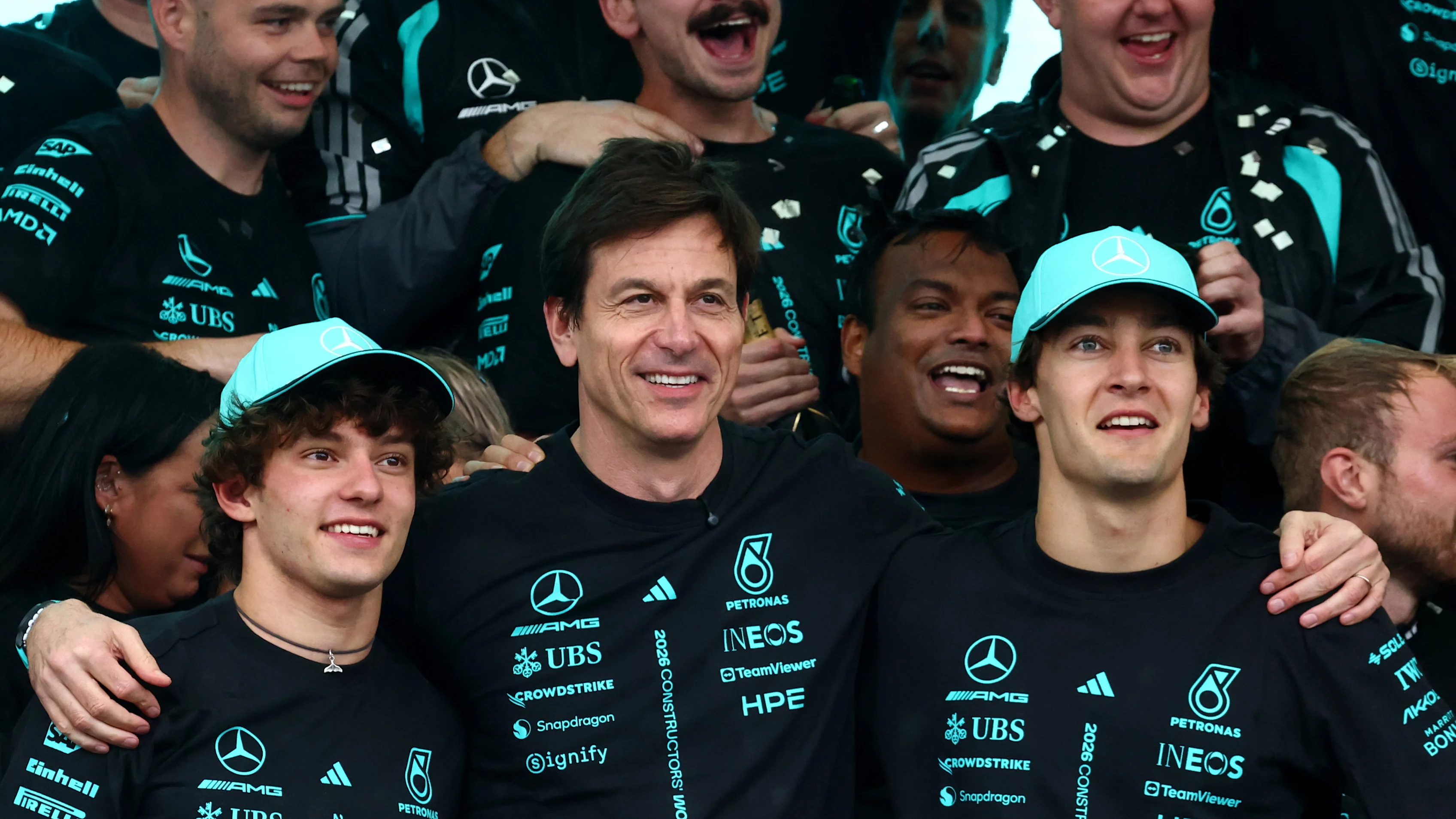
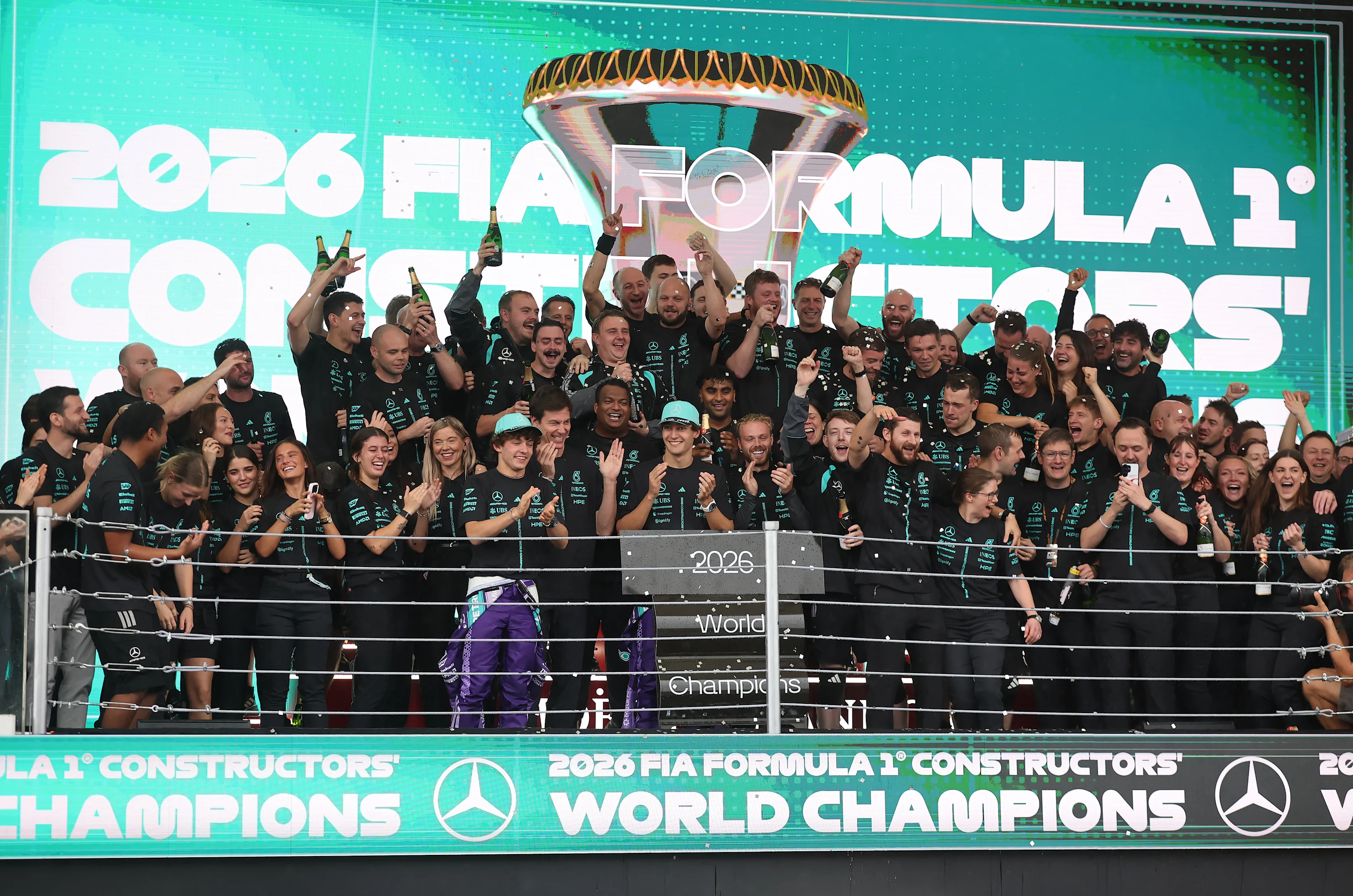
GOATIFYToto Wolff has spent much of his Formula 1 career being measured against the standard his Mercedes team created. In São Paulo, the benchmark became personal. Mercedes clinched its ninth Constructors’ Championship of 2026, giving Wolff a ninth team title as boss and putting him level with Sir Frank Williams. The symmetry is extraordinary: Williams was the man whose team gave the Austrian his first serious foothold in Formula 1 management.
The latest title was secured without a race victory. George Russell finished fourth and newly crowned drivers’ champion Kimi Antonelli fifth at Interlagos on November 8. Their combined points were enough to put Ferrari out of reach with three rounds remaining. That quiet arithmetic completed a spectacular turnaround: Mercedes had not won the constructors’ crown since 2021, and its eight-year winning sequence once looked impossible to recreate.
The achievement is not simply a case of adding one more trophy to an already crowded cabinet. Wolff helped build a dynasty, watched a new set of rules dismantle its advantage, lost Lewis Hamilton to Ferrari and put faith in a teenage replacement. To understand why number nine matters, you have to go back to the team that first made him believe he could run an F1 operation.
Williams Taught Wolff How to Build an F1 Team Long Before Mercedes Made Him a Champion

Wolff did not arrive at the top of Formula 1 with a lifelong team-principal job waiting for him. Born in Vienna in 1972, he first pursued racing, competing in Austrian Formula Ford and taking a class victory in the 1994 Nürburgring 24 Hours. He even raced in the FIA GT Championship in 2004. Those years gave him a driver's understanding of competition, but they also made the limits of a conventional driving career clear.
His other route into motorsport came through business. He founded the investment firms Marchfifteen and Marchsixteen in 1998 and 2004 and developed interests across technology and industrial companies. A connection to HWA AG, the operation associated with Mercedes' DTM and Formula 3 programs, brought commercial management and racing back together. This was not a sudden transition from banker to paddock celebrity: it was a gradual accumulation of experience in businesses that had to deliver under pressure.
In 2009, Wolff invested in Williams. The name still carried huge authority, even though the team was no longer an annual title contender. Sir Frank Williams and Patrick Head had built a constructor with nine championships, won between 1980 and 1997. Those titles had come in very different eras and with champions including Nigel Mansell, Alain Prost, Damon Hill and Jacques Villeneuve. Wolff was joining an institution that knew both relentless winning and the frustrations of losing its competitive edge.
The connection with Frank became much more than an investment relationship. Wolff joined the board and, by 2012, had become executive director. In later reflections he described the founder’s charisma and the direct, sometimes mischievous way Frank spoke to people. Their relationship mattered because it exposed Wolff to the reality of team leadership: maintaining identity, managing investors and staff, and trying to preserve an organisation's competitive purpose when results are no longer coming automatically.
GOATIFY
GOATIFY Formula 1
Explore GOATIFY Formula 1 fan styles while revisiting Wolff's journey from Williams investor to a nine-title Mercedes team boss.


That context makes the nine-title comparison especially meaningful. Williams accumulated his nine constructors’ championships over the period when his own team defined the sport's engineering ambition. Wolff has now overseen nine Mercedes team championships through a different ownership structure, regulation cycle and driver generation. The number is equal, but the journeys were never identical.
There is another difference that makes the comparison more compelling. Wolff left Williams before he had delivered a title with them. He learned inside a team with a championship history, then took that experience elsewhere. Matching Frank's record does not mean replacing Frank's legacy. It means the apprentice from a team in decline eventually reached a total the original founder had made legendary.
The 2013 Mercedes Gamble Created Eight Straight Titles — Then the Car Stopped Winning
In 2013 Wolff left Williams to become a managing partner at Mercedes, acquiring a 30 percent stake and taking broad responsibility for the Formula 1 operation. He entered a project with serious resources but no recent constructors’ title. Niki Lauda was an influential figure in the organisation, Ross Brawn had been guiding its early development, and Lewis Hamilton was beginning his first season after leaving McLaren. The pieces were there, but success on that scale was far from guaranteed.
The first season offered a glimpse of what was being assembled. Nico Rosberg won in Monaco and Great Britain, Hamilton won in Hungary, and Mercedes finished runner-up to Red Bull in the constructors’ standings. The real turning point came in 2014, when the new turbo-hybrid power-unit rules rewarded the team's long-term planning. Mercedes won 16 of 19 grands prix. Hamilton took the drivers’ title and the team captured its first constructors’ championship.
One title became eight in a row. That streak from 2014 through 2021 was more than a strong chassis or a power-unit advantage preserved for years. Rules changed, competition tightened and a bitter Hamilton-Rosberg rivalry tested the internal culture. Rosberg won the 2016 drivers' title, Hamilton subsequently added championships in 2017, 2018, 2019 and 2020, and Mercedes kept finishing ahead of every rival in the standings that rewarded both cars.
The structure of a constructors’ title is important here. One extraordinary driver can win individual races or even a drivers’ championship while the other side of the garage struggles. A team title requires a deep engineering organisation, strong operations, reliability, consistent strategies and two cars collecting points. Mercedes' eight-title run made that broader competence its trademark, rather than treating every season as a one-driver rescue mission.
Then the sport changed around it. The ground-effect regulations introduced in 2022 altered the aerodynamic problem, and Mercedes could not immediately find the performance or predictability it had enjoyed. Red Bull and then McLaren took the team titles during the four-year gap. Across the 2022–25 seasons Mercedes managed only five grand prix wins, a stark comparison with the relentless pace of its 2014 breakthrough.
GOATIFY
GOATIFY Formula 1
Browse GOATIFY F1 gear as Mercedes' eight-year dynasty and four-year recovery reveal how quickly the competitive order can change.


Those lean years also revealed something the original winning run could conceal: whether a leadership team can change course when its old answers no longer work. Wolff had to oversee technical adjustments, absorb public criticism and judge how aggressively to rebuild. He could not solve a fundamental car-performance problem with a press conference, and the historical prestige of his trophies counted for nothing at the next qualifying session.
The most emotionally charged change was Hamilton's move to Ferrari after 2024. A partnership that had delivered six of Hamilton's drivers' titles and immense value to Mercedes was ending. Wolff responded by backing the team's young talent pathway: Kimi Antonelli, then just 18, would partner George Russell from 2025. It was an enormous bet on development, precisely when the team needed results. One year later, that decision became central to a title-winning recovery.
In 2016, the intra-team championship fight showed how difficult it is to separate individual ambition from collective objectives. Rosberg and Hamilton fought for the drivers' crown, but the factory and pit wall still had to deliver competitive, reliable cars for both. A constructor cannot depend on one driver rescuing every weekend; the people preparing, maintaining and operating the second car are part of the championship equation too. This lesson carries into 2027, because Russell and Antonelli will have different personal incentives. Russell is the experienced team leader seeking a first drivers' crown, while Antonelli is now a champion defending his own position. Wolff's responsibility is to keep each side of the garage productive even as their ambitions collide, a challenge that can be hidden when the car has a large advantage.
Antonelli's Record, Russell's Points and the 2027 Fight Make Wolff's Ninth Title Different
Mercedes' 2026 rebound did not emerge out of a single lucky race. The team began the new regulation era strongly and built a lead its rivals could not erase. Antonelli turned the promise of his rookie year into a remarkable championship season: nine grand prix victories and seven further podiums put him beyond reach before the calendar was over. At the Mexico City Grand Prix on November 1, third place behind Max Verstappen and Lewis Hamilton secured the drivers’ crown.
At 20 years and 68 days, Antonelli became the youngest Formula 1 world champion, beating Sebastian Vettel's previous age record. He also ended an Italian drivers’ championship drought stretching back to Alberto Ascari in 1953. The personal story was striking, but it also delivered an organisational verdict. The teenager Wolff had promoted instead of looking for an established replacement for Hamilton was already succeeding at the highest level.
The following weekend brought the team title. Lando Norris won a rain-affected São Paulo Grand Prix, with Verstappen recovering from 21st on the grid to second and Isack Hadjar finishing third. Mercedes did not need to win to clinch its championship. Russell's fourth and Antonelli's fifth place produced enough points to settle the constructors’ contest against Ferrari. That is exactly what a strong two-car team is meant to do: capture the championship even on an afternoon when other cars have the spotlight.
GOATIFY
GOATIFY Formula 1
Shop GOATIFY Formula 1 styles as Mercedes prepares to defend its titles against McLaren, Red Bull and Ferrari in 2027.


Nine drivers’ titles are not what Wolff has equalled. The comparison with Frank Williams is about nine constructors’ championships achieved as a team leader. Williams the team also has nine, and Mercedes now shares that total. Ferrari and McLaren remain above those two teams in the all-time constructors’ ranking. The nuance matters because it keeps the record attached to what Wolff actually directs — an organisation rather than only a driver's individual career.
It is tempting to describe 2026 as the launch of another eight-year Mercedes reign. That is exactly the conclusion the late-season racing cautions against. Norris won in Brazil and McLaren's upgrades produced stronger pace, while Verstappen's charge through the field demonstrated that Red Bull is a serious competitive threat. Ferrari has not vanished, either. Mercedes built its points cushion when its package was at its strongest, but rivals were capable of winning races as the season progressed.
Wolff himself has warned that success this year does not make the following season straightforward. That is not false modesty; it is a lesson learned the hard way in 2022. Development rates change, rivals understand regulations more fully, and a comfortable early margin can become a far narrower fight over a winter. Antonelli defending his title in 2027 is a new challenge, not an administrative formality.
Russell's contribution deserves equal attention in any assessment of the team's recovery. The spotlight naturally follows the record-breaking young champion, but constructors’ championships reward both cars. Russell's experience, consistency and points were part of the reason Mercedes finished the São Paulo weekend celebrating. The decision to keep a dependable senior driver alongside a fast-tracked prospect now looks less like a gamble and more like a coherent team-building strategy.
What gives Wolff's ninth title weight is therefore not the possibility that Mercedes might keep winning indefinitely. It is that the team survived the end of one dominant era and emerged capable of winning again with a different driver pairing and a different car philosophy. The builder of the first dynasty had to become the architect of a recovery. At São Paulo, those were no longer separate descriptions of his career.
When Wolff first joined Williams as an investor in 2009, Frank Williams' nine constructors' championships represented a piece of Formula 1 history he could only study from inside the paddock. Seventeen years later, his ninth Mercedes crown has put him alongside the man who welcomed him into team management.
The milestone should be celebrated without rewriting what happened in between. Mercedes won eight straight titles, lost its edge for four seasons and came back with a new champion and a team able to score with both cars. The next season will test whether that comeback is durable. But no matter how competitive 2027 becomes, number nine has already turned a former Williams pupil into Frank's equal in the record book — and given Mercedes a second chapter that stands on its own.
GOATIFY
GOATIFY Formula 1
Shop GOATIFY Formula 1 shirts, hoodies and racing stickers.


















