

How to Choose an American Football Mouthguard: Fit, Types and 2026 Rules
GOATIFYA mouthguard is probably the smallest piece of American football equipment you will have to wear every snap. It is also one of the easiest to buy badly. A huge lip shield may look fierce behind a facemask, while a barely fitted bargain guard looks discreet in the package. Neither tells you whether the protector will stay on your teeth when you call a play, breathe between snaps or take a hit.
The useful question is not “Which mouthguard looks most like the pros wear?” It is “Which properly fitted protector can this particular player wear consistently, without fumbling with it after every play?” The American Dental Association’s mouthguard guidance supports using a properly fitted guard to reduce sports-related dental and oral injury. It does not promise that any guard will prevent every broken tooth, jaw injury or concussion.
This buying guide compares the three common constructions, explains how to judge retention and fit, separates the 2026 high-school attachment rule from online rumors, and covers braces, hygiene and replacement. The recommendations concern protective equipment; GOATIFY’s separate NFL apparel collection is fan merchandise, not a substitute for an actual athletic mouthguard.
Stock, boil-and-bite or dentist-made: the three real choices

Stock mouthguards arrive pre-shaped. They are inexpensive and convenient when a player has lost a guard just before practice, but that convenience can disappear on the field. A stock guard does not mold to an individual bite; some players must keep their jaw shut to hold it in place. If it slips when you talk or open your mouth, it is not a good regular-use solution. The ADA describes this category as the least effective of the three types because generic shaping can mean poor retention and frequent adjustment. A low checkout price is not much of a saving if the player immediately stops wearing it.
Boil-and-bite guards are thermoplastic models softened in hot water, then molded around the wearer’s teeth. For many players without orthodontic complications, a correctly fitted version offers the practical middle ground: retail availability, a lower initial cost than a dental appointment, and a better chance of staying put than a stock model. That is a conditional recommendation, not an assurance that every boil-and-bite product works. Some models fit beautifully; others are too bulky, poorly shaped or simply the wrong size for the athlete. The molding directions are specific to the model, so a video showing another brand’s soaking time is not your instruction sheet.
Custom-made guards start from dental impressions or scans and are fabricated for a particular mouth. Their main appeal is fit adaptability: a dentist can account for bite shape, unusual dental work and comfort, and a player who uses the guard every day may value that consistency. The catch is more cost, a fitting appointment, and replacement when a young athlete’s teeth change. Custom does not mean indestructible, nor does it magically guarantee freedom from injury. The American Dental Association notes that well-made, consistently worn noncustom options can also be effective.
GOATIFY
GOATIFY NFL
Shop GOATIFY NFL and American football shirts, hoodies and stickers.


Choose by the person rather than by the box. A beginner needing a sensible first guard can start with a well-reviewed, properly molded boil-and-bite design. An athlete with repeated fit problems, significant dental work, a complicated bite or a desire for a professionally tailored guard should ask a dentist about a custom option. A stock mouthguard belongs nearer to the emergency-backup category than the default recommendation. Across all three, verify that the model is intended for contact sports and follows the player’s league and school equipment rules.
One more shopping shortcut: if an over-the-counter product bears the ADA Seal of Acceptance, that reflects an independent evaluation against defined safety and performance criteria for eligible mouth-formed guards. It is a meaningful quality signal, not a guarantee about any individual impact. Fit, willingness to wear the device and league compliance still matter after purchase.
Fit comes before color, airflow marketing and price

The simplest field-side test is whether a guard stays seated over the upper teeth when the player opens the mouth and speaks normally. It should not need a constant death grip from the jaw, catch on the gums, create sharp pressure points or fall out whenever instructions are shouted. A comfortable guard usually protects the dental arch at risk while allowing the athlete to communicate and breathe. A visible front opening on a flashy football lip shield is not, by itself, evidence of better protection or superior athletic performance.
For a boil-and-bite model, read the actual package directions before touching hot water. Use the stated heating temperature and time, cool the softened material as directed to avoid burns, center it correctly on the teeth and press or bite only in the way the manufacturer specifies. Then let it set, test retention and check for sharp edges. Some guards can be remolded; some should not be repeatedly reheated. Do not treat the soaking time on a competitor’s packaging or a random social video as universal. If the finished mouthguard wobbles or is visibly flattened from over-molding, start again within the manufacturer’s limits or replace it.
Take the fit test with the helmet on as well as off. The facemask and chin strap change how the athlete moves the jaw. Practice a few full-sentence calls, take several normal breaths and simulate the way the player places and removes the guard between drives. If a player continually spits it into the facemask, the failure may be sizing or comfort rather than attitude. An expensive protector worn for only the opening series has less practical value than a properly fitted one worn throughout contact drills and games.
Braces change the buying decision. Brackets and wires create shapes that an ordinary tight-molded guard might catch or compress. A player undergoing orthodontic treatment should consult the orthodontist or dentist before molding a retail guard, especially if the teeth are moving during the season. The American Academy of Pediatric Dentistry recommends protective mouthguards in youth collision sports and emphasizes professional dental guidance for players at higher oral-injury risk. Do not attempt a home impression kit over fixed brackets without the clinician’s approval.
Growing players deserve repeated fit checks. A youth guard that worked in August may feel loose after dental changes or be uncomfortable after an orthodontic adjustment. Ask a dental professional whether the particular guard needs more room for erupting teeth. You are purchasing a piece of equipment for the present mouth, not a one-size promise for the next three seasons.
GOATIFY
GOATIFY NFL
Shop GOATIFY NFL and American football shirts, hoodies and stickers.
The 2026 football rule: what is actually banned?
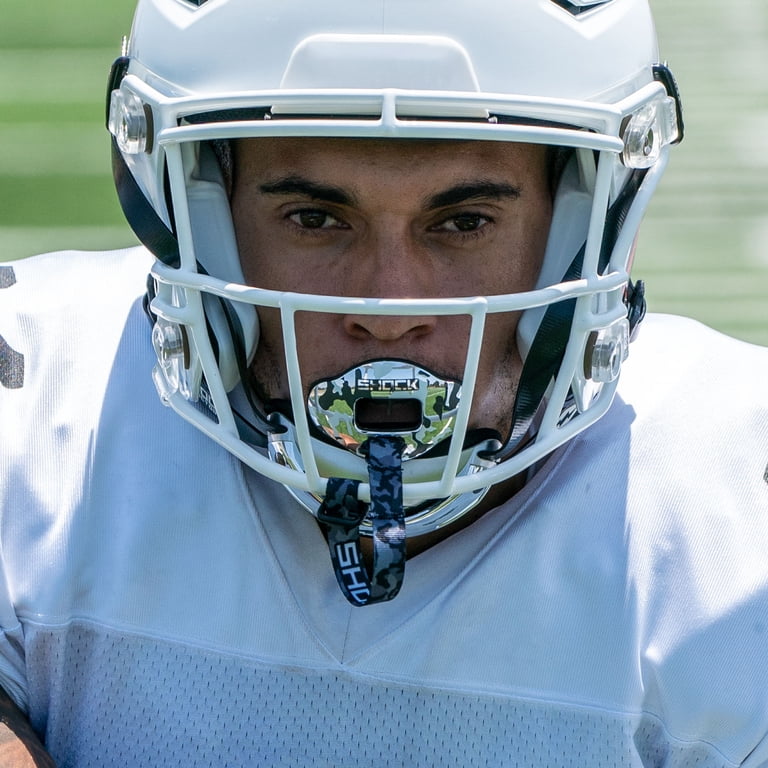
The first rule of buying football equipment is to check the rulebook that actually governs your games. NFL, NCAA, high-school and youth competitions are not interchangeable, and local schools or leagues may add equipment interpretations. Do not assume a product label saying “football legal” settles eligibility in every competition. Have the coach or equipment manager confirm any unusual model before money is spent, especially a giant decorative shield or an attached piece that swings outside the facemask.
For United States high-school football, NFHS announced an additional tooth-and-mouth-protector restriction effective in the 2026 season. Attachments must serve a real teeth-or-mouth protective purpose; equipment that creates a health or safety hazard is not allowed. These are additions to an existing mouthguard requirement, not a brand-new mandate that began in 2026. In practical terms, a decorative attachment without protection value deserves scrutiny. So does a rigid or protruding component that might endanger another player.
That wording does not support the sweeping claim that every tether or every lip guard is automatically prohibited. A connected mouthguard may have a legitimate protective function; the whole design still has to satisfy the applicable rule and safety judgment. Conversely, a mouthpiece with elaborate dangling plastic decorations should not be presumed legal just because a famous player wore something similar in a photograph. The smartest question to ask your equipment official is simple: “Will this specific guard, including every attachment, pass our league’s rules?”
Color confusion is another trap. Online posts sometimes recycle a blanket claim that completely white or clear mouthguards are banned everywhere. NFHS removed a former nationwide high-school prohibition on clear or white protectors years ago; a state association, another league or a specific team may still impose its own requirements. That is precisely why the applicable current rules, not a mixed collection of shopping-site FAQ pages, must decide the purchase. For a straightforward high-school player, the most hassle-free choice is usually a securely fitting compliant design without gratuitous accessories.
Do not buy a new mouthguard on the theory that it will prevent concussion. Mouthguards are valuable dental and oral protectors, but National Athletic Trainers’ Association guidance says there is not high-quality evidence to recommend them specifically for concussion prevention. Research is less settled for concussion than for dental trauma. Proper coaching, tackling technique, concussion recognition and the team’s medical protocols remain separate safety responsibilities; a mouthguard cannot replace them.
Clean it, replace it and actually wear it: the season-long checklist

Buying a good guard is step one; keeping it usable is the less glamorous second step. After every practice and game, rinse it in cool or lukewarm water, gently clean it with a suitable mild soap or product recommended by the manufacturer, and rinse thoroughly. Let it dry and store it in a clean, rigid ventilated case rather than dropping it wet into the bottom of a gear bag. Clean that case too. NATA’s sports dental injury guidance recommends a mild antimicrobial soap, thorough rinsing and ventilated storage. A clean protector also feels less unpleasant to put back into the mouth before the next series.
GOATIFY
GOATIFY NFL
Shop GOATIFY NFL and American football shirts, hoodies and stickers.
Keep the guard away from prolonged heat, including the dashboard of a car on a sunny day, hot-water laundry cycles and direct sun on a windowsill. Heat can warp thermoplastic material, destroying the custom shape the athlete spent time creating. Do not share guards between teammates, even for “one quick rep.” A spare, properly fitted model in its own case is a much better answer to a forgotten or lost primary guard.
Check the material regularly. Cracks, torn corners, a rough or sharp edge, obvious bite-through, an altered shape or a loss of retention mean the guard needs replacement or professional evaluation. Youth players with changing teeth may outgrow a model that still looks clean and intact. There is no universal replacement clock applicable to every brand and every mouth: actual wear, fit changes and the manufacturer’s instructions matter more than a confident but arbitrary “replace every X weeks” rule.
Before ordering, run a quick decision test: Does it fit without clenching? Can the player breathe and communicate comfortably? Does it protect the intended tooth surfaces without irritating the gums? Is it permitted under the actual league rules? Is it manageable to clean and replace? If the answer to any of these is no, the product has failed regardless of its graphics, price or popularity. For children with braces or a complicated bite, the dentist should be part of the choice, not the final resort after three failed home fittings.
For parents managing a whole season, an inexpensive second guard and a second ventilated case can be more useful than paying extra for color-changing effects or a celebrity collaboration. Keep one spare at home or with the equipment bag, teach the player how to inspect it, and make guard use automatic during contact practice as well as games. The real cost of a mouthguard includes whether you can replace it promptly if it disappears on a Friday evening.
And keep the commercial categories straight: GOATIFY’s NFL collection offers football-themed shirts, hoodies, caps and stickers for fans. It does not supply dental protective equipment or replace professional fitting. Buy the actual guard from a suitable sports-equipment or dental source; look at fan apparel only for the separate part of football culture that happens off the field.
The practical pick: start with a correctly fitted boil-and-bite guard if the player has an uncomplicated bite and needs an accessible everyday option. Move to professional fitting when braces, dental work, recurrent slipping or discomfort demand something more individualized. Treat ready-made stock guards as a compromise, not a shortcut around proper fit.
For the 2026 season, verify the actual high-school, college, youth or league rule before buying a heavily accessorized lip shield. Then test the guard with the helmet on, clean it after use, replace it when its shape or retention changes, and make wearing it routine. The best mouthguard is neither the loudest nor automatically the most expensive. It is a compliant, properly fitting guard the athlete will really keep in place when the next snap begins.
GOATIFY
GOATIFY NFL
Shop GOATIFY NFL and American football shirts, hoodies and stickers.


















