

Pittman Returned to Practice. The Steelers Just Lost Their Line Leader.
GOATIFYPittsburgh's November 18 practice report delivered the kind of encouraging news that can transform a team's receiving rotation: Michael Pittman Jr. and Roman Wilson were back on the field. Rookie guard Gennings Dunker returned, too. But the most consequential transaction of the day went in the opposite direction. Mason McCormick, the guard who had started every Steelers game this season, went onto injured reserve after being hurt against Cincinnati.
That contrast matters more than the headline about returning receivers. Pittsburgh has a 6-3 record and a November 22 trip to Philadelphia approaching. Its coach, Mike McCarthy, is trying to determine whether two pass catchers can contribute immediately, while preparing Spencer Anderson to replace an established offensive-line starter. The 21-day return windows are open; they are not proof that anyone is ready for Sunday.
The Steelers have more available options than they did a week ago, but also less certainty in the part of the offense that gives every option time to work. How McCarthy balances those two facts will tell us more about Pittsburgh's Week 11 prospects than the length of Wednesday's injury list.
Pittman and Wilson returned to practice—not the active roster
The distinction between practicing and playing is not administrative fine print. Pittsburgh opened a 21-day activation window for Michael Pittman Jr., Roman Wilson and Gennings Dunker on Wednesday, November 18. All three initially remained on injured reserve. The team can assess them during practice before deciding whether to activate them; they are not automatically cleared for Sunday's game in Philadelphia.
Pittman took part on a limited basis as he continued to work through a foot problem. He had gone onto injured reserve on October 10 and had managed only three starts this season. In those appearances, the veteran receiver caught seven passes for 89 yards. Those numbers are too small a sample to define his value, but they do show how little of Pittsburgh's 2026 passing offense he has been able to influence since arriving from Indianapolis in the offseason.
The Steelers didn't acquire Pittman simply to add a name to the depth chart. A big-bodied outside receiver can offer a different answer to press coverage, short-yardage routes and contested targets, helping diversify an attack built around DK Metcalf and the other available pass catchers. That is a potential schematic benefit, not evidence that Pittsburgh's passing efficiency will immediately improve. A receiver coming off a layoff still needs timing with the quarterback, confidence in his plant foot and enough practice repetitions to execute the full route plan.
Wilson's situation is slightly different. He was a full participant in Wednesday's practice after a hand injury that sent him to injured reserve in October. Before being sidelined, he had produced 14 catches for 188 yards and two touchdowns, more involvement than Pittman had managed in his injury-interrupted first Steelers season. The contrast between Wilson's full participation and Pittman's limited session is an encouraging clue, but an injury designation for one day cannot replace an entire week of evaluation.
Wilson also used the absence to study route running, describing the period as a chance to learn from other receivers even while he couldn't play. That may help him with recognition and technique, but the test in a game is whether he can execute routes against live defenders at full speed, finish catches and avoid hesitation while protecting the recovering hand.
The coaching staff has to answer two linked questions. First, can each receiver contribute enough snaps to justify a game-day roster position? Second, would using him early improve the overall offense more than keeping a healthy player in an established role? Those are not identical decisions. A receiver might be physically ready for a limited package without being prepared for every personnel grouping or a heavy snap count.
GOATIFY
GOATIFY NFL
From injured-reserve comebacks to late-season NFL drama, explore GOATIFY American football fan gear.


Pittsburgh could use more options in the passing game after the loss to Cincinnati. But McCarthy's message on Wednesday was about evaluating the full workweek rather than declaring victory at the first sight of returning players. That restraint is sensible. An extra receiver is valuable only when the timing, health and assignment are reliable enough to turn a promising lineup change into real yards.
McCormick's injury removes more than a starter
While reporters focused on who was back, Pittsburgh made a much firmer decision about who would not be available. The club placed Mason McCormick on injured reserve on November 18 after the guard left its Week 10 loss to the Cincinnati Bengals in the first half. That designation means he will miss at least the required minimum period, including the upcoming game with the Eagles. Any longer-term recovery projection must remain provisional until the club supplies it.
McCormick's absence changes the offensive line at a particularly awkward moment. He started each of Pittsburgh's nine games in 2026. Across three seasons he had made 40 starts in 43 appearances, including all 17 games in 2025 and 14 as a rookie. Continuity is not a glamorous statistic, but that workload is evidence of how consistently he had been part of the same blocking conversations and weekly preparation process.
A guard doesn't protect the quarterback in isolation. He has to identify where pressure is coming from, coordinate with the center on line calls, pass off interior twists, and work in tandem with a tackle when a defense changes its picture after the snap. Those details are hardest to measure on television because an ordinary successful pass-off looks like nothing happened. The result becomes visible only when a handoff is missed and a defender reaches the quarterback before the route structure has developed.
McCormick's removal therefore creates a different kind of injury problem from the one at receiver. Wideout absences can narrow the menu of routes and formations. A missing guard can affect the reliability of nearly every play, regardless of which receiver is on the field. The quarterback's pocket, the first step in the running game and the timing of play-action all depend to some degree on whether the interior line responds as a connected group.
McCarthy has emphasized McCormick's standing within the locker room as well as his play. Teammates and coaches described a player trusted for his consistency, communication and personal presence. That reaction should not become sentimentality masquerading as analysis. The point is that established communication has tangible football value, especially when the replacement must recognize the same calls under the pressure of an unfamiliar opponent.
There is also an opportunity in the disruption. A reserve can perform well enough that the difference becomes manageable, particularly when coaches simplify reads and create predictable help. Yet an adequate individual performance is only one part of replacing a starter. Pittsburgh must maintain its collective standard across first-and-10, third-and-long and obvious passing situations when an opponent can target a new face at the line.
The word 'anchor' is often reserved for a left tackle or a star center. McCormick's experience illustrates why an otherwise unheralded guard can become an anchor through repetition. His injury won't necessarily wreck the offense; it merely raises the cost of every lapse in coordination. The Steelers now need a solution that makes the whole front work, not just a capable player wearing the next jersey.
GOATIFY
GOATIFY NFL
Celebrate the Steelers' trench battles and hard-nosed NFL football with GOATIFY fan apparel.
Anderson gets the first chance; Dunker is a different kind of option
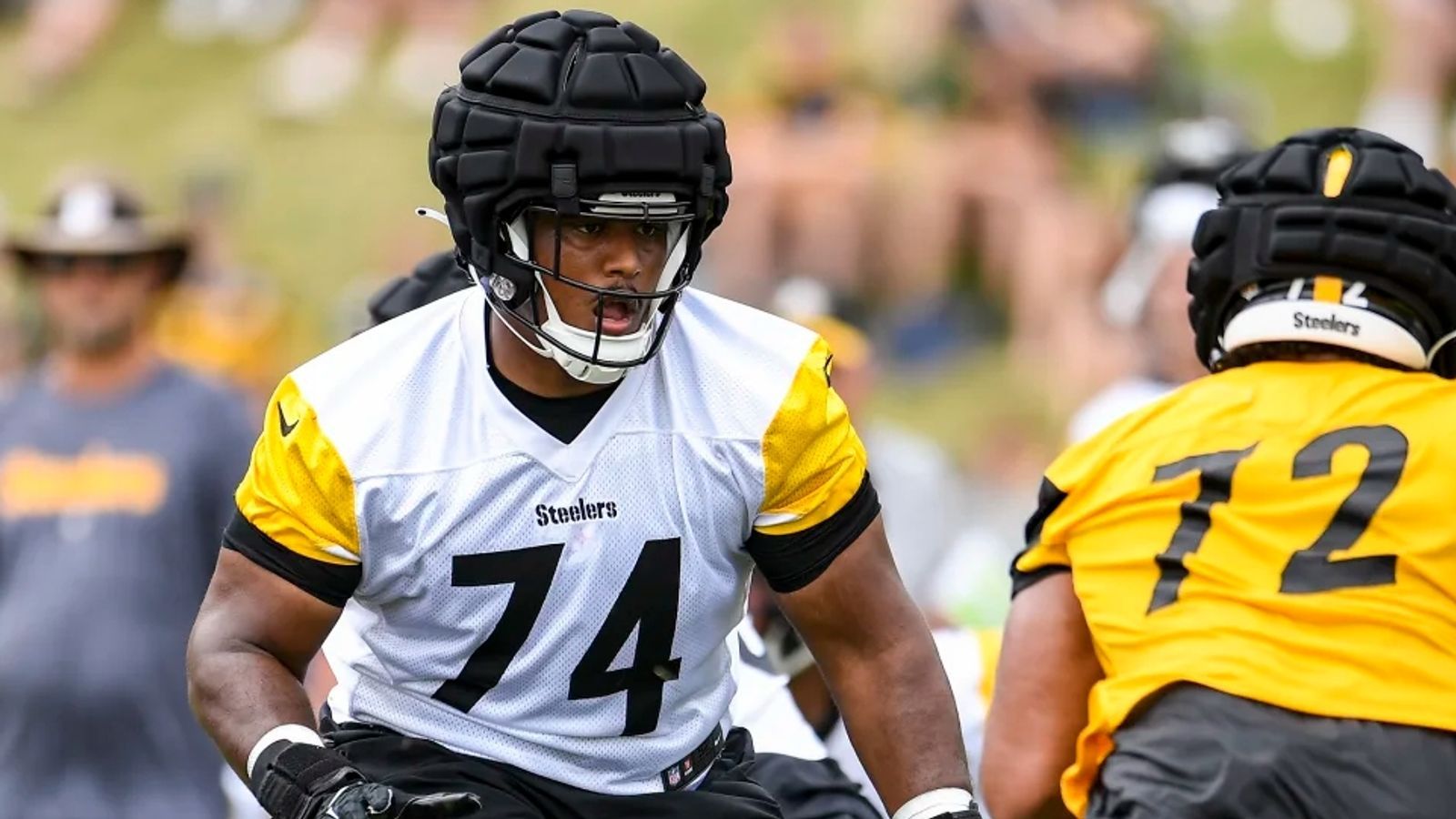
Spencer Anderson is the immediate answer at left guard. Pittsburgh's coaching staff identified him as the player stepping into McCormick's starting role, which makes his preparation against Philadelphia one of the week's most important developments. The question is not whether the Steelers can physically line up five healthy players; it is whether the new combination can preserve the timing and trust that had developed through the season's first nine games.
Anderson has the benefit of already knowing the offense and its language. Coaches have pointed to his athleticism, intelligence and trust from teammates. That makes him a stronger short-term option than a player learning the system from scratch, although familiarity with the playbook and familiarity with a specific combination of adjacent linemen are not the same thing. Even a veteran reserve must take repetitions with the starting center and tackle to make the adjustments automatic.
Some adjustments will be visible. Pittsburgh might give its left-side protection more help against overloads or reduce the number of long-developing dropbacks that ask a new guard to hold blocks for several seconds. Other changes will be subtler: more precise protection identification before the snap, changes to running-game aiming points, or a quicker route available when the Eagles show an aggressive front.
Those adjustments have costs. A tight end who chips a pass rusher cannot release as quickly into a route. A running back who checks an interior gap before releasing is one fewer early option for the quarterback. Asking Anderson to operate alone against the full complexity of a professional front could free those eligible receivers, but it also increases the downside if a pressure read fails. The offensive staff's job is to choose where to spend its protection resources without making the entire attack predictable.
Gennings Dunker represents a separate, potentially useful development. The rookie third-round selection from Iowa resumed practice Wednesday after landing on injured reserve in September. He was a full participant in the first listed session, but he had yet to appear in an NFL regular-season game. His 47 college appearances and 38 starts show meaningful experience with the position, not evidence that he can immediately execute every Pittsburgh protection against NFL defenders.
In his first session back, Dunker acknowledged that he would need to review practice film before understanding exactly where his game stood. That is a more realistic view than treating a return to the field as an instant promotion. The 21-day designation allows the team to evaluate readiness while Anderson prepares to start. It does not require Pittsburgh to put a rookie into a high-leverage game simply because its depth chart has thinned.
This creates an important separation of time horizons. Anderson is the solution Pittsburgh can actually prepare to deploy this Sunday. Dunker could become a depth addition, a rotational contingency or a future option if his recovery and practice performance warrant activation. The receiver returns may improve the offensive skill group relatively quickly; rebuilding line depth requires a careful choice about who is reliable enough to handle the dangerous plays as well as the routine ones.
What Pittsburgh must prove before the Eagles game

Sunday's game against the Philadelphia Eagles now offers Pittsburgh an immediate stress test. The teams meet November 22 at Lincoln Financial Field, with kickoff moved from the originally scheduled 4:25 p.m. Eastern window to 1 p.m. The Steelers arrive at 6-3, while Philadelphia is trying to interrupt a difficult season. That difference in records should not fool Pittsburgh into thinking its changed offensive line can simply rely on reputation.
GOATIFY
GOATIFY NFL
Build your game-day outfit for the next Pittsburgh football test with GOATIFY NFL designs.
Philadelphia's defensive front still poses real protection questions. Even if an opponent's overall results have been poor, an individual rush matchup, a well-timed stunt or an overload can turn a clean pocket into a negative play. Pittsburgh will want Anderson and his neighbors communicating cleanly, particularly on third down when the defense can abandon run-first looks and manufacture pressure.
The Steelers' Wednesday practice information is also a reminder to separate available players from fully available players. Wilson and Dunker were listed as full participants in the first session after their return windows opened; Pittman was limited. The club also listed linebacker Nick Herbig as a nonparticipant with hip/rib concerns, while several defenders carried other participation or rest designations. Those details matter for the whole game, but they should not be conflated with the specific question of whether the offensive additions will be activated.
There are four sensible indicators to watch as the week develops. First, Pittman's practice progression: does he move from a limited workload toward fuller participation without a setback? Second, Wilson's consistency: does he maintain enough activity to suggest that the hand injury won't constrain his catching and blocking duties? Third, Anderson's integration: does Pittsburgh stick with one starting line combination rather than spending game preparation on emergency rotations? Fourth, Dunker's evaluation: does the team treat him as playable depth now or use more of the activation window?
For Aaron Rodgers, the broader strategic issue is rhythm. Veteran quarterbacks can compensate for some protection problems with faster decisions, but only when receivers reach their landmarks and the play's first read is viable. Returning pass catchers can help by giving a trustworthy underneath option or an additional route against a crowded secondary. They cannot erase a free rusher up the middle before the quarterback sets his feet. The two injury stories must be solved together.
There is a temptation to score the week by counting activations: two receivers back would be good, three returning players even better. That metric misses the real objective. An offense that adds bodies yet loses predictable protection could become less efficient, not more. Conversely, a disciplined performance by Anderson and the established line might make a limited receiver group more dangerous than a crowded one operating with poor timing.
Sunday won't determine every player's place in Pittsburgh's season. Injured reserve is built around longer decisions, and the 21-day windows are designed to give a medical and football staff time to assess recovery. The immediate objective is narrower: establish a workable left-side protection plan, let the receiver decisions follow evidence from practice, and give the quarterback a chance to play at the pace the offense requires. Pittsburgh's result against Philadelphia will make that plan easier or harder to defend, but the quality of the process matters regardless of the final score.
Wednesday's developments gave Pittsburgh hope and a problem at the same time. Pittman and Wilson have a pathway back, Dunker can begin preparing as a depth option, and Anderson has an opportunity to establish himself at left guard. None of those facts makes McCormick's absence less significant or guarantees the receivers will be active against Philadelphia.
The next clues are practical: how Pittman responds to successive practices, whether Wilson's full participation continues, which protections Anderson handles comfortably, and what the Steelers decide when they build the game-day roster. The 1 p.m. kickoff on November 22 leaves a short evaluation window, not a license to rush.
Pittsburgh can gain receiving options without gaining offensive efficiency. Until the new line configuration holds up, the most important comeback is not a wide receiver's. It is the offense's ability to function when the snap arrives.
GOATIFY
GOATIFY NFL
Finish the story with GOATIFY NFL shirts, hoodies and stickers in the official football collection.





















