

Yankees May Let Jazz Chisholm Walk — Bednar’s $23.15M Offer Is Only the Start
GOATIFYThe Yankees’ first big offseason choice may not be which superstar to chase. It may be whether they are willing to let one of their most recognizable players reach the market without a qualifying offer attached. An October 16 report says New York is expected to extend a one-year, $23.15 million qualifying offer to closer David Bednar but not to second baseman Jazz Chisholm Jr. Neither decision has been formally announced, and a prediction about an offer is not the same as a final decision about re-signing a player. Yet the reported split captures a larger problem in the Bronx: the roster needs both more dependable production and more financial flexibility.
That calculation comes after a Division Series sweep by Tampa Bay, with captain Aaron Judge sidelined by a calf injury and veteran designated hitter Giancarlo Stanton available only sparingly during the season. The Yankees can keep paying for familiar upside, or they can redistribute resources toward positions that actually keep their stars on the field and their lineup functioning. The $23.15 million question is where that argument begins, not where it ends.
Jazz Chisholm’s qualifying-offer risk is about value, not just talent

Chisholm’s appeal has never been hard to understand. He brings speed, left-handed power, athleticism and the sort of energy that can change the atmosphere of a slow game. In 2025 he reached 30 home runs and 30 steals, demonstrating why a dynamic second baseman can be more than a complementary bat in a lineup dominated by sluggers. His 2026 season was less convincing. Through 134 games before a September thumb injury, he was hitting .232 with 19 home runs and 40 stolen bases, and the year also featured defensive and concentration concerns. Those are meaningful indicators of both his ceiling and his volatility; they are not, by themselves, a complete verdict on his future.
A qualifying offer is a very specific financial bet. It is a one-year contract at a league-set salary, not an invitation to negotiate any amount. If Chisholm accepted a $23.15 million offer, the Yankees would be committing that figure to a player whose production and availability have fluctuated. If he declined and signed elsewhere, New York could receive draft-pick compensation under the applicable rules. Declining to issue an offer would remove that potential compensation but also eliminate the risk of a surprisingly expensive one-year acceptance. The club has to judge not only what Chisholm might earn in a multi-year free-agent deal, but whether his market would make accepting the offer attractive.
The uncomfortable part is that New York would be giving up a type of athleticism it does not possess in abundance. Losing Chisholm’s base-running threat and ability to cover second base could make an already power-heavy offense easier to defend. But a good roster is not a museum of peak versions of players. If the Yankees decide that Chisholm’s 2025 production is less likely to repeat than his 2026 inconsistencies, the money saved must buy a credible replacement plan. Letting him leave without a succession strategy would not be prudence; it would simply transfer the problem to another position.

David Bednar offers the certainty the bullpen has lacked
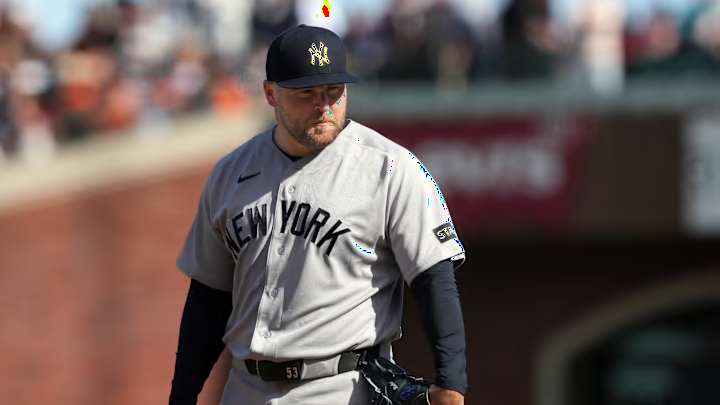
The reported plan for Bednar points in the opposite direction. A one-year qualifying offer to an established closer is a way to protect an important role without committing immediately to a long contract. Bednar gave New York a more reliable ninth-inning identity after several seasons of turnover and late-game uncertainty. His official 2026 pitching line lists a 2.61 ERA across 48 appearances, with 58 strikeouts in 51⅔ innings. Those numbers do not make any reliever immune to volatility, but they explain why the club would value continuity at the back of the bullpen.
The strategic difference between Bednar and Chisholm is not simply that one had a better season. The Yankees can see a narrower, more predictable job for Bednar: enter high-leverage innings, miss bats, and protect leads. Chisholm’s value depends on a wider package of hitting, defense, base running and health. Relievers can deteriorate quickly, too, which makes a one-year commitment attractive if the player accepts. A longer deal could still be sensible, but the qualifying offer preserves an alternative while the market develops.
There is also a draft-pick consideration if Bednar rejects the offer and signs with another team. The Yankees would not be paying $23.15 million merely for the chance at a pick; the club must genuinely be prepared to employ him at that salary. The possibility of compensation, however, improves the downside of losing a player they would otherwise have to replace with another expensive veteran or a less proven internal option.
New York should not confuse a secure closer with a complete pitching staff. A ninth-inning specialist matters most when the starters and setup group can reliably deliver a lead to him. The same front office deciding whether to retain Bednar must also determine how many innings it can reasonably expect from an injury-affected rotation. Bednar is one piece of a workable 2027 plan, not a substitute for one.
Aaron Judge wants urgency — but spending must produce availability

Judge’s reported push for more aggressive spending after the Yankees’ early elimination is understandable. A franchise built to compete for titles cannot treat another October disappointment as a reason to become passive. Judge missed the Division Series after a late-season calf injury, leaving New York without its central offensive force when the season was decided. Entering his age-35 campaign, the captain has less time to wait for a slow retooling than a prospect-led club would.
But the distinction between spending more and building better matters. New York has repeatedly carried famous names whose availability changed the shape of the lineup from week to week. A roster can look formidable in February and still arrive in October with too few dependable at-bats. If the Yankees allocate another large contract to a player with a similar injury or performance risk, they may be purchasing the same uncertainty under a new name.
Judge’s request also has a negotiating dimension. Public pressure from the face of the franchise can sharpen the urgency felt by ownership, even when the captain maintains strong relationships inside the organization. Reports that some executives were irritated by his comments should not be mistaken for evidence of a lasting rift. What matters is whether the club responds with a coherent plan: an everyday lineup that can survive a star’s absence, enough athleticism to score without three-run homers, and a pitching group that does not depend on every veteran staying healthy at once.
The strongest offseason would combine ambition with role clarity. Spend where an upgrade changes the team’s weakest daily outcomes, not merely where the most recognizable name becomes available. That is a harder exercise than signing a headline player, but it is the one the Yankees need after their season ended without Judge in the postseason lineup.

Stanton’s contract makes the roster puzzle harder than it looks

Giancarlo Stanton illustrates the Yankees’ central roster dilemma. His power remains extraordinary, and a healthy swing can still decide a postseason game. Yet he appeared in only 24 regular-season games in 2026 as calf problems disrupted his year. He returned in a limited playoff role, but New York cannot build its 2027 lineup around the assumption that a player approaching 37 will suddenly provide everyday availability.
Stanton is due $25 million for 2027, with Miami responsible for $10 million. That leaves the Yankees with roughly $15 million of their own guaranteed salary commitment whether he contributes or not, before the separate 2028 option mechanics. Releasing him would not free the entire $25 million. Keeping him has another cost: a designated-hitter spot that could help manage Aaron Judge’s workload or create at-bats for younger hitters such as Ben Rice.
That is why the Chisholm and Bednar decisions are connected. A roster carrying Stanton as a primary offensive answer has less room for another expensive bet on health or inconsistent production. The Yankees could keep Stanton in a carefully defined part-time role, or absorb the remaining money to open a spot. Neither option is free, and neither eliminates the need for a dependable lineup.
New York’s offseason should be judged by how many reliable ways the team can win, not how many recognizable names it retains. Chisholm’s potential departure creates a need for speed and defense. Bednar’s return would help secure late innings. Judge’s urgency demands ambition. Stanton’s contract makes every other choice more consequential.
The Yankees have not announced their qualifying-offer choices, and reports about expected decisions can change before the deadline. Still, the early picture is revealing. Bednar appears to be the kind of role-specific investment New York is willing to protect. Chisholm is the more complicated bet: explosive upside attached to a less reliable 2026 season and a salary mechanism that could be expensive if accepted.
New York’s challenge is to make those calls without forgetting why it is making them. Judge wants a club built to win now, while Stanton’s uncertain availability and the need for lineup balance demand discipline. If the Yankees let Chisholm go, they must replace what he does well; if they keep Bednar, they must support him with innings and offense. The smartest offseason will not be defined by a single $23.15 million offer. It will be defined by whether the Yankees emerge with a healthier, deeper team when the next October arrives.
















