

De La Hoya Wants Canelo's Riyadh Fight Moved — Who Protects the Rest of the Card?
GOATIFYOscar De La Hoya has escalated the debate over Canelo Alvarez's October 31 world-title fight in Riyadh. The former champion and promoter wants the event moved, arguing that Alvarez's willingness to travel does not answer what happens to the undercard fighters, coaches, broadcast staff and fans who must also get to Saudi Arabia. His criticism follows reported attacks on the capital's airport and public warnings about the regional security situation.
The bout with unbeaten WBC super-middleweight champion Christian Mbilli remains on the announced calendar. That is an important distinction: a call to relocate is not a confirmed cancellation, and the security conditions may change before fight week. Yet De La Hoya has raised a question that cannot be settled by one star's confidence. A boxing promotion is an operation involving hundreds of people, not just two men stepping through the ropes.
De La Hoya's Warning Is About Everyone Outside the Main Event
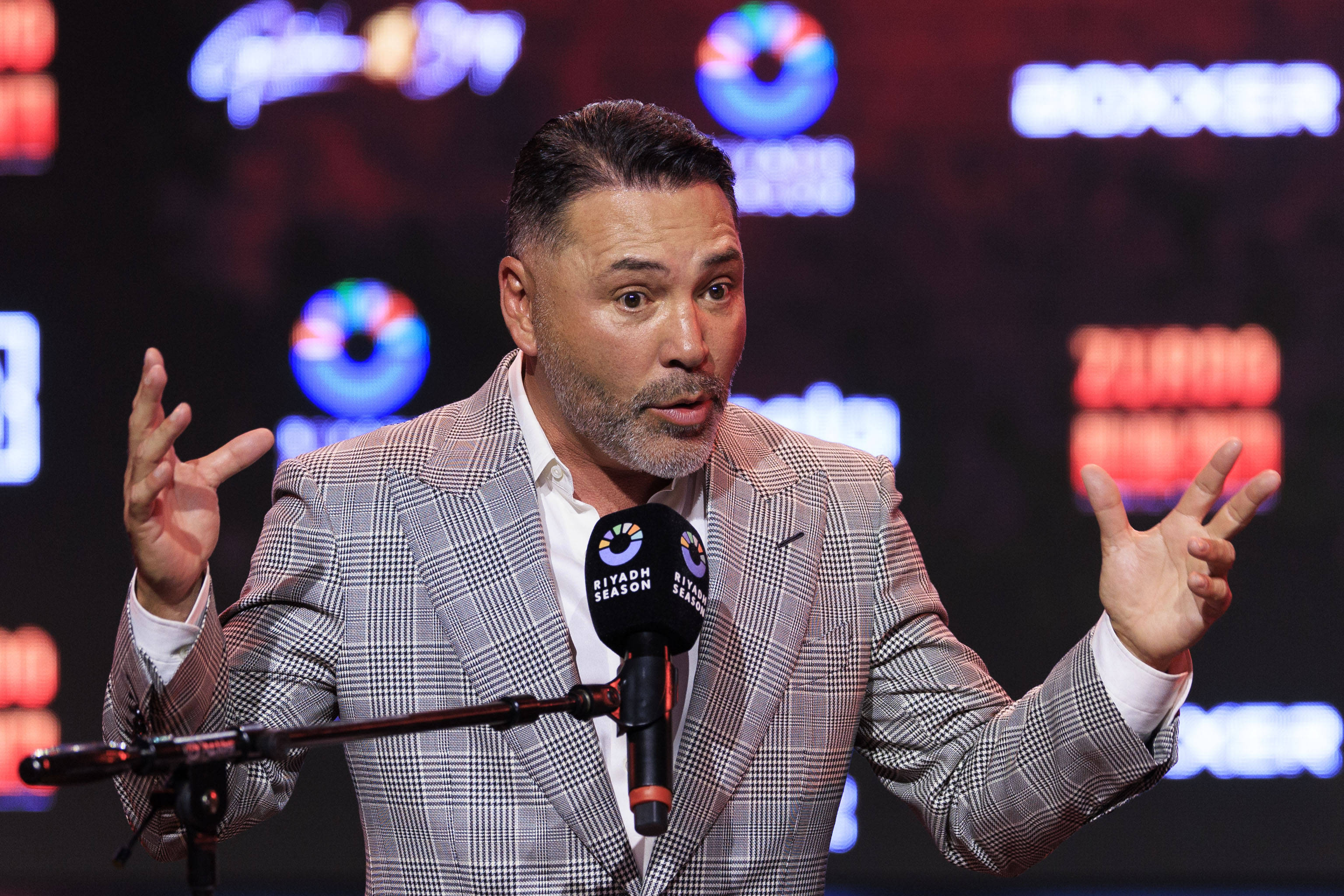
In comments released on October 15 and widely reported on October 16, De La Hoya challenged the decision to keep the Canelo–Mbilli event in Riyadh after attacks on the city's airport. He focused on the difference between a superstar's individual choice and the circumstances of people who do not command the same resources. His point was not that Canelo lacks courage. It was that courage is not a substitute for an operational plan covering everybody connected to a major fight night.
De La Hoya questioned how trainers, cornermen, support personnel and fans would travel if the normal routes into the city were disrupted. He also criticized Turki Alalshikh, the Saudi official closely associated with the event, for praising Alvarez's determination while the wider safety question remained unresolved. Some of De La Hoya's language was combative, and his claims about private-airport arrangements and media influence are allegations, not independently established facts. They should be understood as his criticism rather than treated as verified descriptions of the event's logistics.
Even with those qualifications, the underlying distinction matters. A headliner can decide that a personal risk is acceptable. A fighter on an early undercard, a cutman or a camera operator may face a very different choice if turning down an assignment costs a payday or professional opportunity. A fan who has booked international travel has still another set of considerations. A promoter must consider all those groups separately, including evacuation options, accommodation, insurance, transport and what happens if the security picture changes after everyone has arrived.
De La Hoya's intervention adds a fresh dimension to a story that had previously centered on whether Alvarez himself would fight. The question now is whether the organizers can demonstrate that the whole card can take place responsibly, not merely whether the main attraction is willing to appear.
Canelo's Commitment Is Not the Same as a Security Guarantee

Earlier in the week, Alalshikh said Alvarez had personally confirmed that he intended to proceed with the October 31 bout. That assurance kept the sporting plan intact at a moment when the event's location was attracting unusually intense scrutiny. The fight is scheduled for Riyadh, with Mbilli's WBC super-middleweight championship at stake. As of October 17, there has been no verified announcement in the sources reviewed here that the contest has been moved or canceled.
But an athlete's commitment and an event's readiness are two different things. Promoters must account for venue operations, international arrivals, emergency access and the practical ability of television crews and medical personnel to perform their work. Reports of strikes affecting King Khalid International Airport make those questions more than theoretical. The U.S. mission in Saudi Arabia has urged Americans to remain vigilant because of the possibility of aerial attacks. Such warnings do not automatically prohibit a sporting event, but they do mean that normal assumptions about travel and contingency planning deserve renewed scrutiny.
There is already a comparison from another sport. The Six Kings Slam tennis exhibition, originally due later in October, was postponed to late December following the security deterioration. That does not establish that boxing must take the identical decision: different dates, venues and risk assessments can produce different outcomes. It does show that moving a high-profile event is a real option rather than an unimaginable concession.
The responsible next step would be clarity about the protections available to everyone involved, and the thresholds that would trigger a relocation or postponement. Those details have not been publicly established by the reporting used for this article. It would be premature to claim either that the event is safe or that it cannot possibly proceed. The defensible position is narrower: the event remains planned, serious questions have been raised, and the final judgment depends on facts that may evolve before October 31.

Their Long Feud Makes the Message Louder, Not Automatically Wrong

There is no pretending that De La Hoya is a neutral observer of Alvarez's career. Golden Boy Promotions helped develop Canelo into one of boxing's defining commercial stars, but their relationship ended amid contractual litigation in 2020. The split was followed by public disagreements, including a heated exchange at a 2024 press conference. De La Hoya has also clashed with Alalshikh over the influence of Saudi investment and the direction of boxing's promotional business.
That history gives supporters of the Riyadh event an obvious reason to question the messenger. A critic with a long-running grievance may choose his words to inflict maximum reputational damage. De La Hoya's assertions about other parties' motives, private travel and control of media coverage require independent evidence; his personal disputes cannot supply it. The criticism should not be presented as an official risk assessment from a regulator, security service or organizer.
At the same time, pointing to the feud is not an answer to the substance of the concern. A disputed messenger can still ask a legitimate question. The relevant standard is whether the promoter has credible safeguards for the entire event and whether the people being asked to travel have enough reliable information to make informed decisions. Neither Canelo's record of fighting through adversity nor De La Hoya's history of confrontation settles those questions.
For Alvarez, the surrounding noise arrives during a consequential comeback. He has not boxed since his September 2025 defeat by Terence Crawford, and he subsequently underwent elbow surgery. Training under Eddy Reynoso is supposed to prepare him for an unbeaten champion whose aggression and work rate could make this a demanding return. That sporting challenge is real; so is the need to separate it from the arguments about where and when the fight should happen.
Moving the Fight Would Change the Logistics, Not the Stakes

Christian Mbilli is not an interchangeable opponent who can be dropped into another date without consequence. The 31-year-old champion has built his standing through pressure, volume and a willingness to fight at a pace that can trouble older opponents. He holds the WBC super-middleweight title after being elevated from interim champion status. Alvarez, 36, is attempting to regain a championship after losing his undisputed belts to Crawford. A successful return would put him back into the center of the division's title picture; a defeat could sharply alter the final chapter of his career.
The October 31 card also includes other announced title bouts and a substantial supporting operation. Changing its location would require renegotiating venue arrangements, travel, broadcast logistics and potentially the availability of fighters already in training. Postponement could mean additional camp costs, changed medical preparation and financial uncertainty for competitors who have structured their schedules around a single payday. Those are real complications, and they explain why promoters may be reluctant to alter the plan without a clear trigger.
None of that means the original venue must be defended at any cost. The sport routinely adjusts dates and sites for injuries, contractual disputes and broadcast considerations. A security-driven change would be disruptive, but disruption is a manageable business problem if compared with unacceptable danger. The key is whether organizers have a credible decision process, whether the relevant authorities and participants are consulted, and whether those bearing the risks are given transparent information.
De La Hoya has forced a difficult choice into the open: the October 31 event can remain on the calendar only if the practical conditions support it. The sporting prize will still matter if the fight moves. What cannot be assumed is that a champion's determination to enter the ring resolves the obligations owed to everyone who helps stage it.

De La Hoya's challenge is sharpened by his feud with Canelo and Alalshikh, but the safety issue is bigger than the personalities involved. Alvarez and Mbilli have a legitimate world-title fight to contest, and the October 31 date has not been formally abandoned. Those facts can coexist with uncertainty about whether Riyadh remains the right place to stage it.
The next meaningful development will not be another declaration of fearlessness. It will be evidence of a workable plan for fighters, crews and spectators—or a decision to move the show if the conditions demand it. Until then, the sensible distinction is between a fight that is still scheduled and an event whose full safety arrangements have not been publicly demonstrated.
















