

Sánchez and Ustero Were Dead and Buried — Then Came a 3h43 Kuwait Miracle
GOATIFYAri Sánchez and Andrea Ustero were a set down, 3-0 down in the second and two breaks behind. For most pairs, that is the point where a Major semi-final becomes an exercise in damage limitation. For the Spanish third seeds, it became the beginning of one of the wildest recoveries of their season.
On Friday, October 30, they beat Paula Josemaría and Bea González 4-6, 7-6, 7-6 at the Kuwait Major after approximately three hours and 43 minutes. They survived an opponent's game plan built to isolate Sánchez, transformed Ustero's performance in the middle of the match and escaped another deciding-set crisis to reach their third Major final of 2026. The score is dramatic enough. The tactical and psychological shifts behind it make the result even more revealing.
Josemaría and González Had a Plan — and It Worked Almost Perfectly
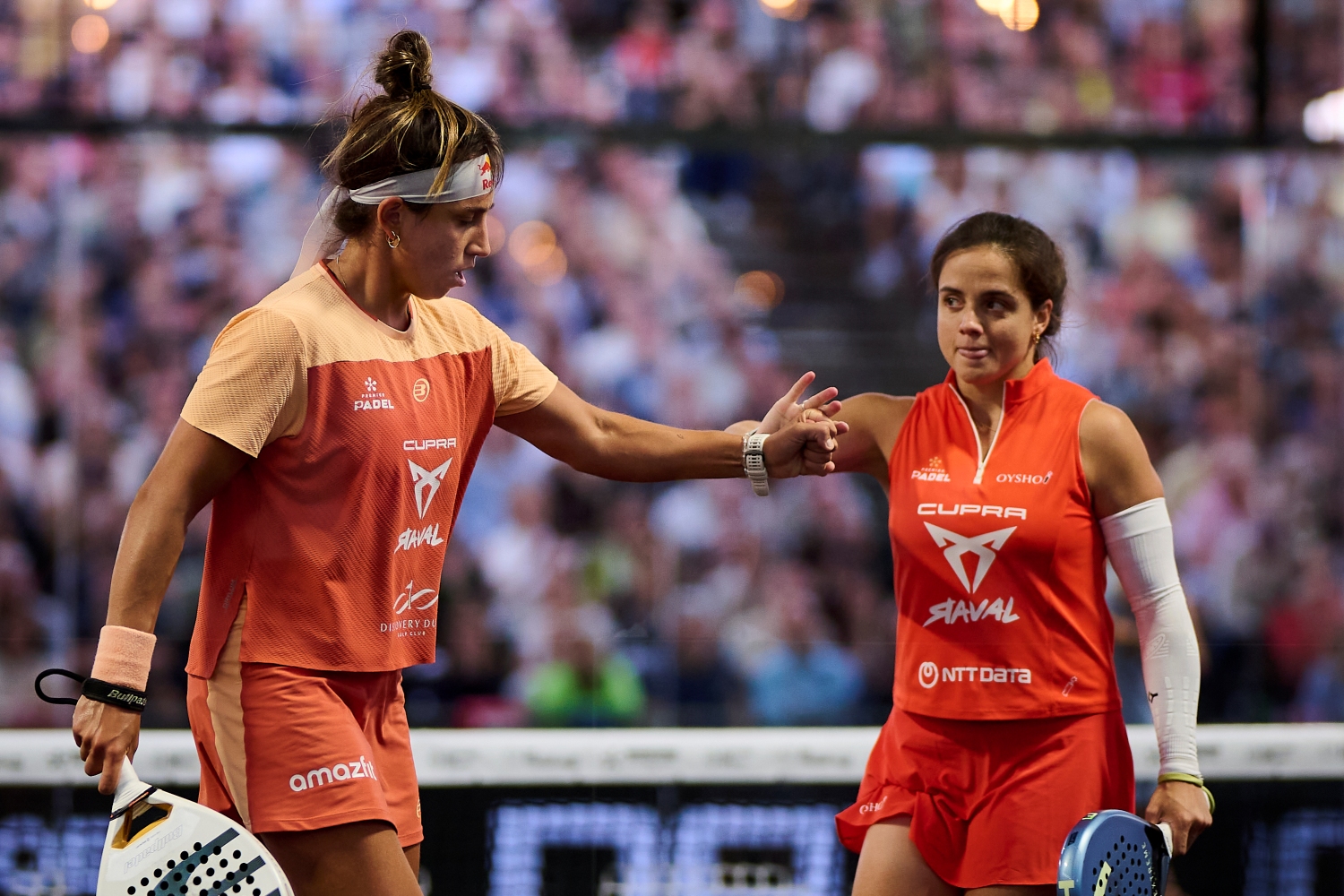
The first phase belonged to the second seeds. Josemaría and González understood the balance of the opposition: Sánchez supplies calm, placement and the ability to reset a point, while Ustero can turn an ordinary rally into a winner with a sudden acceleration. Their response was to make Ustero play an extraordinary number of difficult balls and keep Sánchez away from the action.
That is a demanding tactical assignment, not simply a matter of hitting toward one player. By directing repeated exchanges through Ustero's diagonal, the second seeds could test her decisions under pressure. In slower conditions, the teenager could not always use her smash to escape the pattern. When she tried to force the issue, errors arrived; when she waited, Josemaría and González retained control of the tempo. Sánchez, meanwhile, was deprived of the touches that normally help her organize the partnership.
It was also a smart way to test a young pairing's communication. When one player sees most of the ball and the other feels excluded, the risk is that both begin changing their positioning or shot selection in search of a solution. The partnership appeared uncomfortable during the opening stretch, and frustration was visible. Their opponents took the first set 6-4, then raced to 3-0 in the second with a double-break advantage. A routine straight-sets win looked entirely plausible.
But this is where the score can mislead. A lead created by an excellent plan is not automatically secure for the rest of a match. The plan still has to be executed point after point, and the targeted player gets time to recognize its rhythms. Once Ustero began reading the angles more cleanly, the same high-volume diagonal that had trapped her offered an opportunity to change the match herself.

Ustero Changed the Diagonal, and the Entire Semi-final Tilted

Ustero's recovery was not just about swinging harder. She began choosing better moments to accelerate, meeting the ball earlier and putting more purpose into her volleys. Her opponents had made her the central character of the contest; gradually, she turned that attention into an advantage. Instead of merely surviving the exchanges against Josemaría, she began influencing where they went next.
That change matters because a player under sustained pressure can either chase spectacular winners or rebuild the point from a stable position. Ustero's improved clarity gave Sánchez a way back into the match as well. The experienced partner could contribute without trying to seize every ball, and the pair recovered the coordination that had been missing at the start. Their comeback from two breaks down was built across multiple return games, not delivered by one lucky sequence.
On the other side of the net, González began to lose some of the sharpness that had made the opening so decisive. More mistakes and less consistent execution reduced the protection around the early lead. A 3-0 advantage with two breaks is enormous in professional padel, but it does not finish the job. The pressure shifts dramatically when the trailing pair suddenly starts winning games and the leaders realize the result they had pictured is slipping away.
The second set eventually reached a tie-break. Sánchez and Ustero won it to level the contest, turning a seemingly one-sided afternoon into a full test of nerve. For Ustero, this was the clearest answer to the opponents' opening challenge: the player they had targeted was now central to the comeback. For Sánchez, it was another demonstration of why an experienced partner can be most valuable when the younger player is struggling rather than when both are playing freely.
The psychological reversal was complete. Josemaría and González still had the talent and the tactical tools to win, but they no longer had the uncomplicated control they enjoyed at 6-4, 3-0. They had to solve a moving target while carrying the knowledge that an apparently decisive lead had vanished.

The Decider Became a Break-for-Break Survival Contest

The final set refused to follow a normal script. Sánchez and Ustero struck first with a break, only for Josemaría and González to respond. Momentum kept changing hands, and neither pair could make a lead feel permanent. In a match with so many return-game swings, the usual assumption that holding serve would protect an advantage became unreliable. Every service game felt exposed.
The second seeds even moved ahead 4-2 in the decider, creating another opportunity to shut the door. Yet Sánchez and Ustero recovered again. A crucial Sánchez volley helped bring them back within reach, and Ustero then held to restore parity at 4-4. The same duo that had looked tactically lost early in the afternoon was now finding answers in the most important moments.
That is what made this comeback different from a simple burst of form. The third seeds had already survived one crisis in the second set, then had to repeat the exercise when the match appeared to be escaping them again. Fatigue had become a real factor after more than three hours. Precision on the easy-looking ball, the choice between patience and attack, and the willingness to play one more defensive shot all carried an additional cost.
The deciding tie-break supplied one final reversal. Sánchez and Ustero established a 4-1 advantage, only to be dragged back to 4-4. Two mistakes from Josemaría gave them match points at 6-4, and Sánchez's shot off the back glass forced the final error into the net. The tie-break finished 7-4, ending a 4-6, 7-6, 7-6 epic.
There are matches in which the winner plays the cleaner padel for most of the afternoon. This was not one of them. The losers controlled long stretches and had repeated opportunities to close it out. The winners earned their place by adjusting, enduring and refusing to treat the scoreboard as a verdict. The distinction matters: Sánchez and Ustero did not dominate this semi-final; they survived it and ultimately took command of the moments that decided it.
One of the hardest adjustments in a deciding set is knowing when not to chase the momentum that has just been won. Sánchez and Ustero had already experienced the danger: a break at the start of the third set did not survive the immediate response. They could not treat every point as a chance to finish the match with one spectacular shot. Against two opponents capable of changing direction at the net, a measured rally could be more valuable than a desperate winner.
The final tie-break exposed the same tension in miniature. A 4-1 lead was not safe, and when the score reached 4-4 the entire contest was compressed into a handful of decisions. The two errors that handed Sánchez and Ustero match points were not a verdict on the quality of Josemaría and González; they were the kind of mistakes that become more likely after hours of pressure, movement and repeated changes in momentum. Sánchez's last intervention mattered because it forced one more difficult response rather than requiring a miracle winner.

A Third Major Final — and a Physical Bill That Cannot Be Ignored

The reward is a third Major final of the season. Sánchez and Ustero were runners-up at the Italy Major and champions at the Paris Major, where their partnership delivered one of its defining successes. Now Kuwait offers the possibility of a second Major crown in 2026. That is a remarkable platform for a team built around the contrast between Sánchez's experience and Ustero's explosive, still-developing game.
The victory also changes a rivalry that has become one of the women's circuit's most compelling storylines. Before Kuwait, these pairs were level at four wins apiece in eight meetings during 2026. Sánchez and Ustero now lead 5-4 and have beaten Josemaría and González three times in succession, including the Rotterdam P2 and Milan P1 finals. That sequence is particularly striking because Sánchez and Josemaría were formerly partners at the very top of the sport. Their meetings now pit familiar instincts against new combinations.
For the second seeds, the result will be painful precisely because the initial strategy was so effective. They did not lose because they arrived without a plan. They lost after executing it brilliantly and then failing to respond decisively when their opponents adapted. The margin in a third-set tie-break is tiny, but the consequences for confidence and the year-end race can be substantial.
There is an equally important warning for the winners. Their quarter-final against Tamara Icardo and Claudia Jensen lasted two hours and 53 minutes, and the semi-final added another three hours and 43 minutes. That is approximately six hours and 36 minutes of competitive padel across two matches before the championship contest. The next opponents may try to make that accumulated load a weapon by extending rallies and testing recovery between points.
That physical bill is the price of the comeback. Sánchez and Ustero will enter the final with enormous belief, but belief cannot substitute for fresh legs, sharp reactions and disciplined shot selection. Their best version is not necessarily the one that scrambles out of impossible situations. It is the one that uses the lessons from Kuwait to avoid creating them in the first place.
There is also a broader lesson for the race at the top. The leading women's pairs know one another's patterns so well that a successful tactic can become predictable within the same match. Repeated meetings reward the partnership that can change its approach without losing trust. Kuwait gave Sánchez and Ustero evidence that they can do exactly that, even when their first plan has collapsed. The final will test whether they can produce the same adaptability without needing another exhausting escape.
Friday's semi-final was a lesson in why elite padel cannot be reduced to a ranking, a tactical diagram or even a two-break lead. Josemaría and González controlled the opening and came close to finishing the job twice. Sánchez and Ustero absorbed the punishment, found a different rhythm and kept finding their way back when the match seemed gone.
The 2026 Kuwait Major now has a finalist who has survived more than six and a half hours on court in two rounds and strengthened one of the sport's defining rivalries. If Sánchez and Ustero can recover in time, this extraordinary escape may become the foundation of another Major title. If not, the physical cost of getting there will be the story of the final.
Shop GOATIFY padel products from the Padel-filtered collection scope.

















