How Strong Could a Hulk-Sized Human Actually Become? Muscle, Tendons and Physics
UPLIFT IRON CLUBThe Square-Cube Law Is Hulk's First Real Opponent

If we take Hulk out of comics for a moment and give him ordinary human tissue, the first problem is geometry. A human who becomes taller in roughly the same proportions does not simply become “the same athlete, but bigger.” Linear dimensions increase once, cross-sectional areas increase with the square of that change, and volume—and therefore mass—rises with the cube. That mismatch is the core of the square-cube law.
The University of Wisconsin’s biomechanics treatment makes the strength implication unusually clear. If muscle’s maximum stress stays broadly similar, the maximum force available from a geometrically similar muscle scales with its cross-sectional area, roughly L². Body mass and weight scale roughly L³. So absolute force goes up, but strength relative to bodyweight goes down. Double every linear dimension and the simplified model gives four times the muscle force but roughly eight times the body mass.
That does not mean a huge human would be weak. Quite the opposite: the person could produce enormous absolute forces because the muscles would have huge physiological cross-sectional areas. But ordinary tasks would consume a larger fraction of that force. Standing up, accelerating the limbs, catching a stumble and changing direction all get more expensive. This is why smaller animals can perform feats relative to bodyweight that would be absurd for a geometrically scaled-up version of themselves.
Real humans are not perfect scale models. Muscle architecture, limb proportions and bone geometry change with body size. A 2024 analysis of human lower-limb muscles found that larger humans devote architecture disproportionately toward force production rather than simply scaling every dimension identically. That is a useful reminder that biology adapts. It is not, however, a loophole that lets mass disappear.
For a Hulk thought experiment, the takeaway is simple: making the body enormous gives you a terrifyingly high absolute ceiling, but every extra centimetre brings a mass bill that force production cannot pay at the same rate. Comic-book Hulk ignores that bill. A biological Hulk would spend much of his new strength just controlling his own giant body.

More Muscle Means More Force—but Force Has a Biological Price

Muscle force is more than a visual question of how much meat is on a limb. The important structural measure is physiological cross-sectional area: broadly, how much contractile tissue is arranged in parallel to pull. A systematic review published in the Journal of Applied Physiology describes muscle specific tension as maximum force per cross-sectional area and, after weighting the quality of human studies, recommends about 26.8 newtons per square centimetre as a useful best estimate for human muscle.
That number should not be treated as a magic calculator for Hulk’s deadlift. Joint torque also depends on moment arms, architecture, activation, tendon compliance and technique. But it tells us something important: human muscle does not become infinitely “stronger per square centimetre” just because we make the person bigger. If Hulk is made from ordinary human contractile material, spectacular force requires spectacular cross-sectional area.
There is another catch. Recent modelling work points out that a muscle has to accelerate some of its own mass. Under geometric scaling, force capacity grows roughly with L² while the tissue mass being accelerated grows with L³. At very large sizes, the muscle is not only moving the bar, car or opponent; it is paying an increasingly large internal inertia cost simply to move itself quickly.
This helps explain why “strong” and “explosive” are not interchangeable. A hypothetical giant could produce extraordinary slow force yet struggle to express equally extraordinary limb acceleration. The fastest punches, jumps and changes of direction demand force in a short time, and a gigantic arm contains a gigantic amount of tissue that has to be accelerated and then decelerated safely.
Human architecture does adapt toward force as bodies get larger, which makes the real picture more generous than the crudest square-cube cartoon. Larger muscles can pack more fibers in parallel, and trained people can add cross-sectional area far beyond average. Still, the governing material remains muscle. A Hulk-sized human can become brutally strong by human standards without gaining a fictional new kind of contractile tissue. To reach comic Hulk territory, the physiology itself would have to change—not merely the dimensions.

Bones, Tendons and Joints Become the Next Bottleneck

Even if we give our giant human enough muscle to create massive force, that force has to travel somewhere. Muscle tension is transmitted through connective tissue into tendons, across joints and into bones. A system is only as useful as the structures that can repeatedly transmit the load without failing.
Bone is not passive scaffolding. Its cross-sectional geometry strongly influences axial, bending and torsional strength, and skeletons adapt to habitual loading. Research on modern human long bones shows that mechanically meaningful measures of bone strength scale with body mass and limb dimensions rather than remaining fixed. A larger person can therefore have thicker, more robust bones than a simple photograph enlarged in Photoshop would suggest.
But adaptation is not invulnerability. The limb is a lever. A longer bone increases the distance over which forces can create bending moments, while the heavier segment raises the loads involved in stopping, landing and changing direction. If a Hulk-sized person tried to move like a normal-sized explosive athlete, joint and bone loads would become extreme very quickly.
Tendons deserve even more attention because they sit between force-producing muscle and bone. Their collagen structure is excellent at transmitting tension and storing elastic energy, yet tendon adaptation is slower and more constrained than the fantasy version of “add muscle and everything else catches up.” At the tendon-to-bone attachment, material properties transition gradually from compliant tendon toward stiff mineralised bone. That gradient exists because abruptly joining materials with very different stiffness is mechanically difficult.
For lifters, the miniature version of the same lesson is familiar: muscular strength can rise faster than connective tissues feel ready for, especially when loading jumps suddenly. For a giant human, the problem scales into the centre of the design. Thickening bones and tendons helps, but doing so adds still more mass. Enlarge the joints to distribute load and you alter limb geometry. Reinforce every structure and the body becomes heavier again.
So a biologically plausible Hulk would probably look less like a normal bodybuilder enlarged five times and more like a heavily engineered strongman: disproportionately robust joints, massive tendon cross-sections, broad bones and movement choices that respect those structures. Comic Hulk gets to smash through the floor. Human Hulk has to worry about whether the floor—and his ankles—can tolerate the impact.
Why a Giant Can Be Stronger and Still Move Worse

Hulk is not merely strong on screen. He accelerates a huge body explosively, jumps extraordinary distances and changes direction while throwing objects that weigh more than cars. Those are much harder abilities to preserve during biological scaling than slow maximum force.
Acceleration follows the familiar relationship between force and mass. As body and limb mass climb, more force is required to create the same acceleration. A giant thigh can generate much more force than an ordinary thigh, but the leg it must swing is also dramatically heavier. Recent muscle modelling makes this internal inertia explicit: muscle tissue itself becomes part of the load that active fibers have to accelerate.
That is one reason large strength athletes are a better real-world analogy for a human Hulk than elite gymnasts. Strongmen can produce staggering absolute force, carry enormous implements and move vehicles, but the events reward controlled acceleration, leverage and technique rather than the relative-strength acrobatics of a much lighter athlete. The human body can be optimised toward huge force, but every design has trade-offs.
Speed also magnifies the structural problem. Fast movement requires not only accelerating a heavy limb but decelerating it. Land from a jump and the skeleton must absorb the momentum of the whole body. Swing a huge arm at high speed and the shoulder has to manage that limb through the end of the range. A theoretical Hulk who retains human tissue might therefore be most impressive in slow or moderate-speed strength tasks: pulling, carrying, pushing and bracing.
None of this means large athletes must be slow. Real strongmen sprint, jump and carry loads surprisingly well for their mass, while throwers and heavyweight combat athletes can be highly explosive. The point is relative: preserving the same agility while multiplying total body dimensions is physically expensive.
A plausible giant-human training style would probably prioritise force production with carefully controlled velocity, enormous trunk stiffness, efficient footwork and tasks that keep the centre of mass manageable. Comic Hulk can leap between buildings because the story supplies whatever power-to-weight ratio is required. A human Hulk would likely be frighteningly powerful across the ground—and much less interested in testing his landing mechanics from the roof.

So What Could a Human Hulk Actually Lift?

There is no honest single-number answer because we have not specified the giant’s height, mass, proportions, muscle cross-sectional area, tendon dimensions, bone geometry or technique. But the constraints let us sketch the shape of the answer.
First, a Hulk-sized human would almost certainly be absolutely stronger than a normal-sized human. More physiological cross-sectional area means more potential muscle force. If the skeleton and connective tissues scaled adaptively rather than as a naive enlargement, the person could handle forces far beyond ordinary elite lifters. The real-world existence of enormous strongmen already shows how far human absolute strength can move while staying inside recognisably human biology.
Second, the giant would not be proportionally as strong as the comics imply. In the simplest geometric model, doubling linear scale gives roughly four times force capacity but eight times mass. Real anatomy can partially compensate through different proportions and muscle architecture, but it cannot make L³ stop being L³. If the body became three times taller while remaining geometrically similar, the naive model would imply roughly nine times muscle force against about twenty-seven times the body mass.
Third, maximum strength would probably be expressed best in tasks that minimise violent accelerations: heavy pulls, pushes, carries and static bracing. A specially built bar and platform might let the athlete move loads that dwarf modern records. That is very different from casually lifting a tank overhead, swatting away a flying vehicle or jumping kilometres. Those feats require not only force but impossible power-to-weight, materials and energy delivery.
And that is the dividing line between “huge human” and “Hulk.” Comic Hulk is allowed to change the material rules. His muscles, tendons, bones and energy system behave as fictional super-materials, and many versions make his strength increase with rage. A giant biological human does not get those upgrades for free.
The fun conclusion is that physics does not make a human Hulk boring. It makes him a different kind of monster: massive, exceptionally hard to move, built around thick load-bearing structures and capable of extraordinary absolute strength. He just would not scale like a videogame slider. The larger he becomes, the more of his superhuman-looking muscle is spent solving the mundane engineering problem of being enormous.

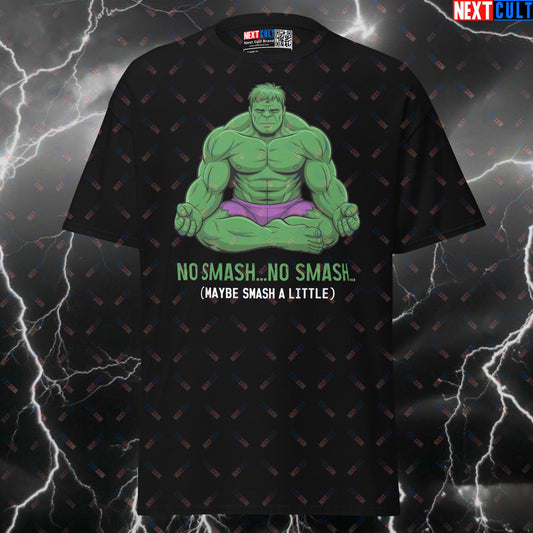
Superhero-inspired gym shirts and workout gear for lifters chasing comic-book strength and muscle.
EXPLORE COLLECTION