

Medvedev Gave Cobolli Zero Break Points. Alcaraz Is Next.
GOATIFYDaniil Medvedev's first ATP Finals match in two years looked tense on the scoreboard and remarkably comfortable every time he stepped up to serve. Flavio Cobolli, playing his first match at the season-ending event in front of an Italian crowd, dragged the opening set into a tie-break. Medvedev still walked away with a 7-6(4), 6-3 victory on Monday, November 16, without conceding a single break point across ten service games.
That distinction is the story. Medvedev did not overwhelm Cobolli with constant spectacular winners. He created a match in which his opponent repeatedly faced danger while he rarely had to defend his own serve. Cobolli rescued six of eight break points overall, including five before the opening tie-break, but he could not manufacture even one chance against the Russian's delivery. The result put Medvedev alongside Carlos Alcaraz at 1-0 in the Ivan Lendl Group.
Wednesday, November 18, brings their direct meeting. Alcaraz just opened his own Turin campaign by beating Frances Tiafoe 6-2, 6-2. This is not a guaranteed path to the semifinals for either man; round-robin standings can still change quickly. But Medvedev has established an intriguing opening position: his serve can remove the usual pressure from his baseline game, provided it remains just as sharp against a returner far more likely to make him play extra balls.
Ten clean service games made every Cobolli hold feel temporary
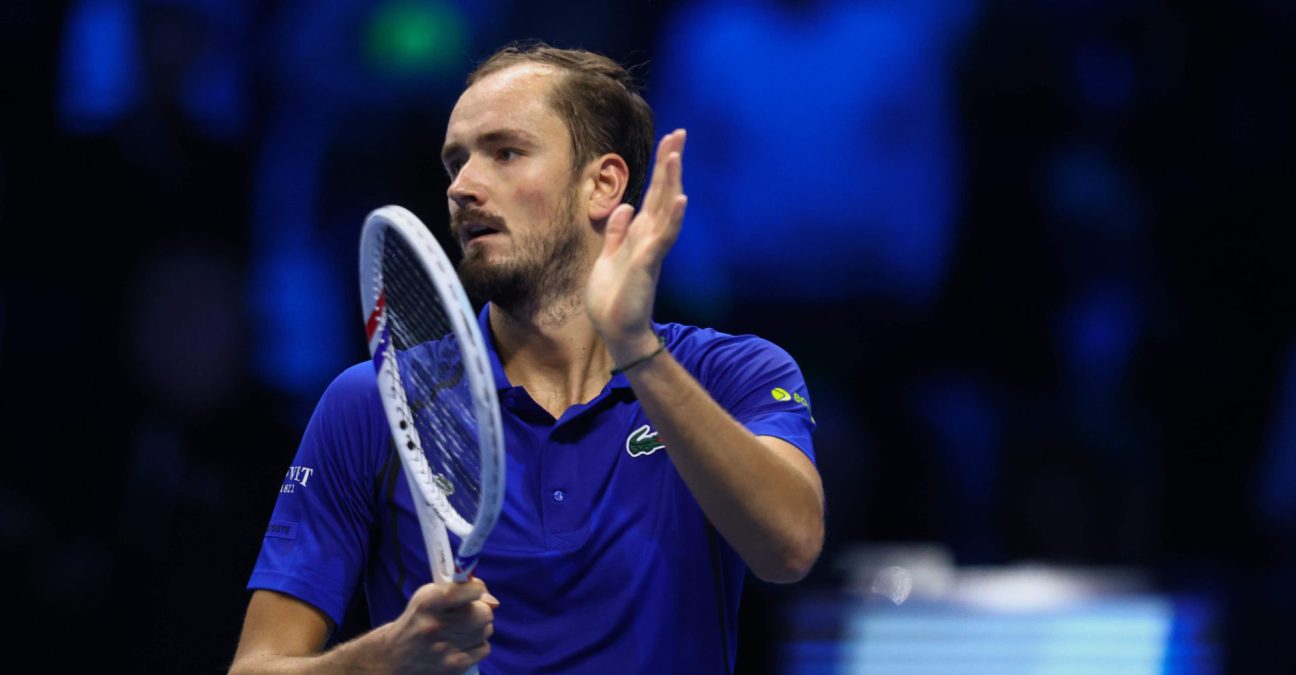
The easiest way to misunderstand a 7-6 first set is to assume the two players were equally close to controlling it. Cobolli was competitive, brave and often inventive. Yet their service games had very different levels of security. Medvedev held every time he served. Cobolli regularly had to play an extra point or produce a daring shot merely to keep the set level. One player was accumulating pressure; the other was surviving it.
Medvedev won 34 of his 41 first-serve points, an 83 percent conversion rate. His nine aces helped, but the figure that matters more is the absence of even a single break point faced. A serve does not need to land untouched to be effective. On a quick indoor hard court, a well-placed first delivery can force a short return, create a manageable first groundstroke, or make the receiver feel compelled to take a risky swing before the rally has properly started. Medvedev exploited that pattern throughout the evening.
He did hit three double faults, so this was not a mechanically perfect performance. The crucial difference was that his mistakes did not arrive in clusters big enough to let Cobolli threaten a service break. Medvedev could start return games knowing that an unsuccessful attack was unlikely to put his own position in danger. That psychological asymmetry becomes especially uncomfortable for an opponent serving with an expectant home audience behind him.
The match-point totals reinforce the balance. Medvedev won 70 points to Cobolli's 55, a fifteen-point margin across two sets. He finished with 17 winners against Cobolli's 14 and slightly fewer unforced errors, 18 to 20. Those are useful indicators, not a substitute for watching the patterns: Medvedev did not need an overwhelming winners advantage because his serve consistently supplied favorable rally beginnings.
GOATIFY
GOATIFY Tennis
Shop GOATIFY tennis products from the Tennis-filtered collection scope.


It also explains why the second set looked less dramatic than the first. Cobolli kept hanging on until the seventh game, but each new service hold demanded another escape. When the first break finally came, Medvedev was not suddenly discovering a tactic. He had been applying it from the opening set. His reward was a chance to serve from ahead rather than merely hold level, and he used it to accelerate toward the finish.
Cobolli survived the danger five times before a tie-break finally broke him
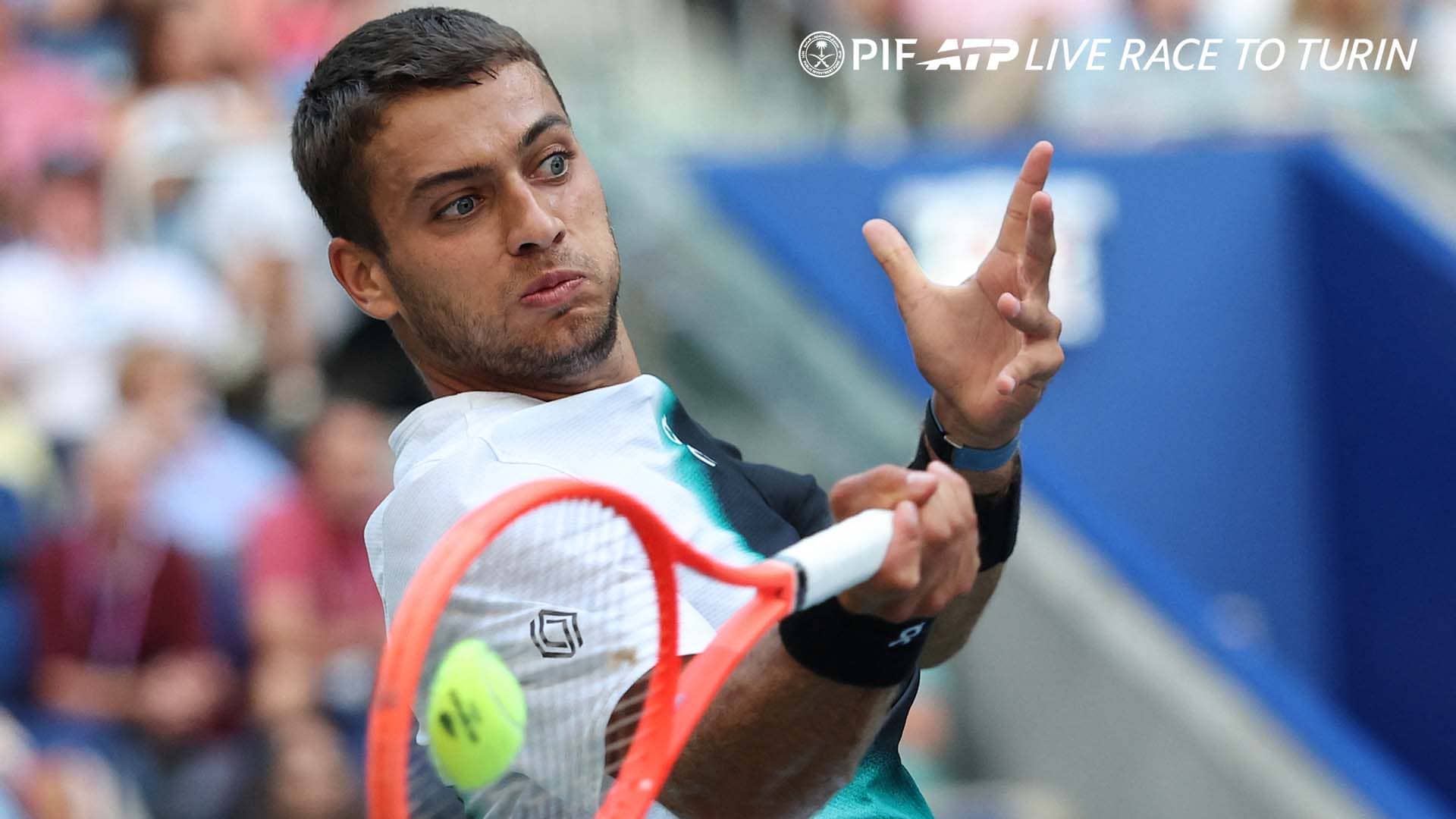
Flavio Cobolli deserves more than a sentence about being overmatched. His first ATP Finals appearance came against a former champion with an almost untouchable serve, on a court where the margins can disappear in a single point. He still fought to save two break points at 2-2 and three more at 4-4 in the opening set. At those moments, the Italian had to combine aggressive shot-making with enough composure to avoid offering easy errors.
There was a particularly telling escape when Cobolli produced an ambitious backhand passing shot under break-point pressure. The crowd responded because it was the sort of moment that can transform the energy in an arena. Yet saving a break point is not the same as gaining control of a match. Medvedev's next service game could still be completed without meaningful danger, leaving Cobolli obliged to perform another rescue act shortly afterward.
That is how a tie-break can become a deceptively narrow ending. Cobolli had avoided losing his serve throughout the first set, but he had not forced Medvedev into a comparable crisis. In the breaker Medvedev struck first for 2-0, surrendered the miniature advantage, and then edged ahead again. The 7-4 conclusion was close enough to acknowledge the Italian's resistance, while still reflecting which player had enjoyed the more reliable platform.
In the second set, Medvedev finally converted the return pressure into actual breaks. After games stayed on serve through 3-3, Cobolli lost his delivery in the seventh game. Medvedev then held for 5-3 and broke again to finish. The Italian saved one match point but could not survive the next. Across the match Cobolli saved six of eight break points; his defensive record was admirable, but Medvedev created too many opportunities for that ratio to hold forever.
The bigger picture should not erase Cobolli's progress. His 2026 included the sort of results needed to reach this elite eight-player field, and arriving in Turin as an Italian debutant is a landmark in itself. He had also endured a pause after retiring from a match in Vienna in October. A difficult opening loss against Medvedev does not undo those achievements. With Frances Tiafoe next on Wednesday, however, Cobolli must find a way not merely to save his serve but to put consistent return pressure on an opponent. In round-robin tennis, the response matters almost as much as the setback.
GOATIFY
GOATIFY Tennis
Shop GOATIFY tennis products from the Tennis-filtered collection scope.


Tennis GOAT Golden Racket & Ball Decal Sticker
Add tennis personality to your favourite gear.
Shop Now ↗

Tennis GOAT Golden Racket & Ball Crewneck Sweatshirt
A tennis fan design for everyday wear.
Shop Now ↗Missing Turin in 2025 changed what Medvedev's 2026 comeback means

Medvedev's win is also more significant because he was not here a year ago. For six consecutive seasons from 2019 through 2024, he had qualified for the year-end championship. Missing the event in 2025 interrupted that run and raised a reasonable question about how quickly a former world No. 1 could return to the level of the tour's most consistent performers. This week's appearance is his seventh overall, not simply another automatic entry.
The answer arrived in stages during 2026. Medvedev built a four-title season, winning in Brisbane, Dubai, Hangzhou and Almaty, then secured his place in Turin after defeating Adrian Mannarino during the Vienna tournament. By the time the season finale began, he had compiled 53 tour-level victories, second on the ATP Tour behind Alexander Zverev's reported 66. Those wins represent accumulated reliability across different weeks and conditions, not one isolated hot streak.
Medvedev's 2020 ATP Finals title gives him a different kind of credibility in this building. That championship run involved victories over Novak Djokovic, Rafael Nadal and Dominic Thiem, three opponents who demanded very different answers. He reached the title match again in 2021 before losing to Zverev. That past experience cannot win a point in 2026, but it helps explain why he did not panic when Cobolli's crowd made each saved break point feel like a breakthrough.
His first match back was particularly appropriate for the version of Medvedev who has always been awkward to solve. At his best he combines a difficult-to-read serve, deep positioning on return, flat groundstrokes and a willingness to extend rallies until an opponent tries too much. His season has not been identical to his peak years, and it would be premature to declare him the favorite for the whole championship after one opening win. It is fair to say that the foundations of his recognizable game were present in Turin on Monday.
There is an important difference between qualifying and contending. A season-long points total earns access to the tournament; successful group tennis requires immediate precision against opponents who have also spent the year winning regularly. Medvedev passed the first test by controlling his own service games and making Cobolli work. The next test removes the comfort of facing a debutant, because Alcaraz already has proof that he can dominate the same court and group. That is where Medvedev's comeback becomes more than a feel-good qualification story.
Alcaraz is not Cobolli: Wednesday demands more than a locked-down serve
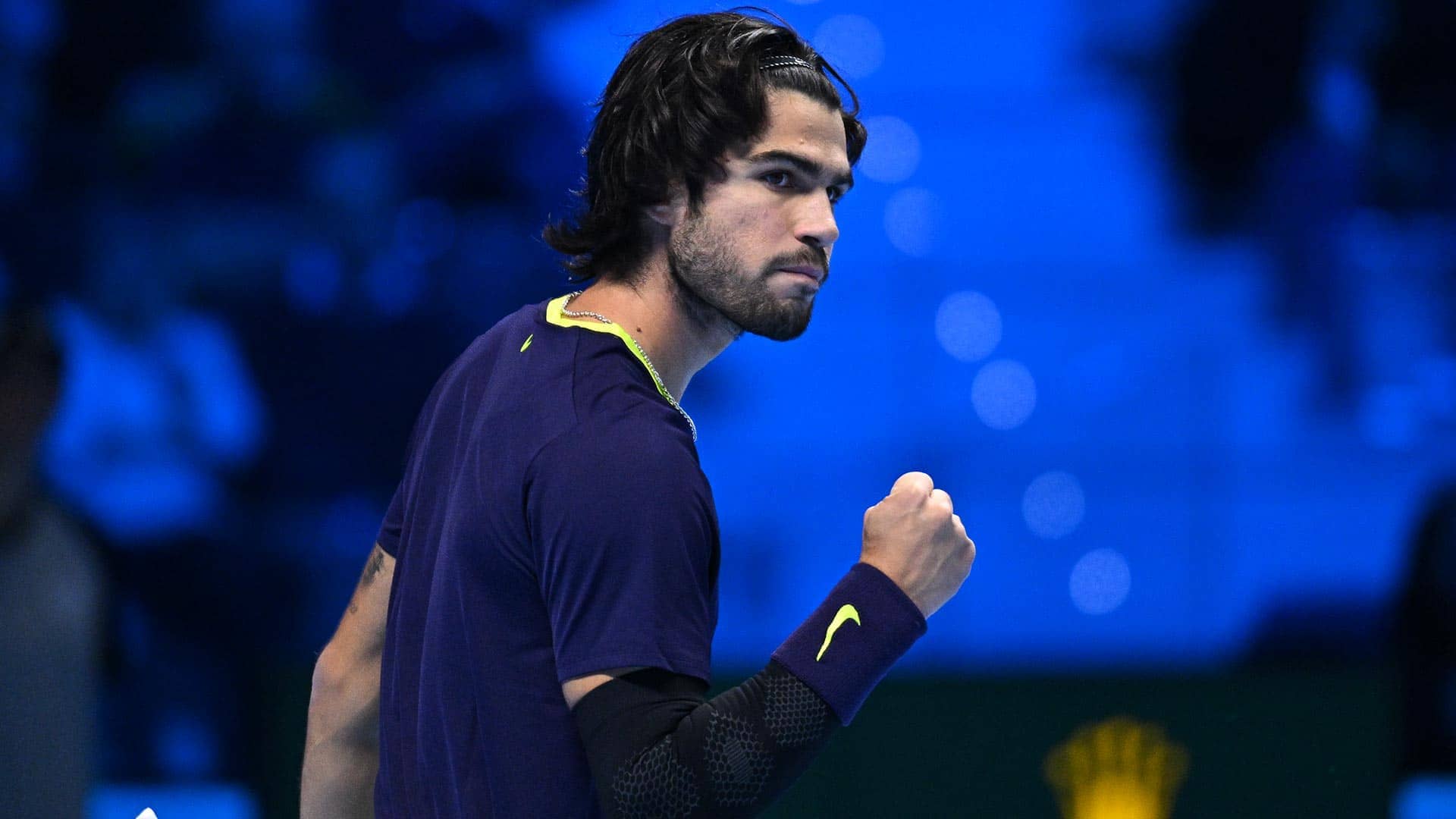
Medvedev can take enormous confidence from facing zero break points against Cobolli, but Carlos Alcaraz offers a different test. The Spaniard opened his 2026 ATP Finals with a 6-2, 6-2 win over Frances Tiafoe in just 69 minutes. That result is not a mathematical prediction for Wednesday; opponents and matchups differ. It is a warning that Alcaraz arrived in Turin ready to attack from the first return game rather than spend an entire set waiting for an opening.
GOATIFY
GOATIFY Tennis
Shop GOATIFY tennis products from the Tennis-filtered collection scope.


Against Cobolli, Medvedev could often make the first serve the defining stroke. Against Alcaraz he may have to win more neutral rallies after decent returns come back into play. Alcaraz can redirect pace, change direction earlier in a point and turn a defensive position into an attacking one. The Russian's serve will still matter enormously, particularly on a quick indoor surface, but the percentage of first-serve points won against one opponent should not be projected mechanically onto another.
There is a credible route for Medvedev. His flat, deep groundstrokes can make it uncomfortable for even the most athletic players to improvise, especially when the ball arrives early and consistently to difficult positions. A quick indoor court also limits how much time Alcaraz has to use his movement and variety. Medvedev's ideal match is not a highlight-reel exchange every second point. It is one where he holds routinely, returns deep enough to deny easy first attacks, and forces Alcaraz to play long spells without the simple change of pace he prefers.
The danger is that Alcaraz can make a single return game feel different from all the others. One aggressive second-serve return, a sharply angled pass and an improvised point at the net can turn a 30-15 lead into break-point pressure. Medvedev therefore needs to protect his second serve and manage points when the first ball does not create an immediate advantage. His Cobolli performance demonstrated control, but it did not require him to recover from a service break or navigate a sustained crisis on serve.
Both players enter Wednesday at 1-0 in the Ivan Lendl Group, with Cobolli and Tiafoe also scheduled to meet after losing their openers. A victory would put the winner in a strong position; it would not automatically settle every semifinal permutation. That is what makes the meeting compelling. Medvedev's return has given him an opportunity to prove that his 2026 resurgence works against the very best. Alcaraz has a chance to show that his opening demolition of Tiafoe was the start of a serious title campaign. One of those stories gets the next chapter, not the final verdict, on Wednesday.
Medvedev's 7-6(4), 6-3 win over Cobolli was built on a simple but powerful advantage: every return game was a chance to attack while every service game was secure. He was not broken because Cobolli never reached a break point in the first place. The Italian's five early rescues and his determined first-set tie-break pushed the former champion, but they never turned the contest into an equal fight for service control.
The result matters for a player who missed the 2025 season finale and fought his way back with four 2026 titles. It also has a limit. Alcaraz brings a different speed of return, more ways to change a rally and his own emphatic opening win. If Medvedev serves this well again and adds pressure in the return games, a second Turin title becomes a discussion worth having. If the Spaniard finds the second serve and turns short points into long ones, Monday's impressive numbers may look less decisive. For now the match has delivered a clear answer about Medvedev's form—and an excellent question about his ceiling.
GOATIFY
GOATIFY Tennis
Shop GOATIFY tennis products from the Tennis-filtered collection scope.
Tennis GOAT Golden Racket & Ball Crewneck Sweatshirt
A tennis fan design for everyday wear.
Shop Now ↗


















