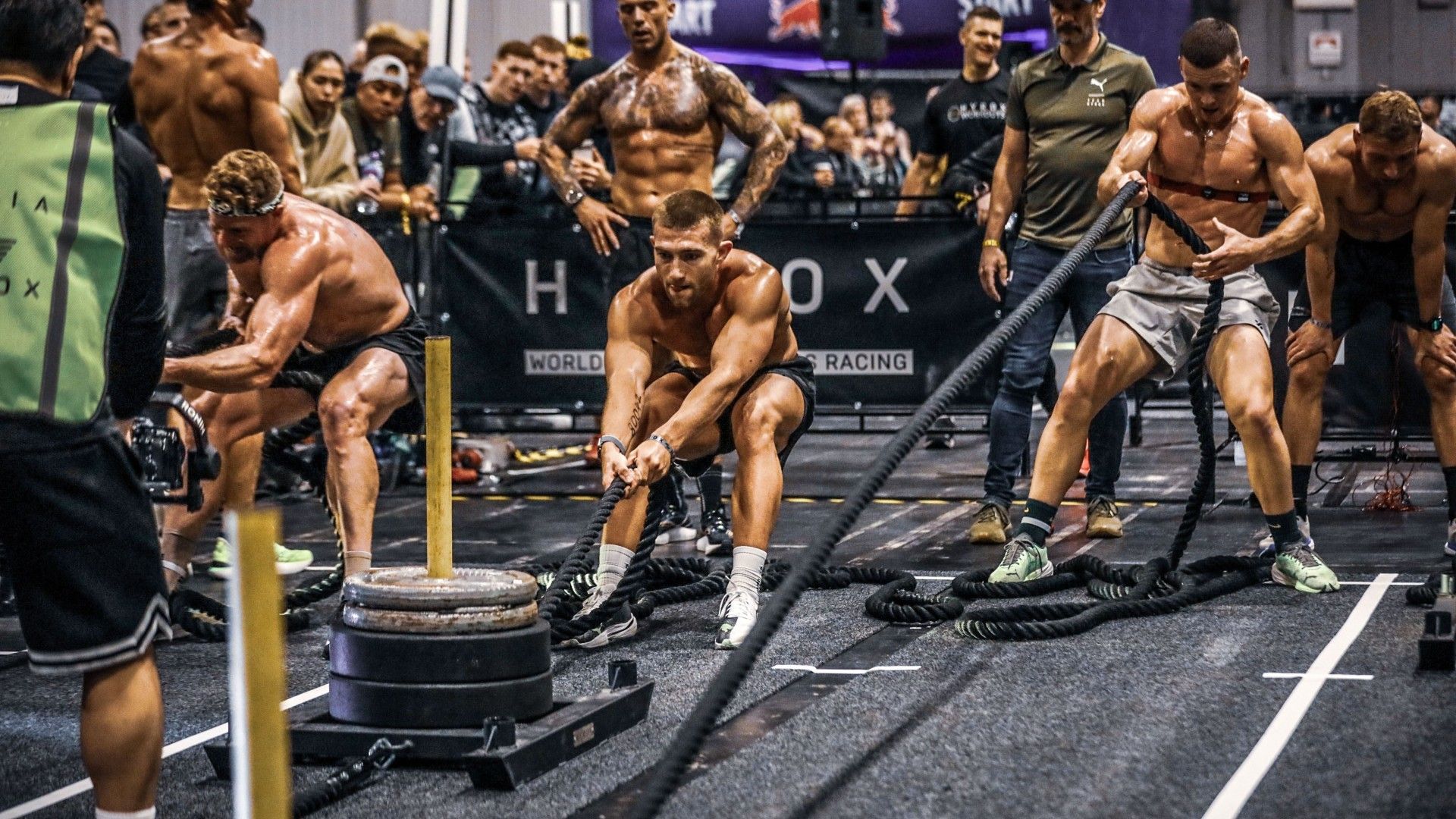
HYROX With Less Running? Inside the Hybrid Games’ 10-Station Fitness Race
UPLIFT IRON CLUBHybrid racing has spent the last few years teaching gym athletes a strange lesson: being strong is useful, being fit is useful, but being able to switch between the two while your heart rate is high is a separate skill. The Hybrid Games takes that idea and tweaks the familiar formula. Instead of eight long one-kilometre runs, it breaks the race into ten 600-metre runs, each followed by a different station, before a final 200-metre sprint.
That sounds like a small change. It is not. Shorter run blocks mean more transitions, more opportunities to attack a station hard, and less time for poor pacing decisions to disappear during a long kilometre. The result looks recognisably like modern hybrid fitness, but the demands are shifted toward repeatable power, station skill and the ability to settle quickly after each effort.
Here is what the current format asks for, how it differs from HYROX, and what a normal gym athlete should train if the race appeals to them.
What the Hybrid Games Format Actually Looks Like

The published format is simple enough to remember: run 600 metres, complete a station, repeat that sequence ten times, then finish with a 200-metre sprint. Across the race that works out to 6.2 kilometres of running, but the important detail is how fragmented that distance is.
The stations are unusually broad for this style of event. The sequence currently includes a 50-calorie air bike, 100 wall balls, a 1,000-metre row, 80 metres of burpee broad jumps, 50 dumbbell snatches, 100 metres of weighted lunges, a 200-metre farmers carry, a 60-metre sled pull, a 1,000-metre SkiErg and a 60-metre sled push. Men and women use different published loads for several stations.
That gives the race more movement variety than a simple run-and-machine test. There is cyclical conditioning, loaded locomotion, unilateral work, grip, explosive hip extension and enough squat volume to punish anyone who goes out too hard.

Less Running Than HYROX Changes the Race More Than You Think

HYROX is built around eight one-kilometre runs. The Hybrid Games keeps the run-station rhythm but shortens each running block to 600 metres and increases the number of stations to ten. That does not automatically make the race easier. It changes where fatigue accumulates.
A kilometre gives a strong runner time to settle into rhythm and potentially repair the damage from a mediocre station. Six hundred metres arrives and disappears much faster. If you leave a sled or a set of wall balls breathing through your ears, the next station can appear before you feel fully organised again.
That creates a premium on controlled acceleration. The athlete who sprints the first half of every run may gain seconds early and lose minutes later. A better strategy is usually to leave each station decisively, find a sustainable cadence quickly and arrive at the next movement capable of starting without a long recovery pause.
For athletes who enjoy hybrid racing but are less interested in a running-dominant contest, that distribution is part of the appeal. The running still matters, but strength endurance and station competence get more chances to influence the result.
The Extra Stations Reward Functional-Fitness Skill

Several movements will feel familiar to HYROX athletes, but the air bike and dumbbell snatch give the format a stronger functional-fitness flavour. Those movements reward technical efficiency, not merely a large aerobic engine.
On the air bike, aggressive early calories are expensive because both the arms and legs are contributing. On dumbbell snatches, a smooth hand change and repeatable hinge can save energy that a frantic pull wastes. Burpee broad jumps punish athletes who turn every jump into a maximal leap instead of choosing a distance they can reproduce.
This is where CrossFit-style training experience can transfer well. An athlete accustomed to switching movements under fatigue already understands the value of breathing patterns, transition discipline and choosing a pace that survives the whole workout.
But there is no need to turn every training day into a competition simulation. Technique is easier to improve when fatigue is controlled. Learn the station first, then practise maintaining it after running.

Grip and Loaded Movement Could Decide the Back Half

The back half contains a nasty combination: farmers carry, sled pull, SkiErg and sled push. By then the forearms have already handled rowing, dumbbell snatches and lunges. Grip that felt irrelevant in the opening kilometres can suddenly become the reason an athlete has to stop.
Farmers carries should therefore be trained as more than a grip exercise. Good posture, short efficient steps and controlled breathing let the whole body share the job. If the bells swing excessively or the shoulders collapse forward, each metre becomes more expensive.
Sled work creates a different problem. There is no perfect universal training load because turf friction changes dramatically between facilities. Practise the pattern and effort level rather than obsessing over matching a number in your gym. Strong quads and calves matter on the push; lats, trunk position and rhythm matter on the pull.

How to Train for It Without Turning Every Workout Into a Race

The temptation with hybrid events is to recreate the entire race every Saturday. That feels specific, but it can be a poor way to improve. The full format produces so much fatigue that technique gets sloppy and progression becomes difficult to measure.
A more useful week separates the qualities. Keep one or two genuine strength sessions built around squats, hinges, presses, pulls and loaded carries. Keep two aerobic sessions, with at least one mostly easy enough to accumulate volume. Add one race-specific session that combines 400-to-800-metre runs with two or three stations.
For example, three rounds of a 600-metre run, 15 dumbbell snatches per side and a moderate farmers carry teaches the transition without requiring a two-hour sufferfest. Another week could pair 600 metres with wall balls and sled pushes. Progress the pace or quality gradually.
The final ingredient is station exposure. If wall balls are your weakness, practising them once every three weeks will not fix it. Short, low-drama technical doses are often more valuable than occasional heroic workouts.
Who Is the Hybrid Games Best Suited For?

The format makes obvious sense for CrossFit athletes who want a race with less gymnastics and barbell complexity, and for HYROX athletes who want more station variety and shorter run segments. Traditional lifters can also enjoy it, but they should respect the running and cyclical conditioning instead of assuming strength alone will carry them.
First-time hybrid racers may actually appreciate the psychological structure. Six hundred metres is short enough to feel manageable, and each station gives the race a new task. The downside is that ten transitions create ten opportunities to lose time through hesitation or poor setup.
The biggest mistake would be reading “less running” as “easy.” The race still asks for thousands of metres on foot, substantial machine work, sleds, carries, lunges, wall balls and burpees. It simply spreads the stress differently.
That is also what makes the concept interesting. Hybrid racing does not need one universal template. Change the run length, change the stations and suddenly the same broadly fit athlete has a different puzzle to solve.

Functional Fitness & Hybrid Training Gear
Gym designs for HYROX, CrossFit and hybrid athletes who like their conditioning with a little suffering.
EXPLORE COLLECTION