

Henderson Is on IR. Two Patriots Return. Munich's Offensive Plan Just Changed.
GOATIFYThe New England Patriots arrived in Germany with a crowded injury report and no easy answer in their backfield. On Saturday, the uncertainty turned into actual transactions. Running back TreVeyon Henderson went on injured reserve, while fullback Reggie Gilliam and offensive lineman Greg Van Roten came off it. Guard Andrew Rupcich was elevated from the practice squad. These were not cosmetic changes before Sunday's game against the Detroit Lions. They altered which players are available, which formations New England can run and how much protection quarterback Drake Maye can expect.
Henderson's placement on injured reserve rules him out for at least four games under the applicable return timetable. The team did not promote another running back for Munich, a meaningful clue that Rhamondre Stevenson, listed as questionable with a knee injury, could be available. It is a clue, not a game-day clearance. Meanwhile, Gilliam's return offers a possible answer to a stagnant under-center offense, and Van Roten may have to start immediately behind a line that has repeatedly changed personnel.
There is an important distinction between the headline and the football consequences. New England has already moved beyond the Friday injury-report stage: Henderson's absence and the two activations are confirmed. Stevenson's participation, Gilliam's workload and Van Roten's exact assignment remain decisions to be tested against Detroit. With kickoff at Allianz Arena on Sunday morning in the United States, those decisions will determine whether the Patriots can give Maye a functioning offense rather than simply a collection of familiar names.
Henderson's IR move turns a weekly absence into a longer backfield problem
Henderson had already been ruled out against Detroit, but Saturday's designation changes the timeline. Being unavailable for one game invites the usual weekly speculation about practice participation and questionable tags. Being placed on injured reserve establishes a longer minimum absence. It removes any immediate debate about whether New England should dress him in Germany and makes the question of the running-back rotation a multi-week problem rather than a one-week improvisation.
The second-year runner's value is not just hypothetical upside. He came into 2026 after a rookie campaign with 911 rushing yards, 221 receiving yards and ten total touchdowns. This season he has recorded 203 rushing yards on 52 carries across six appearances, and his absence has forced the Patriots to rethink how they distribute snaps and how defenses can anticipate them. His acceleration offers a different profile from a bruising early-down option or a back whose best contribution is blitz recognition.
Henderson has also publicly discussed a serious medical episode and unexplained neurological symptoms that required hospitalization. Those details deserve care, not speculative diagnoses or a football-first countdown. The team has not established a precise return date, and an injured-reserve roster move is not evidence that his health has recovered or deteriorated in any particular way. The sensible reading is narrow: he is unavailable for at least the required games, and the Patriots have created a roster opening while he focuses on recovery.
The backfield decision with immediate competitive consequences concerns Stevenson. He traveled to Germany and was limited in recent practices. New England chose not to elevate Terrell Jennings from the practice squad on Saturday. That makes Stevenson's availability a reasonable expectation, especially with Corey Kiner and Lan Larison already part of the projected group. But the official inactive list will still settle the matter. A team can plan for a player and decide not to use him if the medical evaluation changes.
GOATIFY
GOATIFY NFL
The Patriots' reshaped backfield has fans watching every roster move. Explore GOATIFY NFL gear.


Stevenson is particularly difficult to replace on obvious passing downs. Quarterbacks trust running backs who recognize where an extra rusher is coming from and arrive at the correct protection assignment before the pocket collapses. A young back may be exciting on the ball and still need time to master that detail. If Stevenson plays, his pass protection could be as important as his carries. If he does not, Maye's protection plan must account for a thinner group with fewer established options.
Gilliam's return offers a test of the running game New England has been missing
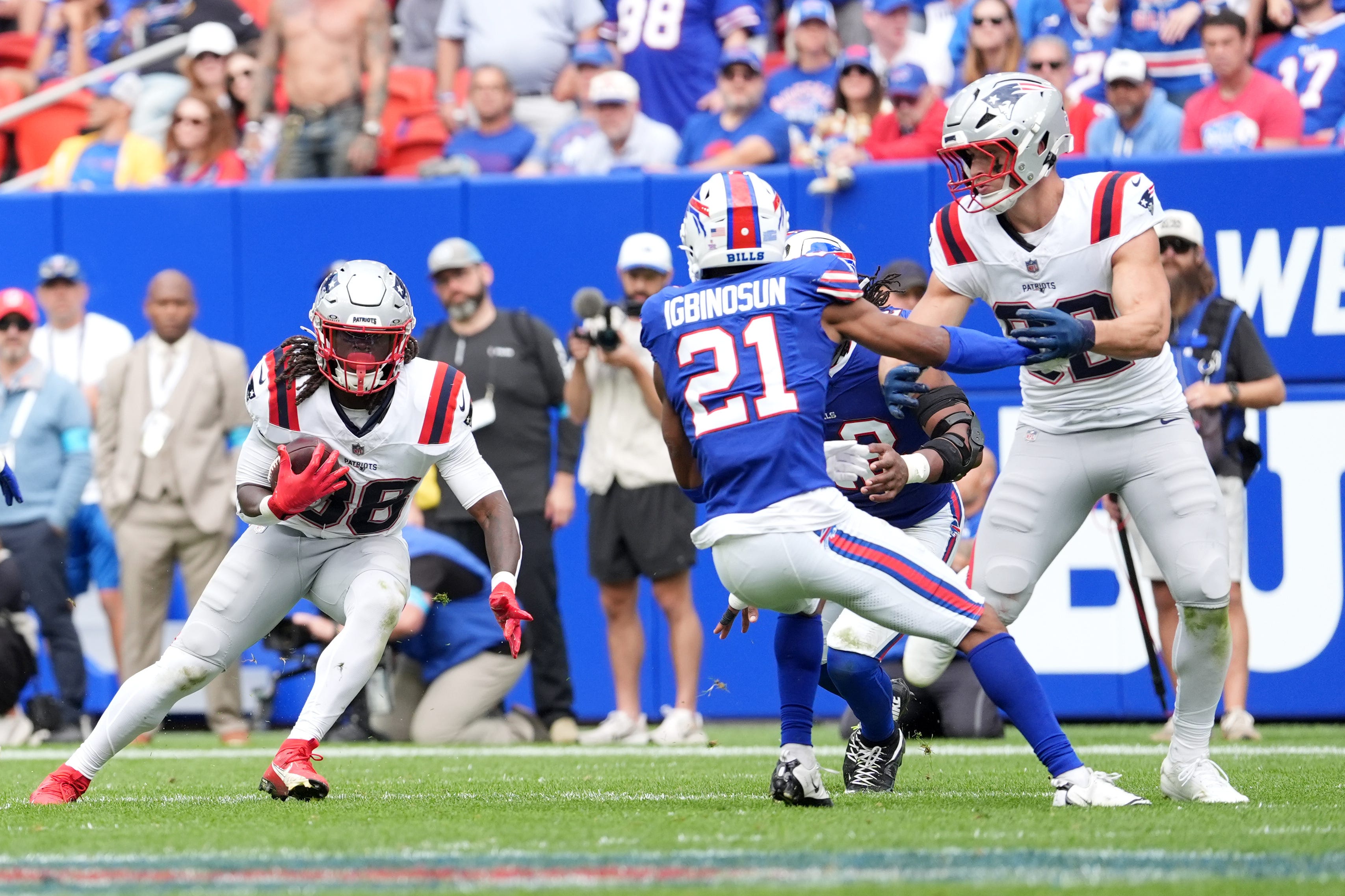
Gilliam is a fullback, which makes him an easy name to overlook in a transaction roundup. His return has wider implications than a depth-chart line. New England signed him after a long run in Buffalo, where he had experience as a lead blocker in successful ground attacks. He missed five games in this stretch while dealing with a knee problem. Getting him back gives the Patriots a chance to put an actual fullback in front of a runner instead of trying to manufacture the same looks with improvised personnel.
The case for using him begins with numbers that are difficult to dismiss. With Maye under center this season, the Patriots have averaged minus 0.14 expected points added per play, ranking 26th in the league according to the team's Saturday analysis. Their play-action rate has been 21.9%, 24th, and play-action passes have produced minus 0.36 EPA per attempt, 31st. Those measures do not prove a single blocker caused the weakness. They do show an offense failing to turn its formation and run threat into efficient downfield opportunities.
A fullback can change that relationship in subtle ways. In a two-back set, a defense has to respect a potential lead block, an outside run or a pass that begins with nearly the same picture. If the linebacker flows toward the ball carrier and the safety takes a step toward the line, Maye gets a window behind them. But the threat must be credible. Putting Gilliam on the field does not automatically fix missed blocks, slow-developing runs or receivers who struggle to separate.
There is also a straightforward physical benefit. With an injured offensive line, an extra blocker can give the running back a cleaner first read and reduce the need for a perfect interior combination. Against a Detroit front that can disrupt timing, even one positive run early in a series can open a more manageable second down. That matters because long-yardage situations force Maye into predictable dropbacks precisely when New England is short of healthy linemen.
The tension is that heavy personnel can reduce receiving options if the defense does not respect the fake. New England should not turn Gilliam's return into an obligation to run on every first down. The best version is a selective tool: run behind his lead block, sell the same picture on play-action, then return to wider formations when Detroit commits extra defenders to the box. That is how a specialist earns value beyond his individual snap count.
Stevenson's status matters here again. A physical ball carrier who can read blocks and protect Maye makes a fullback package more flexible. Kiner or Larison could also be part of the plan, but predicting a full snap distribution before the inactives would be fiction. The more grounded question is whether Gilliam's return produces a noticeably cleaner front-side crease and helps the offense avoid asking Maye to rescue every drive from third-and-long.
GOATIFY
GOATIFY NFL
Shop GOATIFY football shirts, hoodies and fan styles while New England searches for an effective ground game.
Van Roten returns to an offensive line facing its sixth combination in ten games
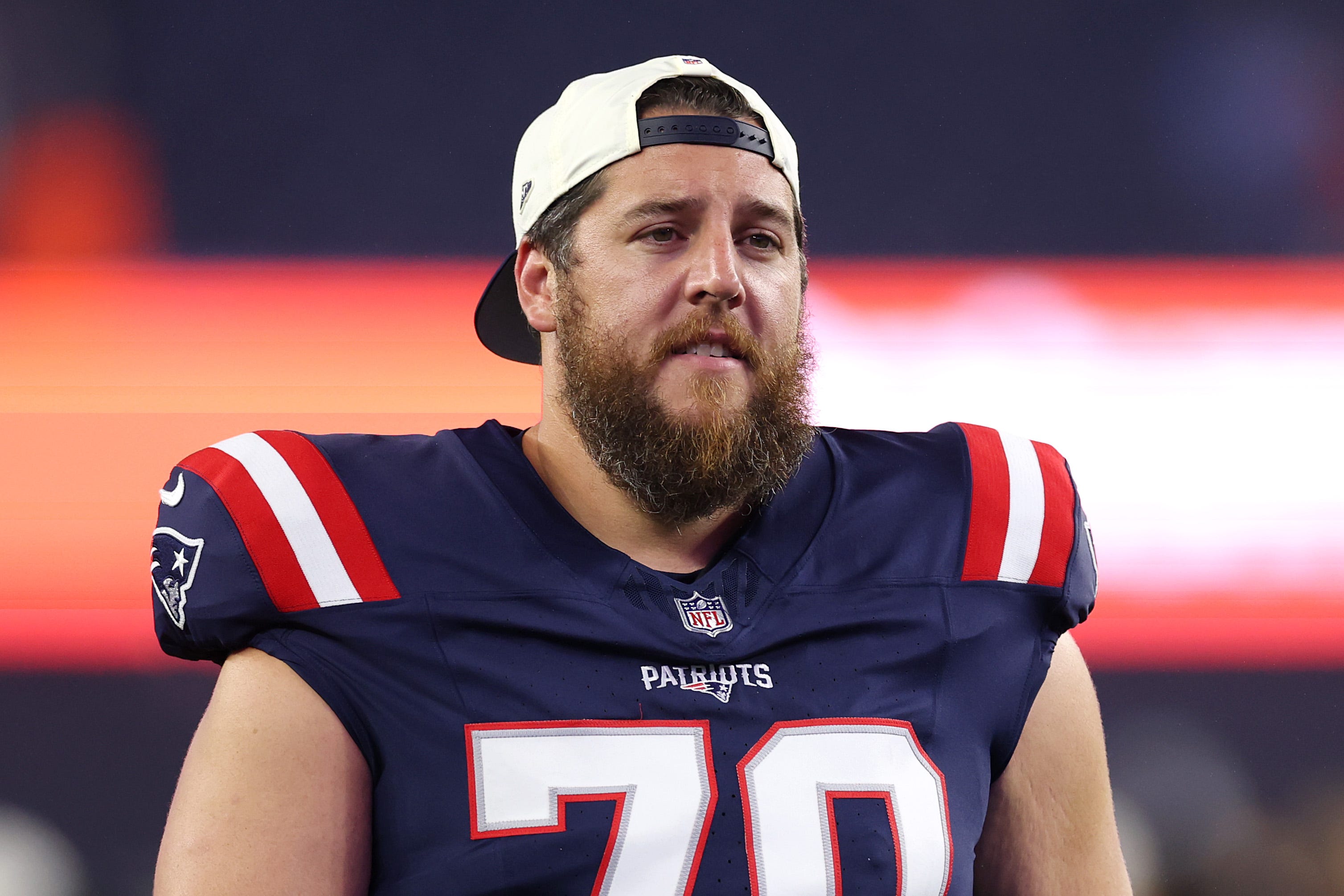
The offensive line does not have the luxury of easing Van Roten back slowly if New England's medical and coaching staffs determine that he is ready. The 36-year-old guard has been out for six games with a hamstring issue. He last appeared in the Week 3 matchup at Jacksonville, playing the opening 22 snaps at right guard. Now Ben Brown is ruled out with a knee injury, and the veteran may be needed at left guard immediately.
The projected front for Munich is Will Campbell at left tackle, Van Roten at left guard, Jared Wilson at center, Matt Pryor at right guard and Morgan Moses at right tackle. The operative word is projected. Saturday's transaction confirmed Van Roten has an active roster place; it did not guarantee he will take every snap at that position. Still, this arrangement would represent New England's sixth offensive-line combination over its first ten games, a significant disruption to the chemistry required for inside protection.
An offensive line's performance is more than the sum of five individual blocking grades. Guards and centers have to exchange defenders on twists, sort late pressure looks and decide who takes a linebacker when the front shifts. The back joins that conversation in pass protection. Constant personnel changes make those decisions harder, especially against a defense willing to disguise which player will rush and which will drop into coverage.
Van Roten has the experience to help, but it is worth resisting the easy redemption narrative. During his brief stint replacing Mike Onwenu earlier this season, he allowed three quarterback pressures in 33 pass-blocking snaps across Weeks 2 and 3, according to the Patriots' own analysis. That is a small sample and not a prediction for Sunday, but it argues against declaring the line fixed simply because a familiar veteran returns. His timing, movement and communication after a six-game absence still matter.
The problem is intensified by the broader injury sequence. Onwenu is expected to miss the rest of the season because of an ankle injury, Vera-Tucker remains on injured reserve with a hamstring issue, and Brown cannot play in Munich. Every individual absence has forced the remaining group to relearn its assignments next to someone else. A healthy Van Roten could provide stability, but asking one player to solve a season-long issue would ignore how many of those changes have occurred around him.
Andrew Rupcich's elevation provides another clue about the team's concern. Walter Rouse has been questionable while managing a concussion, making interior depth especially valuable. Rupcich is an insurance policy rather than proof of another confirmed absence. If New England has to reshuffle again during the game, the difference between one trained backup and none could be the difference between a clean exchange of a stunt and a free runner reaching Maye.
Munich is now a game-day decision tree, not merely an injury report

It is tempting to read every Saturday transaction as a declaration of Sunday's starting lineup. That is not how a game-day roster works. Henderson's injured-reserve placement is definite. Gilliam and Van Roten are now eligible because they were activated. Rupcich has been elevated. Whether Stevenson plays, how many two-back formations Gilliam sees and whether Van Roten starts at left guard are all questions that require a further game-day answer.
GOATIFY
GOATIFY NFL
As the Patriots try to protect Drake Maye behind another new line, browse GOATIFY NFL merchandise.
The decisions interact. Suppose Stevenson is active but limited: a fullback package might help protect the running game, yet it could also concentrate too much of the plan on a player whose knee is not at full strength. Suppose Van Roten begins at left guard but struggles with sharp changes of direction: the coaching staff may have to adjust its protection calls or keep additional blockers close to Maye. Neither scenario is guaranteed. Both demonstrate why one transaction cannot be judged in isolation.
New England has also ruled out cornerback Carlton Davis III and interior lineman Ben Brown. A.J. Brown and other players carried questions into the trip, so the team's final inactive list remains consequential beyond the names in Saturday's announcement. If Detroit can establish leads and force New England into obvious passing situations, the pressure on the reshuffled line grows. If the Patriots can run efficiently enough to stay ahead of the chains, some of those protection problems become less frequent.
The bye week after Munich provides a second layer to the roster strategy. The team has used five of its eight regular-season injured-reserve return designations, including the new activations. Romeo Doubs and Alijah Vera-Tucker are possible future returnees, but neither is assured a particular date. Those remaining designations are a resource the club must allocate while balancing near-term competitiveness and longer-term health. Henderson's current absence should not be translated into an automatic future activation slot.
The international setting adds attention, not different football rules. Sunday at Allianz Arena is still about early-down efficiency, getting Maye into manageable down-and-distance situations and limiting the number of protection calls that depend on strangers functioning as a long-established line. Detroit will not hand New England an easier matchup because its roster was patched together on the eve of kickoff.
There are three particularly useful indicators to watch. First, whether Stevenson appears among the active running backs and handles passing-down protection. Second, whether Gilliam's two-back packages produce actual positive rushing outcomes rather than just a different formation. Third, whether Van Roten and the interior line communicate cleanly against pressure and twists. Those observable details will say more about the quality of these roster decisions than a simple tally of how many injured players returned.
The Patriots gained two usable pieces on Saturday, but they did not gain the version of their roster that existed on paper in training camp. Henderson's move to injured reserve formalizes a longer absence. Gilliam supplies a potential lead-blocking answer to inefficient under-center and play-action football. Van Roten gives an injured interior line a veteran who knows the system, though he has not played in six games. Rupcich is additional insurance, not an instant cure.
The clearest mistake would be to call this a solved injury crisis before the first snap. Stevenson remains a game-day decision, a sixth line combination needs to communicate under pressure, and the next set of possible IR returns belongs to the weeks beyond Munich. If the Patriots can protect Maye, run from credible two-back looks and avoid emergency shuffles, these transactions will have made a meaningful difference. If not, the roster moves will have revealed how much rebuilding is still left to do.
GOATIFY
GOATIFY NFL
Shop GOATIFY NFL and American football shirts, hoodies and stickers.


















