

Sanz Made 124 Sprints — His Pair Ran 787 Metres More and Still Lost
GOATIFYJon Sanz covered 2,361 metres and made 124 sprints in the Düsseldorf Premier Padel final. Agustín Tapia ran 1,736 metres and made just 57. Yet Tapia and Arturo Coello lifted the trophy, while Sanz and Franco Stupaczuk went home with another runner-up finish. Those numbers make the 2026 Germany P2 a useful challenge to one of sport's easiest assumptions: the busiest athlete is not necessarily the most effective one.
Fresh tracking figures from the men's and women's finals reveal two sharply different versions of elite padel. In the men's match, the losing pair travelled 787 metres farther than the champions. In the women's match, Claudia Fernández and Martina Calvo both outran and outscored Ari Sánchez and Andrea Ustero. Neither outcome makes distance a meaningless statistic. Together they show why movement has to be understood alongside court position, rally construction, recovery and the quality of the next shot.
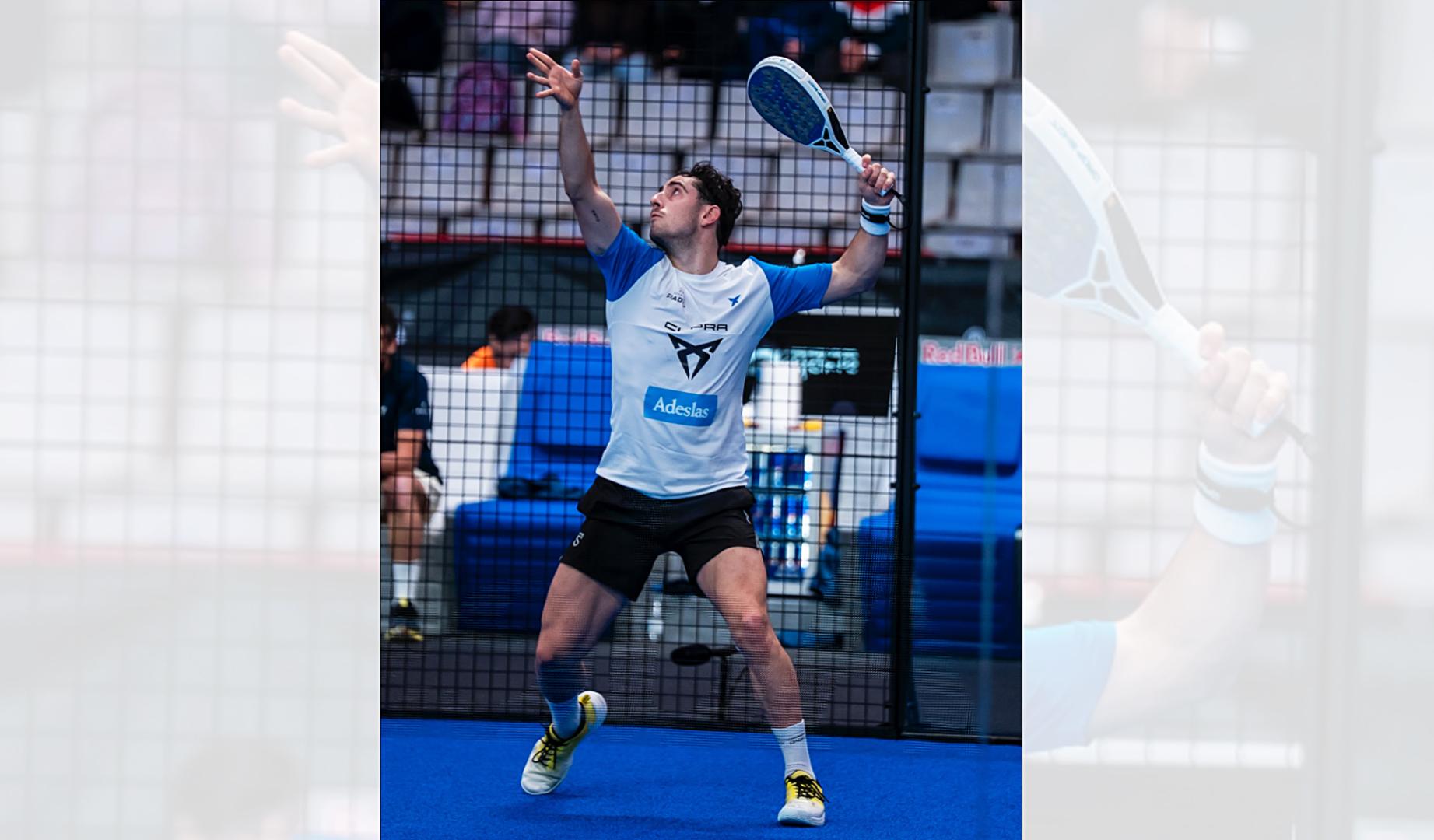
Sanz's 124 sprints made him the busiest player in the men's final
The raw distance table starts with Sanz at 2,361 metres. Stupaczuk covered 1,992, Coello 1,830 and Tapia 1,736. That puts Sanz 369 metres ahead of his own partner and 625 ahead of Tapia. Over a final decided 6-2, 7-6, those gaps are not trivial. They describe an athlete repeatedly crossing space, resetting his position and getting involved in exchanges even when the opposition held the initiative.
The acceleration numbers make the contrast sharper. Sanz registered 124 sprints, against 77 for Coello, 68 for Stupaczuk and 57 for Tapia. He also reached a top speed of 4.7 metres per second, roughly 17 kilometres per hour. His recorded distance above 2.5 metres per second was 1,016 metres, almost twice Tapia's 526. The picture is of a player whose contribution depends on repeated changes of direction rather than one spectacular burst.
That is consistent with the pressure Sanz and Stupaczuk have brought to the tour. They reached another final after beating Alejandro Galán and Federico Chingotto in the semifinals, the second time they had defeated that pairing in consecutive tournaments. Sanz's left-handed attacking game can force opponents to defend awkward trajectories, while Stupaczuk supplies a steady partner alongside him. It would be misleading, though, to assume every sprint was an attacking success. Some were recovery runs after a ball dragged the pair out of position.
The distinction matters when comparing workloads. A player can travel farther because he is retrieving more difficult balls, because his side deliberately defends deeper, or because the opponent is controlling the centre of the court. Conversely, a player with fewer metres might be anticipating exceptionally well or might simply be receiving fewer playable balls. Movement totals do not tell us which explanation dominates without the video and rally context.
For Sanz, the data still underline the value he brings. His willingness to cover ground kept the final competitive after a difficult first set, and the challengers had a genuine chance to force a decider. The next step is not necessarily running even more. It is finding ways to turn all that movement into more points finished on their terms.

Tapia and Coello ran 787 metres less — and still controlled the result

Across the men's final, Tapia and Coello accumulated 3,566 metres between them. Sanz and Stupaczuk reached 4,353. The challengers therefore covered 787 metres more, roughly 22% beyond the champions' total. The tracking summary also puts the challengers at 87 metres per minute compared with 72 for the winners. If kilometres alone decided titles, the result would have gone the other way.
The scoreboard gives the necessary correction. Coello and Tapia won 6-2, 7-6, collecting their 11th title of the 2026 season and extending a run that had already delivered trophies in Paris and Rotterdam. Sanz and Stupaczuk had their moments: they started brightly and later served with an opportunity to level the match at one set apiece. But the world number ones answered at the crucial moment, broke back and closed the second set in a tiebreak. Superior efficiency in the decisive exchanges mattered more than superior total mileage.
Heat-map figures offer one possible explanation. Coello spent approximately 64% of the measured time in the intermediate area of his own half, with 29% deeper and 6% near the net. Tapia's distribution was similar: 66% intermediate, 26% back and 8% close to the net. Stupaczuk, by comparison, spent 39% of his time in the back area, while Sanz spent 35% there. Those differences suggest the losing pair were required to defend from deeper positions more often.
Another useful measurement concerns spacing between partners. Tapia and Coello averaged 3.7 metres of lateral separation when operating near the net, compared with 5.5 metres while defending. The tighter attacking shape can reduce open gaps and make the next volley easier to reach, although the number by itself does not prove that every attacking sequence was optimal. Positioning, the height and direction of the incoming ball, and the quality of the previous shot all matter.
Coello's blocks and Tapia's shot selection were important features of the match. When an opponent's hard overhead comes back with control rather than panic, the attacker may have to hit another ball from a worse position. That creates work for the player who appeared to be dictating the rally. The winners also produced 32 winning smashes against 24 for the challengers, while committing 26 unforced errors to their opponents' 33 in the match figures reported after the final. Those indicators fit the broader story: fewer wasted movements and cleaner finishes.
The lesson is not that running less should become the goal. The goal is to occupy the right space early enough that a pair does not have to chase every ball. Tapia and Coello showed how that economy can survive a serious challenge from opponents who were willing to cover almost every corner of the court.

Fernández and Calvo won the women's final by doing more of the running

The women's final turns the men's interpretation upside down. Claudia Fernández and Martina Calvo won 6-3, 6-0 against Ari Sánchez and Andrea Ustero, and this time the champions also led the physical workload table. Calvo covered 2,162 metres, Fernández 2,048, Sánchez 1,988 and Ustero 1,837. Together, the winners travelled 4,210 metres to their opponents' 3,825, a difference of 385 metres.
The sprint comparison was even more pronounced. Calvo made 63 recorded sprints and Fernández 59, giving the pair 122. Sánchez had 26 and Ustero 19, a combined 45. Calvo also logged 699 metres at speeds above 2.5 metres per second, followed by Fernández on 562, Sánchez on 485 and Ustero on 350. This was not a case of the losing pair being dragged into an endless defensive chase while the winners stood still. The winning team was the one producing more of the repeated high-intensity movements.
That makes sense when placed beside the match's tactical character. Fernández and Calvo repeatedly imposed pressure early in rallies and converted that activity into control of points. Their acceleration was productive, not merely reactive. The official result confirms how quickly the contest got away from the opposition: after taking the opening set 6-3, they did not drop a game in the second. The final lasted just over an hour, a striking contrast with their demanding semifinal.
That semifinal had required three hours and seven minutes to overcome Paula Josemaría and Bea González, with Fernández and Calvo saving match points on the way to the final. They then recovered quickly enough to deliver a dominant title performance the next day. It was their second trophy together after London and their first P2 title. Sánchez and Ustero arrived as the champions of Paris and Rotterdam, so this was not a comfortable matchup on paper.
None of that means sprint counts are a universal predictor of winning. The women's final featured a different tactical balance, different rally patterns and a different distribution of opportunities. What the comparison does establish is that movement can have opposite meanings in different matches. One team can be running more because it is under pressure; another can be running more because it is generating pressure. The scoreboard and shot patterns are what tell those situations apart.

The rally-length split explains why the 6–0 was more than a hot streak

The rally-length breakdown gives the women's result a second layer. Of 50 points lasting less than 20 seconds, Fernández and Calvo won 31, or 62%. They also claimed 22 of the 35 points in the 20-to-35-second range, approximately 63%. Even when exchanges stretched beyond 35 seconds, they won five of nine, about 56%. The sample in that longest category is small, but the pattern across all three groups is notable: the winners did not depend on just one type of rally.
That breadth helps explain why the second set finished 6-0. Sánchez and Ustero could not simply make points longer and expect the balance to flip. Nor could they reliably shorten exchanges to escape the pressure. Fernández and Calvo were ahead in the brief exchanges, the middle-duration rallies and the limited number of very long ones. When a pair has answers across those situations, the opponent has fewer obvious tactical adjustments.
There is an important statistical caution here. Rally-duration buckets do not show who served, who first controlled the net, or whether a point ended through a winner or an error. A 63% share of medium-length rallies does not tell us which stroke created the advantage. The sample of nine long points is especially vulnerable to a few individual exchanges changing the percentage. The figures are evidence of breadth, not a complete causal model of the match.
The men's data require the same care. Sanz's 124 sprints and his team's extra 787 metres make the effort impossible to miss, but they cannot by themselves distinguish forced retrievals from intelligent court coverage. The heat maps suggest where players spent time, not why every point developed that way. A coach would want to synchronize tracking with video, point outcomes, net possession and the previous shot before drawing a firm conclusion about technique or tactics.
There is also a practical takeaway for players below the professional level. Fitness creates the capacity to repeat efforts, but footwork decisions determine how much of that capacity is wasted. Partners who move together, recover toward useful positions and recognize when to defend rather than attack can make their court coverage more economical. On other points, an explosive first step is precisely what turns an even rally into an attacking chance.
Düsseldorf supplied both examples in one afternoon. The men's champions succeeded despite lower measured workloads; the women's champions combined greater movement with dominance at every measured rally duration. That contrast is more informative than a slogan about who ran the farthest.
Movement tracking is valuable because it exposes work that the scoreboard cannot show. Sanz's extraordinary running explains part of the threat he and Stupaczuk posed to the world's best pair, while Tapia and Coello's positioning and finishing explain why the extra effort was not enough. In the women's final, Fernández and Calvo showed that the team doing more of the moving can also be the one directing the match.
The best question is therefore not how many metres a player covers. It is what each movement achieves: a better court position, a harder ball for the opponent, a controlled recovery or a point won. The 2026 Düsseldorf finals provided two very different answers — and a reminder that padel is a sport of decisions as much as endurance.
Shop GOATIFY padel products from the Padel-filtered collection scope.
















