

McDavid Hit 50 in 21 Games. Levi Made One Goal Enough.
GOATIFYFor 20 games, Connor McDavid had made the Edmonton Oilers’ season feel like a nightly scoring exhibition. Game 21 was almost the opposite: a 1–0 win in Toronto, one assist from the captain, one clean shot from Evan Bouchard and 19 stops from Devon Levi. Yet the smallest possible winning margin delivered McDavid’s biggest statistical headline of the year. He reached 50 points through 21 games, joining an extraordinarily short list in NHL history.
The scoreboard did not look like a game dominated by a superstar on a 200-point pace. That is precisely why the result mattered. Edmonton did not need McDavid to provide three goals or four assists. He created the decisive opening, his defenseman finished it, and his goaltender gave Toronto nothing the officials would count. For a club with legitimate championship expectations, winning without an offensive explosion offers a different kind of evidence.
On the other side, the Maple Leafs completed a six-game homestand without a point, and even a lengthy review of a John Tavares deflection could not give them an equalizer. These were two very different versions of early-season urgency, separated by a single goal.
McDavid's 50 points belong in a club of five, not a normal scoring race

Fifty points in 21 games is not just a fast start. It is a threshold that almost every brilliant scorer in NHL history has failed to reach that quickly. Before this November, the names attached to it were Wayne Gretzky, Mario Lemieux, Bernie Nicholls and Mike Bossy. McDavid became the fifth different player in that company with an assist on Edmonton's only goal in Toronto. The scoreline gave the moment a strange symmetry: an extraordinary season milestone recorded in a game that barely moved the scoreboard.
His 11 goals and 39 assists make the shape of this streak unusually revealing. McDavid has been more provider than finisher, and he does not require a spectacular end-to-end rush to change a game. Against Toronto he created an opening for a defenseman at the point. One pass moved the attack to a shooting lane; one finish made the assist count. It is not less valuable because the highlight belongs partly to someone else. The captain's threat compels opponents to respect his speed and vision, and those decisions can produce space for a teammate even when he is not the one taking the shot.
The 21-game run is also a separate historical question from the 50-point sprint. A player can accumulate points at an outrageous rate with a few blank nights and several huge games; a season-opening point streak demands production every time the team plays. McDavid has now kept that promise through more than a quarter of the schedule. His next game would give him a chance to match Dany Heatley's 22-game opening streak from 2005–06, but it would still be far short of Gretzky's famous 51-game start in 1983–84. Those are distinct records, and combining them into one vague claim understates what makes each exceptional.
GOATIFY
GOATIFY Hockey
McDavid's milestone belongs beside the NHL's biggest names. Browse GOATIFY Hockey's fan gear while exploring the record-breaking Oilers start.


There is an obvious temptation to pencil a final scoring total into the record book already. At 50 in 21, the arithmetic works out to roughly 195 points over 82 games. That is not a forecast, just the straight-line pace. Injuries, opponent adjustments, fatigue and natural variance can change it quickly. What is real on November 15 is the 50, the 21, and the fact that he collected the milestone in a game Edmonton could win without leaning on a three-point performance. That last distinction might matter more to this roster's postseason ambitions than another gaudy regular-season box score.
Bouchard's one clean point shot made McDavid's assist decisive

At 15:34 of the second period, the difference between two points and another tense finish came down to a small change of angle. McDavid sent a backhand pass to Evan Bouchard at the point. The defenseman had enough room to set a hard slap shot, which beat Anthony Stolarz on the glove side. That was it for the scoring. A contest featuring some of the NHL's most recognizable offensive players ultimately hinged on a defenseman's release from distance.
It was Bouchard's 12th goal of the season, an eye-catching number for a blue-liner with only 21 Edmonton games played. It also underscored how different the Oilers' attack becomes when the threat at the top of the zone is credible. Opponents cannot devote every defender to the rush or crowd every pass between McDavid and Leon Draisaitl if a trailing defenseman can punish an open lane. That makes Bouchard more than a complementary scorer. His shot changes how the defense has to position itself before the puck reaches him.
Stolarz stopped 22 shots and gave Toronto every reasonable opportunity to steal a point. One goal allowed is not the profile of a goaltender who lost the game for his side. The problem was at the other end, where Toronto could not turn its own 19 registered shots into a legal goal. Edmonton's finishing efficiency was hardly spectacular — it took 23 shots to find one goal — but on this night it only needed one clean finish paired with sustained discipline. Plenty of high-octane teams can score six when the puck is moving freely. Protecting a 1–0 lead is a much less glamorous challenge.
Edmonton also entered the game on a run of strong results, not an isolated hot night. This fourth straight victory moved the club to 15–3–3, with points in 12 of its previous 14 games. The more telling lesson is that the Oilers did not collapse into forcing low-percentage offense after failing to score early. They waited until a useful passing angle appeared, converted it and resisted the urge to trade end-to-end chances with a desperate home side. Nobody should mistake one shutout for a season-long defensive transformation. But it was an example of a contender winning on terms other than its usual raw firepower.
Levi's 19-save shutout was about control, not a spectacular shot total
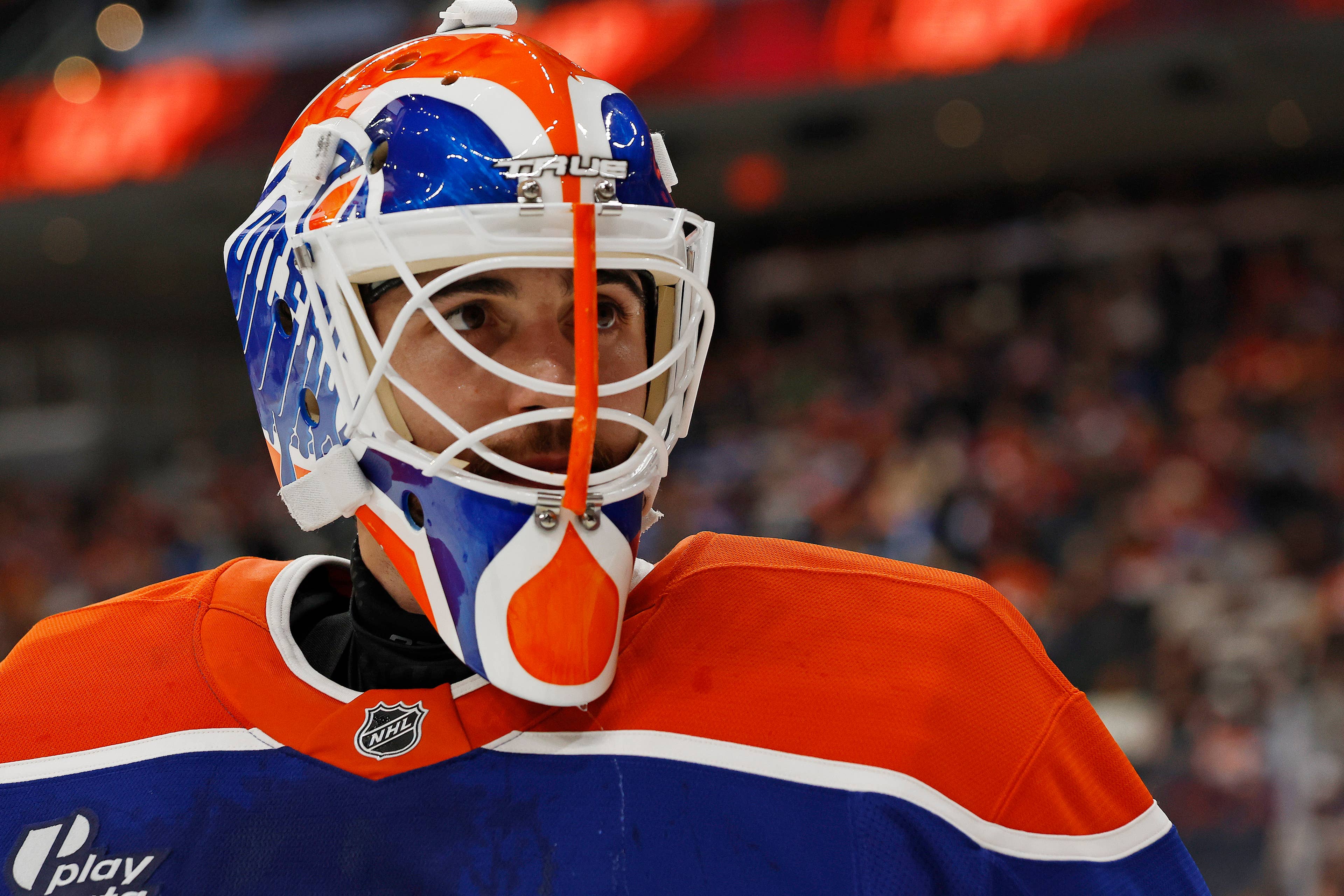
Shutouts are often remembered as a sequence of impossible glove saves and desperate scrambles. Devon Levi's first NHL shutout did not need that kind of highlight reel. He faced 19 shots, stopped all 19, and reached the final horn with Edmonton ahead 1–0. It was less about one spectacular intervention than making sure Toronto never found a second chance that turned into a counting goal. Behind the points milestone, his calm night supplied the result's structural foundation.
GOATIFY
GOATIFY Hockey
Bouchard's point shot decided a narrow Oilers win. Discover GOATIFY's Hockey fan designs as Edmonton shows it can win tight games too.
That is especially meaningful because Levi's place in Edmonton's crease was not predetermined at the start of the season. The young goaltender had arrived after a July trade from Buffalo, entered a crowded depth chart and then earned more responsibility through his early performances. He also missed time with an injury before returning to the lineup in November. This shutout improved his Edmonton career record to 9–1–0 through his first 10 games, the best 10-game start by a goaltender in Oilers franchise history. A ten-game sample is far too small to settle a permanent starter debate, but it is more than a random one-night surprise.
There were still moments that required a keeper's focus. Toronto's apparent equalizer early in the third took the puck over Levi's head before video review determined the stick had been too high. In the last seconds, Auston Matthews had an opening in the slot, but his attempt missed the net. Ryan Nugent-Hopkins then helped close down the traffic created by William Nylander. The goaltender had to stay mentally ready for precisely the moment when a quiet game becomes chaotic. A 1–0 margin does not allow any lapse, whether the opposing team has ten shots or forty.
Edmonton's skaters deserve their share of the clean sheet. The Maple Leafs generated little volume, and the defensive group protected inside space well enough that a late push never became a flood of dangerous shots. That matters for interpreting any shutout correctly: the goalie earns it, while the team's shape often determines how difficult it must be. If the Oilers can marry this level of collective control with McDavid's unprecedented production, the opponent's assignment becomes harder in two directions. It is not enough to survive the top line; it is also necessary to create goals against a team that has shown it can protect a lead.
Toronto's disallowed goal cannot explain six straight home defeats

Toronto had one fleeting moment when a grim home stand looked ready to change its script. John Tavares redirected a puck into the net a minute into the third period, briefly making it appear that the Leafs had drawn level. The celebration did not survive the review: officials ruled that his stick had contacted the puck above the crossbar. The goal came off the board, and the 1–0 score stood. In a game with so few opportunities, the call understandably felt enormous.
But a six-game homestand without a point cannot be reduced to a borderline deflection. Toronto lost all six in regulation, conceding 23 goals and scoring nine. Its record dropped to 8–12–2, and its home mark fell to 4–9–1. The local game notes also showed an uncomfortable pattern when Toronto falls behind: the team had struggled to reverse games in which the opponent scored first, and this night provided another example. Winning teams are allowed to have unlucky reviews. Losing teams cannot depend on those reviews for all their offense.
GOATIFY
GOATIFY Hockey
Levi's first NHL shutout underlined Edmonton's team defense. Explore GOATIFY Hockey apparel and accessories for fans of the sport's defining moments.
Anthony Stolarz was one of Toronto's steadier performers in this game. His 22 saves kept the score within one shot for more than forty minutes after Bouchard's winner. The opposite side of the ledger is tougher: 19 Toronto shots across an entire home contest gave Levi relatively little sustained traffic to manage. Those totals do not tell us everything about shot quality, and a single match cannot diagnose an entire power play, transition game or dressing room. Still, the combination of an extended losing streak and another low-output night demands an answer rooted in repeatable chance creation, not merely the hope that the next puck bounces differently.
There was a compelling subplot behind the Edmonton bench. Mike Babcock was coaching his first game in Toronto since the Maple Leafs dismissed him in November 2019, returning as leader of a red-hot Oilers team. That history made the matchup easier to sell as a personal reckoning, but Babcock did not have to outmaneuver his old club with an elaborate scoring play. His team scored once and protected the advantage. Jim Hiller's Leafs worked hard enough to stay close, yet the practical outcome was another defeat. The uncomfortable contrast was on the ice, not in the coaches' past.
Toronto's next task is straightforward to state and difficult to execute: find a way to establish more dangerous offensive possessions before desperation time. The disallowed Tavares deflection showed how narrow the margin can be. Six straight home defeats showed why living on that margin is not sustainable. If the Leafs wait for the perfect bounce to solve a structural problem, the losing streak is more likely to grow than vanish.
Edmonton will remember the night as both a milestone and a blueprint. McDavid reached 50 points faster than nearly anyone in league history, but Bouchard and Levi were just as essential to a victory that required discipline rather than a scoring avalanche. The Oilers are 15–3–3 and have won four straight, and their next test is maintaining the same standard when their captain is not accumulating points at a historic rate.
For Toronto, a disallowed equalizer and another scoreless night at home cannot hide six regulation defeats in six games. The Leafs need more than a break on one review. They need to manufacture the volume and quality of chances that stop close games from becoming another long evening of chasing the scoreboard.
McDavid's possible 22nd consecutive point game will draw the next round of attention. The more revealing standard is whether Edmonton can keep limiting opponents' dangerous chances when it has no scoreboard cushion. A single 1–0 win does not establish a championship defense, but it proves this group has another path to victory when the best player on the ice records only one assist. Toronto faces the inverse test: its most talented attackers must create sustained pressure before the closing minutes, not merely chase a miracle with the goalkeeper pulled.
GOATIFY
GOATIFY Hockey
Shop GOATIFY NHL and hockey shirts, hoodies and stickers.


















