

Four Packers Ruled Out. Seven More Questionable. Minnesota Gets an Opening.
GOATIFYOne week after Green Bay put up 45 points in New England, its next division game has become a test of how many essential pieces an NFL roster can lose before the plan starts to change. The Packers ruled out four players for Sunday's November 15 meeting with Minnesota: running back Josh Jacobs, center Sean Rhyan, edge defender Micah Parsons and tight end Josh Whyle. Linebacker Zaire Franklin is doubtful. Seven more players carry questionable designations, including starters on the offensive line and across the defensive backfield.
That is not the same as saying 12 active Packers will miss the game. Some names are on injured lists, others may be activated, and questionable is deliberately not a ruled-out designation. But the combination matters. Green Bay must replace a lead runner with a fractured finger, protect Jordan Love without its usual center, and defend against a familiar NFC North opponent while several important defensive roles remain unsettled.
The 6-3 Packers are coming off a 45-27 win over the Patriots, when Love threw for 372 yards and three touchdowns. Those numbers make the offense look capable of surviving disruption. Minnesota, however, brings a different challenge, particularly with its appetite for pressure and its ability to force a quarterback to identify threats before the snap.
Jacobs is out, and the run-game answer has to include protection
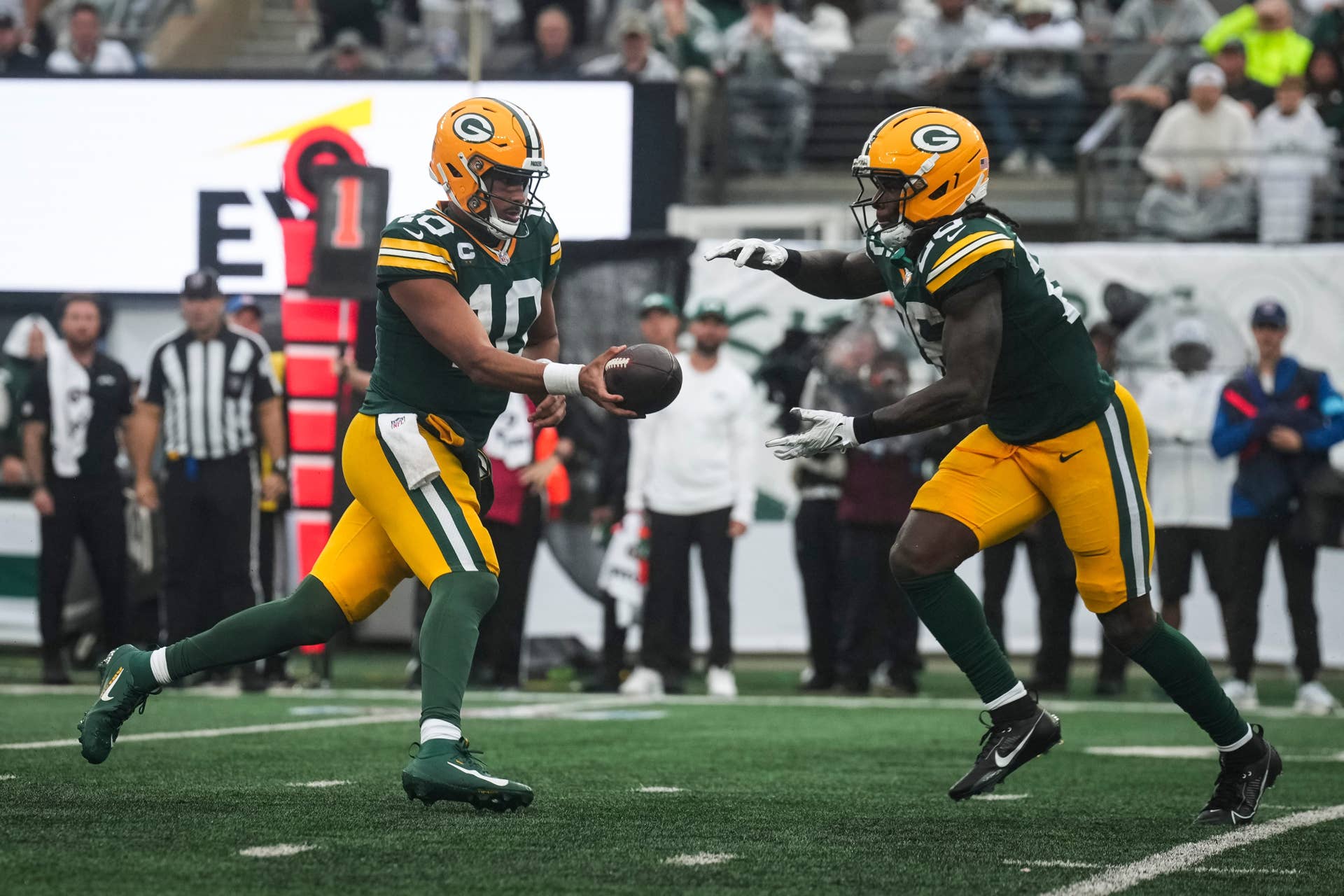
Jacobs' absence is the cleanest certainty on an otherwise complicated injury sheet. He fractured the ring finger on his right hand during the win over New England, when his finger caught in a defender's facemask. He tried to return but could not grip the football effectively. Matt LaFleur said a procedure was needed; as of the final Friday report, the operation had not yet taken place. Neither the Packers nor that report provided a firm return date, and the possibility of injured reserve should not be mistaken for a transaction already completed.
The immediate football question is whether Green Bay can reproduce the best part of its rushing performance against the Patriots without reproducing the circumstances that forced a change. Kaleb Johnson carried 14 times for 68 yards and a touchdown after Jacobs departed. His 34-yard run was the team's longest of the season to that point. Pierre Strong Jr. supplied eight carries for 22 yards. Green Bay finished with a season-high 129 rushing yards, evidence that the backfield can generate production without every touch passing through Jacobs.
But there is a meaningful difference between finding 129 yards against one opponent and arriving at the next matchup with a stable division of labor. Johnson can threaten a crease with a decisive downhill cut. Strong can handle a change-of-pace assignment. MarShawn Lloyd may return to the game-day group after missing the Patriots game with a knee issue. Chris Brooks, questionable as he works through an injured-reserve practice window, could be especially valuable because he knows the protection rules and can function as an outlet in the passing game.
That last point deserves as much attention as the rushing total. Minnesota's pressure packages often ask a running back to identify a late-arriving defender, adjust a protection call, or release only when the quarterback is protected. A runner who averages an extra yard on a carry does not necessarily help if he misses a blitz pickup that creates a free run at Love. Brooks' availability, Johnson's assignment discipline and Lloyd's health therefore have direct consequences for the passing game, even on snaps when none of them touches the ball.
GOATIFY
GOATIFY NFL
Explore NFL-themed gear while the Packers work through a backfield without Josh Jacobs.


LaFleur can simplify some of those decisions. Early-down runs from heavier looks could make the Vikings honor a genuine downhill threat. Quick throws and screen actions can punish defenders who fly toward the line. A backfield rotation can also prevent one inexperienced player from shouldering every down-and-distance situation. Yet the Packers cannot telegraph a pass merely by putting their best protector into the backfield, nor a run every time a more explosive ball carrier appears.
The sensible expectation is a committee rather than the assumption that a single replacement will imitate Jacobs. Green Bay has several ways to distribute carries; it has fewer proven ways to reproduce the combination of ball security, receiving versatility, short-yardage power and blitz recognition that a veteran starter ordinarily supplies. Sunday will show which job the coaching staff values most in each situation.
Without Rhyan, the protection plan matters more than Love's arm

Center Sean Rhyan has been ruled out with an ankle injury, and that moves the problem from the backfield into the middle of the offense. Center is not merely one more blocking position. The exchange, protection identification and timing of combination blocks all begin there. A line can compensate for a missing starter, but it has to be synchronized against the opponent most willing to make the pre-snap picture uncomfortable.
Green Bay has already had to manage Rhyan's absence in recent games, so Sunday is not a completely new experiment. The difficulty is the number of adjacent uncertainties. Veteran guard Kevin Zeitler is questionable with ankle and triceps issues. Travis Glover is questionable with a knee problem. Left guard Aaron Banks, by contrast, has no final game designation despite appearing on the practice report earlier in the week. That distinction matters: an injury list should not be turned into a list of absences by implication.
Against Minnesota, the challenge is not only to block the four defenders initially aligned near the line of scrimmage. An aggressive pressure look can send a defensive back, drop an apparent rusher, or force the center and quarterback to decide whether the protection should slide one direction. When a running back is uncertain in his pickup and the middle of the line is changing, two individual injuries can amplify each other. A free blitzer is often created by a disagreement, not simply by an opponent winning a one-on-one matchup.
Love's Week 9 performance gives Green Bay a real counterargument to the idea that a rearranged line guarantees an offensive collapse. He completed 23 of 29 passes for 372 yards and three touchdowns against New England without throwing an interception. The Packers scored 45 points, and the offense repeatedly exploited space created by its play design. A quarterback in that rhythm can discourage blitzes by finding the vacated area quickly and making defenses pay for committing extra bodies.
















