Adesanya Says Retirement Will Be Final — and His Second Act Is Already Taking Shape
GOATIFYIsrael Adesanya is not announcing his retirement. He is drawing a line around what retirement will mean when it finally arrives. After a remarkable run at the top of the UFC middleweight division and a painful sequence of defeats, the former champion says he wants his last fight to be exactly that: his last fight, not the first chapter of an endless comeback cycle.
In a new discussion about life beyond the cage, Adesanya described the pull of adrenaline, the film opportunities he once turned down and the perspective he has gained from Georges St-Pierre. Those details matter more than any imagined retirement date. He still wants to compete, but he is beginning to describe a future in which competing is no longer the only thing that gives his days shape.
It is an unusually revealing distinction for a fighter whose identity has long been built around big stages, championship pressure and finding a way to rise when the lights are brightest.
Four losses have changed the conversation, not his appetite for risk

The urgency is not difficult to understand. Adesanya is 37, has spent more than 16 years in professional combat sports and has lost four consecutive fights. The latest setback came against Joe Pyfer at UFC Seattle in March, when the younger middleweight stopped him by technical knockout at 4:18 of the second round. Before that, defeats to Nassourdine Imavov and Dricus du Plessis had already turned questions about his next title run into questions about how much longer he should keep fighting.
That is a sharp change for a man who once made the middleweight championship feel like a permanent part of his personal brand. Adesanya's title reigns were built on distance control, quick reads, feints and the ability to turn an opponent's impatience into openings. He was not simply a champion who collected defenses; he became one of the division's defining stylistic reference points. Opponents spent years preparing for the specific puzzle he presented.
None of that disappears because his recent results have gone the wrong way. But past excellence also cannot settle the question of whether another fight is a good idea. Timing, durability and the ability to manage exchanges can shift by small margins at the highest level. A veteran can still have excellent moments in a bout and lose because one mistake is punished more severely than it would have been a few seasons earlier. Pyfer's victory was a reminder of how unforgiving that equation has become.
Adesanya's new comments do not mean he has changed his mind about fighting again. Immediately after the Pyfer loss, he publicly resisted the idea that he should walk away. His latest remarks concern the endpoint rather than the next booking: whenever the end arrives, he wants to be able to leave without chasing another crowd reaction or another payday just to feel like himself.
He also recognizes that the need for excitement does not vanish when an athlete stops competing. He floated ideas ranging from unusual travel experiences to testing himself at a poker table. These were examples of the kind of uncertainty he might seek, not firm plans. The common thread is that he expects to miss the feeling of risk, and he would rather redirect it than use it as an excuse to return to a cage after his competitive chapter is over.
That distinction is important. Wanting stimulation is not the same as needing to fight. Many retired athletes struggle because their schedule, social circle and sense of achievement were organized around a single pursuit. Adesanya is trying to imagine what fills that space before it becomes empty. Whether he can follow through will only become clear after he actually retires, but asking the question now gives him a better chance than waiting until the morning after his farewell.

The second act is taking shape: films, travel and Georges St-Pierre
Adesanya has already identified opportunities that championship life once forced him to decline. He said he turned down roles in two major films because they conflicted with title defenses. He did not identify the projects, so there is no basis to speculate about the movies or claim those offers remain open. What matters is the trade-off: being a champion created enormous visibility, but defending that status demanded a calendar that left little room for other ambitions.
His current circumstances are different. Adesanya suggested that a potential new acting opportunity could be easier to accommodate because he is no longer preparing to defend a belt several times in a year. He also spoke about filming more content and traveling. Those are not substitutes for a confirmed next UFC opponent, and they are not evidence of a retirement announcement. They are signs that he is building more than one way to measure a successful year.
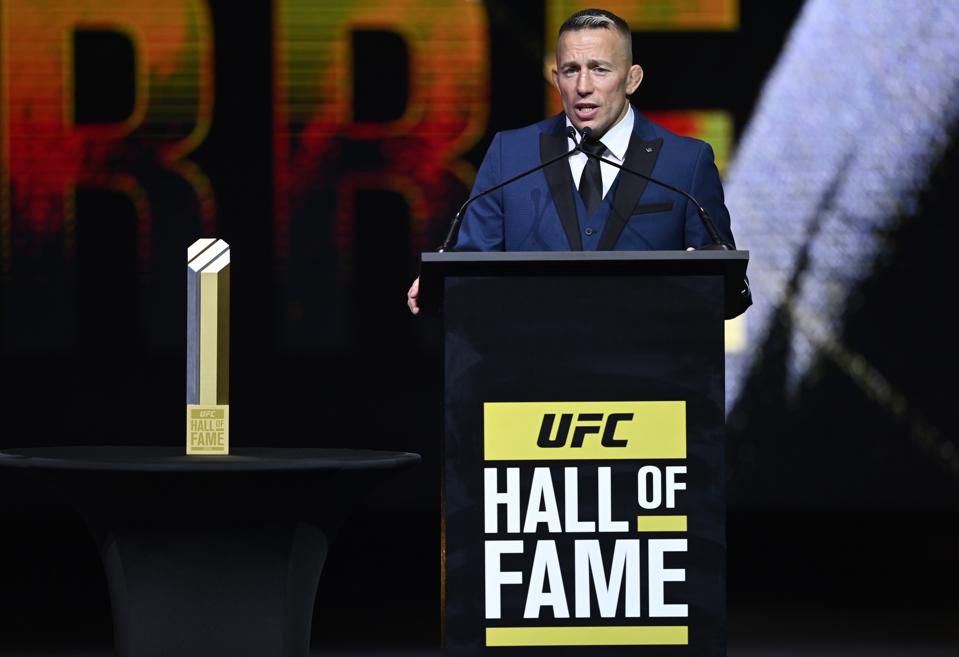
The most meaningful influence in that process may be Georges St-Pierre. Adesanya described the retired two-division champion as someone whose advice carries special weight because he understands the demands of championship-level fighting. St-Pierre's perspective is useful precisely because he completed the transition Adesanya is contemplating: he reached the summit, stepped away and established a public life that did not require another bout to justify his legacy.
That does not mean the two men need to make identical decisions. Their careers, styles and circumstances are different, and no one can know from the outside when a fighter has reached the right moment to stop. The value of St-Pierre's example is narrower and more practical. He represents proof that the competitive identity can remain part of a person's story without remaining the only chapter that matters.
Adesanya's interest in entertainment is also not a sudden reinvention. He has long mixed fight promotion with a distinctive public persona, visual storytelling and online content. A transition into acting or other media would use skills he has already practiced in front of large audiences, although the work itself would require new discipline and no particular role is guaranteed. The opportunity is to make those interests meaningful enough that a future without training camps still feels active rather than diminished.
There is a competitive consequence, too. A fighter who believes he has credible options outside the sport may find it easier to make a clear decision inside it. He does not have to accept every proposed matchup as a referendum on his worth. He can weigh the physical cost, the sporting value and the life he wants afterward without pretending that his only possible future is another comeback.
For now, the next step remains unknown. Adesanya has not supplied a retirement date or a final opponent. His recent words should be read as a philosophy for leaving, not a schedule for doing it. That is a less dramatic headline than an immediate farewell, but it is arguably a more significant development in how the former champion thinks about the rest of his career.

Adesanya's latest message is not that he has finished fighting. It is that he does not want retirement to become a revolving door. The four-fight skid makes the subject unavoidable, yet his explanation is about more than losses: he wants to protect what he built while leaving room for the person he can become after the cage.
The possible film work, travel, creative projects and advice from St-Pierre all point toward the same goal. When he finally chooses to stop, Adesanya wants a life exciting enough that he will not need to return merely to feel the old rush. The date is still his to decide. The harder task, and the one he has started preparing for, is making that decision stick.