

Browns vs. Steelers: 76 Years of Grudges and AFC North Stakes
GOATIFYTwo cities separated by roughly 135 miles of highway have spent more than seven decades arguing over the same patch of football territory. Cleveland and Pittsburgh share industrial roots, hard-weather Sundays and a belief that defensive football ought to hurt an opponent's plans. Yet the Browns-Steelers rivalry has never been a simple story of equally matched neighbors trading punches. Its history is a sequence of reversals: Cleveland's early superiority, Pittsburgh's long era of control, a three-season disappearance and a modern contest that changes character depending on which side of the Ohio-Pennsylvania border hosts it.
The numbers tell one version. Following their November 1, 2026 meeting, Pittsburgh led the combined regular-season and playoff series 84-66-1 in 151 games. Cleveland still owned some of the rivalry's most powerful memories, including the first eight meetings and a spectacular 2021 postseason upset. Both clubs won at home in the 2026 season, but the scores and the venues explained why a shared historical rivalry is not the same thing as shared modern leverage.
To understand why this matchup still matters, start with what each city believes it has earned: Cleveland sees a founding football power fighting to recover its standing; Pittsburgh sees sustained excellence that deserves to set the standard. Every head-to-head game becomes a fresh hearing of an argument neither fan base considers settled.
Cleveland owned the beginning before Pittsburgh rewrote the rivalry

The Browns entered the NFL in 1950 with something to prove. They had won all four championships in the All-America Football Conference, but the established league was hardly obliged to respect an outsider's résumé. Cleveland answered on the field, beating the Steelers 30-17 in Pittsburgh on October 7, then crushing them 45-7 in the Cleveland rematch. The second result was not a marginal victory inflated by a fluky play. Marion Motley ran for 188 yards on 11 carries, and Otto Graham led an offense that could exploit space and punish missed assignments.
That opening established an imbalance that would have sounded absurd to a Steelers fan raised on later dynasties. Cleveland won the first eight games of the series and 12 of its first 13. The Browns were not the scrappy underdog in the founding chapter; they were the team explaining the NFL to a frustrated divisional neighbor. The underlying geography made the matchups frequent, but the imbalance made them personal. Pittsburgh was not merely losing to another team. It was losing repeatedly to a nearby club that arrived from another league claiming it belonged among football's elite.
The power shifted over time rather than on a single cinematic Sunday. Cleveland's long run of league relevance gave way to an era in which Pittsburgh assembled a championship model around physical defense, disciplined coaching and increasingly formidable rosters. The 1970s Steel Curtain teams won four Super Bowls, creating the enduring Pittsburgh image of institutional strength. By the early 1980s the series had changed meaning: the Browns were often looking for proof they could compete with a divisional standard that had moved west on the turnpike.
GOATIFY
GOATIFY NFL
From the first Browns victories onward, every era has its own football identity. Explore GOATIFY's original NFL designs.


That reversal is central to the rivalry's identity. Most long-running matchups are sold as if the same two teams have always occupied the same level. Here, the dominant club has changed, and the shift has lasted long enough to reshape generations of expectations. Older Cleveland fans can point to championships and a period when beating Pittsburgh was ordinary business. Younger Pittsburgh fans can point to decades of results and ask why the Browns still talk like an equal adversary. Both are drawing from real chapters; neither chapter is the whole book.
Consider what creates the emotional charge of a rivalry. Shared history matters, but so does disagreement about which history gets the final word. The Browns-Steelers game carries both. Every Pittsburgh win can feel like confirmation of the modern order. Every Cleveland win can feel like restoration of something taken for granted long ago. That is why even a game between teams with uneven records rarely feels like disposable schedule filler.
The 1995 farewell proved this was bigger than disliking the other side
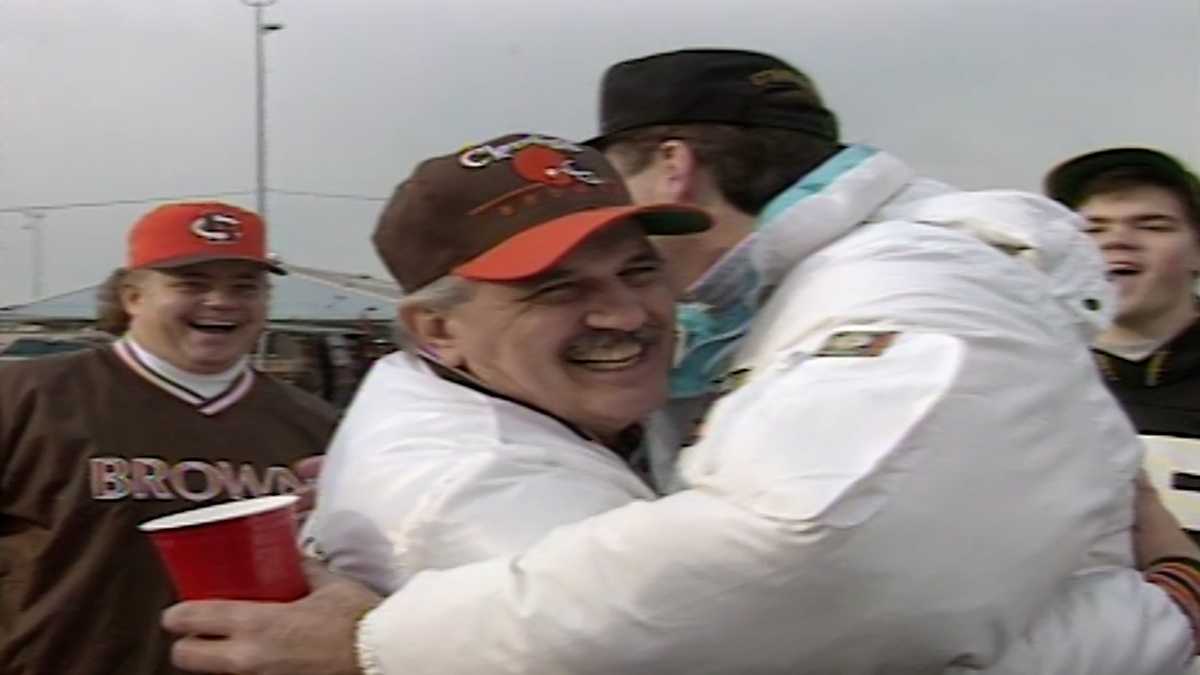
The most revealing Browns-Steelers scene did not end with two sets of supporters trading insults. On November 26, 1995, Pittsburgh played at Cleveland Municipal Stadium as the Browns prepared to leave the city. Owner Art Modell's plan to relocate the football operation to Baltimore threatened to erase not just a roster from Cleveland's calendar but a fixture of the region's shared life. The Steelers won that game 20-17, yet the score is rarely the reason anyone remembers the afternoon.
Archival reporting from the stadium shows fans of the rival teams embracing, aware that this might be their last chance to share the ritual. Their support for different teams had not disappeared. What had changed was the comparison: a hated opponent across the line suddenly seemed preferable to no opponent at all. Rivalries need continuity, and Cleveland was about to lose its team. Pittsburgh supporters could recognize that loss without offering Cleveland any mercy in the standings.
The Browns franchise's departure after the 1995 season created a gap from 1996 through 1998. The NFL eventually returned to Cleveland in 1999 with the Browns name and historical identity intact, while the relocated football organization operated as the Baltimore Ravens. This is an important distinction: the rivalry's Cleveland side sees its history as having remained with the city, rather than treating the 1999 team as the beginning of an entirely new emotional story.
Yet returning the brand did not instantly restore competitive balance. Pittsburgh spoiled Cleveland's 1999 return with a 43-0 road victory in the clubs' first meeting of that season. For the Browns, that score captured the cruelty of resuming a historic argument without the organizational momentum to compete on equal terms. For the Steelers, the old rival had returned, but it had to earn its place on the field again. The uneven years that followed made that demand harder to answer.
GOATIFY
GOATIFY NFL
A rivalry survived the disappearance of its Cleveland team. Celebrate the shared football tradition with GOATIFY NFL gear.
The episode also helps draw a necessary line between fierce fandom and actual mistreatment. Debating a referee, celebrating a defensive stop or remembering a humiliating score is part of the culture around this game. Player misconduct, personal threats or violence are not an admirable expression of loyalty. The moment in 1995 when rival supporters could show sympathy remains a better measure of how deeply both cities understood what the matchup meant.
The playoff ledger explains Pittsburgh's edge — and Cleveland's one unforgettable answer

The teams meet twice in a normal regular season, but their playoff history is surprisingly narrow. Only three postseason meetings are in the rivalry ledger through November 2026. Pittsburgh won the first two, in the 1994 season and after the 2002 campaign. The latter was a 36-33 wild-card escape in January 2003, the sort of result that reinforced the Browns' frustration: even when a game was there to be taken, the opponent usually found a way to survive.
Then came January 10, 2021. Cleveland traveled to Pittsburgh for a wild-card game and won 48-37, its first playoff victory since the 1994 season. A catastrophic opening for the home team helped the Browns race to a 28-0 first-quarter lead. Pittsburgh fought back and piled up passing production, but the Browns had created a cushion big enough to turn a tense finish into a milestone. That win gave Cleveland a result that its supporters could hold against years of lectures about the difference between the franchises.
It mattered more than one victory in an individual season. Football rivalries thrive on their exceptional days: the upset no one predicted, the turnover that changed momentum, the moment an old script failed. Cleveland's playoff breakthrough supplied a modern counterweight to Pittsburgh's overwhelming run of head-to-head success. It did not erase earlier losses, and it did not make Cleveland the more successful recent organization. It proved that the underdog could change the stakes on a night that actually ended someone's season.
Still, the rivalry's arithmetic is difficult to ignore. The Steelers led 84-66-1 overall after the second 2026 meeting, and Pittsburgh's record in the three playoff games remained 2-1. A rivalry can be emotionally balanced without being statistically balanced. The Browns have enough signature successes to make the fixture meaningful, but the Steelers have accumulated more weeks in which the result matched expectations. That difference is why one Cleveland win tends to be celebrated as a statement, while Pittsburgh fans often treat a victory as the price of doing business.
Some notorious confrontations have also become part of the lore, including the 2019 on-field incident involving Myles Garrett and Mason Rudolph. Its place in the record is not an invitation to glamorize it. The most revealing contrast is between the rivalry at its best — difficult football, shifting tactics, high-pressure postseason consequences — and moments when emotion crosses a line. The former makes this game worth protecting; the latter is not the reason it deserves its reputation.
The 2026 split shows why location, division games and standards still matter

Fast-forward to the 2026 regular season and the old home-field divide looked almost laboratory-clean. On October 1, Cleveland beat Pittsburgh 27-24 at Huntington Bank Field. Exactly one month later, the Steelers won the return 27-6 at Acrisure Stadium. The first result gave Browns supporters evidence they could win a meaningful divisional game in front of their crowd. The second was a reminder that traveling to Pittsburgh remains an altogether different assignment.
GOATIFY
GOATIFY NFL
Playoff nights make a rivalry legendary. Browse original GOATIFY football apparel and fan accessories.
In the November 1 game, Jaylen Warren ran for 143 yards and a touchdown, and Pittsburgh's defense sacked Cleveland quarterback Deshaun Watson eight times. The Steelers amassed 200 rushing yards, forcing the Browns to defend both field position and the clock. It was not only a numerical reversal of October's three-point Browns win. It changed the game's texture: Cleveland's offense could not sustain enough possessions to make the opponent uncomfortable, while Pittsburgh repeatedly dictated terms at the line of scrimmage.
That victory marked Pittsburgh's 23rd consecutive regular-season home win against Cleveland at the stadium opened in 2001, tying an NFL record for consecutive home victories over a single opponent. The exact record is a better explanation of the rivalry's modern asymmetry than sweeping claims about which fan base wants it more. Cleveland can win in Cleveland; the deeper challenge has often been turning one dramatic home performance into repeatable success in Pittsburgh. Travel alone does not explain decades of results. Execution, roster depth and a program's ability to withstand hostile momentum matter more.
The two 2026 head-to-head results also matter in the AFC North beyond pride. Divisional games feed directly into the standings and can affect postseason tie-break calculations. Splitting the season series denies either club a clean two-game head-to-head sweep, making records in other divisional and conference contests more important if their final totals are close. It would be wrong to announce a settled playoff picture in November; the remaining schedule still matters. What is settled is that neither team can count on the other to supply an easy second win.
That is the enduring challenge for both sides. Cleveland must turn its best isolated moments into a consistent standard, not just a set of cathartic Sundays. Pittsburgh must avoid allowing a history of control to become complacency, especially when the Browns show they can challenge the balance at home. Their shared division forces the debate to recur, whether the quarterbacks, coaches and postseason forecasts change or not. The Turnpike Rivalry continues because neither club has the option to file it away as history.
A rivalry is sometimes described as a collection of grudges. This one is closer to a collection of competing definitions of success. Cleveland's case begins with its dominance at the NFL's doorstep, survives a painful relocation and points to its 2021 postseason victory as proof that the hierarchy can still be challenged. Pittsburgh's case rests on the longer ledger, sustained winning and the striking difficulty Cleveland has had breaking through on the road.
After 151 meetings, the Steelers lead 84-66-1. The number is concrete, but it cannot tell the whole story of two fan bases who have seen the same highway connect joy, anger, resilience and occasional solidarity. The next Browns-Steelers game will add one more result. It will not end the argument — because the argument is part of what both cities have spent 76 years building.
GOATIFY
GOATIFY NFL
Shop GOATIFY NFL and American football shirts, hoodies and stickers.


















