England Went 3–0 Up. Trafford Saved the 3–2 Win Tuchel Needed.
GOATIFYFor an hour, England made a visit to the world champions look almost comfortable. Then one defensive mistake, one red card and the most dangerous teenager in European football turned a three-goal lead into a test of survival. By the time the final whistle ended Sunday’s Nations League drama in Madrid, Thomas Tuchel had his defining result: Spain 2, England 3. But the player who kept it from becoming a collapse was the goalkeeper he had chosen ahead of an established international No. 1.
Harry Kane’s penalty, Ezri Konsa’s header and Ben White’s finish put England 3–0 up. Elliot Anderson’s dismissal for fouling Lamine Yamal opened the door for Mikel Oyarzabal and Nico Williams to make it 3–2, before James Trafford’s reflexes slammed it shut. England finished top of Group A3 and secured a seeded position in the Nations League quarter-finals. The night was both a demonstration of how good Tuchel’s side can be and a warning about how quickly its control can disappear.
That tension is why this result deserves more than a scoreline. The first hour said something meaningful about England’s ceiling; the last half-hour said just as much about its decision-making, goalkeeper depth and ability to survive a genuine elite-level storm.
England's first hour was a blueprint, not a lucky three-goal lead
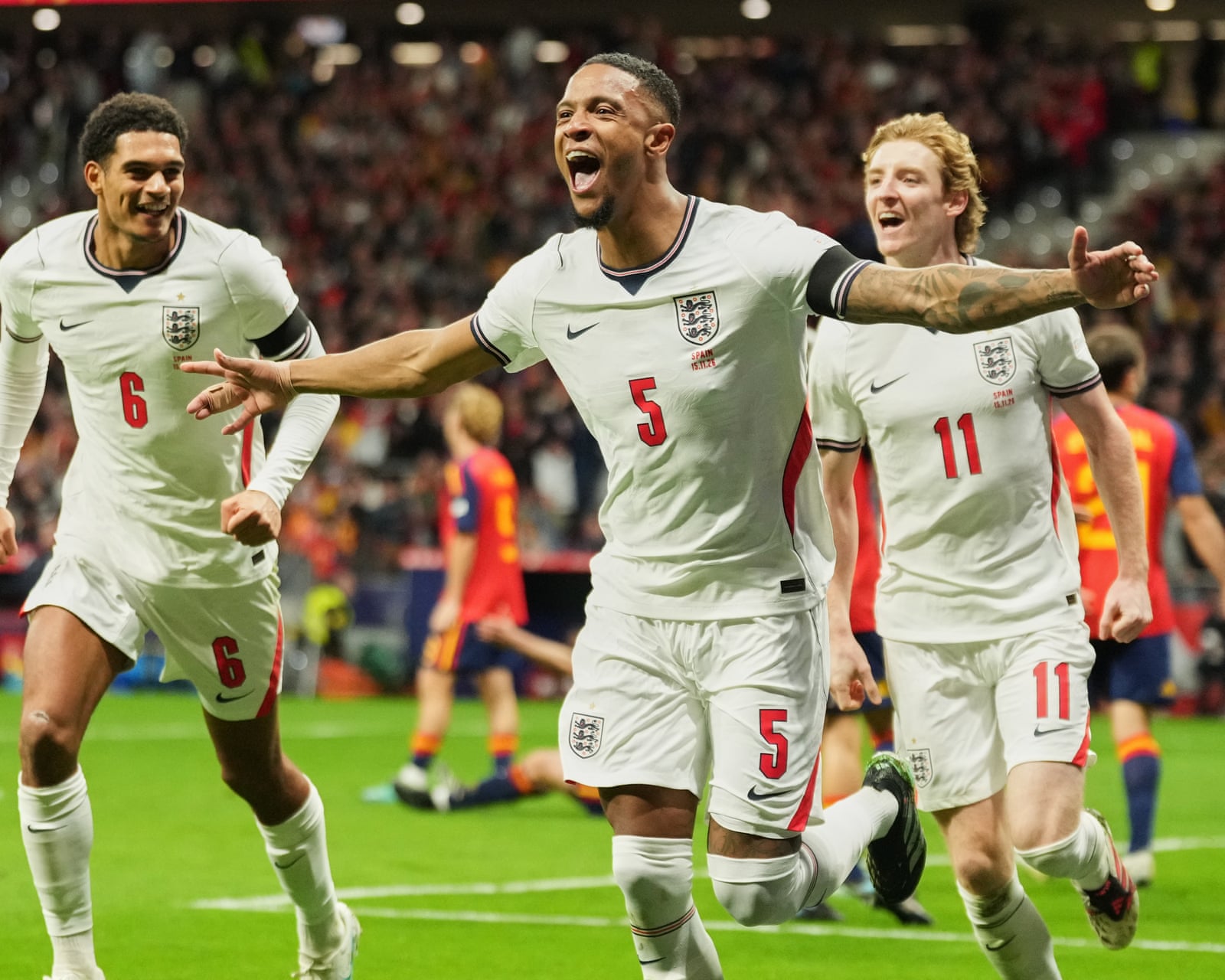
Calling the opening 60 minutes an ambush would flatter Spain. England did not wait for a counterattack or depend on an isolated piece of brilliance. They pushed their starting positions up the pitch, competed for the ball in midfield and tried to force the world champions to defend facing their own goal. In a stadium where visiting teams often spend entire spells simply chasing the ball, Tuchel's players set the terms instead.
The early chances established the tone. Jude Bellingham arrived in the area quickly enough to test Unai Simón, Anthony Gordon offered a direct running threat and Harry Kane repeatedly occupied defenders rather than standing isolated at the top of the attack. Declan Rice and Elliot Anderson were willing to receive under pressure and play forward. This was not possession for the comfort of the statistics sheet. England were using the ball to provoke decisions from Spain's back line.
That distinction matters because there are two ways to interpret a 3–0 lead against a powerhouse: a clinical team taking its few chances, or a team forcing enough uncomfortable situations for the score to become a reflection of play. England were much closer to the second category. Spain had very little room to build cleanly through the middle. The visitors supported attacks with numbers and were not afraid to commit their full-backs, especially Ben White, to the next phase.
The first breakthrough came from Kane's experience inside the penalty area. He made sure Pau Cubarsí could not recover a clean defensive position, drew the challenge and converted the penalty shortly before the interval. England's captain had missed from the spot in the reverse fixture at Wembley in September. In Madrid he made the same kind of chance count, registering his 93rd international goal. It was an important individual detail in a night that was not really about a single star.
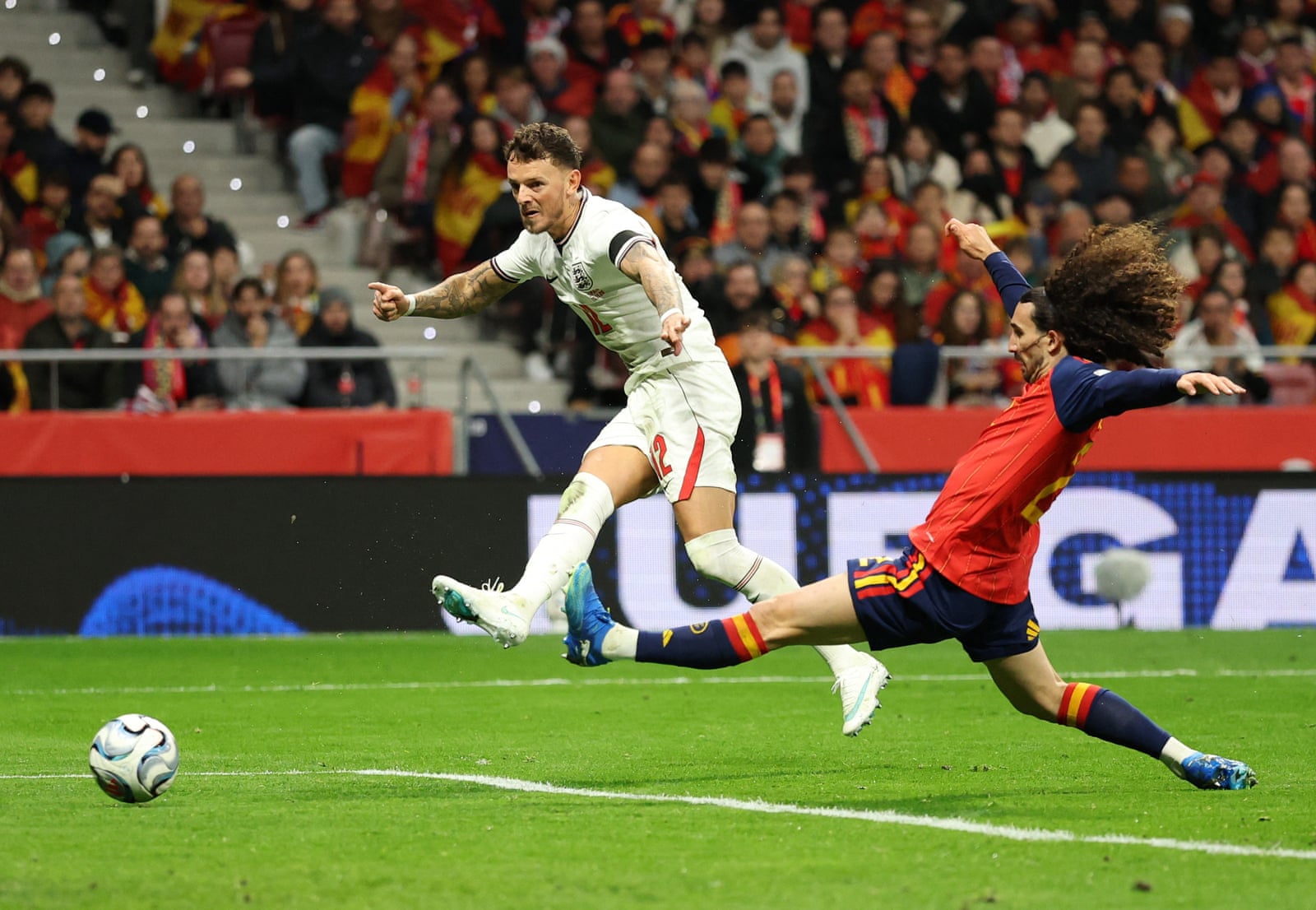
After half-time, England increased the punishment. Bellingham's forceful run helped win the corner from which Rice delivered and Konsa headed in the second. The central defender found space in a crowded area; that takes both delivery and coordinated movement, not merely luck. White then surged from right-back and completed a move involving Kane and Bellingham, finishing low to make it three. Those two goals showed different mechanisms: a set piece backed by rehearsed movement, then a full-back arriving in an attacking position where Spain were not ready for him.
GOATIFY
GOATIFY Soccer
England's fearless first-hour football made Madrid believe in the Three Lions. Explore GOATIFY Soccer fan designs and match-day gear.

Jude Bellingham – World Cup Champion GOAT Sticker
Add football personality to your favourite gear.
Shop Now ↗


Jude Bellingham – Football’s Coming Home Sweatshirt
A football fan design for everyday wear.
Shop Now ↗
Kylian Mbappe Red Ninja Turtle Raphael with Mug
Add football personality to your coffee break.
Shop Now ↗It would be tempting to say a three-goal lead settled the question of whether England could compete with the world's best. What it actually showed was more specific and more useful. Tuchel can field a side that presses with conviction, creates from multiple areas and keeps technically gifted opponents from dictating the tempo. Those are repeatable principles. Whether the team can maintain them through fatigue, substitutions and changes of momentum is a separate challenge—and one Madrid was about to deliver in brutal fashion.
One Quansah error gave Yamal a route back into a game Spain had lost
The most dangerous stage of a convincing victory can be the moment when the winning side believes the difficult work has already been done. At 3–0 England had a margin most teams would consider secure. Against Lamine Yamal, however, the danger did not disappear with the scoreboard. It just needed one opening.
Jarell Quansah was dispossessed as the last defender, and Yamal immediately turned the loose-ball situation into an attack on the penalty area. Anderson's attempt to stop him was judged a foul worthy of a straight red card. The punishment came in two parts: England lost a midfielder for the rest of the match and Spain gained a penalty. Oyarzabal converted it, turning what had looked like a rout into a game with a sharp new emotional direction.
Anderson's decision is worth examining without making it a morality play. A defender or midfielder protecting a three-goal lead must assess the difference between allowing a shot and committing a foul that may bring dismissal and a penalty. The temptation to intervene is powerful when a player of Yamal's quality has escaped toward goal. But it also carries a potentially greater team cost than the chance itself. England paid that cost immediately: they were forced to give up territory, reorganize their midfield and defend for an extended period with only ten men.
The key tactical change was not merely numerical. Spain were suddenly encouraged to attack with greater directness and less fear of an English counterpress. Yamal began to receive the ball in areas where he could face defenders, shift them with a first touch and make the extra pass before the back line could settle. England's wide players had previously been part of the attacking thrust; now they had to run repeatedly toward their own goal.
Spain's second was the clearest illustration. Gordon lost possession in midfield and the ball was worked to Yamal on the right. His delivery reached substitute Nico Williams, who finished to cut the deficit to one. The earlier English combination play, so decisive in constructing the lead, had been replaced by Spanish attacks arriving quickly enough to make every clearance feel temporary. The home crowd had a reason to believe a draw was coming.
Tuchel tried to restore balance through personnel. Myles Lewis-Skelly replaced Kane, Djed Spence came on for Gordon and Dan Burn later reinforced the defensive effort. Those decisions sacrificed the attacking options that had helped produce the lead, but the calculation was straightforward: with ten men, England now needed to defend areas, not dominate every phase. Even so, retreating is never as simple as adding defenders. The midfield still had to prevent clean passes into Yamal, the full-backs had to avoid being isolated and any won ball had to be retained long enough to relieve pressure.
That is the uncomfortable lesson of the red card. England's first-hour dominance was real, but a single avoidable transition altered the structure of the match. Spain's quality made the error expensive rather than terminal. The Three Lions survived the change, but the reason they did so increasingly wore goalkeeper gloves.
GOATIFY
GOATIFY Soccer
The game flipped in one moment, but football's drama doesn't need a final whistle to deliver a surprise. Shop GOATIFY Soccer shirts and stickers.


Kylian Mbappe – World Cup Champion GOAT Sticker
Add football personality to your favourite gear.
Shop Now ↗

Bottlers FC Tottenham Hotspur Parody , Spursy Sweatshirt
A football fan design for everyday wear.
Shop Now ↗

Trafford earned his England goalkeeper argument in the thirty minutes that mattered
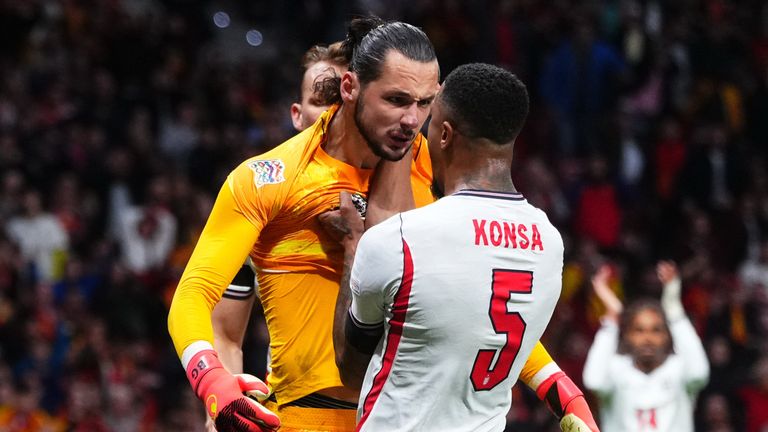
For most of the first hour, the most revealing fact about James Trafford's evening was how little he had to save. Spain struggled to create a clear route into England's penalty area while the visitors controlled the pace. That made Tuchel's decision to start the Leeds United goalkeeper instead of Jordan Pickford look bold but hardly testable. Then Anderson went off, and the entire selection debate was compressed into half an hour.
Suddenly Trafford was dealing with wave after wave of attacks. He had to hold his position while Yamal picked passes, reset immediately when shots created rebounds and stay mentally present despite the drastic change from long periods of near inactivity. Spain forced chances through Fermín López, Williams and other late runners. Trafford reacted to shots at close range, then had to be ready for the second ball. Those actions were not isolated spectacular reflexes: they were a demonstration of concentration under sustained stress.
The sequence everyone will remember came in added time. Trafford made an initial save and recovered fast enough to stop another attempt in the same movement, preserving the 3–2 score at precisely the point when England had almost no margin left. It was the kind of moment that turns an excellent team display into an actual victory. All the tactical bravery of the opening hour would have been remembered differently had the goalkeeper conceded a third.
The bigger question is what one extraordinary match means for the depth chart. Pickford has years of England experience and has repeatedly delivered in major tournaments. Trafford entered Madrid with a fraction of that senior international résumé, though his 2026 club form was strong. The goalkeeper had conceded eight league goals for Leeds from opportunities assessed at 12.40 expected goals; that goals-prevented difference of roughly 4.40 is a useful sign of positive shot-stopping performance, not a complete measurement of everything a keeper contributes. Pickford also had a positive differential by the same metric, so the comparison should not be reduced to a single late double save.
Distribution matters as well. Tuchel's approach demands that a goalkeeper offer a passing option when opponents press aggressively, rather than simply launch the ball at the first sign of danger. Trafford had already helped England move through Spain's first line of pressure before the red card. When a manager wants his team to take calculated risks in buildup, the person at the back must understand when to invite pressure and when the safe clearance is the correct answer.
The temptation now is to announce that the No. 1 shirt has changed hands. Tuchel has resisted that certainty, stressing competition rather than handing out a permanent promotion. That is sensible. Trafford has proved he can handle a terrifying thirty-minute examination against elite opposition, but a first-choice international keeper is judged across many different match states: set-piece congestion, long stretches without a shot, aerial pressure, distribution, defensive organization and the ability to make difficult decisions in ordinary games.
Still, the practical outcome is unmistakable. Pickford is no longer competing solely with a promising understudy. He is competing with a goalkeeper who has produced a signature performance when the stakes were highest. England's goalkeeper debate did not need a manufactured controversy before Sunday. It now has the evidence of Madrid, and that is a much more meaningful source of pressure.
Tuchel won the group, but the quarter-finals will test what England learned
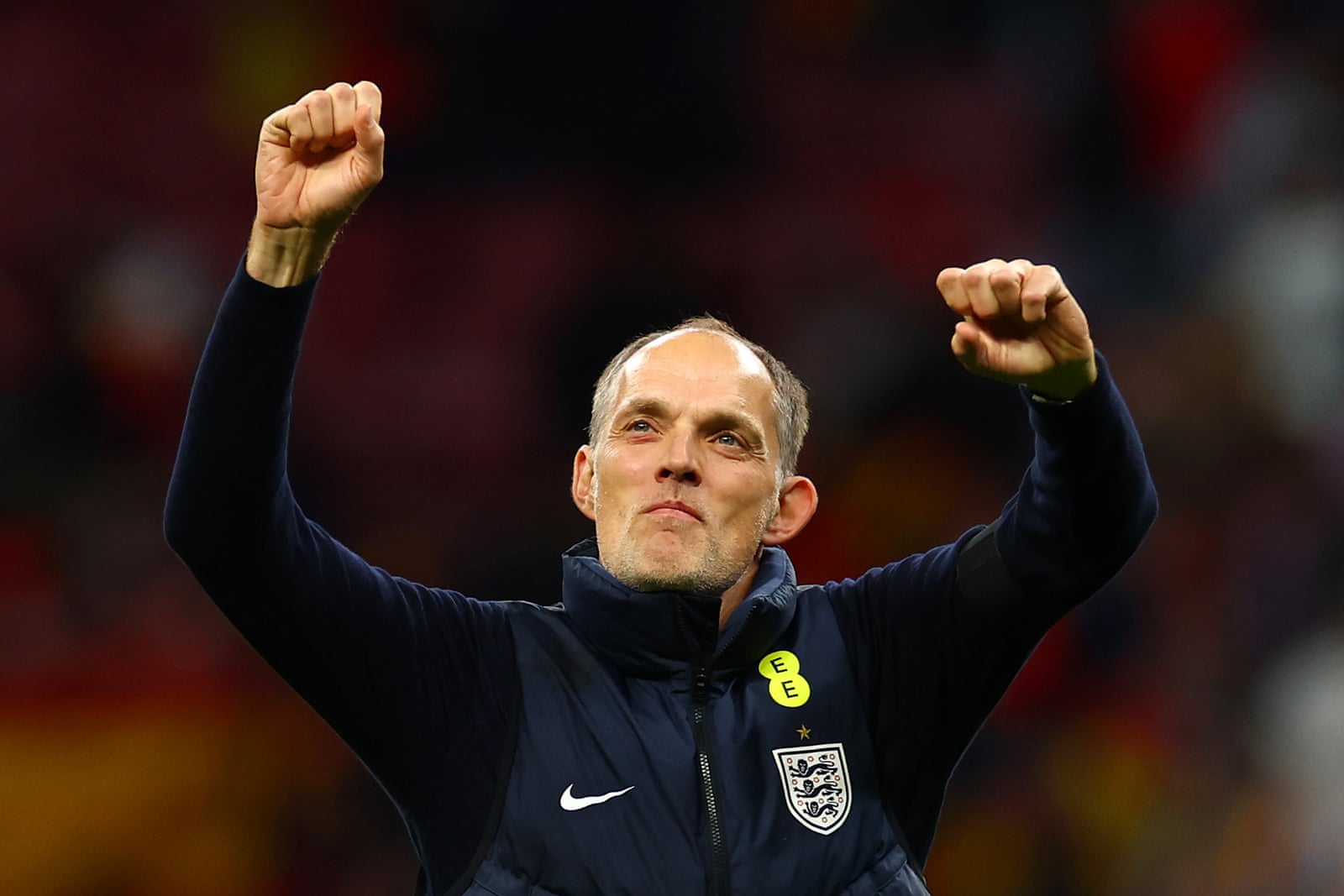
England's reward is concrete: first place in their Nations League group and a seeded place in the quarter-final draw. That means the 3–2 victory was not simply a good night against a famous opponent. It changed the competitive position from which Tuchel's team enters the next stage. The two-legged quarter-finals in March will demand something different again: control over an entire tie, not merely one memorable hour.
GOATIFY
GOATIFY Soccer
From goal-line heroics to the last tackle, celebrate football's unforgettable pressure moments with the GOATIFY Soccer collection.

Lionel Messi - GOAT Soccer Crewneck Gift Sweatshirt
A football fan design for everyday wear.
Shop Now ↗
Trashford Marcus Rashford Manchester United Hoodie
A football fan design for everyday wear.
Shop Now ↗
Kylian Mbappe France Euro 2024 Ninja Turtle Mug
Add football personality to your coffee break.
Shop Now ↗

Championshit Tottenham Hotspur Parody , Sticker
Add football personality to your favourite gear.
Shop Now ↗
Kylian Mbappe Ninja Turtles Real Madrid Soccer Hat
A football fan design for everyday wear.
Shop Now ↗There is a reason Tuchel described the victory as his strongest performance as England manager. Spain were not a convenient opponent whose reputation exceeded their form. Their run of results since the previous season had been extraordinary, with only a penalty-shootout defeat interrupting a 43-match stretch before this game. Winning in Madrid while playing assertive football for the majority of the contest should count as a legitimate sign of progress.
But the manager should separate three strands of the performance when he reviews it. The first is the initial plan, which succeeded emphatically. England pressed as a unit, advanced through midfield, made room for Bellingham to carry the ball and involved White in attacking zones without disconnecting the rest of the side. The second is the moment of defensive decision-making that created the red card. Quansah's mistake and Anderson's intervention cannot be wished away because the team ultimately won. The third is the response to being a man down: a combination of resilience, substitutions, individual defending and extraordinary goalkeeping.
Those strands call for different work on the training pitch. Tuchel should preserve the boldness that made the first hour possible. Asking England to become timid because they nearly lost a three-goal lead would be exactly the wrong lesson. Equally, he needs clear rules for how his defenders and midfielders deal with transitions when they are the last player between a dribbler and goal. A foul that changes the game's numbers can be costlier than the chance it prevents.
There is also a selection problem of the desirable kind. Bellingham's driving runs were central to England's attacking momentum. Rice combined defensive responsibility with decisive delivery. Kane remains a reliable penalty taker and focal point. White's advanced role gave the side another way to threaten. Trafford then showed that a goalkeeper outside the previous hierarchy could win a match against the strongest opposition. Rather than narrowing Tuchel's choices, the Spain result has supplied him with more ways to build a side for different opponents.
Spain's final half-hour is a warning not to mistake score control for performance control. They had the talent to turn one opening into a prolonged assault, with Yamal making the decisive connections. England's next elite opponent may punish an identical mistake even more efficiently, or may not allow a three-goal lead in the first place. A seeded quarter-final draw offers an advantage, not immunity.
The lasting value of Madrid therefore lies in the balance of two truths. England were brave enough and organized enough to trouble the world champions in open play. They were also fallible enough to almost erase their own achievement. A manager building toward knockout football needs to keep both truths in view. The first tells Tuchel he has the foundations of a dangerous side; the second tells him where the structure still needs reinforcing.
England did not beat Spain because the world champions were suddenly ordinary. Tuchel’s side beat them by making the first hour uncomfortable, turning aggressive movement and brave passing into a three-goal advantage, and then holding their nerve when everything changed. The red card makes the performance harder to summarize but not less impressive.
Trafford left Madrid with the save sequence everyone will replay. Bellingham, Rice, Kane, Konsa and White supplied the attacking platform that made those heroics worth three points. Yamal and Spain supplied a reminder that control against a great side is always temporary unless it is protected by sound choices.
The next test is not another highlight reel. It is whether England can repeat the positive patterns without needing a goalkeeper to rescue them, and whether Tuchel can turn a famous one-off into a dependable formula for the knockout rounds.
GOATIFY
GOATIFY Soccer
Shop GOATIFY soccer and football shirts, hoodies and stickers.


Kylian Mbappe Blue Ninja Turtle Leonardo with Mug
Add football personality to your coffee break.
Shop Now ↗
AMADNESS Amad Diallo Manchester United Sweatshirt
A football fan design for everyday wear.
Shop Now ↗
Manchester Shitty Football Parody Decal Sticker
Add football personality to your favourite gear.
Shop Now ↗