

Mexico's $1 Billion F1 Race Is Betting on Fans, Not Superstars
GOATIFYFormula 1's Mexico City Grand Prix is approaching another enormous weekend, but its organisers are not trying to outspend every other race on celebrity spectacle. With more than 400,000 weekend admissions and promoter estimates putting its annual economic value around $1 billion, the event's pitch is surprisingly modest: make the water easy to find, keep the coffee hot, let Mexican culture lead and give the crowd a reason to come back.
That approach is especially revealing in 2026. Sergio Pérez returns to his home race with Cadillac and a 300th Grand Prix start on the horizon, while Kimi Antonelli could seal the world championship on Sunday. Those are major sporting storylines. Yet the people running the event insist its long-term identity must be larger than one driver, one championship or one headline act.
Mexico's question is no longer simply whether it can fill the Autódromo Hermanos Rodríguez. It is whether a locally rooted, expensive, government-supported Formula 1 event can keep earning its place in an increasingly competitive global calendar.
Why Mexico Is Choosing Small Details Over Celebrity Spectacle

Federico González, the Mexico City race promoter, describes a philosophy that sounds more like the operating manual of a good neighborhood business than the marketing strategy of a global sporting giant. The biggest experience is built from dozens of little decisions. Fans remember the state of the bathrooms, the temperature of a drink and whether getting around the venue feels straightforward. A star on stage can be exciting, but it cannot compensate for a frustrating day in the stands.
That is why the 2026 edition is leaning into Día de Muertos rather than trying to import an international celebrity for the national anthem. The Coral Ensamble México AC, an independent local choral organisation, is scheduled to perform it. Mexican wine will feature in hospitality, and the promoter is highlighting local food, crafts and traditions. The point is not that international entertainment is unwelcome; it is that a Grand Prix in Mexico should feel unmistakably Mexican.
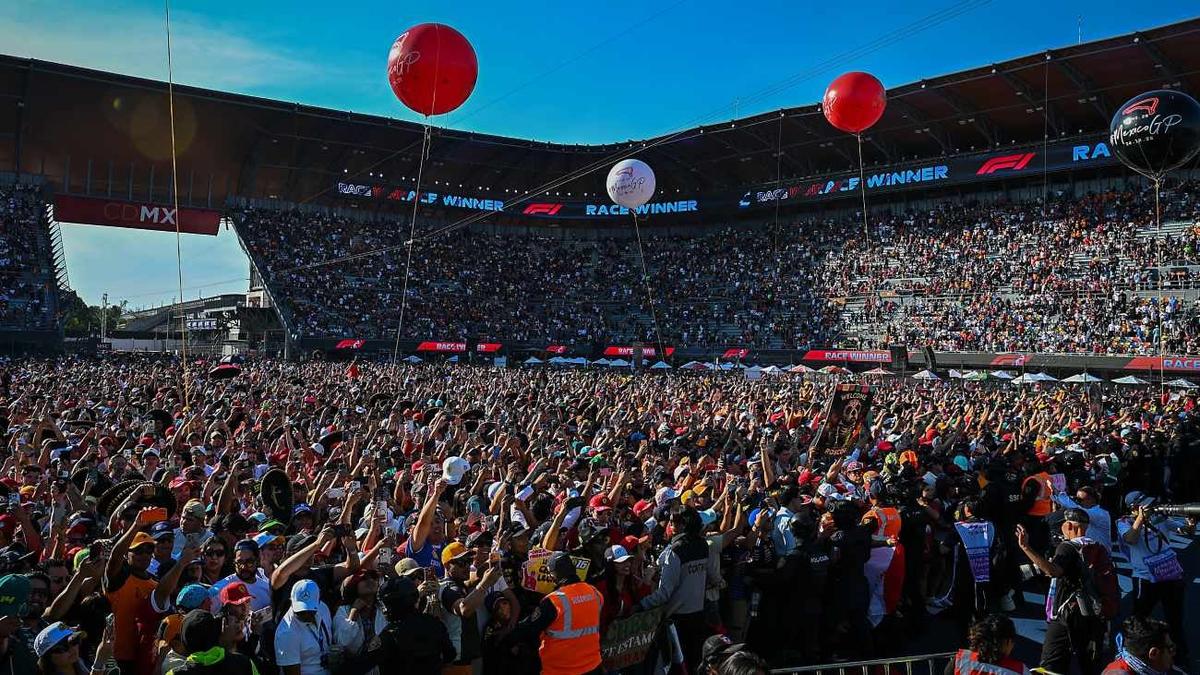
The circuit makes this approach unusually visible. Cars thunder along a long straight and then pass through the extraordinary stadium section, where the grandstands rise around the track like a football arena. The sight and sound of thousands of spectators packed into that bowl is part of the broadcast's identity. It is difficult to manufacture that feeling with a celebrity booking because the crowd itself supplies the spectacle. Even a driver running far outside the points can receive a stadium-sized reaction when the fans feel that the occasion belongs to them.
Mexico also wants the event's environmental work to have a local footprint. One initiative supports the restoration of Xochimilco's chinampas, the traditional agricultural islands and canals that are an important part of the region's cultural and ecological history. That is a more specific promise than a generic sustainability slogan. It still deserves scrutiny over measurable results, but the choice of project connects the race to the place hosting it.
None of this means a major event can operate cheaply. Large crowds require transport, security, temporary infrastructure and a huge workforce. The useful distinction is where the promoter wants attention to go. Instead of announcing a bigger show every year, Mexico is trying to make the core event smoother, more welcoming and more culturally recognisable. In a championship where venues compete for a limited number of calendar slots, that identity may be its strongest differentiator. It is a strategy that also gives regular ticket holders, rather than only hospitality guests, a direct stake in the event's success.

Pérez Is Back, but Mexico Already Proved It Can Survive Without Him

Sergio Pérez has been central to the modern Mexico City Grand Prix. For many spectators, seeing a Mexican driver on the grid transformed an international sporting event into a personal national occasion. His return with Cadillac in 2026, and the prospect of celebrating his 300th start at home, gives organisers an obvious emotional focal point. It also creates a useful test of how the event's audience has changed.
When the race returned to Formula 1 in 2015, the promoter recalls a crowd dominated by committed male racing followers. Since then, the sport's global audience has broadened, with more women, younger fans and people discovering racing through entertainment and social media. That shift is visible in the way a Grand Prix is consumed. Some visitors come for tyre strategy and lap times; others are drawn by the atmosphere, personalities, design and city-wide celebration. The strongest events can accommodate both groups without treating either as an afterthought.
The 2025 race offered evidence that Mexico's appeal is no longer dependent on a local driver being on the starting grid. Pérez was absent from Formula 1 that season, yet the event still recorded 401,326 admissions across three days, according to promoter figures. That was slightly below the 404,958 record from 2024, not a collapse. It is important not to treat the difference as a precise measure of Pérez's drawing power: ticket sales, capacity, pricing and other conditions all affect attendance. Three-day admissions also count visits, not necessarily that many unique individuals.
Now Pérez returns in Cadillac colours after extending his commitment to the new American team through 2029. He is not arriving in a championship-contending car, and his weekend will be judged differently from the years when he could challenge for podiums with Red Bull. The local reaction can nevertheless be enormous. A home hero does not need to win to give a race its most emotional moment. His appearance also offers the new Cadillac operation a rare opportunity to connect with a huge audience in person.
That is the delicate balance for organisers. They should celebrate Pérez as the remarkable story he is, while ensuring the entire event still works for the spectator who supports Ferrari, McLaren or Mercedes, or who simply wants to experience the atmosphere. A fanbase capable of filling the circuit with and without Pérez is more durable than one built around a single personality. His return is a bonus to an identity that has already grown beyond him. The future question is whether the event can keep those newer supporters interested when their favorite driver changes team, retires or fails to finish.

The $1 Billion Headline Is Huge — but It Needs Context

The numbers attached to Mexico City's Grand Prix are striking. The promoter points to an estimated annual economic impact around $1 billion, and studies covering the race's return in 2015 through 2025 attribute roughly $8.4 billion in cumulative economic benefits and media exposure to the event. The same long-term assessments cite more than 90,000 jobs supported across that period. Those figures explain why local politicians pay attention when the next contract negotiation comes around.
But an impact estimate is not the same thing as cash deposited into the city treasury. Tourism spending, local business activity, media exposure and wider multiplier effects can all appear in these calculations. The result depends on methodology and assumptions. A headline number may be useful for comparing years, but it should not be confused with a direct financial return to taxpayers or a guarantee that every resident benefits equally. A promotional valuation of media exposure is particularly different from money actually spent by visitors.
The scale of the race still has obvious practical consequences. Hundreds of thousands of admissions mean demand for hotels, restaurants, transport, catering, security, temporary construction and event staff. International visitors can spend money beyond the circuit, while global broadcasts provide visibility that an ordinary advertising campaign would struggle to replicate. The question is how much of that activity is genuinely additional, how much would have happened anyway and how effectively it reaches local businesses. A visitor who shifts an existing holiday to race weekend is not the same as a visitor who would otherwise never have come.
The organiser also argues that deliberately choosing Mexican suppliers, performers and hospitality products keeps more of the event's spending connected to the host economy. That is a sensible direction. It is also something that can be measured: procurement contracts, local hiring, environmental investment and visitor spending are more tangible than promotional impressions alone. The most persuasive case for public support would make those outcomes transparent rather than asking the public to accept one enormous figure on faith.
At the same time, Formula 1 itself is a powerful bargaining partner. Other cities want races, and hosting them requires substantial commercial commitments. Mexico's stadium atmosphere and cultural appeal are assets that competitors cannot easily copy, but they do not eliminate the cost of remaining on the calendar. For the event's supporters, the $1 billion figure is a powerful selling point. For policymakers, it should be the beginning of the evaluation, not the end. The most useful annual report would separate direct spending, estimated spillovers, promotional value and actual public costs so the race can be judged on evidence instead of spectacle.
The 2028 Contract Clock Is Already Ticking
Mexico City is secured on the Formula 1 calendar through 2028, but that does not mean its long-term future is automatic. The modern race has depended on a partnership with the city government since federal backing for the original return deal ended. The current arrangement places political decisions alongside commercial negotiations, and the next extension will need local authorities to conclude that the benefits still justify the investment.
The timing is significant. Mexico City's mayoral term runs through 2030, creating a period in which the current administration can consider the race's next chapter. Organisers say they want to continue, but they also acknowledge that a contract is ultimately a joint decision. The economic-impact argument, visitor experience, environmental projects and local supplier relationships will all be part of the case for renewal. No crowd size alone can guarantee that the political and financial terms will remain acceptable.
One addition already planned for 2027 is Formula 2 support racing. That matters beyond giving ticket holders another session to watch. A visible route through the junior categories helps fans understand where future Formula 1 drivers come from, and it creates another stage on which emerging Mexican talent might eventually compete. For a country whose modern F1 identity has been so closely linked to Pérez, showing the next generation has particular resonance. It could also give young supporters a reason to follow the sport beyond the biggest Sunday names.
The circuit itself remains a major part of the package. At more than 2,000 metres above sea level, the Autódromo Hermanos Rodríguez asks unusual questions of car cooling, aerodynamics and engine management. The track's long straight and stadium section give drivers and spectators a combination that is hard to find elsewhere. In 2026, the racing stakes are substantial too: Antonelli arrives close to sealing the title, while Pérez's home milestone gives the crowd a separate reason to celebrate. Those two stories can coexist without the event having to choose one identity.
The danger for any successful event is believing that a sell-out means the job is finished. The promoter's emphasis on cold drinks, clean facilities, local music and authentic culture is an admission that a great race weekend is assembled one experience at a time. Mexico has already proved it can attract a vast audience. The harder assignment is making that audience, the city and Formula 1 all want the partnership to continue after the current deal expires. That means treating the race as a long-term civic relationship, not merely a three-day broadcast opportunity.

The Mexico City Grand Prix does not need to imitate Las Vegas or any other race to justify its place. Its strengths are already visible: a huge and evolving audience, a spectacular circuit, a distinct cultural setting and a returning national hero. The real test is whether organisers can turn those strengths into lasting value for the people who host the event.
That means treating economic estimates as claims to substantiate, not trophies to display, and remembering that the fan who needs water, transport or a clean restroom matters as much as the VIP guest. Mexico's most persuasive argument for staying on the calendar may be the simplest one: it knows exactly what kind of Grand Prix it wants to be.

















