Salazar Survived 3½ Hours — Then Sánchez and Ustero Won 6-1, 6-1
GOATIFYAlejandra Salazar spent three hours and 31 minutes fighting for one more match in her final professional season. Alongside Aranzazu Osoro, she survived a deciding-set tiebreak against Araceli and Lucia Martinez to reach the Germany Premier Padel P2 quarter-finals in Düsseldorf. The reward was barely a pause before facing the hottest women's partnership on tour.
By Friday afternoon, that contrast had become the story. Ariana Sánchez and Andrea Ustero beat Salazar and Osoro 6-1, 6-1, according to the tournament's updated match results. A marathon escape on Thursday was followed by a one-sided exit against a pair arriving with consecutive titles in Paris and Rotterdam. It is tempting to explain everything through fatigue, but the score alone cannot establish that. The more interesting question is how two different kinds of competitive strength collided in the same 24-hour stretch.
Salazar's week also fits into a wider Düsseldorf picture: the women's seeds all survived the round of 16, while the men's contenders navigated wildly different routes into the last eight. The German P2 is showing the gap between earning another opportunity and having the resources to seize it.
Salazar's 3-Hour, 31-Minute Escape Was a Win in Its Own Right

Salazar and Osoro's 7-5, 6-7, 7-6 victory over Araceli and Lucia Martinez was the longest women's round-of-16 match in Düsseldorf. Three sets, two narrow finishes and a deciding tiebreak demanded concentration well beyond the usual rhythm of a straight-sets win. At 40, Salazar is approaching the end of a career that has stretched across eras of professional padel, but her willingness to keep competing for every point has not diminished.
The match was not a routine victory dressed up by its duration. The first set finished 7-5; the Martinez pairing answered by taking the second 7-6; then Salazar and Osoro had to find another tiebreak to finish the job. When both pairs keep returning to level terms, neither can simply protect a comfortable lead. The emotional and tactical demands accumulate as the match stretches, and every new service game becomes a fresh chance to lose the advantage.
That makes the result meaningful even without a trophy attached. Salazar has said she wants to enjoy her final season until the last point. Her farewell is not merely a sequence of ceremonies: she is still contesting high-pressure matches against younger opponents and still winning some of them. Osoro deserves equal billing. Doubles endurance depends on both players defending the glass, making good decisions under pressure and giving the partner enough confidence to keep taking the right risks.
The partnership has spent recent weeks regularly reaching quarter-finals, including in Madrid, Paris and Rotterdam. Those appearances are not the same as beating the top seeds, but they establish that Salazar and Osoro remain difficult to dismiss. In Paris, they even took a set from Sánchez and Ustero and led 2-0 in the deciding set before losing six straight games. Düsseldorf gave them another opportunity to test that matchup, only after a substantially more exhausting route through the previous round.
The important distinction is between admiring a marathon and assuming it guarantees momentum. Winning after three and a half hours proves resilience in that match. It does not restore the energy spent getting there. The quick turnaround to a quarter-final against an in-form partnership was the harshest possible way to test how much of Thursday's escape could carry into Friday.

Sánchez and Ustero Turned the Quarter-Final Into a 6-1, 6-1 Statement

Sánchez and Ustero made the quarter-final emphatic: 6-1, 6-1. The result should be reported for what it is, a straight-sets win by the higher-ranked, in-form partnership, rather than treated as proof of a particular injury or physical problem for Salazar and Osoro. Without reliable point-by-point or medical evidence, claims about exhaustion causing the defeat would go beyond the available record.
There was a striking difference in how the two pairs reached this stage. Sánchez and Ustero also needed three sets in the round of 16, recovering from 4-6 down to beat Jimena Velasco and Raquel Eugenio 4-6, 6-3, 6-1. But their second and third sets showed an ability to change the direction of a match decisively. Against Salazar and Osoro, they carried that authority into the next round without allowing the contest to become another extended test of nerves.
Their recent form makes the result less surprising than the margin might suggest. The Spanish duo won the Paris Major and then the Rotterdam P2 in consecutive weeks. In Rotterdam they defeated Paula Josemaría and Bea González 6-4, 6-4 in the final after eliminating world No. 1 pair Gemma Triay and Delfi Brea in the semi-finals. That run is not just about confidence; it means they have already solved a range of high-level pairings under title pressure.
The tactical explanation has to remain conditional without detailed shot-level data from Düsseldorf. Sánchez is capable of building points patiently and defending difficult spaces, while Ustero can change a rally's tempo with attacking choices. Against an older pairing coming off a marathon, shortening exchanges and refusing to surrender initiative would be a logical approach. But the verified fact is the scoreline, not a complete map of how each game was won.
For Salazar, the loss does not erase the previous evening. It does, however, underline the unforgiving level of the tour's leading partnerships. She can still create a dramatic moment, still reach the business end of events and still make her final season matter on court. What she cannot control is whether the next opponent offers any room to recover. For Sánchez and Ustero, another convincing win strengthens the case that their Paris-Rotterdam surge is becoming a sustained run rather than a short-lived peak.
Coello, Tapia and Lebrón Kept the Men's Title Race Moving
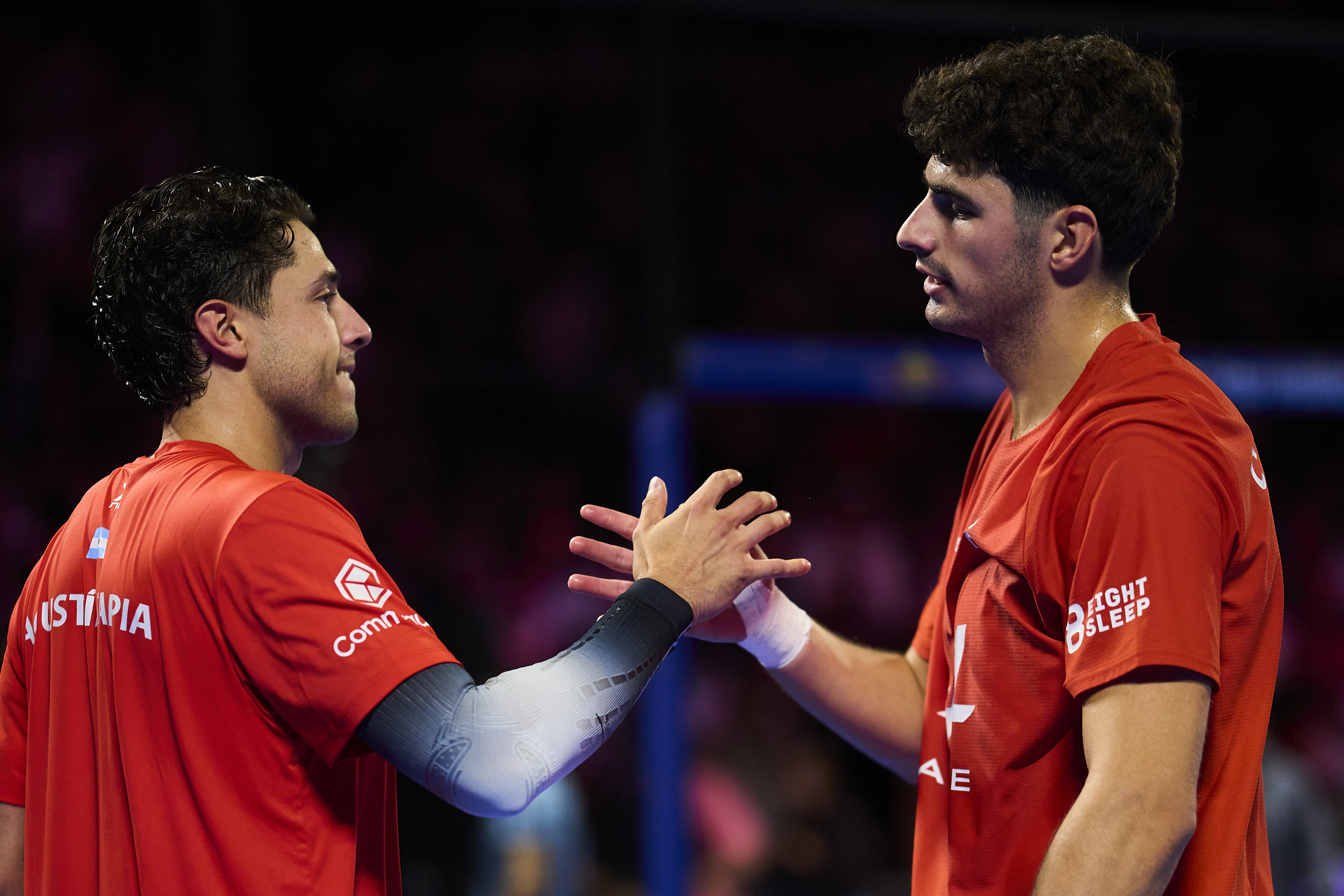
The men's draw delivered its own test of how favourites handle different routes through a tournament. Arturo Coello and Agustín Tapia moved past José Antonio Diestro and Marc Sintes 6-2, 6-3 in the round of 16, then defeated Gonzalo Alfonso and Tino Libaak 6-2, 7-5 in Friday's quarter-final. The second set was tighter, but the world No. 1 pair still avoided a deciding set and advanced toward another title weekend.
Alfonso and Libaak had earned their chance. They beat Fran Guerrero and Javi Leal earlier in the week, then overcame Solano Marmolejo and Ramiro Pereyra 6-3, 6-4 to reach the last eight. The Argentinians had also been named in their country's World Cup squad, adding another significant week to a partnership that has built momentum beyond one event. Their reward was a rematch with the toughest pairing in the sport, only a week after pushing Coello and Tapia to three sets in Rotterdam.
Juan Lebrón and Leo Augsburger likewise recovered from a slow start in the round of 16, beating Iñigo Jofre and Juanlu Esbrí 3-6, 6-3, 6-3. They followed that comeback by defeating Maxi Arce and Juan Tello 6-3, 6-3 in the quarter-finals. Those results show why the scoreboard from one difficult set cannot tell the whole story of a title contender. The strongest pairs often distinguish themselves through the adjustments they make after an uncomfortable start.
At the other end of the men's draw, defending champions Alejandro Galán and Federico Chingotto had survived Javi Garrido and Juani De Pascual 4-6, 6-1, 7-5. Their next challenge was a reunion with Maxi Sánchez Blasco and Sanyo Gutiérrez, who advanced after beating lucky losers Álvaro Montiel and Dani Santigosa 6-2, 6-2. Franco Stupaczuk and Jon Sanz were scheduled to meet Martín Di Nenno and Paquito Navarro in another meeting between established names.
These matchups give Düsseldorf a useful measure of competitive depth. Some favourites cruise, some are forced to rebuild a match, and some outsiders use one upset to demand another opportunity. The women's quarter-finals provided the sharpest contrast of all: Salazar's epic route into the last eight, followed immediately by Sánchez and Ustero's overwhelming response.

Düsseldorf has already produced a memorable passage in Salazar's farewell season. The 3-hour-31-minute victory was a reminder that her competitive identity is still intact. The 6-1, 6-1 defeat that followed was a reminder that the sport's new leading partnerships do not make room for sentiment.
For Sánchez and Ustero, the next question is whether their recent winning streak can carry them to a third consecutive title. For the men's favourites, the weekend will test whether the top seeds can turn another demanding draw into a final. And for Salazar, the story remains larger than Friday's score: she is still competing, still fighting through long matches and still writing the closing chapter on her own terms.
Shop GOATIFY padel products from the Padel-filtered collection scope.