Brennan Hit Every Fairway — Six Pars Won Him a Third PGA Tour Title in Japan
GOATIFYMichael Brennan did not finish the Baycurrent Classic with a spectacular birdie barrage. He finished it with six consecutive pars, a flawless final-round driving record and a lead that nobody could quite erase. On Sunday, October 11, the 24-year-old American closed with a three-under 68 at Yokohama Country Club to win at 16-under 268, one stroke ahead of Jacob Bridgeman and Keith Mitchell. The margin was narrow; the control behind it was not.
Bridgeman had a short chance to catch him. Mitchell had briefly surged clear. Defending champion Xander Schauffele arrived at the last hole within striking distance. Each challenger found a way to lose ground while Brennan kept finding the fairway and making the putts he needed. That combination has become the defining feature of his rise: three PGA Tour victories in only 33 starts, including two in 2026, without needing every Sunday to look the same.
The winning stretch was six pars, not six birdies
Golf highlights usually reward the shot that changes a leaderboard. Brennan's final round in Yokohama was more revealing for the shots that did not change it. He made four birdies and one bogey for a 68, yet the signature sequence was six pars from the 13th through the 18th. Those six holes were not an absence of ambition. They were the practical response to a crowded leaderboard on a course where one misjudged approach, bunker shot or tee ball could erase an entire day's work.
The turning point had already come. Starting Sunday tied with Jacob Bridgeman and Zach Bauchou at 13 under, Brennan dropped a shot at the 10th. He then birdied the 11th and 12th, repairing the mistake immediately and moving into the position that would hold up through the final group. It is tempting to call that response a momentum swing, but the useful detail is how little he allowed the bogey to dictate the rest of the round. Two good scoring chances were converted; the remaining task was to keep the ball in play.
That last part was unusually literal. Brennan found all 15 fairways in the final round. For a player known for producing serious speed off the tee, a perfect driving record is more than a tidy statistic. It meant he could approach each green from the short grass instead of spending his last few holes escaping rough or negotiating trees. The difference matters most when the lead is small: a straightforward par attempt gives a challenger the burden of making birdie, while a recovery shot can turn the entire contest into a scramble.
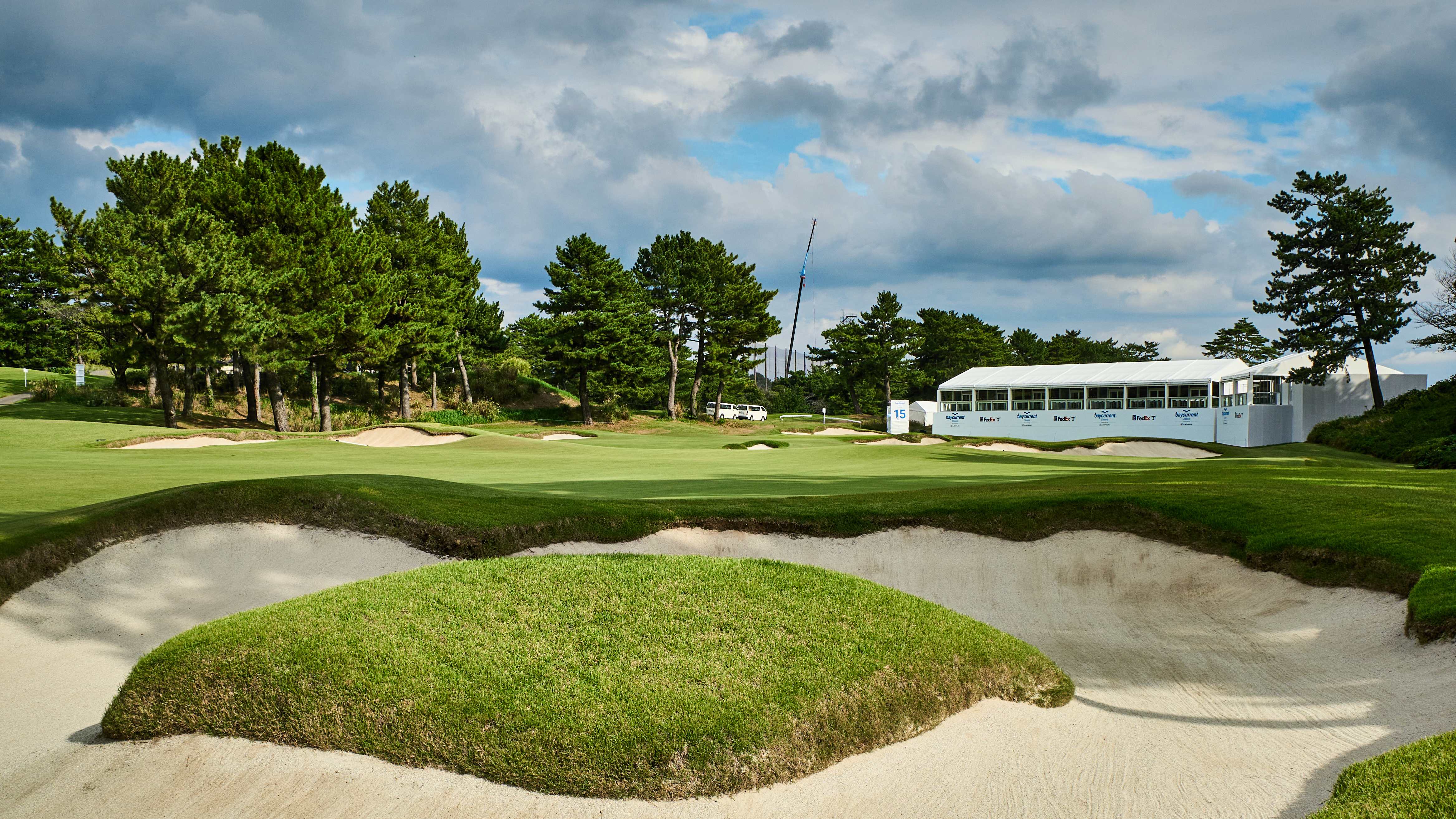
Yokohama Country Club rewards that kind of discipline. Its rolling land, sloping lies and defended greens make it possible to lose control without ever making a wildly poor swing. The tournament's closing holes offered enough danger that even players striking the ball well could not assume they would get home untouched. Brennan's best rescue came at the par-three 16th, where a lengthy shot from a greenside bunker finished about a foot from the cup. That was a par that looked routine only after he had produced the hard part.
The 16th also showed the limits of a scorecard. Six straight fours and threes can appear uneventful in a summary of the final round, but the sequence contained decisions about target selection, distance control and how much risk was justified. A player protecting a one-shot advantage still has to keep creating manageable next shots. Brennan did not need to hole a miracle putt because his tee-to-green work repeatedly left him in positions where par was available.
His rounds of 68, 67, 65 and 68 added up to 268, 16 under for the week. The Saturday 65 placed him among the leaders, while Sunday's 68 answered a different question: could he preserve the scoring advantage when the field stopped offering him an easy path? There was no runaway margin, and the players behind him had more than enough ability to win. Brennan had to produce a round whose quality was measured not by the number of highlights but by the number of avoidable errors he refused to make.
The last tee shot carried its own pressure. He knew Bridgeman had been close enough to force a playoff, and he had seen the leaderboard change around him. Instead of treating the 18th as an invitation to chase one more birdie, Brennan treated the hole as the final test of his control. He got the ball into a position from which two putts would finish the job. For a 24-year-old still early in his Tour career, the distinction between protecting a lead and merely hoping it survives is enormous. In Japan, he demonstrated the former.

Bridgeman, Mitchell and Schauffele kept asking questions — and Brennan had answers

The scoreboard was close enough that Brennan could not simply coast. Bridgeman, his former college-golf contemporary, pushed to 15 under and had a five-foot birdie attempt on the 17th that would have tied the lead. It slid by. At the 18th he faced a long birdie putt over a ridge and could not make the decisive move. His final-round 69 left him one back. That does not make Bridgeman's week a failure; it shows how tiny the margin can be between a strong performance and a trophy when another player is eliminating mistakes.
Bridgeman had reason to trust his form. He entered Japan after winning the Biltmore Championship in Asheville in September, his second PGA Tour victory of 2026. He had also shared the 54-hole lead in Yokohama. Yet the putt at 17 became the hinge of the tournament: a short opportunity that normally feels makeable suddenly carried the weight of an entire four-day contest. Brennan's steady closing pars made every one of those missed chances more expensive.
Mitchell offered a different kind of challenge. He played a five-hole stretch in five under, mixing three birdies with an eagle, and briefly looked capable of forcing the issue from the front. But the last ten holes played two over for him. He still signed for 68 and a share of second at 15 under, an excellent result in a deep field. His round was the mirror image of Brennan's: the more spectacular burst did not win because it was followed by the wrong kind of volatility on the harder stretch.
Schauffele's finish was the clearest illustration of the course's punishment. The defending champion, who had won this event in 2025, reached the 18th one shot behind the leader. A tee shot left of the fairway into the trees led to a double bogey, and a closing 67 became a tie for fourth at 13 under rather than a possible late challenge for the title. He had played well enough over most of Sunday to be a real threat. The last hole proved that good ball-striking over 71 holes cannot insulate a player from the 72nd.
Other familiar names also had their moments. Adam Scott threatened on the front nine before a damaging run on the back sent him down the standings. Jordan Spieth posted a final-round 67 and finished tied for 13th at 11 under. Home favorite Hideki Matsuyama also closed with 67, but nine under left him tied for 21st. The Baycurrent field was strong enough to give the winner an impressive list of pursuers, and the leaderboard kept moving right up to the end.
For Brennan, the win is also a measure of the speed of his development. His first PGA Tour title came at the Bank of Utah Championship in October 2025, when he arrived on a sponsor invitation after a dominant run on PGA Tour Americas. He added the Wyndham Championship in August 2026, a victory that rescued his place in the FedExCup Playoffs after he entered the regular-season finale outside the top 100. Now Japan makes three titles in 33 PGA Tour starts. That is a startling conversion rate for a player who was still trying to secure a permanent route onto the main circuit a year earlier.
There is a financial and competitive reward as well. The Baycurrent winner's share was $1.44 million from an $8 million purse. The victory also brings a qualifying benefit for the 2027 U.S. Open under the Tour's current criteria, and it was expected to move Brennan into the world's top 25 for the first time. Those details matter because a fast-rising player needs access to stronger fields, not just another line on his résumé. More starts against the best are the next test of whether his unusually efficient early career can continue.
It would be too simple to declare him the next dominant player after one tightly fought fall tournament. He has already experienced difficult Sundays and missed opportunities during 2026. What Japan provides is evidence of adaptation. In August he needed a birdie run to seize control at the Wyndham. In October he needed to respond to a bogey, manage the course and let six pars carry him over the line. Winning in different ways is often a more meaningful indicator than winning with the same strength every time.

The Baycurrent Classic was decided by a stroke, but Brennan's closing stretch was not a lucky escape. After correcting a mistake at the 10th, he created a cushion with consecutive birdies and then forced his rivals to manufacture a better number on a demanding back nine. The 16th-hole bunker save, the last six pars and a final-round record of 15 fairways hit tell the same story: the most useful shot was often the one that removed disaster from the equation.
His third PGA Tour title gives him another marker of progress and more opportunities to test himself against stronger fields. Bridgeman and Mitchell were close enough to win, and Schauffele's failed defense showed how quickly one swing can overturn an excellent round. Brennan's edge in Japan was less dramatic than that. He knew when to attack, when to accept par and when to make everyone else take the risk.