

Rosas Feared the Worst for Barcelos. His UFC Breakthrough Came With a Warning.
GOATIFYRaul Rosas Jr. won the biggest fight of his young career on September 26, 2026, and spent the immediate aftermath worrying whether the man across from him was still alive. His fifth-round victory over Raoni Barcelos at UFC Vegas 121 had all the sporting ingredients of a breakout: a demanding first main event, a veteran opponent with momentum, and a late finish when the scorecards were turning against the younger fighter. But the sight of Barcelos losing consciousness and receiving emergency attention changed the meaning of the moment before Rosas could celebrate it.
His earlier account, revisited in a November 12 report, Rosas described the alarm he felt while Barcelos remained down. The Mexican bantamweight did not pretend to know the precise medical cause. He remembered looking for signs that the Brazilian was breathing, hoping he would recover and return to his family, and struggling to reconcile the seriousness of the incident with the result on his own record. Barcelos was hospitalized after the bout and later reported that he was doing well. That reassuring development does not turn the finish into an ordinary knockout or establish a medical explanation that has not been clearly disclosed.
For Rosas, now 22 and carrying a 13-1 professional record after six consecutive UFC victories, the fight was also proof that promise is different from readiness. Barcelos had stretched him across almost the full 25 minutes, forced him to work through unfamiliar adversity and entered the last round ahead on all three judges' cards. The younger man's opportunity to win had narrowed to a finish. He got that outcome, but not in the clean, celebratory way a prospect imagines before walking into the cage.
The resulting story is bigger than one dramatic clip. It is about what the fight showed technically, what Rosas actually knows about a frightening ending, what remains uncertain about Barcelos's condition, and how an ambitious contender processes a breakthrough that came with a reminder of the sport's risks.
The final-round collapse stopped the celebration before it started

The last exchange of UFC Vegas 121 remains difficult to reduce to a conventional highlight. Rosas and Barcelos were fighting at the Meta APEX in Las Vegas on September 26 when the younger bantamweight pressed forward in round five. During a takedown sequence near the fence, Barcelos suddenly went limp. The official result recorded Rosas as the winner by knockout or technical knockout at 1 minute, 38 seconds of the final round. What the result line cannot communicate is how quickly the atmosphere changed once everyone realized Barcelos was not getting back up.
Medical personnel entered the octagon, attended to the 39-year-old Brazilian and arranged his transport to a trauma center. Rosas immediately stopped treating the moment like a personal triumph. He asked spectators to keep Barcelos in their thoughts and expressed concern for his opponent's safety. That reaction mattered because it made plain that a result in a combat sport is not an account of the human experience surrounding it. The competitor who wins can also be shaken by what happened to the person he fought.
GOATIFY
GOATIFY UFC & MMA
Raul Rosas Jr.'s win reminded MMA fans how much every five-round battle demands. Explore GOATIFY's UFC and MMA collection while following the sport's biggest stories.


Rogainz Joe Rogan UFC MMA Martial Arts Sticker
Add MMA personality to your favourite gear.
Shop Now ↗


MMA GOAT Gold Middle Finger Fight Crewneck Sweatshirt
A MMA fan design for everyday wear.
Shop Now ↗
Rosas's later reflections have a similar emotional center. He said he feared for Barcelos's life when the veteran remained motionless, and that seeing signs of breathing offered some relief. He also explained that he had not felt he delivered an obvious fight-ending head strike immediately before the collapse. Those are personal recollections, not a diagnosis. Different observers have debated whether exhaustion, an earlier exchange, the takedown or another factor played a role, but the publicly available fight report and the official result alone do not settle the medical mechanism.
That distinction is essential. Rosas speculated about what might have happened, as fighters naturally do when replaying traumatic moments, yet a speculative explanation is not the same thing as a physician's conclusion. The responsibly verifiable facts are narrower: Barcelos lost consciousness in the final round, received immediate attention, was taken for assessment and later communicated that he was recovering. Accounts of his initial care described him as responsive and able to move his limbs after treatment. No reader should infer from that reassuring update that the danger was imagined or that there is a publicly established diagnosis.
Barcelos's response deserves room alongside the winner's. The Brazilian had been making the most of a rare main-event opportunity and had performed strongly for four rounds. In later comments he described pride in the effort even as the ending forced an uncomfortable reckoning. His concern was not merely that a decision slipped away; it was that a compelling performance ended with a health scare. The same bout could be a competitive success and a personally frightening experience.
The image that will stay with many viewers is therefore not simply Rosas's hand being raised. It is a tense pause in which the usual language of knockouts, bonuses and rankings became inadequate. A fighter's first responsibility in that instant was to notice that his opponent needed help. The fact that Barcelos later returned home is the most important development of all, while the question of exactly why he lost consciousness should be left to medical evidence rather than confident guesses from a video replay.
Barcelos was winning the fight Rosas still found a way to finish
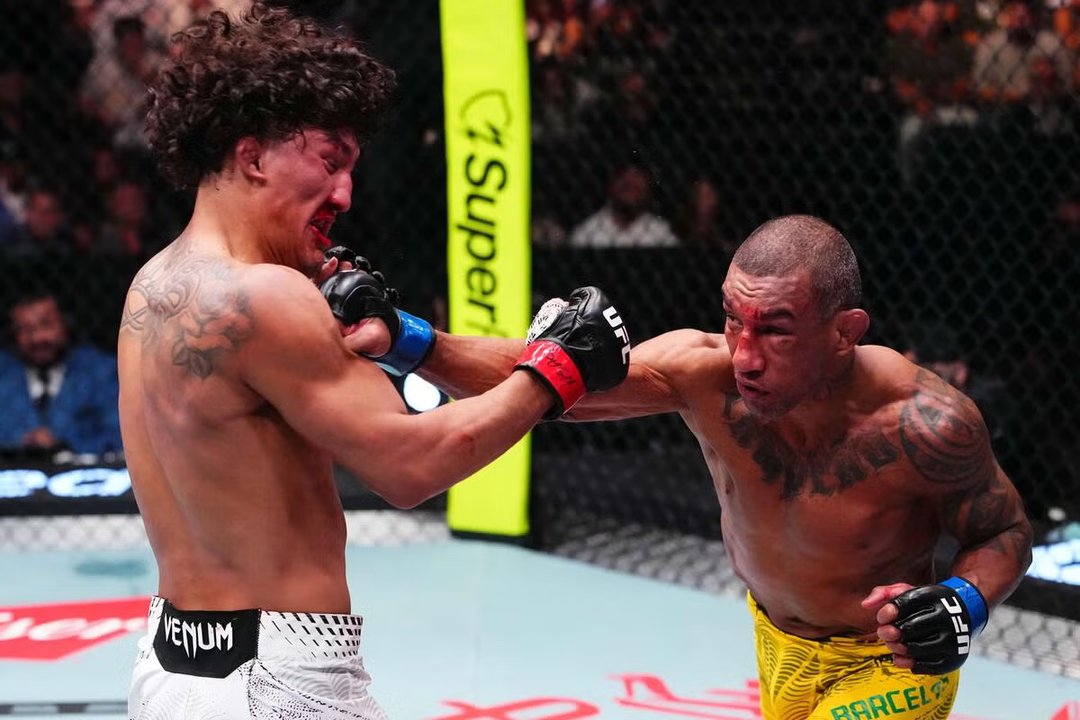
Before the medical emergency, this had been one of the most instructive fights of Rosas's career. The contrast was obvious: a highly promoted prospect seeking to accelerate toward the top of the bantamweight division against a veteran who had built a five-fight winning streak and knew how to make a promising opponent uncomfortable. Rosas started with energy and a willingness to exchange. Barcelos gradually introduced the kind of range management, counterstriking and wrestling transitions that turn an early burst into a long, exhausting argument.
The second round revealed how dangerous that veteran experience could be. Barcelos found repeated openings on the feet and began to punish Rosas for advances that were less controlled than they looked in the opening minutes. The Mexican's usual pressure no longer translated automatically into clean offense. The next two rounds developed into difficult mixtures of striking, takedowns and positional grappling. Barcelos could shift between attacking and controlling, asking Rosas to defend his balance, his back and his stamina rather than simply his chin.
GOATIFY
GOATIFY UFC & MMA
From Barcelos's wrestling adjustments to Rosas's fifth-round push, UFC competition rewards many different skills. Browse GOATIFY MMA fan designs.

UFC GOAT Gold Middle Finger Fight Decal Sticker
Add MMA personality to your favourite gear.
Shop Now ↗


In the fourth, the veteran's control was especially significant. He threatened from strong grappling positions while the younger fighter was forced to protect himself and survive. The episode did not erase Rosas's skill; instead, it showed where an ambitious contender still needed adjustments. Once he could no longer dictate the pace, Rosas had to find ways to interrupt an opponent's preferred rhythm instead of merely sustaining his own. A prospect can look dominant in quick finishes and still have important questions unanswered until someone forces him deep into a long bout.
All three judges gave Barcelos a lead through four rounds, with two cards at 39-37 and one at 39-36. In practical terms, Rosas could not rely on another competitive five minutes and hope the decision would favor him. The assignment had changed: he needed to create a decisive moment. He came out with greater urgency in the fifth and pursued the sequence that ended the contest, although the loss of consciousness made the immediate result deeply troubling rather than straightforwardly emphatic.
The scorecards help explain why the win should be discussed with nuance. They do not diminish Rosas's perseverance or his official victory. They show that Barcelos had solved important parts of his game for most of the night. Rosas learned he could remain in a contest while tired, frustrated and behind, then still produce an opening. He also learned that relying on a late surge is a precarious way to advance against increasingly accomplished bantamweights, who may be harder to finish and better at protecting a lead.
Rosas's own account suggested that the difficult stretches were part of what made the test valuable. Barcelos had a sophisticated mixture of grappling, wrestling and striking and did not surrender easy control. Such rounds are less glamorous than a short highlight but often more useful for a developing athlete. They expose footwork that needs tightening, entries that are too predictable and stretches when the defender is forced to expend energy without changing position. The technical lesson is not that Rosas should discard pressure; it is that he needs several versions of it.
That is why the performance can be simultaneously encouraging and cautionary. Rosas's resilience and intent were unmistakable. Barcelos's lead and sustained success were just as real. A full appraisal must hold both facts instead of editing the first four rounds out of the story because the last one produced a dramatic stoppage.
The contender's next step is about judgment as much as ambition

For Rosas, the Barcelos fight was a major career threshold even before the final-round drama. At 22, he has already accumulated experiences that many fighters do not receive until much later: national attention, the expectation of eventual title contention, a high-profile defeat in his formative years and a sequence of wins that restored his trajectory. His victory over Rob Font earlier in 2026 helped move him toward veteran opposition; beating Barcelos added a five-round examination to a résumé previously known in part for precocity and aggressive grappling.
The updated record of 13 wins and one loss tells a clean story, and a six-fight UFC winning streak sounds even cleaner. Neither number captures everything a contender must improve before taking on the division's most complete athletes. The Barcelos performance showed willingness to absorb pressure, but also reminded viewers that Rosas can be forced into sustained defensive stretches. If the UFC accelerates his path, future opponents will study how Barcelos separated Rosas's early momentum from his middle-round efficiency.
GOATIFY
GOATIFY UFC & MMA
Rosas's rise adds another name to a deep UFC bantamweight division. See GOATIFY's UFC-inspired apparel, accessories and fight-fan designs.

Rogainz Joe Rogan UFC MMA Martial Arts Sticker
Add MMA personality to your favourite gear.
Shop Now ↗MMA GOAT Gold Middle Finger Fight Crewneck Sweatshirt
A MMA fan design for everyday wear.
Shop Now ↗His long-stated aim of reaching championship level at an unusually young age creates a second type of pressure. Ambition helps an athlete train and compete, but rankings are not developmental shortcuts. The next sensible matchup should test a concrete improvement in his ability to respond to experienced strikers and grapplers over three or five rounds. A harder name is not automatically a better decision if the performance is not translating into greater control. Rosas can be both a legitimate prospect and a fighter with unfinished work.
Barcelos, meanwhile, should not become a footnote in someone else's ascent. The Brazilian was ahead entering the final round, showing why experienced bantamweights remain difficult to replace with hype. His recovery and any medically appropriate path back are matters separate from whether fans want a rematch or a return to the rankings. Nothing in a promotional timetable should be confused with a medical clearance, and public discussion should resist treating a frightening collapse as merely an unusually dramatic end to a loss.
The broader question concerns how combat sports talk about risk. A knockout can be an accepted part of the rules without making every frightening consequence routine. Fighters and officials act under agreed protocols, but spectators rarely see the full medical process or subsequent decision-making. Rosas's reluctance to celebrate while Barcelos was down was a reminder that an opponent is not just the obstacle between an athlete and a ranking. A hard-fought contest can create genuine respect and fear at the same time.
That perspective may ultimately say something useful about Rosas's maturity. It would be easier to frame his reflections as a simple declaration that nothing can stop him. Instead, they suggest a young man who recognizes that winning and feeling good about the way a fight ended are different experiences. A responsible account can praise the competitive resilience that brought him through the fifth round while declining to sensationalize the medical event that followed.
What comes next should therefore be judged on two timelines. In sporting terms, Rosas needs to build on a demanding victory and show that he can take more of a fight's middle rounds against difficult opposition. In human terms, Barcelos's health and recovery deserve patience and independent attention. The future of the bantamweight division matters, but it cannot supply an answer to questions about an individual fighter's medical status.
Six straight UFC victories have made Raul Rosas Jr. a serious name in the bantamweight conversation. The September 26 fight showed that his determination survived a veteran's best stretches and that he could still find a finish when the scorecards left him no comfortable option. It also exposed technical challenges a cleaner headline would have hidden. Those lessons may prove as important as the win itself.
Yet the most revealing part of his November 12 reflections is not about rankings or matchmaking. Rosas remembers fearing that Raoni Barcelos might not recover from the collapse that ended their fight. Barcelos later delivered welcome updates after medical evaluation, but the precise mechanism of the incident should not be asserted without reliable clinical evidence. The result belongs in the record book; the empathy, uncertainty and hard-earned perspective are what give this particular breakthrough its weight.
GOATIFY
GOATIFY UFC & MMA
Shop GOATIFY UFC and MMA shirts, hoodies and fight fan gear.
UFC GOAT Gold Middle Finger Fight Decal Sticker
Add MMA personality to your favourite gear.
Shop Now ↗


















