

Turin's $5.17M Jackpot Has a Catch: Five Wins, No Losses
GOATIFYThe richest possible week in men's tennis is now worth $5.171 million at the ATP Finals. But the number comes with a condition: the singles champion must win all five matches in Turin. A player can lift the same trophy after losing once in the group stage and collect significantly less. The difference is built into a payment system that rewards victories as well as the final result.
The ATP confirmed on November 11 that the 2026 Finals will distribute a record $15.75 million across singles and doubles. That is $250,000 more than last season, yet every additional dollar is going to singles. Doubles payments have not increased. With the eight-man draw approaching and several fresh faces joining established champions, those details are more than accounting: they shape the stakes of every round-robin match, even before elimination becomes possible.
Five victories unlock $5.171 million, but every match has a price

At a conventional knockout tournament, a player advances or goes home. Turin's eight-player singles contest begins differently. Two groups of four play round-robin matches, so each competitor is scheduled to meet three opponents. The two best players in each group progress to the semifinals. Wins matter twice: they help determine progression and they add cash to an eventual payday.
A singles player who completes all three group matches earns a $338,000 participation fee. Every round-robin victory then contributes another $405,000. A semifinal win is worth $1,206,000, and winning the final adds $2,412,000. Add three group victories, the semifinal and the final to the participation fee and the total reaches exactly $5,171,000. The unbeaten champion would also collect the maximum 1,500 ATP ranking points available at the event.
Now remove one group-stage win. Assuming a player still qualifies for the semifinals and wins the title, the total falls to $4,766,000. It is a $405,000 difference for a defeat that did not ultimately prevent a championship. That is the distinctive financial tension of the Finals: a match can be survivable in the standings but costly in the ledger.
There are smaller variations, too. Participation payments are prorated if a singles player takes part in fewer than all three group matches. The published schedule awards $169,000 for one and $253,000 for two, before reaching the full $338,000. A designated alternate has a separate $156,000 fee. These rules matter when injuries or withdrawals interrupt the round robin; the advertised participation payment is not automatically identical for every player in every scenario.
The increases since 2025 are relatively restrained despite the enormous headline. Last year's full participation amount was $331,000, each group win paid $396,500 and the maximum unbeaten prize stood at $5,071,000. This season the top figure rises by $100,000. The overall purse climbs from $15.5 million to $15.75 million, roughly 1.6 percent, making it a record rather than a radical restructuring.
The money also changes how fans should read group-stage results. A player who has already qualified may still have hundreds of thousands of dollars and ranking points at stake in the final round-robin match. Conversely, a competitor who cannot reach the semifinals can still earn meaningful additional money from a late victory. There is a competitive reward attached to the individual result, not only to the bracket.
GOATIFY
GOATIFY Tennis
An unbeaten Turin run can be worth $5.171 million, but every round-robin result matters. Explore GOATIFY tennis gear for the season finale.


Tennis GOAT Golden Racket & Ball Crewneck Sweatshirt
A tennis fan design for everyday wear.
Shop Now ↗
Singles gets the entire increase while doubles stands still
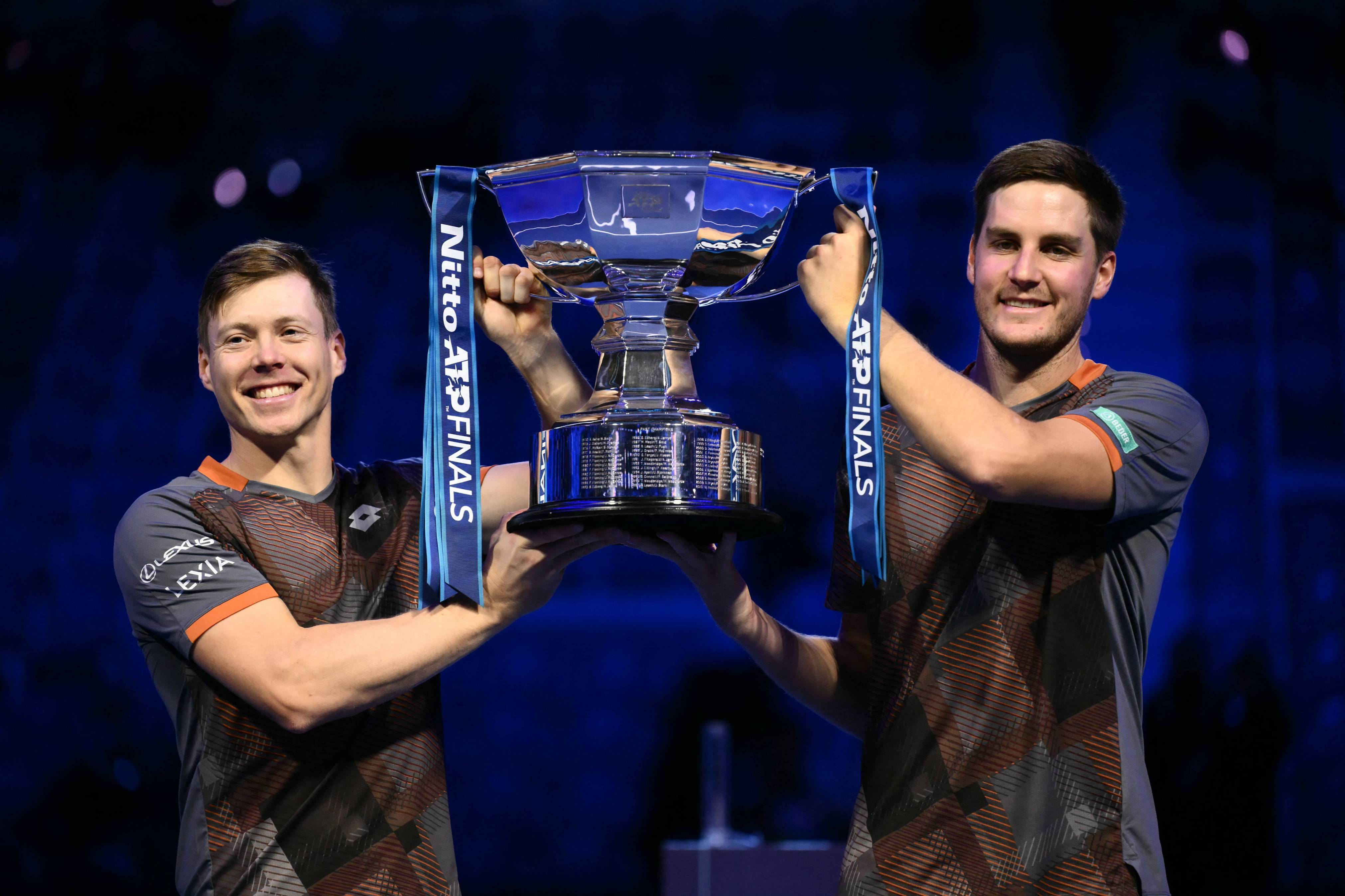
The increase is not distributed evenly across the tournament. Singles now accounts for approximately $12.7 million of the combined prize fund, up from $12.45 million last year. The doubles allocation remains $3.05 million. In other words, the entire $250,000 improvement goes to one part of the event, while the other enters the 2026 edition on the same schedule as 2025.
For doubles, the published figures are payments per team, not to each partner separately. A pair completing its three group matches receives $134,200, with another $96,600 for each group-stage win. Victory in the semifinal contributes $178,500 and the final adds $356,800. Put together, an unbeaten doubles pair can earn $959,300, which the two players share under their own arrangements.
That distinction is easy to miss when the singles maximum of $5.171 million and doubles maximum of $959,300 sit side by side. The latter is the combined team amount. If divided equally, it would represent $479,650 per player before any other financial considerations. The maximum doubles payment is not $959,300 for each partner.
The comparison is especially relevant to Harri Heliovaara and Henry Patten, the defending doubles champions, who won the trophy in Turin in 2025. Their success illustrates the different demands of a tournament in which all eight pairs must manage repeated high-pressure matches, rather than a straightforward single-elimination path. An archival image of their 2025 celebration is a reminder that the title itself still carries major status even when the prize table stays still.
For a doubles team, one early loss can reduce the maximum possible take by $96,600 while leaving qualification alive. A win in the final carries $356,800, but it is not a standalone bonus that replaces earlier earnings; the payments accumulate. The same principle governs singles, although the amounts are dramatically larger.
Freezing the doubles schedule is a policy choice with practical consequences. The ATP Finals remains an exceptional opportunity for doubles specialists, yet the gap between the two title-winning scenarios grows because the incremental investment is concentrated on singles. That is the clearest story behind a total purse whose percentage growth initially looks modest.
Alcaraz chases a first crown as Zverev brings Finals experience
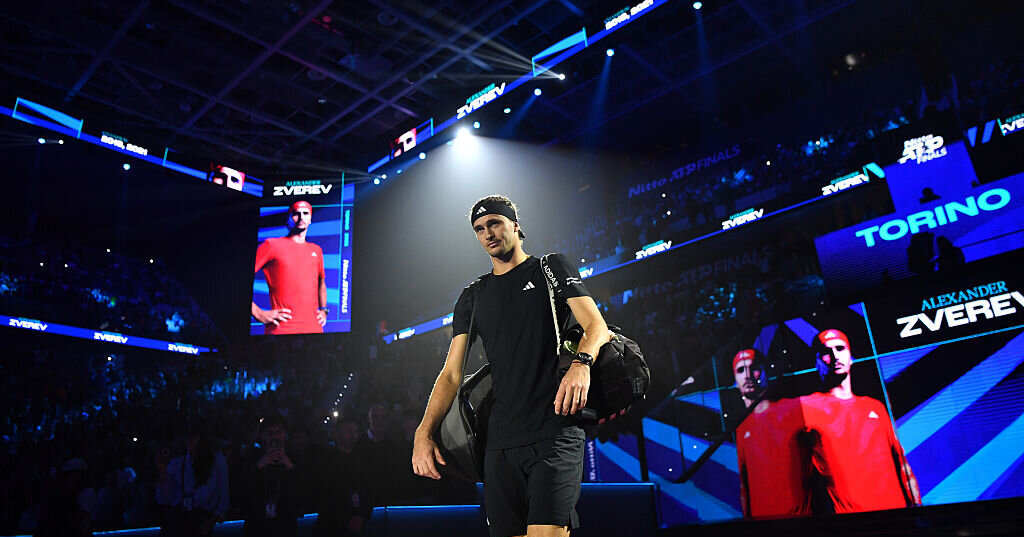
Money explains the scoring of the week, but the field gives it context. Alexander Zverev arrives as a two-time ATP Finals champion, with titles in 2018 and 2021. Daniil Medvedev won the event in 2020. They are the two former singles winners among this year's eight qualifiers. Zverev's previous appearances in Turin, including the earlier occasion pictured here, underline the value of knowing how to manage a group format in which one difficult match does not always end a campaign.
Carlos Alcaraz is chasing something his résumé still lacks: a season-ending singles crown. He reached the 2025 final, losing to Jannik Sinner, and arrives with fresh indoor momentum after defeating Ben Shelton for the Paris Masters title on November 8. The combination of major-tournament pedigree and the prospect of a first Turin trophy makes him central to the week's competitive story, regardless of the prize figure.
GOATIFY
GOATIFY Tennis
From Zverev and Alcaraz to four debutants, Turin will test the best singles players on tour. Find GOATIFY tennis designs for fans and players.


Tennis GOAT Golden Racket & Ball Decal Sticker
Add tennis personality to your favourite gear.
Shop Now ↗
There is also an unusually strong debutant thread. Flavio Cobolli, Arthur Fils, Frances Tiafoe and Rafael Jodar are all set for their first appearances at the Finals. Ben Shelton has played the event before, while Medvedev and Zverev bring title-winning experience. The differences in familiarity with the format could become important when a player has to recover from an opening defeat and return to court quickly against another elite opponent.
Turin's draw is scheduled for Thursday, November 12, at noon local time. The eight singles players will be divided into two groups of four, with the top two from each advancing to Saturday's semifinals. Round-robin competition begins on Sunday, November 15, and the championship match is scheduled for Sunday, November 22. Those dates are fixed; potential semifinal matchups are not known until the draw and group results settle them.
Ranking points follow the same win-by-win logic as the prize money. A group win is worth 200 points, a semifinal victory 400 and a final victory 500. A perfect five-win run therefore produces 1,500 points. Players already near the top of the rankings can make substantial movements with a good week, while newcomers have a rare chance to earn elite-level points against a compact field of opponents.
These incentives make the Finals strategically unlike a standard event. A player cannot simply protect a lead through an easy early draw: every singles opponent is among the season's qualifiers. An unbeaten campaign demands beating five top-tier competitors in eight days. It is not enough to win a final after surviving the group; the full $5.171 million requires perfection across the entire sequence.
For Zverev and Medvedev, the challenge is to use experience to produce another deep run. For Alcaraz, it is to convert an already decorated season into a missing trophy. For the four newcomers, simply winning a round-robin match would bring both a notable result and $405,000. Different ambitions intersect under the same rules, which is precisely why the structure produces meaningful matches well before the final Sunday.
The ATP Finals' new record is real, but the headline figure is conditional. An unbeaten singles champion would make $5.171 million; a champion with a round-robin defeat would earn less, and doubles teams are competing for a maximum $959,300 shared by the pair. All of the $250,000 rise in the overall fund has been allocated to singles, making the distribution story almost as striking as the total.
When play begins on November 15, the more revealing number may be $405,000. That is the additional money attached to every singles group win, even if a player has already done enough to reach the next round. Turin's combination of guaranteed appearances, cumulative match bonuses and ranking-point rewards turns every match into its own contest within the larger championship. The five-win jackpot is simply the most dramatic possible outcome.
GOATIFY
GOATIFY Tennis
Shop GOATIFY tennis products from the Tennis-filtered collection scope.


Tennis GOAT Golden Racket & Ball Decal Sticker
Add tennis personality to your favourite gear.
Shop Now ↗


















