

Castle Scored 32. The Spurs Made Golden State Look Outnumbered.
GOATIFYThe Warriors had not scored a point, and the Spurs had already scored 18. Six minutes into Friday's NBA Cup meeting in San Antonio, that was the entire argument. Golden State had Stephen Curry watching with an oblique injury, a small lineup trying to create space, and no reliable way through a defense that seemed to occupy every passing lane. San Antonio, meanwhile, had the kind of freedom an opponent rarely gives a team packed with athletes and playmakers.
Stephon Castle turned that opening mismatch into his most productive scoring game of the season. He finished with 32 points as the Spurs crushed Golden State 123–85 on November 13, 2026, stretching their winning streak to 11 games and improving to 2–0 in NBA Cup play. Victor Wembanyama needed fewer than 21 minutes to assemble a double-double. The final margin was 38, but the more revealing number was 14: the Warriors' entire first-quarter output.
This was not simply a case of one superstar being unavailable and another imposing his will. San Antonio attacked the weakness created by Curry's absence, used its size to deny Golden State comfortable two-point shots, and found a 22-year-old guard capable of punishing opponents who dared him to fire from outside. That combination is why the win deserves more than a scoreline.
An 18–0 start exposed the size and spacing mismatch
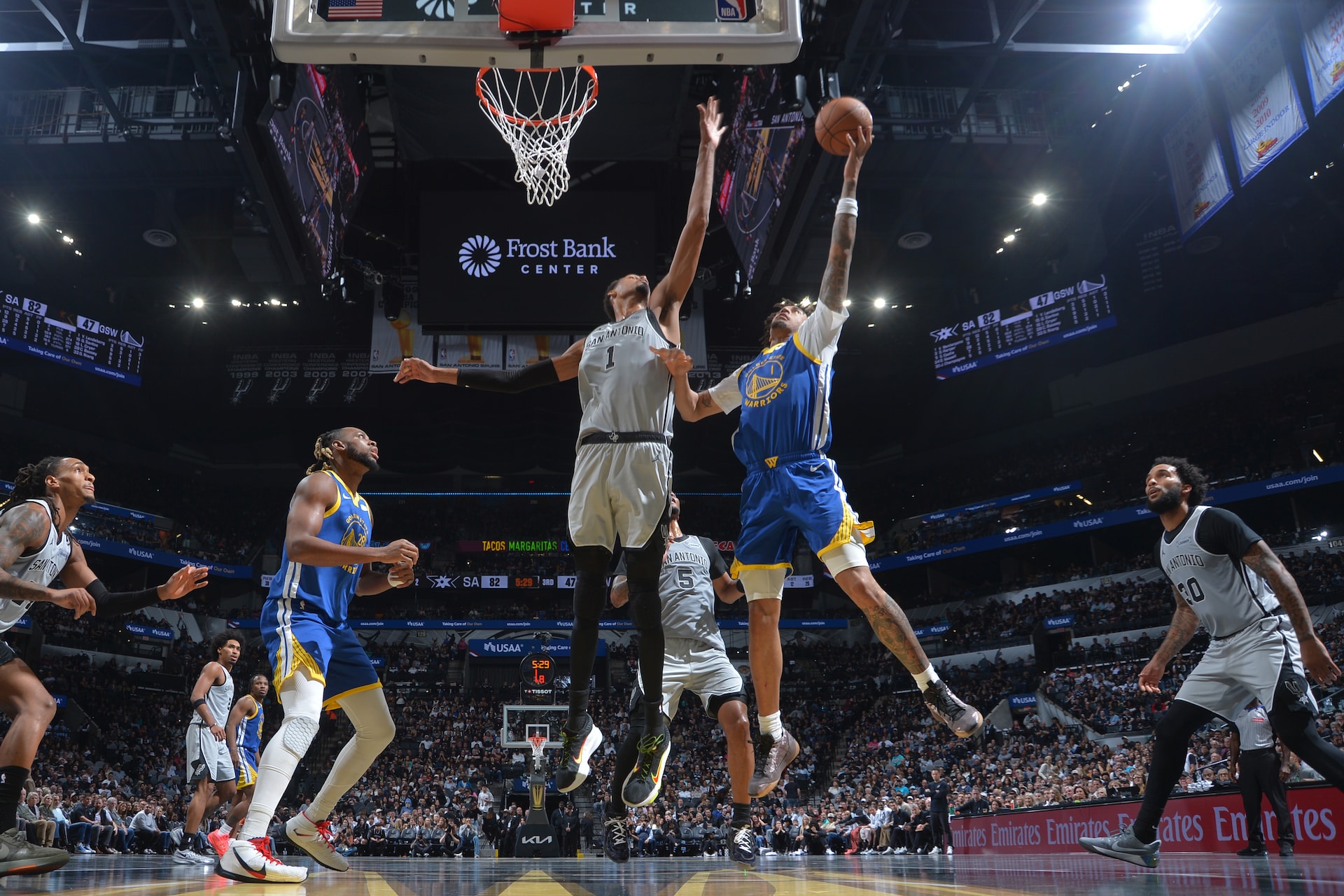
Steve Kerr began with De'Anthony Melton, Brandin Podziemski, Will Richard, Yaxel Lendeborg and Draymond Green. The hope behind that smaller, mobile group was understandable: put enough ballhandlers and movement around one another to force San Antonio's size to chase rather than dictate. But the Spurs could pressure the ball without sacrificing protection behind the play. With Wembanyama roaming near the basket and quick defenders recovering to shooters, the usual trade-off between perimeter coverage and interior protection barely appeared.
Golden State missed its first 11 field-goal attempts. The opening score reached 18–0 before Gui Santos finally broke the drought with a drive. That sequence was a lesson in more than bad shooting. The Warriors could not bend the defense, so passes were made late and contested attempts arrived without the advantage that makes a possession efficient. When a smaller lineup cannot create separation, it is left competing for rebounds against a much larger opponent after every miss.
San Antonio led 38–14 after 12 minutes, the lowest-scoring quarter by an opponent against the Spurs this season. By halftime the margin was 63–33. Golden State improved its resistance in some second-quarter possessions, but the initial damage gave San Antonio complete control of tempo, substitutions and risk. A team playing catch-up also tends to become more predictable: possessions hurry, players reach for difficult jumpers, and the defense can see the next action coming.
The box score explains how persistent the mismatch became. San Antonio collected 60 rebounds to Golden State's 43 and scored 56 points in the paint compared with the Warriors' 28. Those figures are not isolated accidents. The size advantage changed where Golden State could shoot, who could finish through contact, and how often a missed shot became one more chance for the Spurs. Golden State finished just 16-for-52 on two-pointers, worse than its 15-for-41 shooting from beyond the arc.
GOATIFY
GOATIFY Basketball
Explore GOATIFY Basketball while San Antonio's defense dominates the court against Golden State.

Stephen Curry GOAT Shooting Threes Pullover Hoodie
A basketball fan design for everyday wear.
Shop Now ↗


There is a temptation to call this a one-night cold spell. That misses why it looked so systematic. San Antonio could use length to close a first passing window, then still have enough reach to challenge the next attempt. Golden State made 15 triples, one more than the Spurs, yet lost by 38 because it could not create enough quality work in the areas between those makes. A team can survive a bad quarter. Surviving a game in which the opposing defense controls the geometry is considerably harder.
Castle punished the invitation to shoot — and Wembanyama did not have to score
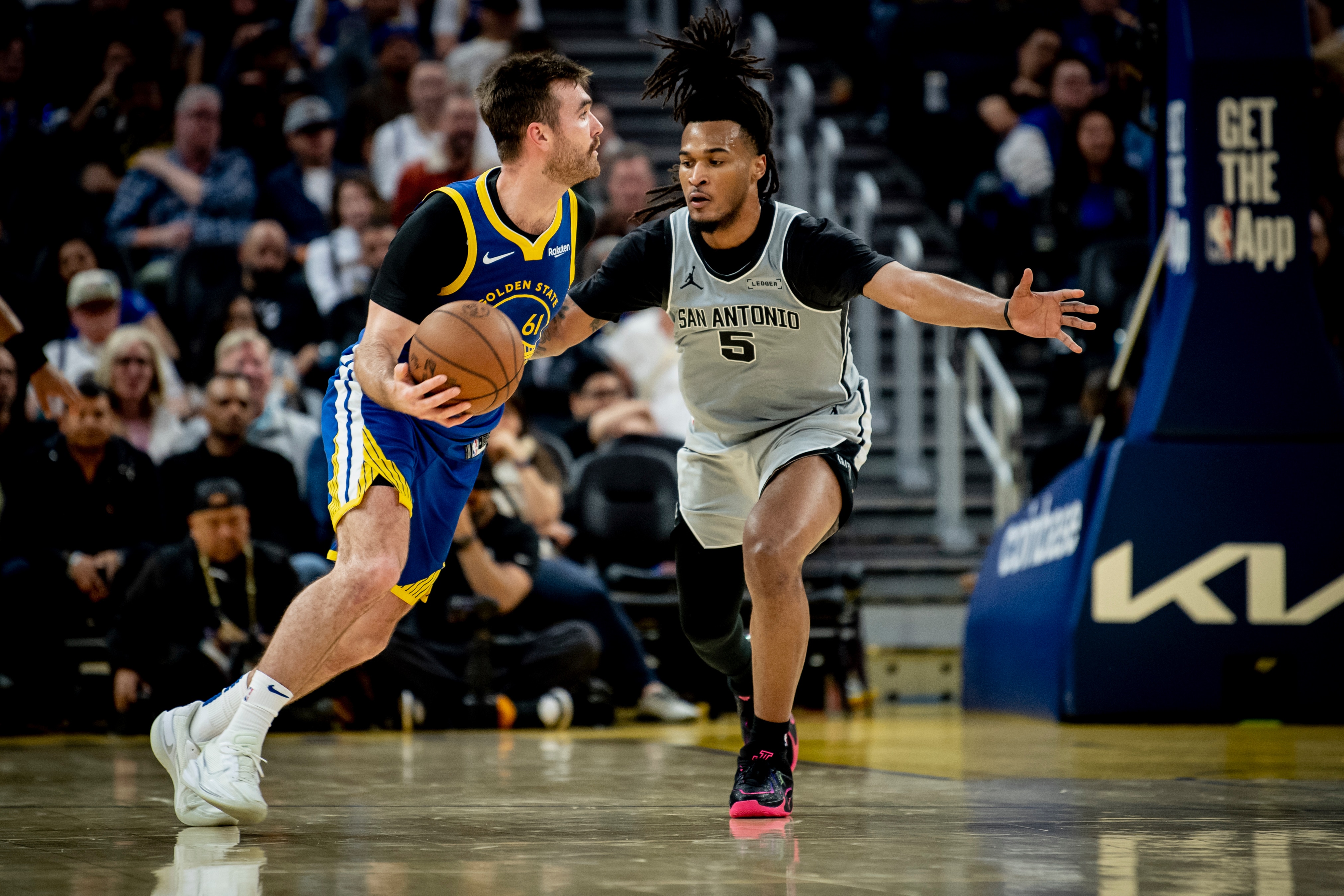
Stephon Castle arrived at this game still negotiating his role within a deeper San Antonio backcourt. Alongside De'Aaron Fox and Dylan Harper, he does not always handle the ball as often as he did earlier in his career. That has created a straightforward defensive bet for opponents: make him prove the jumper is dangerous rather than let him use his size to bulldoze the lane. Golden State made that bet, and on this night the price was devastating.
Castle delivered 32 points in only 25 minutes and seven seconds, hitting 12 of 18 shots, five of eight attempts from three, and all three of his free throws. He added five rebounds and six assists while committing just one turnover. Five made threes are particularly important because the most effective way to crowd a powerful driver is to leave just enough room outside. When a defender stays off Castle and he can hit open looks, the defense loses the ability to choose between taking away his shot and keeping him from the rim.
His production did not arrive as disconnected highlight plays. Castle was the Spurs' best scorer in a night when they could move from a defensive stop to an organized attack before Golden State had reset. He had 13 points and three triples in the opening quarter, establishing a threat that made subsequent drives and passes more difficult to anticipate. The dunk fed by a Wembanyama pass in the third quarter also illustrated how their contrasting sizes create different headaches: the big man can see over a defense while the guard attacks the opening underneath it.
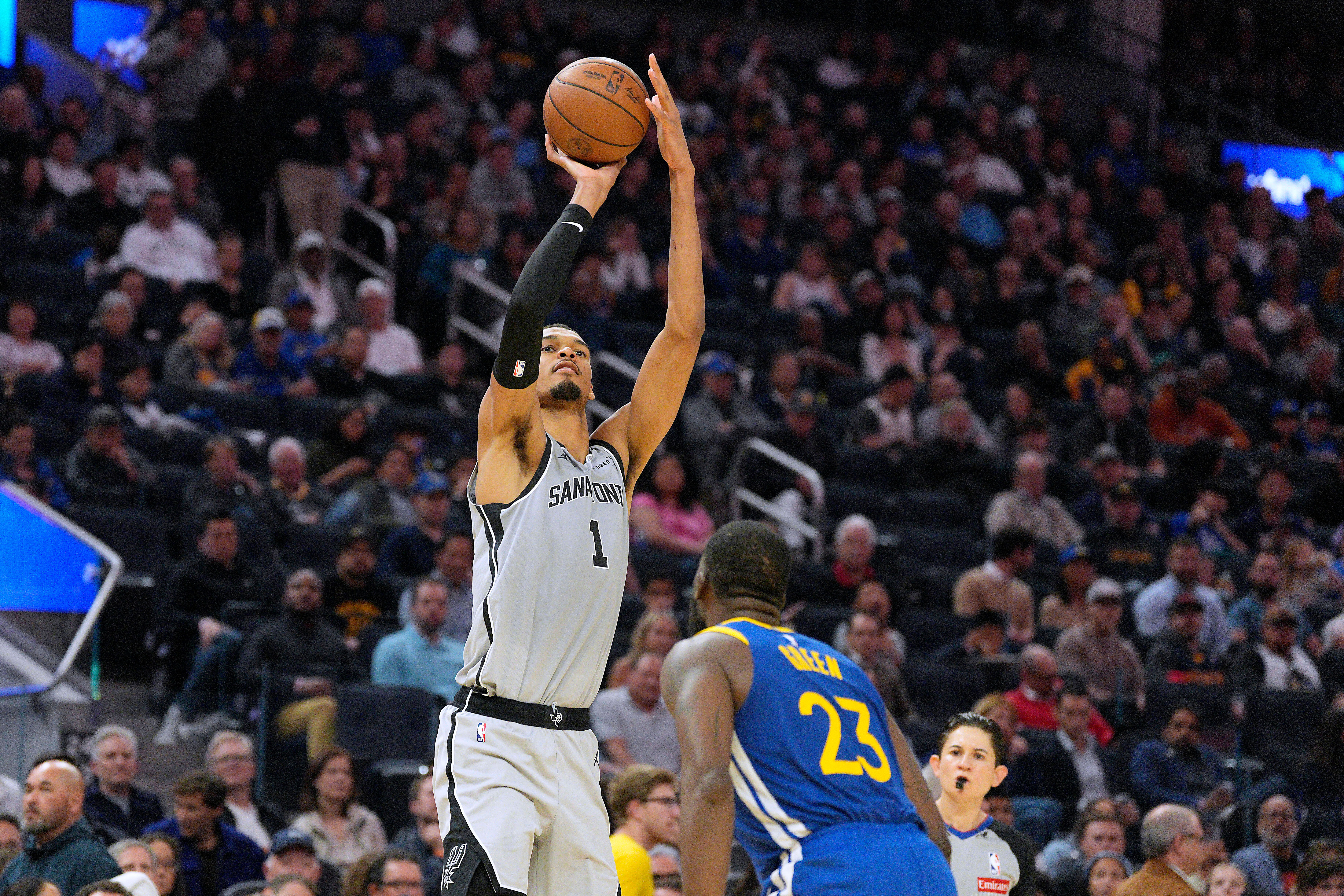
Wembanyama's own line could look modest at first glance: 12 points on 5-for-11 shooting, 12 rebounds, six assists, a steal and two blocks. It took only 20:54 of court time. When a star occupies multiple defenders, changes shot trajectories and distributes the ball above contests, his impact is not captured solely by points. San Antonio was able to dominate without needing an enormous scoring night from its most recognizable player, and that may be the best sign of how its offense has matured.
This matters beyond a November shooting spike. Coach Mitch Johnson had already emphasized Castle's growth in decision-making and defensive commitment during the early season. The guard still has to establish that opponents cannot regularly ignore him from deep; one five-for-eight night does not rewrite an entire shooting profile. But a player who can defend, rebound, drive, connect passes and occasionally supply this level of outside punishment gives San Antonio a much wider range of combinations that work against good opponents.
GOATIFY
GOATIFY Basketball
Browse basketball-inspired GOATIFY designs as Castle's shooting changes the Spurs' offensive options.

Kobe Bryant – No. 24 GOAT Celebration Sticker
Add basketball personality to your favourite gear.
Shop Now ↗
Michael Jordan – Repeat 3-Peat Champion Sweatshirt
A basketball fan design for everyday wear.
Shop Now ↗


Wemby G.O.A.T. - Victor Wembanyama Basketball Mug
Add basketball personality to your coffee break.
Shop Now ↗Without Curry, Golden State found a scorer but not an offense

Stephen Curry's absence shaped the game before the opening tip. The Warriors' offensive system is built around defenders reacting to him even when he has not touched the ball. His off-ball movement pulls help toward the perimeter, his shooting forces defenders to follow unusually far from the basket, and his quick decisions can turn an ordinary screen into an open layup somewhere else. A right oblique tear sustained in Wednesday's loss to Houston removed that pressure. Golden State expects to be without him for at least two weeks, with the next medical assessment rather than an exact return date determining what comes after.
That does not mean Curry alone explains a 38-point defeat. Teams must still execute the basics without their top creator. Against San Antonio, the Warriors' five starters combined for only 30 points, fewer than Castle scored by himself. Lendeborg, a rookie being asked to shoulder more responsibility, finished 1-for-13 from the field with three points and seven rebounds. Podziemski scored eight on 2-for-10 shooting and registered no assists. The combination left Golden State without enough successful first actions to make the Spurs rotate.
L.J. Cryer supplied the obvious counterexample. His 20 points were a career high, and he made six of 11 three-point attempts while distributing six assists without a turnover in roughly 24 minutes. Charles Bassey added 11 points on five of seven from the floor. They were the only Warriors in double figures. Their individual successes matter, because they demonstrate Golden State did have paths to usable offense, but a few good possessions cannot support a full game when the defense is struggling to find reliable combinations.
It was striking that Golden State did not lose this game because San Antonio buried an overwhelming number of additional threes. The Warriors actually hit 15 to the Spurs' 14. The losses came elsewhere: San Antonio shot 46-for-95 overall, compared with Golden State's 31-for-93, and owned the rebounding battle by 17. A team can win the three-point count and still be dismantled when its opponents repeatedly reach the paint, finish with greater efficiency and generate better possessions after misses.
For Kerr, the useful response is not to ask every player to imitate Curry. It is to create simpler advantages while he is out: more decisive interior screening, actions that put Cryer in positions to move the defense, and lineup combinations that do not sacrifice every second-chance battle for extra speed. Those adjustments will not recreate an all-time shooter. They can, however, prevent the offense from becoming five individual players attempting to beat a defense that is already set and waiting.
A 38-point NBA Cup margin added weight to an 11-game statement
San Antonio did not need to manufacture late drama to make Friday count. By the end of the third period it led 97–60, and the starters spent the final quarter on the bench. The largest lead had been 43. Even with a comfortable finish, though, the Emirates NBA Cup gave the score a second meaning. Group-stage point differential can help decide tiebreakers, so a comprehensive margin has value beyond the satisfaction of an emphatic regular-season win.
GOATIFY
GOATIFY Basketball
Find GOATIFY Basketball favorites while the Warriors work through the offense without Curry.

Stephen Curry G.O.A.T. - Steph Curry Greatest Sticker
Add basketball personality to your favourite gear.
Shop Now ↗
Kevin Durant G.O.A.T. - Basketball Coffee Cup Mug
Add basketball personality to your coffee break.
Shop Now ↗
Basketball Stephen Curry GOAT Champion Muscle Tank
A basketball fan design for everyday wear.
Shop Now ↗


Basketball Stephen Curry GOAT Champion Trophy Sticker
Add basketball personality to your favourite gear.
Shop Now ↗The Spurs now stand 2–0 in West Group C and 11–2 overall, having won 11 consecutive games after beginning the season with two losses. The run includes very different kinds of victories. Two days before this rout they recovered from a large deficit to beat Chicago; here they avoided the need for a comeback by dominating from the first possession. Good teams can win a close game after making mistakes. Strong contenders also have to identify vulnerable opponents early and close the door without giving them a way back.
San Antonio has options that make those contrasting styles possible. Wembanyama's size and shot-blocking give defenders confidence to contest at the perimeter. Castle can guard demanding assignments and create offense. Fox, Harper and the other guards provide different tempos and angles for the attack. Against Golden State the Spurs assisted on 34 baskets, compared with the Warriors' 23, which helps explain why the domination did not require one player to take every difficult shot. Even Keldon Johnson's 18 points showed how scoring could arrive beyond the central stars.
There was also a confrontation that deserved proportionate attention. Draymond Green was assessed a Flagrant 1 after sending Wembanyama out of bounds with a shove from behind in the second quarter. That was a serious foul, but it was not an ejection, and it was not the reason Golden State was being blown out. The Warriors were already struggling with San Antonio's movement, length and half-court coverage. Treating the incident as the defining cause would be convenient and inaccurate.
For a team that reached the 2026 NBA Finals, the central question is whether this depth and defensive identity hold against healthier, more disciplined competition. November dominance is evidence, not a trophy. The Cup schedule and upcoming Western Conference matchups will test whether Castle's improved scoring balance is repeatable and whether the Spurs can maintain their edge when the opponent's best player is available. Golden State, now 1–1 in its group, has the immediate challenge of salvaging offense during Curry's recovery before its next trip to New Orleans.
Friday's game delivered two messages that cannot be reduced to Curry's absence. Golden State looked alarmingly short of dependable creation against an opponent with the length to take away easy shots, and the Spurs showed they can turn that advantage into a rout without needing Wembanyama to carry the scoring load. Castle's 32 points made the headline, but the defense, rebounding and passing built the margin.
One game cannot prove Castle is suddenly an elite three-point shooter, or that Golden State will stay this poor throughout Curry's absence. It did show the difference between a team able to attack a weakness from several positions and one searching for the first reliable possession. San Antonio's 11th consecutive win was impressive not because 123 points appeared on the scoreboard, but because the Warriors were denied the room to compete from the opening minutes.
GOATIFY
GOATIFY Basketball
Shop GOATIFY basketball shirts, hoodies and stickers.
Kevin Durant G.O.A.T. - Basketball Coffee Cup Mug
Add basketball personality to your coffee break.
Shop Now ↗
Crying LeBron – NBA Basketball Pullover Game Hoodie
A basketball fan design for everyday wear.
Shop Now ↗
Basketball Alien Wemby UFO Abduction Graphic Tee
A basketball fan design for everyday wear.
Shop Now ↗
Basketball Victor Wembanyama Sci-Fi Alien Sweatshirt
A basketball fan design for everyday wear.
Shop Now ↗

Victor Wembanyama Alien Wemby NBA Basketball Sticker
Add basketball personality to your favourite gear.
Shop Now ↗



















