

The Last Kick Was Classic Wonderboy. Thompson Retired on His Own Terms at UFC 334.
GOATIFYAt Madison Square Garden on November 14, 2026, Stephen “Wonderboy” Thompson was supposed to be saying goodbye. That did not mean Charles Radtke had agreed to play a supporting role. The younger welterweight attacked the 43-year-old veteran's space early, looked for takedowns and made the farewell fight feel precarious rather than ceremonial. For a while, the story was not the ending that Thompson wanted; it was whether his signature striking could still find enough room to matter.
Then the timing returned. Thompson survived the grappling pressure, increased his volume and finished Radtke with a spinning wheel kick at 2:54 of the third round. The knockout ended the UFC 334 preliminary card and, by Thompson's own pre-fight declaration, his mixed martial arts career. He left his gloves in the octagon. The result was unusually tidy for a sport that rarely promises anybody a clean final scene. More importantly, the sequence explained why the style that made him famous had survived long enough to produce one last improbable moment.
The first round tried to turn a karate farewell into a wrestling match

Radtke's opening approach was practical. Against a long-range counterstriker, the safest way to avoid being picked apart on the outside can be to deny him the outside altogether. He advanced early, shot for the legs within the opening minute and made Thompson spend energy on standing up and defending clinch positions rather than setting his feet for counters. Those exchanges were not glamorous, but they were the necessary threat underneath any conversation about a nostalgic retirement highlight. Radtke was trying to win a real fight, not provide a farewell exhibition.
The significance of that pressure becomes clearer when considering how Thompson traditionally operates. His sideways stance and springing footwork invite an opponent to make the first committed move. When the distance is right, a straight punch or a quick kick can intercept that commitment before the attacker gets organized. When the distance is wrong, those same tools are harder to use. A fighter leaning on the fence, hand-fighting for underhooks or peeling a grip off his hips is not choosing angles freely. That is why the first round mattered even though it would not appear in the knockout replay.
Thompson worked his way back upright and eventually separated. Rather than treating each escape as permission to chase a finish, he began to reestablish the straight punches and the narrow lane down the middle that define his approach. Radtke continued to move forward. The key tactical shift was that forward motion gradually stopped being automatic access to a clinch: Thompson had begun making the advance cost something. The contest was still live and uncomfortable, but he no longer looked obliged to spend every exchange reacting to the younger man's preferred pace.
Age also sharpened the test. At 43, Thompson was not going to become a pressure wrestler or a volume brawler simply because the occasion was emotional. His realistic path was to preserve balance, create exits and let Radtke pay for entries. For fans who associate Wonderboy with bouncing feet and improbable head kicks, the mundane escape work was as important as the spectacular finish. A retirement fight is decided by the same geometry and energy as any other fight, and the early minutes reminded everyone of that.
GOATIFY
GOATIFY UFC & MMA
The clash between wrestling pressure and striking distance is part of what makes MMA compelling; explore GOATIFY's original UFC and fight-fan designs.


That context prevents the ending from becoming a misleading fairy tale. Radtke was competitive and implemented a coherent way to attack Thompson's weaknesses. The older fighter's accomplishment was not avoiding adversity; it was solving enough of the actual problem to make his best weapon available. The comeback started in the clinch, not in the air.
A wheel kick was the ending, but the setup began a round earlier
In the second round, Thompson's offense became less like a series of isolated counters and more like a steady argument about distance. He touched Radtke with straight punches, mixed in kicks and moved before the response could consistently close the gap. Radtke tried to wrestle again, but Thompson resisted and kept the exchange from becoming another sustained control sequence. The difference was not simply that the veteran was landing more; it was that his opponent had to make more decisions every time he stepped forward.
Thompson's striking works because opponents cannot always tell which movement is a probe and which is the beginning of the real attack. A bounce can change range without a committed strike. A straight punch can interrupt a rush. A kick can arrive at a height and angle that a conventional boxing guard was not built to address. By the later stages of round two, Radtke had been asked to solve those possibilities repeatedly. He was still dangerous, but the fight had moved closer to the terms Thompson had spent a career teaching his opponents to dislike.
The final round continued that direction. Thompson opened with range-finding kicks and punching combinations, and Radtke's replies became less frequent as the attacks accumulated. There was already an earlier high kick in the round, an important reminder that the finishing strike was not the first time the head had been threatened. The opponent had to deal with punches in front of him, kicks on the outside and the possibility that an apparently retreating striker might suddenly reverse direction. That layered threat is what makes a spinning attack possible against a resisting professional.
At 2:54 of round three, the wheel kick landed cleanly and sent Radtke to the floor. The referee intervened and the fight was over. Descriptions alternate between a spinning back kick, hook kick and wheel kick, but the essential result is clear: a rotating high strike connected, produced the stoppage and closed Thompson's career. One official video listing incorrectly labels the finish as round two; contemporary written fight reports and result summaries consistently place it in the third. The accurate timestamp and round matter more than choosing the most dramatic name for the technique.
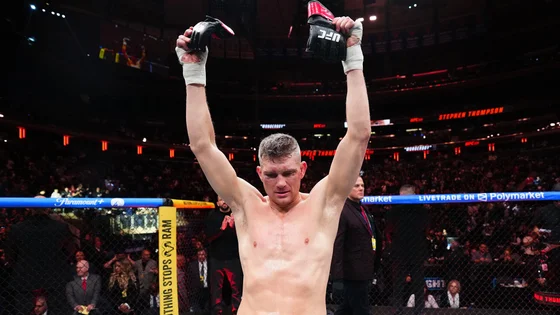
The scene afterward was as consequential as the strike. Thompson had already told the public this would be his last appearance, so the gloves left in the cage were not a tease about whether retirement might happen. It was a visual confirmation. His raised arms and the response at the Garden converted a difficult three-round fight into a rare moment when sporting result and personal choice arrived together. The highlight will be the kick, but its emotional force comes from knowing the fighter was not planning to come back and attempt it again.
GOATIFY
GOATIFY UFC & MMA
That final wheel kick was a pure MMA highlight—celebrate the sport's iconic finishes with GOATIFY UFC and MMA fan gear.


UFC GOAT Gold Middle Finger Fight Decal Sticker
Add MMA personality to your favourite gear.
Shop Now ↗

MMA GOAT Gold Middle Finger Fight Crewneck Sweatshirt
A MMA fan design for everyday wear.
Shop Now ↗
The Garden saw the title-chasing Wonderboy and the version who knew when to leave
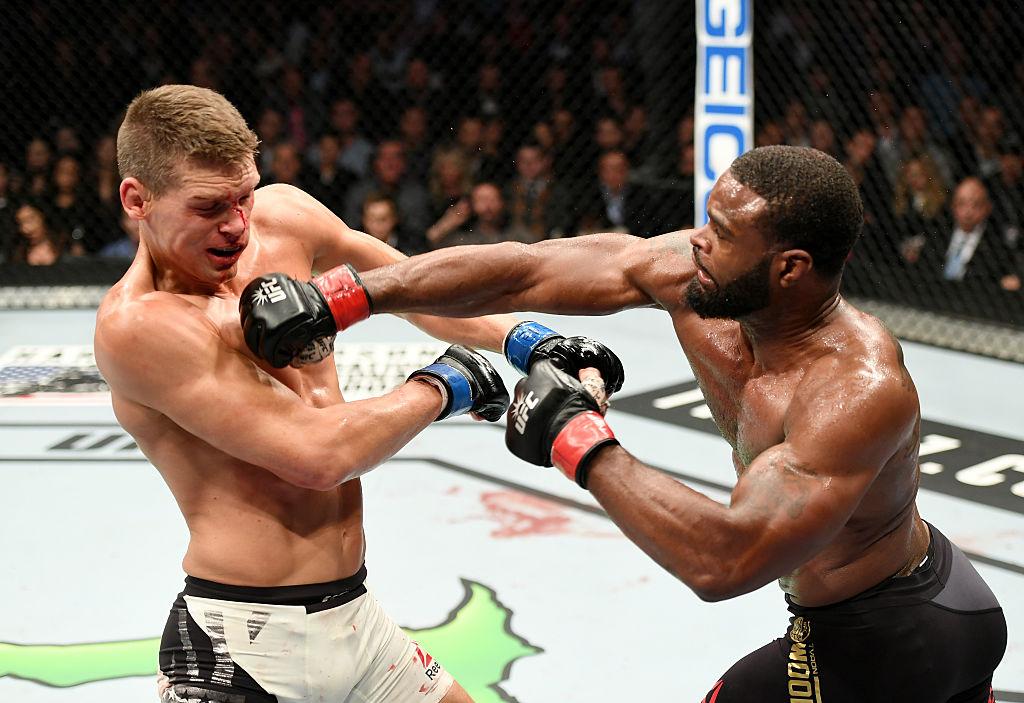
Madison Square Garden was more than an impressive building for this particular farewell. Ten years earlier, Thompson challenged Tyron Woodley for the UFC welterweight championship at UFC 205, the promotion's landmark New York event. Their first title bout ended in a majority draw. A 2017 rematch finished with Woodley winning a majority decision. Those outcomes denied Thompson the championship but fixed him firmly in the story of one of the most competitive welterweight eras. His return to the same arena in 2026 was not a title chase; it was an opportunity to end the story without pretending the earlier chapters had disappeared.
That arc complicates the usual definition of greatness. Thompson does not leave as a former UFC champion, and there is no need to rewrite the record to make the farewell impressive. He leaves as a two-time championship challenger, a durable elite-level specialist and one of the fighters who made an unusual striking system work against high-quality mixed martial artists. He did not succeed by becoming interchangeable with everyone else. His footwork, side-on stance and ability to strike across an opponent's approach remained recognizable even when an opponent found a way to beat him.
The stylistic contrast also explains why his late career contained painful nights. MMA opponents eventually learned to attack his legs, pressure him against the fence and blend strikes with wrestling threats. Different fighters found different ways to limit his space. Some of his final appearances were losses, and nobody should confuse a single retirement knockout with proof that those tactical problems had vanished. But those setbacks made the last win more interesting: Thompson adapted within the bout without surrendering the technical identity that had always made him distinctive.
His UFC debut in 2012 ended with a head-kick knockout of Dan Stittgen. Fourteen years later, his last UFC fight ended with another spectacular kick. That symmetry is striking, though it should not erase all the competitions in between: close scorecards, a championship draw, injury recoveries, changing generations of welterweights and the relentless search for favorable distance. The first and last knockouts are useful bookends, not a substitute for the long middle of the career.
At UFC 205, the important question was how Thompson could win a belt against a defending champion. At UFC 334, the important question was whether he could still express what made him Wonderboy while leaving on a date of his own choosing. The venue stayed the same; the standard of success changed. That is why the Garden connection feels earned rather than merely cinematic.
The gloves stayed behind; the family, coaching and karate identity will not

Thompson did not make the retirement decision in the emotional fog after the knockout. He entered the fight having publicly said that it would be his last, which changes how the crowd's reaction should be understood. The win was an extraordinary bonus, but the plan to stop competing did not depend on Radtke cooperating. Choosing the exit before knowing the result is a different form of control from the one a fighter tries to establish during a round. It also avoids the familiar combat-sports cycle in which a dramatic victory becomes an argument for one more fight.
GOATIFY
GOATIFY UFC & MMA
From martial-arts gyms to watching fights with family, show your MMA fandom with GOATIFY's fight-themed tees, hoodies and accessories.

Rogainz Joe Rogan UFC MMA Martial Arts Sticker
Add MMA personality to your favourite gear.
Shop Now ↗MMA GOAT Gold Middle Finger Fight Crewneck Sweatshirt
A MMA fan design for everyday wear.
Shop Now ↗His father, Ray Thompson, was in the corner at Madison Square Garden. That detail matters because Stephen's fighting style was never simply a fashionable technique adopted for UFC opponents. It came from a karate environment and a family coaching relationship that shaped how he stood, moved, taught and carried himself. The final kick may travel as a video detached from the person who performed it, but its origins run through years of repetition away from television. The visible continuity between the young head-kick finisher and the 43-year-old veteran was built over far more mornings in a gym than nights under arena lights.
Thompson has also spoken about a shift toward family life, including becoming a father. In a sport that often rewards an unwillingness to concede anything to age, publicly acknowledging new priorities can be mistaken for a lack of competitive fire. The opposite is true here: his final bout required training through camp, defending takedowns and producing an elite technical finish with a younger opponent trying to ruin the ceremony. The fact that he still wanted to win did not oblige him to keep fighting indefinitely.
There is an obvious legacy beyond the win-loss record. Thompson showed that traditional karate tools could be adapted for the cage without losing their character. He brought an unusually welcoming public persona into an industry built on provocation. He gave young strikers a distinctive model of how balance, distance and timing can become weapons, while his losses gave the same students evidence of where that model must be reinforced against clinch and wrestling pressure. A useful legacy is not one that hides weaknesses; it is one people can learn from in full.
After the stoppage, Thompson's emotion did not look manufactured. The gloves on the canvas gave the crowd an unusually clear answer: there would be no next training camp designed to redeem a bad result or extend a lucky one. His career ended at 18-9-1 overall and 13-9-1 in UFC competition, with a fresh knockout attached to a record that already contained years of difficult, meaningful fights. The farewell was memorable precisely because there was still an opponent trying to stop it from happening.
A spinning wheel kick does not settle every debate about Stephen Thompson's place among the all-time welterweights. It does not transform a two-time title challenger into a champion or rewrite the defeats that came before. It does something rarer: it lets the last actual performance look like a convincing expression of the fighter himself.
Radtke made the goodbye difficult, which is why the result counts. Thompson solved the pressure, found the distance and finished with the karate timing that started his UFC story. At Madison Square Garden, after 14 years and two different versions of himself, Wonderboy put his gloves down and left the argument exactly where he wanted it: inside the cage, with the final kick already thrown.
GOATIFY
GOATIFY UFC & MMA
Shop GOATIFY UFC and MMA shirts, hoodies and fight fan gear.
UFC GOAT Gold Middle Finger Fight Decal Sticker
Add MMA personality to your favourite gear.
Shop Now ↗


















