

Alcaraz Drew Medvedev. Zverev Got Shelton. Turin's Groups Have Teeth.
GOATIFYTurin now has its two groups, and the 2026 ATP Finals draw is a reminder that seedings can only protect a player so far. Carlos Alcaraz has been placed alongside former champion Daniil Medvedev, home entrant Flavio Cobolli and Frances Tiafoe in the Ivan Lendl Group. World No. 1 Alexander Zverev heads the John McEnroe Group with Ben Shelton, Arthur Fils and Rafael Jodar. The eight men will start the year-end championship on November 15 knowing that a poor opening performance can make the remaining round-robin matches feel like knockouts.
At first glance the groups look symmetrical: an established title contender at the top, a dangerous second seed, and two names capable of turning a single afternoon upside down. Yet the pressure is distributed very differently. Alcaraz arrives after winning Paris, Vienna and Tokyo, while Zverev brings both the No. 1 ranking and two previous ATP Finals titles. Medvedev is back after missing last year's event, Shelton is chasing a breakthrough against elite opposition, and four men will experience this tournament for the first time. Jannik Sinner, champion in 2025, is absent through injury. That changes the tournament's centre of gravity before anyone serves a ball.
Alcaraz and Medvedev share the Ivan Lendl Group — with two dangerous outsiders

Alcaraz is the headline name in the Ivan Lendl Group, but the pairing with Medvedev is what makes the draw immediately compelling. Their matches can turn into an extended argument over court position. Alcaraz wants to use quick acceleration, disguise and sudden changes of direction to get an opponent away from the baseline. Medvedev is comfortable standing unusually deep, absorbing pace and asking the other player to hit one more aggressive ball. On an indoor court where rhythm is easier to establish, whoever controls that distance can dictate much more than the score suggests. The Spaniard cannot assume that his recent run of trophies will make the Russian uncomfortable.
That run is substantial. Alcaraz finished the Paris Masters by beating Shelton 7-6 in the first-set tiebreak and 7-5 in the second, extending a burst that also delivered titles in Vienna and Tokyo after his return from a wrist injury. The result was especially revealing because Shelton's serve kept the final competitive, yet Alcaraz found enough returns and enough variety in the longer exchanges to take the decisive moments. Turin will ask a slightly different question. Instead of navigating a conventional draw with one opponent at a time, he must prepare three sharply contrasting styles while managing fatigue and qualification mathematics. Starting well matters; so does not spending every match searching for a spectacular answer.
Medvedev brings another kind of authority. He won the ATP Finals in 2020 and has experience with the strange rhythm of a tournament in which a defeat need not mean elimination. He missed the 2025 edition, so this is a return rather than the routine continuation of a streak. His ability to flatten the ball, redirect a rally and hold nerve over long games makes him awkward for opponents who prefer to finish points quickly. Against Alcaraz, the argument will be over whether patience becomes pressure or simply gives the Spaniard enough time to create angles. Against Cobolli and Tiafoe, it may be about denying two emotional, energetic players the chance to dictate the match's tempo.
GOATIFY
GOATIFY Tennis
Alcaraz, Medvedev and Turin's rising challengers give tennis fans plenty to follow. Explore GOATIFY Tennis designs inspired by the sport's biggest moments.

Tennis GOAT Golden Racket & Ball Crewneck Sweatshirt
A tennis fan design for everyday wear.
Shop Now ↗


Tennis GOAT Golden Racket & Ball Decal Sticker
Add tennis personality to your favourite gear.
Shop Now ↗Cobolli has the additional complication and privilege of playing in Italy. He is one of four singles debutants and, with Sinner absent, the home audience has an obvious new protagonist. His reward is hardly gentle: both Alcaraz and Medvedev are proven winners on the biggest stages, and Tiafoe brings his own flair and shot-making. Yet that is exactly why this group is more than a two-man contest. One surprise result from Cobolli or Tiafoe could turn the final day into a three-way scramble. Neither newcomer needs to win the entire event to influence who survives the group. In a format where every competitor faces the other three, stealing a victory from a favourite is often enough to redraw the semifinal picture.
Tiafoe also matters because his attacking instincts are quite different from Medvedev's defensive geometry. When his first strike lands, exchanges can become shorter and messier, the type of contest that tests a front-runner's composure rather than only their technical consistency. The group therefore puts Alcaraz under three distinct pressures: outlast Medvedev, contain Cobolli's home-court energy and resist Tiafoe's momentum bursts. Winning the group would be a strong statement, but treating second place as a failure would misunderstand how demanding the draw has become.
Zverev gets Shelton, Fils and Jodar: three threats that require different answers
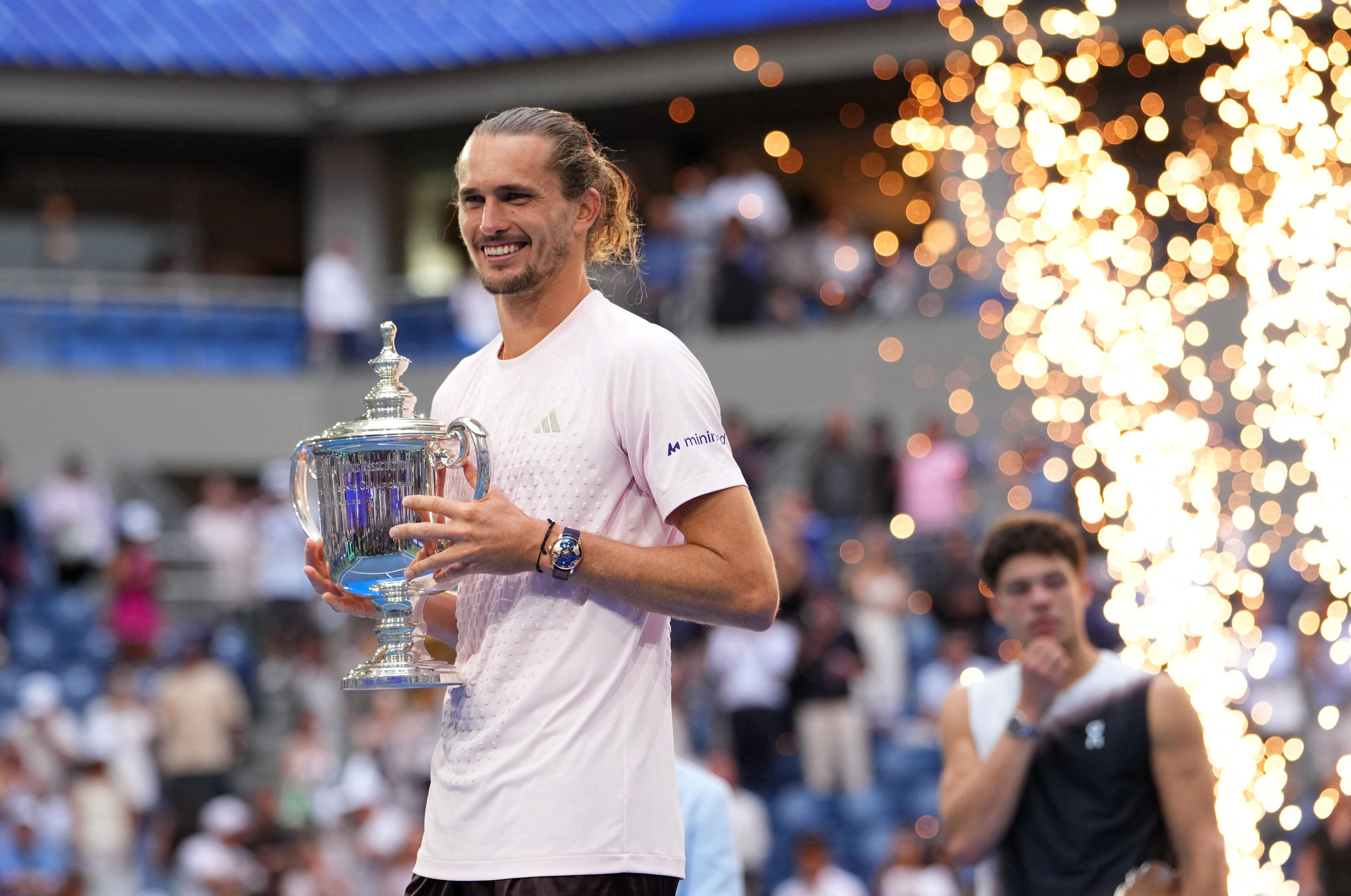
Zverev leads the John McEnroe Group as world No. 1 and the only player in his section who already knows what it feels like to win this event. His ATP Finals titles came in 2018 and 2021, experience that can be particularly valuable when a round-robin match turns into a debate over whether to protect a lead or take a risk. The German's serve and backhand give him a firm foundation indoors. But the names below him make this a test of adaptability rather than a group he can simply manage on reputation.
Shelton is the most obvious immediate threat. His left-handed delivery can remove whole sections of the return game from an opponent, especially if he lands his first serve and then follows with an assertive forehand. It is also impossible to ignore the recent stakes between these players. Zverev defeated Shelton in the US Open final in September, while Shelton later pushed Alcaraz hard in the Paris Masters final. Those results do not make the American predictable or harmless; they suggest that he can generate pressure against the very best but must convert his most promising periods more efficiently. The rematch with Zverev is an opportunity to show that the lesson was learned.
Arthur Fils gives the group a different shape. He can attack behind athletic movement, a heavy forehand and the willingness to change direction early. He has faced all three group opponents before, so the debut setting does not mean he is entering blind. The Frenchman's recorded head-to-head against Zverev stands at two victories and five defeats, with one win each in his two meetings with Shelton and one in three against Jodar. Those figures do not predict this week's scores, but they underline why the middle of the draw should not be treated as decorative. Fils has already proved he can trouble every name he sees across the net.
Jodar's presence may be the biggest surprise to anyone who stopped following his progress a year ago. In 2025 he was still playing college tennis at the University of Virginia and ranked No. 166. He has since completed a remarkable climb into the season finale, following a prior appearance at the Next Gen ATP Finals. That journey gives him something the established contenders may not have: comparatively little accumulated disappointment against this group on a stage this large. If he plays freely and takes a set from the wrong opponent, qualification mathematics could change quickly. Every veteran in the section has a reason to respect his ability to disrupt a plan.
GOATIFY
GOATIFY Tennis
Zverev's title experience meets Shelton's power and two new ATP Finals contenders. Discover GOATIFY Tennis gear while the Turin race unfolds.


Zverev can still be the favourite without being protected from uncertainty. He must survive Shelton's serving bursts, absorb Fils's sudden acceleration and avoid allowing Jodar to turn an unfamiliar matchup into a highlight-reel opportunity. His task is to accumulate two or three disciplined performances rather than chase perfection in each one. The margin between advancing first and reaching the final group match under pressure can be as small as a lost service game or an untidy tiebreak. That is why this lineup has teeth despite the presence of a two-time champion at its head.
Four debutants, no Sinner — the 2026 Finals have a different centre of gravity

The most noticeable omission from the list of eight is Jannik Sinner. The Italian won the 2025 edition and would ordinarily have been one of the central stories in Turin, but injury keeps him out this year. His absence is not merely a missing name on a poster. It removes a recent champion from the field and changes the emotional equation for the home crowd. Rather than watching the established Italian star defend his position, local fans will follow Cobolli's first attempt to establish one. That is a very different kind of suspense.
The new faces are numerous by the standards of an event that brings together only eight singles players. Cobolli, Fils, Tiafoe and Jodar are all appearing for the first time. They did not arrive by the same route. Cobolli is the immediate national focus in Italy, Fils is a French contender with genuine power against the established names, Tiafoe is a seasoned tour personality finally getting his opportunity in this format, and Jodar represents a rapid climb from college tennis and the Next Gen stage. Their stories turn the tournament into a meeting of trajectories, not just rankings.
Several of the milestones are unusually specific. Fils is the first Frenchman to reach the season finale since Gaël Monfils in 2016. Alcaraz and Jodar give Spain two direct qualifiers for the first time since Rafael Nadal and David Ferrer in 2015. Shelton and Jodar both spent time in American college tennis, adding another connection between very different careers. None of these details hands anyone a service break. But they help explain why the 2026 event feels open to surprise even with Zverev and Alcaraz installed as the leading seeds.
The American pair also carry a longer historical target. Shelton and Tiafoe are trying to become the first United States singles champion at the season finale since Pete Sampras in 1999. That does not make a title likely, especially with both men in challenging groups, but it does put their opportunity in perspective. Shelton must find a way through Zverev's consistency and the two debutants behind him; Tiafoe must handle the destructive baseline combinations offered by Alcaraz and Medvedev. Their pathways are different, while the burden of converting a good indoor run into a major title is shared.
For the newcomers, the bigger lesson is that qualifying is only the first milestone. They now need to make three separate match plans, manage the consequences of setbacks and recover quickly enough to compete again. A dramatic loss might still be followed by advancement. A big opening win could be wasted by a poor second performance. The format rewards players who can change tactics while remaining emotionally steady. Whoever among Cobolli, Fils, Tiafoe and Jodar handles that tension best could end up defining the week as clearly as either of the top two seeds.
GOATIFY
GOATIFY Tennis
Four ATP Finals debutants have changed the 2026 picture. Browse the Tennis collection for fans following the next generation of champions.


Tennis GOAT Golden Racket & Ball Crewneck Sweatshirt
A tennis fan design for everyday wear.
Shop Now ↗Why the round robin matters: Turin's schedule, semifinals and a loaded doubles draw

The ATP Finals are built to turn an elite eight-player field into a sequence of high-stakes calculations. Each man plays the other three competitors in his group during the round-robin phase, with the top two advancing to the semifinals. That structure matters as much as the headline draw. A player who loses early is not necessarily out. Conversely, a strong first win is only a starting point, because every subsequent match can affect who qualifies and how the semifinal pairings fall. The best route through the week is rarely obvious on opening day.
It also changes the meaning of a close match. When multiple players finish level on victories, the details of sets and games become relevant under the tournament's tie-break procedures. That is why a player who cannot rescue a losing match still has an incentive to contest every game. It may be tempting to look ahead to a hypothetical Alcaraz-Zverev final, yet the more immediate story is which two players emerge from each group. A surprise in the first two days could force one of the leaders into a final round-robin match with no margin for another slip.
The 2026 tournament runs at Turin's Inalpi Arena from November 15 through November 22. Group matches occupy November 15-20, with the singles semifinals on Saturday, November 21 and the championship match on Sunday, November 22. Afternoon singles sessions are scheduled for 2 p.m. local time, while evening singles matches are scheduled not before 8:30 p.m. The exact opponents and session order will shape preparation: an early afternoon contest presents a different recovery rhythm from a late indoor match. Players do not get the luxury of treating the whole week as one continuous final.
There is also a substantial doubles tournament running alongside the singles. Defending champions Harri Heliovaara and Henry Patten head the Todd Woodbridge Group with Marcelo Arévalo and Mate Pavić, Théo Arribagé and Albano Olivetti, and Orlando Luz and Rafael Matos. The Mark Woodforde Group is led by Christian Harrison and Neal Skupski, alongside Marcel Granollers and Horacio Zeballos, Simone Bolelli and Andrea Vavassori, and Kevin Krawietz and Tim Pütz. Those pairings give Italian spectators another strong home connection even while Sinner is absent from the singles field.
The doubles draw is worth watching for more than local interest. In a compact format, returning teams and newly formed partnerships have to solve each other rapidly; familiarity can matter, but a high-quality serving day can compress the difference between favourites and outsiders. For singles fans, the broader lesson is the same. Turin is not a conventional elimination bracket, and none of the groups should be read as a guaranteed semifinal outcome. The draw gives Alcaraz and Zverev a theoretical path, then asks six other elite professionals to change it. That challenge begins on Sunday, not in a final that exists only on paper.
There is no easy half of the 2026 ATP Finals. Alcaraz carries the form, but he must negotiate a former champion in Medvedev and two first-time competitors who can inject chaos. Zverev carries the ranking and the tournament history, but Shelton, Fils and Jodar can punish a slow start in three very different ways. Cobolli has a chance to give Turin an Italian story of its own, while four newcomers arrive without the weight of previous Finals disappointments.
The sensible prediction is that Alcaraz and Zverev will be difficult to dislodge. The more interesting question is not simply which favourite wins the title, but how often the others can force them to abandon their preferred patterns. Watch the opening service games, the second-set responses and the final group standings. On November 15, this looks like a two-star tournament. By the end of the round robin, it may look nothing like one.
GOATIFY
GOATIFY Tennis
Shop GOATIFY tennis products from the Tennis-filtered collection scope.
Tennis GOAT Golden Racket & Ball Decal Sticker
Add tennis personality to your favourite gear.
Shop Now ↗


















