

MacKinnon Is Out a Month. Makar Is Out Two Weeks. Colorado Has a New Problem.
GOATIFYColorado went into the second period in Ottawa with two of hockey's most productive players. By Saturday, the Avalanche had timetables for both of them, and neither was encouraging. Nathan MacKinnon is expected to miss at least a month, while Cale Makar is facing roughly two weeks out. Both have lower-body injuries sustained during Thursday's 4-3 overtime loss to the Senators. A team built to overwhelm opponents with speed, skill and possession now has to find a different way to win.
The distinction between the two absences matters. Makar's shorter window offers a relatively near-term route to restoring the first power-play unit and Colorado's most adventurous defenseman. MacKinnon's absence extends across a far larger block of the schedule, removing a center who drives scoring chances shift after shift. And for the first two weeks, Jared Bednar must plan without both at once.
This is more than a routine injury update. Colorado's next test is not whether another player can impersonate either superstar. It is whether enough separate contributions—from centers, defense pairs, special teams and goaltending—can compensate for the responsibilities that usually sit with two names.
The injury update turned two frightening exits into a month-long problem

The first warning came Thursday night in Ottawa. Colorado had rallied from a two-goal deficit in a game that ultimately went to overtime, but the score became secondary when two essential players disappeared during the middle period. Makar's shift around the 10:44 mark of the second lasted only four seconds. He went down the tunnel, returned for one brief 23-second appearance, then did not play another shift. MacKinnon exited later in the same period after a battle near Senators defenseman Artem Zub. The center reacted around his right side, remained on the bench briefly and headed to the room.
At first, the immediate question was availability for the next game, not how to cover multiple weeks. Saturday's medical update removed that uncertainty. MacKinnon's estimated absence of at least one month is substantially longer than Makar's approximately two weeks. Colorado therefore faces two overlapping problems: surviving the initial stretch without either star and rebuilding its attacking structure around an extended vacancy at center even after Makar is potentially back.
MacKinnon's numbers explain why there is no obvious replacement. He had 30 points in 20 games, including 10 goals and 20 assists, and was among the NHL's leading scorers when he was injured. That is 1.5 points per game in the early season. Last season he produced 53 goals and 127 points, finishing among the league's elite in both categories. Those totals do not merely represent a finisher waiting for passes. MacKinnon creates entries, forces defenders to retreat, absorbs top matchups and makes teammates dangerous because opponents have to account for his acceleration.
The Avalanche also rely on the pressure he applies without the puck. When their strongest line has the puck, Colorado can dictate where a shift is played and limit how often its own defense has to defend sustained zone time. Without its lead center, the club must manufacture more of that territorial advantage with forechecking, clean exits and tighter changes. That is hard to measure in a single scoring box, but it may be the biggest adjustment of the next month.
GOATIFY
GOATIFY Hockey
As Colorado adjusts without MacKinnon, discover GOATIFY Hockey gear for fans following every lineup change.


MacKinnon's track record makes the comparison especially stark. He has reached 100 points in four consecutive seasons, won the 2023-24 Hart Trophy and helped Colorado capture the Stanley Cup in 2022. Those credentials do not guarantee that his absence produces a specific number of losses. They do establish that this is not a role a team can simply fill by promoting its next-highest scorer. A center who can both threaten the net and drive play under pressure affects practically every unit around him.
One subtle detail in the recovery timetable deserves attention: it is an estimate, not a guaranteed return date. Colorado has not publicly supplied the level of medical specificity needed to predict how either injury will respond to treatment and skating workloads. A week on a calendar is not the same as a week of game-ready conditioning. The responsible approach is to plan for the announced absences, avoid turning optimistic dates into promises and let the medical updates—not external speculation—determine when the two stars are ready.
Makar's absence exposes the power play and the defense at the same time
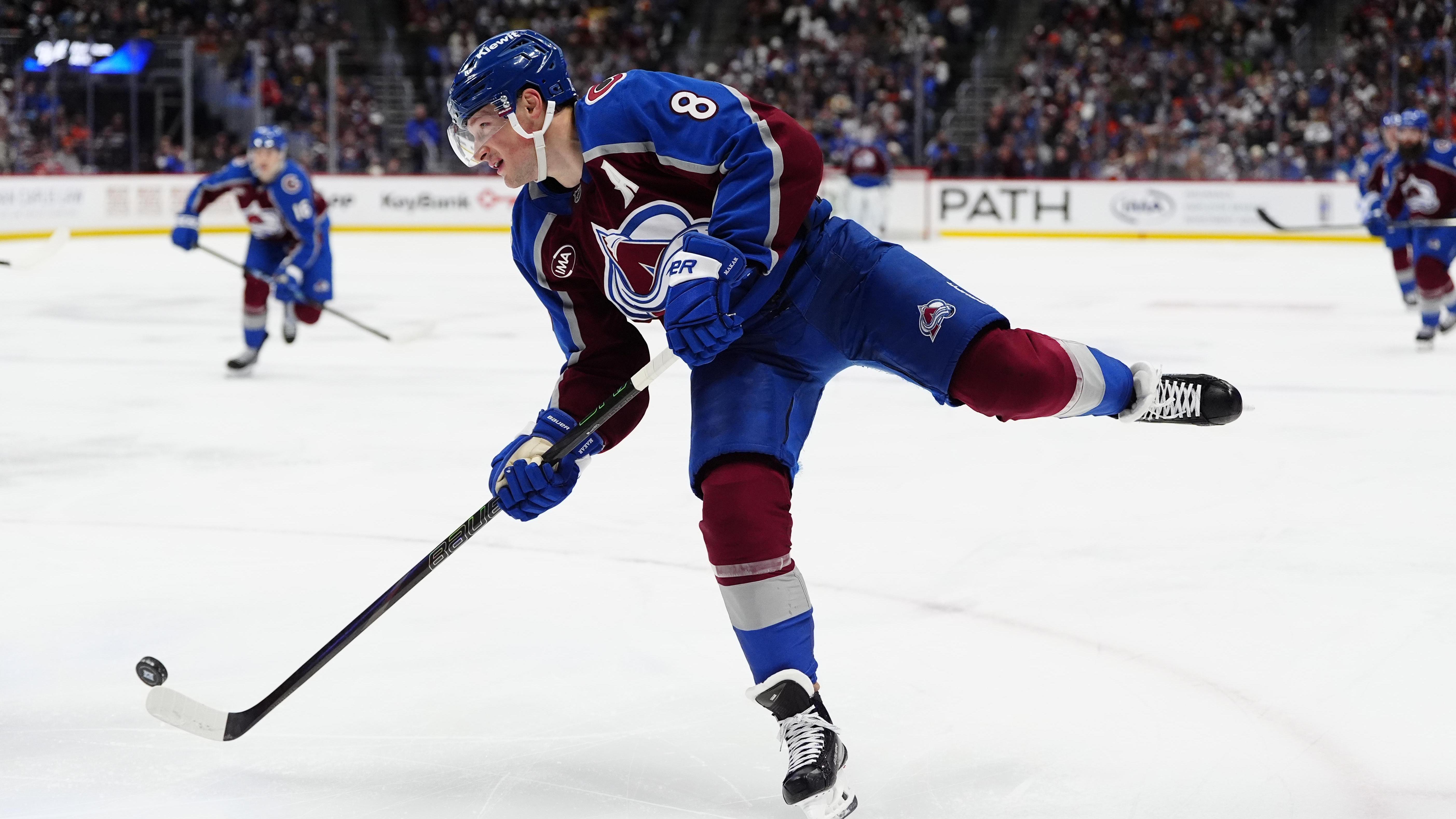
Two weeks can sound manageable in isolation. For Colorado, losing Makar while MacKinnon is already sidelined is far more disruptive than the calendar suggests. Makar had 23 points in 19 games—five goals and 18 assists—before his injury. Those are exceptional offensive totals for a defenseman, but raw points capture only the visible part of his contribution. His ability to escape pressure, carry the puck through neutral ice and join the attack gives Colorado the option to turn a defensive recovery into a scoring chance in a few seconds.
That skill also lets the Avalanche play more aggressively. With Makar available, a teammate can make a supported pass out of danger rather than forcing a chip along the boards. Opponents must account for him on the blue line because he can shoot, move laterally or attack the space behind an advancing forward. When he is absent, the replacement might be reliable defensively but cannot be expected to reproduce the same combination of puck control, deception and speed. The team's overall margin for error becomes narrower.
The power play is an obvious pressure point. MacKinnon and Makar are both central to the first unit's threat profile. MacKinnon forces penalty killers to respect an elite shooting option and rapid cross-ice exchanges. Makar controls movement at the top, changes passing angles and can punish a defender who overcommits to one side. With both unavailable, simply giving their minutes to two other players would preserve the number of skaters but not the structure opponents are preparing to defend.
Bednar's alternatives are therefore strategic rather than purely positional. Colorado might favor a simpler approach that generates rebounds, uses the net-front area more consistently and avoids the low-percentage exchanges that become harder without elite puck movers. It could seek more shots early in a power play instead of expecting the perfect passing lane to appear. None of these adjustments needs to become a permanent identity; they are ways of producing usable offense during a temporary personnel shortage.
GOATIFY
GOATIFY Hockey
Makar's absence will test Colorado's blue line; explore GOATIFY Hockey styles while the Avalanche reshape their units.
The defensive workload is also affected by the absence of Josh Manson, already on long-term injured reserve with an ankle injury. That removes another established presence at a moment when the blue line is being rebalanced. Devon Toews and Brent Burns are among the experienced names who could take on additional responsibilities, but the particular combinations and minutes remain coaching decisions. Increased ice time has consequences: a defenseman who plays more against top opponents has fewer shifts available against easier matchups, and the partners beside him face changes of their own.
Makar's achievements explain why this is a problem of quality, not just volume. He has won two Norris Trophies and was the Conn Smythe Trophy winner on Colorado's 2022 championship run. Through 19 games this season, his scoring rate was above a point per game from defense. His return, whenever medically cleared, should give Bednar a powerful organizing piece. Until then, the Avalanche must guard against the temptation to ask a single substitute to cover every part of his job.
The practical benchmark for Colorado's altered blue line is not whether its replacement players create highlight-reel rushes. It is whether the team breaks out of its zone efficiently, protects the middle of the ice and keeps the opposition from repeatedly attacking tired pairs. If those elements hold, Colorado can remain competitive even without a defender capable of changing a game in one possession.
The first test belongs to Necas, Lehkonen and everyone pushed up the lineup

The new injury timeline immediately changes the way Colorado's game against Montreal should be evaluated. The Canadiens are not an opponent the Avalanche can expect to manage on autopilot. Entering Saturday, Montreal was 12-3-4 and Colorado was 11-6-3. Those records set up a demanding road matchup even before the absences are considered. The immediate objective is to stay structurally sound while testing which players can absorb the offensive and defensive opportunities that MacKinnon and Makar usually command.
Martin Necas is one of the most natural candidates to assume more of the attacking burden. He has the speed and transition skill to create plays without simply waiting for somebody else to deliver the puck. But his challenge becomes different when opponents know Colorado's leading center is unavailable: a defense can allocate more attention to the next major threat, and every productive shift becomes harder to earn. Necas does not have to imitate MacKinnon. He does have to keep forcing defenders to move their feet rather than letting Colorado's attack become static.
Artturi Lehkonen provides another route. His value includes difficult-area work—screens, rebounds, battles for position and pressure near the crease—that can turn an otherwise ordinary shot into a second chance. With some of Colorado's most sophisticated puck movement temporarily reduced, offense built from traffic and retrievals may matter more. Lehkonen's 14 goals entering the weekend are further evidence that Colorado does not have to wait for MacKinnon to return before finding scoring contributions elsewhere.
Gabriel Landeskog, Nazem Kadri and Brock Nelson give Bednar experienced forwards with distinct styles and potential to shoulder added responsibilities. The actual deployment can change shift by shift, and there is no reason to pretend a projected line combination is a confirmed game plan. What matters is the principle: preserve credible scoring threats on more than one line while avoiding an exhausting concentration of work on whichever unit happens to find early success.
GOATIFY
GOATIFY Hockey
From Necas to Lehkonen, the Avalanche need new heroes. Browse GOATIFY Hockey apparel and fan accessories.
Colorado's loss in Ottawa offered a reminder that the rest of its roster is capable of creating offense in unusual circumstances. Lehkonen and Landeskog scored on power plays, while Parker Kelly produced a short-handed goal in a contest the Avalanche ultimately lost 4-3 in overtime. Those goals cannot erase the importance of MacKinnon and Makar, but they do demonstrate that Colorado's scoring routes are broader than two stars. A healthy team uses that breadth to complement its headline talent. An injured team needs to rely on it.
The personnel dominoes extend beyond established veterans. Gavin Brindley was recalled to give the Avalanche another forward option, while Alex Gagne was set for an NHL debut on the blue line against Montreal. Those moves underscore the distinction between replacing a name on the roster and replacing everything that player contributes. A newcomer can provide energy or a reliable five-minute stretch without taking the toughest matchup every shift. Bednar's task is to find those manageable assignments and build a collective performance around them.
Goaltending can shape the next few weeks just as decisively as the scoring chart. If Colorado has to spend longer defending without its two best transition drivers, its goaltenders will see a different distribution of chances and zone time. The answer cannot simply be asking for miraculous saves. Better defensive-zone exits, disciplined neutral-zone spacing and fewer unnecessary penalties all reduce the burden. A team that accepts some lower-event hockey for a short period may be more effective than one that insists it must play at full speed with a compromised lineup.
There is also an important difference between surviving the first game and sustaining a month of results. After Montreal, the schedule will keep presenting opponents who learn from earlier matchups and adjust to Colorado's new combinations. Even if Makar returns around the expected two-week mark, MacKinnon's longer absence will still require a functioning center rotation and secondary scoring. The Avalanche can control their process more directly than their record in any one night. Keeping games close, protecting the lead when they have it and building a repeatable five-on-five structure are the clearest early signs of a viable adjustment.
Colorado is not going to discover a hidden MacKinnon or a second Makar in the next practice. What it can discover is whether its roster has enough depth and adaptability to hold its position through the hardest part of the injury schedule. The shorter two-week timeline makes Makar's return an important potential reset, but that date remains subject to recovery. MacKinnon's minimum month away is the larger structural challenge.
That gives Bednar two urgent priorities: find workable defense and special-teams solutions while both superstars are missing, and build a sustainable attack that still functions after one of them returns. The first few games will reveal which adjustments are real. They will not settle Colorado's season. For a team with championship expectations, the test is how well it protects those expectations before its biggest difference-makers are healthy again.
GOATIFY
GOATIFY Hockey
Shop GOATIFY NHL and hockey shirts, hoodies and stickers.


















