

Ricciardo Won Eight F1 Races. For Years, He Thought It Wasn't Enough.
GOATIFYDaniel Ricciardo's Formula 1 record contains eight Grand Prix victories, 32 podium finishes and some of the sport's most recognizable celebrations. For years, though, he viewed that collection through the absence of one thing: a world championship. Looking back in a new November 11, 2026 interview, the Australian sounds less interested in the title that eluded him and more appreciative of the races he actually won.
That change in perspective matters because Ricciardo's career was never short of moments at the very top. He broke through with Red Bull in Canada in 2014, discovered how brutally a Monaco win could slip away in 2016, returned to conquer the same streets in a wounded car in 2018 and delivered McLaren's first victory in nine years at Monza in 2021. Each result represented a different kind of pressure, and none required him to be a world champion to demonstrate elite driving.
His story also challenges an easy way of judging Formula 1 careers: counting trophies without accounting for opportunities. Drivers cannot choose whether their cars are championship contenders, but they can make decisive overtakes, protect damaged machinery, recover from setbacks and bring people along for the celebration. Ricciardo did all four. His reflections reveal why the achievements once overshadowed by an unfulfilled ambition now feel more complete.
Canada Was the Win That Made Everything Seem Possible
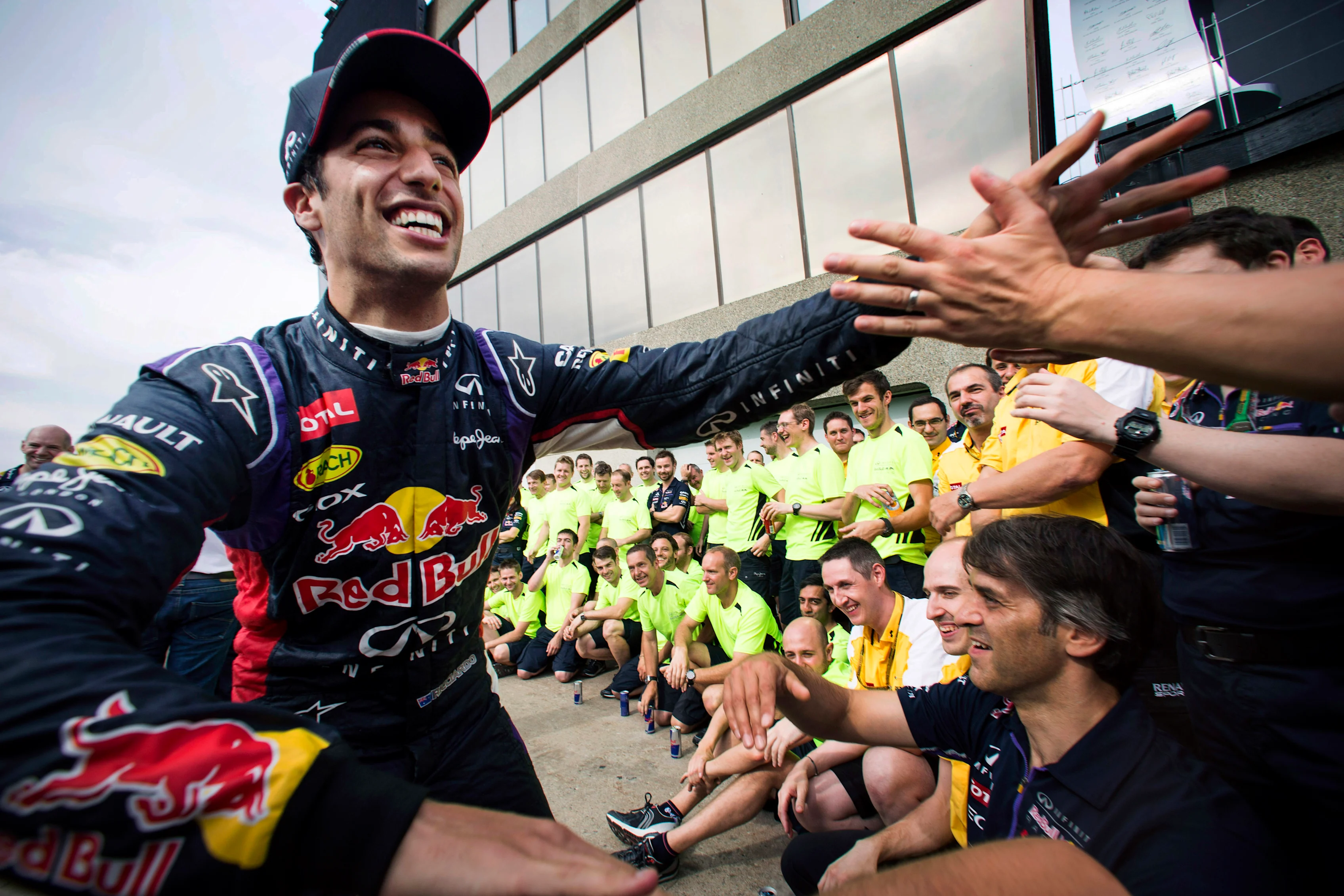
Ricciardo arrived at Red Bull in 2014 with a rare opportunity and an awkward benchmark. He was taking a seat alongside Sebastian Vettel, the reigning four-time world champion, while Mercedes had become the standard against which every other team measured itself. He had already reached the podium twice in his first season with the team, but a podium is not quite the same proposition as knowing you can win a race outright.
Canada provided that proof. Ricciardo started sixth in Montreal and worked forward as the Grand Prix developed. Lewis Hamilton's retirement changed the possibilities at the front, but the opportunity still demanded action rather than patience alone. In the closing stages Ricciardo passed Sergio Perez and then Nico Rosberg, turning the opening created by Mercedes' problems into his own first victory. His disbelieving reaction on the radio captured the size of the breakthrough better than a polished victory speech could have done.
It was a particularly important win because Red Bull had been expected to spend the season chasing the dominant Mercedes package. Ricciardo did not have the most straightforward route to first place, and his decisive moves came in the portion of the race when defending a podium position would already have looked like a success. That difference is part of what separates an opportunistic result from a genuinely convincing one. He seized the chance when it appeared and did not settle for being the beneficiary of another team's misfortune.
The triumph also shifted the scale on which he judged his career. Once a young driver knows he can beat champions, a championship becomes a plausible destination rather than an abstract dream. Ricciardo added further wins in that Red Bull period, at a time when being consistently competitive against the biggest names mattered almost as much to his growing reputation as collecting trophies. But the comparison with a full-season title contender never went away. The benchmark kept moving whenever he reached it.
In the new interview, he acknowledges that he once struggled to regard his career as successful without winning the Drivers' Championship. That is a revealing admission from somebody whose first victory had been so joyful. There are two distinct kinds of excellence in F1: making the most of the car and circumstances available on a particular Sunday, and having the machinery and consistency to accumulate the highest points total over a season. They overlap, but they are not interchangeable. A driver can prove championship-level qualities without ever having an uninterrupted championship-level opportunity.
GOATIFY
GOATIFY Formula 1
Ricciardo's maiden win in Canada showed how much one late-race pass could change. Discover GOATIFY Formula 1 apparel and racing stickers that celebrate the moments fans remember.


It is also easy to flatten the Canada result into a career statistic years later. The number eight does not convey the late-race overtakes, the sudden opening in an otherwise Mercedes-dominated year or the emotional effect of beating Rosberg to the flag. Those details explain why the memory remains meaningful even as Ricciardo reassesses what he accomplished. A first win confirms what ambition suspected; it tells a driver the sacrifices can become something tangible. It cannot promise that the rest of the career will follow a tidy progression toward a world title.
That tension runs through Ricciardo's retrospective. He does not pretend that the championship ambition was unreasonable or that missing it never hurt. Instead, he is beginning to judge the remarkable achievements that did happen on their own terms. Canada was a result that another driver could have missed even with the same opening. Ricciardo made it count. That is not a substitute for a championship, but it deserves more than the role of a footnote to one.
Monaco Took a Win Away. Two Years Later, Ricciardo Took It Back.
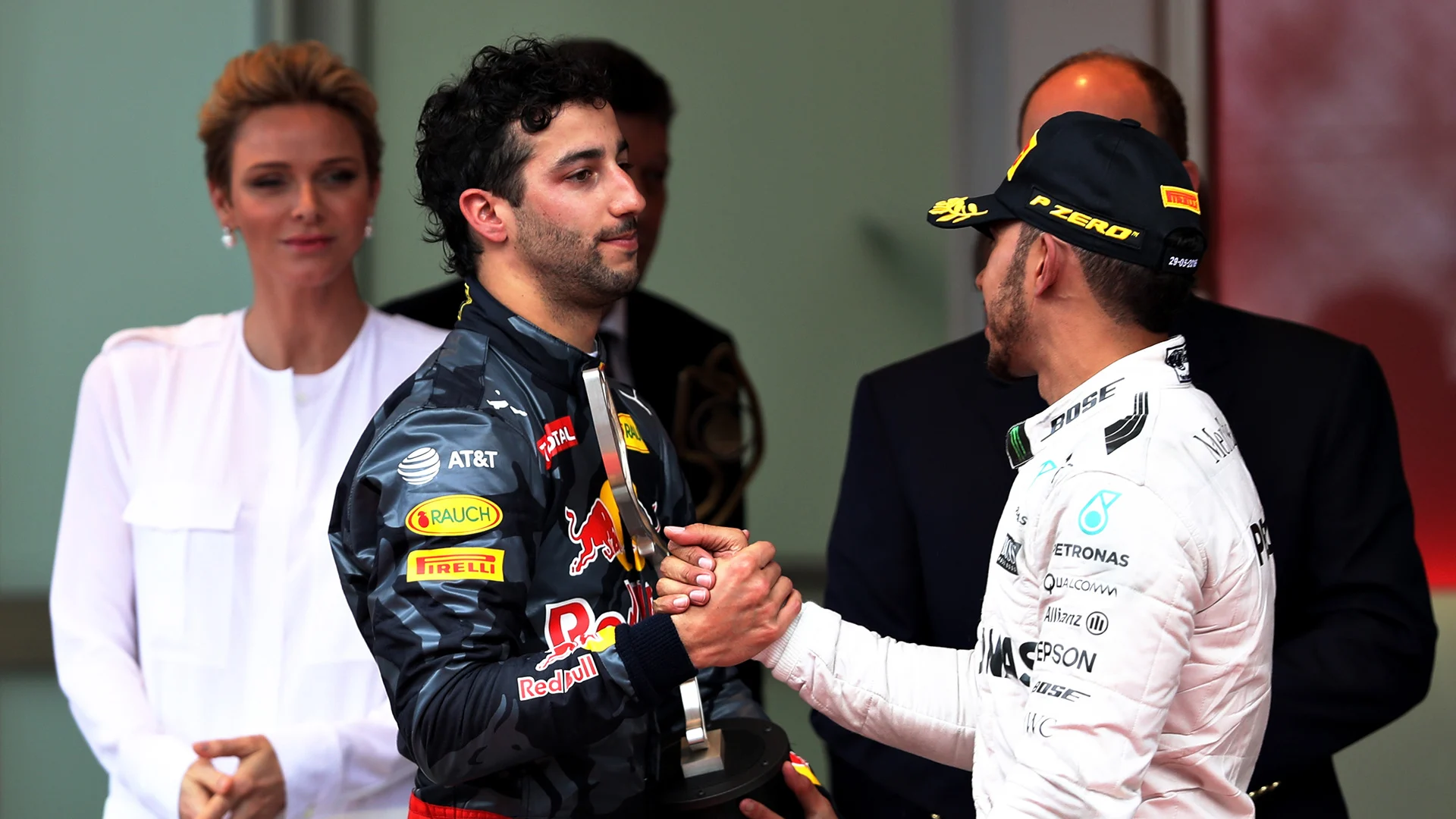
Few venues expose the difference between driving brilliantly and winning quite like Monaco. Ricciardo felt unusually at home on the streets of Monte Carlo. He could commit to the barriers with confidence, judge the narrow margins and find speed at a circuit where a tiny mistake is normally expensive. He earned his first pole position there in 2016, and in his recollection that achievement almost felt overdue rather than surprising. It was one of the clearest periods of confidence in his career.
The race began in wet conditions. Ricciardo led and managed the changing track as the field moved from full wet tyres to intermediates and, eventually, slicks. He appeared to have the pace and track position to win. Then a final pit stop overturned the race. Red Bull's crew did not have the correct tyres ready when he arrived, leaving him stationary while the team retrieved the required set. Hamilton emerged ahead; Ricciardo chased, but finished 7.252 seconds behind the Mercedes.
Those facts can look mundane in a results archive: a pole converted into second place, a seven-second gap, a race won by a rival. They feel very different from the cockpit. Monaco makes passing unusually difficult even when the faster car is behind, so the pit-lane mistake carried consequences that the driver had little power to reverse. Ricciardo had done the difficult part of the weekend and watched the likely reward disappear in an operational failure.
He now describes the situation as a lesson in losing sight of the fundamentals while reacting to a competitor. The team changed its response to Hamilton's strategy, and the resulting confusion meant it failed to execute the stop. The broader point is about control. Race teams ask drivers to manage tyres, temperatures, braking points and risk, but the driver's performance depends just as much on people making decisions beyond the steering wheel. Even a pole lap and a strong race can be undone in the seconds when the car is stationary.
Ricciardo's retrospective does not erase his anger about 2016. Rather, it gives that anger a defined place in the story. He had reason to believe Monaco could have been one of the landmark wins of his career. He also knew that a great lap, a dominant stint and an opportunity missed are not the same as a Grand Prix victory. The near-miss hung over the next time he was quick enough to fight for the win.
GOATIFY
GOATIFY Formula 1
Pole positions and pit stops can change a Monaco weekend in seconds. Explore GOATIFY F1 designs for fans who follow every strategy call and racing move.


That next opportunity arrived in 2018. Ricciardo again started from pole, but this time the danger came from the car itself rather than a missing tyre set. He lost a significant amount of power and found himself relying on fewer gears around the circuit. Instead of building a comfortable advantage, he had to manage a wounded Red Bull while Sebastian Vettel remained close enough in the Ferrari to punish a mistake. Ricciardo has explained that he did not fully understand the extent of the mechanical problem from the cockpit. In retrospect, that lack of knowledge might have spared him some anxiety during the fight.
Monaco's constraints worked both ways. The short straights reduced the opportunity for the pursuing Ferrari to exploit its horsepower, but they also left Ricciardo virtually no margin for an error under braking or on corner exit. He could not simply drive away. His task was to keep the car operating, avoid giving Vettel a clean chance and withstand the pressure from behind for lap after lap. Winning with a compromised machine can require an altogether different talent from setting the quickest qualifying time.
When he crossed the line, the outcome answered a question that had followed him since the 2016 defeat. It was not a replay with the same circumstances reversed. He had won by surviving a new problem, using track position intelligently and refusing to let anxiety turn into a costly mistake. The celebration that followed, including his plunge into the Red Bull swimming pool, looked spontaneous and ridiculous in the best sense. Yet the build-up had been anything but carefree: Ricciardo recalls the sleeplessness and pressure of knowing another Monaco chance might not come along.
That mixture of fear, precision and relief is what makes the two races inseparable. Monaco 2016 shows that a driver cannot control everything required to win. Monaco 2018 shows that when the car goes wrong, a driver still has meaningful ways to protect a result. Together they provide a more revealing assessment of Ricciardo's ability than simply listing one second place and one victory. His best drives were not always his easiest afternoons.
The Shoey Was the Show. Monza Was Proof He Still Belonged.

Ricciardo's career is remembered for more than the way he drove a Formula 1 car. The broad grin, the radio laughter and the podium shoey became an unmistakable part of his public identity. Drinking celebratory champagne from a racing boot sounds like the sort of joke that could briefly amuse a paddock and then vanish. Instead, the ritual spread. Fellow drivers, including Hamilton and Verstappen, took part, and even celebrities were invited into the joke.
He explains that the intention was not to make elite racing seem easy. The point was to loosen an atmosphere that often treated visible enjoyment as somehow incompatible with serious competition. At times, drivers on the podium looked more burdened than delighted. Ricciardo wanted to give himself and the people around him permission to celebrate. There is an important condition inside that philosophy: results have to justify the attention. A personality cannot substitute for pace, but a successful competitor can make achievement feel shared rather than sealed behind professional detachment.
The 2018 pool jump after Monaco brought those two sides of Ricciardo together. He had just endured one of the most stressful wins of his career, controlling a damaged car while a rival stalked him through the streets. Once the race ended, the release was theatrical rather than reserved. He later traced the idea to an absurd movie moment and admitted that he expected to embarrass himself. The reaction became part of the event's memory. It was an expression of relief as much as showmanship.
That perspective also helps explain why the 2021 Italian Grand Prix looms so large in his account. By then Ricciardo had left Red Bull, raced for Renault and joined McLaren. The move did not immediately produce the form or confidence he had once possessed. He has spoken about doubting himself and wondering whether he would ever stand on the top step again. At one point in that season, the question was not whether he would become champion. It was whether he would still feel like the driver who had won races before.
GOATIFY
GOATIFY Formula 1
From managing a damaged Red Bull to holding off Vettel, Ricciardo's Monaco redemption remains a classic. Browse GOATIFY Formula 1 tees and race-day gear.


Monza offered a weekend that suited the strengths of the McLaren. The car was quick on the straights, and Ricciardo was comfortable with the circuit. He got ahead of former teammate Verstappen at the start and managed the lead as the race unfolded. The much-discussed crash between championship rivals Verstappen and Hamilton removed two obvious threats, but Ricciardo had already put himself in position to capitalize. He still had to execute, keep the pace and take the chequered flag. Lando Norris finished second to complete a McLaren one-two.
The result ended McLaren's nine-year wait for a Grand Prix victory and gave Ricciardo his eighth, and final, F1 win. It was his first with a team other than Red Bull. Those details matter to the meaning he attaches to it today. He had proved that he could win for another organization, not simply reproduce a familiar Red Bull formula. Mechanics, strategists, engineers and teammates shared the result. For a driver who had lost confidence, hearing the wider team celebrate was evidence that he had contributed to something bigger than his own trophy cabinet.
He remembers the relief as vividly as the champagne. That is why calling Monza an opportunistic win because other cars retired would miss the substance. Grand Prix victories are never awarded for having the most compelling personal story; they require a driver to make the right moves and hold position when a chance is available. Ricciardo created and protected the opportunity. The team's first win in almost a decade was also the restoration of his faith in his own abilities.
The human details connect the Canada, Monaco and Monza chapters. In Montreal he seemed surprised that a childhood ambition had become real. In Monaco he experienced how cruelly the sport can deny a deserved reward, then how much sweeter a return opportunity can feel. In Monza he rediscovered the driver he had feared might be gone. Across all of them, he made the people around him part of the moment. His shoey was never the reason those races happened, but it made their joy more memorable.
Ricciardo's current perspective is not an argument that a championship is unimportant. It is a rejection of the notion that anything less makes the rest irrelevant. F1 history rightly celebrates its champions, while also remembering drivers whose racecraft, resilience and character shaped eras without delivering the season-long crown. Eight victories do not tell the whole story. The range of ways Ricciardo earned them, and the feelings they now bring back, tell far more.
Ricciardo's November 2026 reflections are not a claim that a missed world championship no longer matters. They are evidence that its absence need not define everything else. The first win in Canada, the devastation of Monaco in 2016, the improbably controlled victory two years later and the joy of Monza form a career story with more texture than a single number can provide.
Eight Grand Prix wins placed him among the drivers able to seize rare opportunities against the best in the sport. The other moments—the radio laughter, the shoey, the fear before Monaco and the collective relief in McLaren's garage—help explain why those results still resonate. They show both the cost of chasing success and the pleasure of occasionally reaching it.
He once judged his career against the title that did not arrive. The older Ricciardo can look back at the proof that did: passing Rosberg in Canada, nursing his Red Bull around Monaco, and crossing the line for McLaren at Monza. None of those memories becomes smaller because he never won the championship. They are the reasons his place in Formula 1 history remains distinctive.
GOATIFY
GOATIFY Formula 1
Shop GOATIFY Formula 1 shirts, hoodies and racing stickers.


















