

Borralho Told Pereira They Were Friends. Now He Fights Poatan’s 3–0 Teammate.
GOATIFYAt UFC 334, Caio Borralho will be trying to beat more than the man standing across the cage. He will be fighting a teammate of Alex Pereira, a friend and former training partner who has seen parts of Borralho's game that ordinary opponents can only study on film. The twist is not that Pereira and Borralho have suddenly fallen out. It is that their friendship has become one of the most intriguing tactical wrinkles on Saturday's card.
Borralho meets Yousri Belgaroui in a three-round middleweight contest at Madison Square Garden on November 14, 2026. The Brazilian brings an 8-1 UFC record and an ambition to get closer to a title opportunity. Belgaroui, the former elite kickboxer training with Pereira and Glover Teixeira, arrives with three UFC wins and three finishes. The matchup sets a proven ranked contender against a dangerous newcomer whose promotional resume is still short but spectacular.
In an interview published on fight day, Borralho described contacting Pereira soon after the booking. He made clear that their respect was intact, that training together would have to wait until after the contest, and that the competitive divide would not become a personal one. That is a sensible boundary. It also leaves an uncomfortable question: what happens when the other corner has worked with you in striking exchanges, full MMA sparring and grappling?
The simple preview would call this a wrestler against a kickboxer and move on. Neither fighter deserves such a thin description. Borralho believes his striking is underrated, while Belgaroui has made his professional MMA transition by adding weapons to an already formidable stand-up base. Their collision may hinge less on one spectacular technique than on the threat of the next one.
Pereira Knows Borralho's Game. That Doesn't Mean Belgaroui Can Borrow It.

Borralho's message to Pereira was the sort of conversation most fighters would prefer to have before entering a training room, not before stepping into a packed arena. The pair have worked together in the United States and at the Fighting Nerds setup in Brazil. Pereira has seen Borralho work on his feet, inside full mixed-martial-arts sparring and on the mat. When Belgaroui joined the team built around Pereira and Glover Teixeira, that shared experience became relevant to a high-stakes contest.
According to Borralho, the conversation itself was calm. He told Pereira that he remained an admirer and a friend, explained that their next joint session would have to wait, and expressed respect for Teixeira's camp. The distinction matters: cooperation before a booking does not oblige either team to withhold strategic information once contracts are signed. Elite fighters share rooms, coaches and sparring partners; occasionally the calendar turns that cooperation into useful opposition intelligence.
Still, there is a gap between knowing an opponent's strengths and being able to neutralize them. Pereira may understand the timing of Borralho's entries or the transitions he prefers when a scramble moves toward the back. Belgaroui must make those reads himself under the lights, against someone who can alter a combination halfway through or change levels after drawing a defensive reaction. Advice may narrow the surprises, but it cannot transfer Pereira's reflexes to another athlete.
GOATIFY
GOATIFY UFC & MMA
Explore GOATIFY UFC fan designs as Caio Borralho and Alex Pereira set friendship aside for one fight.


UFC GOAT Gold Middle Finger Fight Decal Sticker
Add MMA personality to your favourite gear.
Shop Now ↗Borralho has also argued that Belgaroui is experienced enough to trust his own preparation rather than become consumed by what his teammate remembers. That is plausible. A veteran of high-level kickboxing needs a consistent game plan more than a catalogue of every exchange an acquaintance once had in the gym. The information that can matter most is practical: whether a jab leaves the hips exposed, whether a kick brings a predictable counter, or whether a pressure sequence lets Borralho close the gap safely.
The Pereira connection creates a powerful storyline precisely because both camps can be professional without pretending the relationship has no competitive cost. Teixeira's team knows the danger presented by Borralho's ground work; Borralho knows his opponent has been preparing alongside a fighter who understands world-class striking at an unusually intimate level. Both men have something to use and something to protect. The bout will settle only the fight-night argument, not the broader friendship.
That context makes Pereira an important character in the story, but not its protagonist. The two athletes who must solve these problems are Borralho and Belgaroui. Once the cage door closes, a message between friends cannot defend a takedown, check a low kick, or decide whether the next exchange stays standing.
Belgaroui Has Finished All Three UFC Fights. The Ground Is Still the Unknown.

Belgaroui's case for an immediate breakthrough is built on three UFC appearances and three stoppages. He knocked out Azamat Bekoev in October 2025, followed by finishes of Mansur Abdul-Malik and Djorden Santos in 2026. That is an attention-grabbing introduction to a division where contenders often need years to put together a streak. It is also a small sample, and it has not yet answered every question that a ranked, tactically adaptable opponent can ask.
His experience predates those UFC wins. Belgaroui competed at a high level in GLORY kickboxing and challenged for its middleweight title on three occasions. He faced Israel Adesanya and Pereira in kickboxing before becoming a teammate of the latter in MMA. Those years matter when assessing his confidence and composure: this is not a beginner who has simply found three clean punches. He has spent a professional career learning to recognize feints, read distance, build combinations and keep his shape under pressure.
Yet the transition from kickboxing to mixed martial arts changes the price of every decision. A long combination that is safe when opponents can only punch and kick becomes a potential entry point for a level change. A fighter who wants to stand tall to see over an opponent's guard may also expose his hips. Even a successfully defended shot can force a striker to reset, interrupting the rhythm required to put together sustained offense. Belgaroui's job is not only to stop takedowns; it is to keep that defensive work from erasing his most dangerous offense.
GOATIFY
GOATIFY UFC & MMA
Shop UFC and MMA fan styles while comparing Belgaroui’s knockout streak with Borralho’s full MMA skill set.


MMA GOAT Gold Middle Finger Fight Crewneck Sweatshirt
A MMA fan design for everyday wear.
Shop Now ↗
Rogainz Joe Rogan UFC MMA Martial Arts Sticker
Add MMA personality to your favourite gear.
Shop Now ↗

Borralho, meanwhile, has a more varied UFC history than the quick label of grappling specialist suggests. His 2024 decision win over Jared Cannonier lasted five rounds; his March 2026 victory over Reinier de Ridder came by unanimous decision across three. He has already dealt with dangerous stand-up opponents and with the physical demands of top-level MMA. His approach can begin with jabs, kicks and lateral movement, with the threat of a shot making opponents reluctant to plant and answer back.
The most intriguing question is therefore about sequencing. If Borralho establishes the possibility of a takedown without spending every minute wrestling, Belgaroui may throw fewer combinations, defend his waist earlier or keep extra distance between exchanges. But if Belgaroui can punish entries with straight shots, maintain space and force Borralho to reset after failed attempts, those same takedown threats might become costly distractions. Neither outcome is guaranteed simply because one fighter owns the stronger kickboxing pedigree and the other has a broader MMA toolkit.
Friday's weigh-in supplied one less uncertainty. Borralho registered 185.4 pounds and Belgaroui 186 pounds, both within the non-title middleweight limit. The contest is scheduled for three five-minute rounds. In a fight of that length, the first few exchanges can do more than set a mood: they can decide who must spend the remaining minutes chasing a result. A clean early takedown could make Belgaroui cautious; a hard counter could make Borralho reconsider how openly he changes levels.
The upset path is easy to picture without declaring the upset likely. Belgaroui wants separation, confidence in his defensive wrestling, and enough clean striking time to use his finishing instincts. Borralho wants a fight in which the threat of several different attacks forces reactions that he can exploit. The larger surprise may be if either man wins by doing more of the work he is supposedly not known for.
Borralho Wanted a Higher Rank. This Fight Can Rewrite the Middleweight Queue.
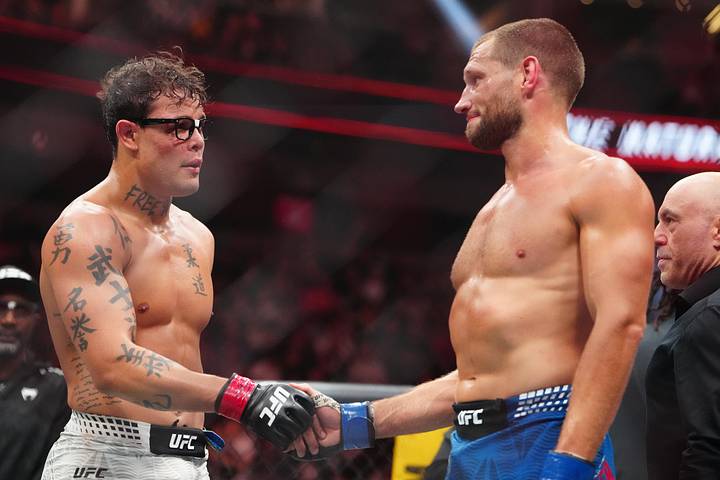
Borralho did not initially welcome the assignment. In his fight-week comments he explained that his first preference was for an opponent higher in the rankings, someone whose name would more obviously move him toward a title shot. Once he learned there was no such matchup available, he accepted Belgaroui. He framed the choice as a professional decision rather than a grudge and acknowledged that the Dutch contender's performances made him a legitimate challenge.
That response makes competitive sense. A fighter with eight wins in nine UFC appearances has already done a great deal to earn an established position. The organization does not award a title fight solely for beating someone below you, but a loss to a rapidly rising finisher can send a contender much farther backward than a win sends him forward. For Borralho, the task is to defend both his ranking and his case for bigger assignments. For Belgaroui, the prize is the chance to turn three impressive finishes into a result against an opponent the division already recognizes.
Borralho's most recent chapter illustrates how fast that equation can change. He suffered a unanimous-decision defeat to Nassourdine Imavov in September 2025, then returned with a unanimous decision over Reinier de Ridder in March 2026. The comeback strengthened his standing without erasing the cost of the setback. Another quality performance here would allow him to say the recovery was not a one-night correction; it was evidence that his full skill set remains effective against contrasting opponents.
GOATIFY
GOATIFY UFC & MMA
Browse GOATIFY UFC gear as Borralho and Belgaroui chase different routes toward the middleweight rankings.

MMA GOAT Gold Middle Finger Fight Crewneck Sweatshirt
A MMA fan design for everyday wear.
Shop Now ↗UFC GOAT Gold Middle Finger Fight Decal Sticker
Add MMA personality to your favourite gear.
Shop Now ↗Belgaroui's position is almost the inverse. His UFC career began in October 2025, so his record inside the promotion is compact, but every fight so far has ended with an opponent stopped. A fourth win over Borralho would have a meaning beyond the number in the win column. It would test whether his striking translates when faced with a proven contender's layered game, and it would give the promotion a reason to discuss him alongside established middleweights instead of treating him as an exciting prospect.
There is a larger division-wide consequence too. Ranked contenders have to decide when to take risks against someone who is building a reputation faster than the rankings can reflect. New names need opportunities to demonstrate that finishing unranked opposition is not their ceiling. UFC 334 offers a reasonably clean answer to that tension: one man has the credibility; the other has momentum. Whichever fighter imposes his preferred range and pace will leave the bout with a much stronger argument about where he belongs.
The setting amplifies the stakes. Madison Square Garden is the stage for a UFC 334 lineup headlined by Ciryl Gane against Josh Hokit, with Kayla Harrison and Amanda Nunes also on the card. Borralho and Belgaroui are not being asked to carry the entire event, but they have an audience that may be larger than a routine contender matchup would draw. A decisive finish could be remembered well after the headlines about the title fights have faded.
That is why the Pereira angle should not crowd out the real sporting issue. It provides a vivid entry point and perhaps a small informational edge, but the ranked-vs-rising-contender dynamic is what makes this contest consequential. Borralho needs a performance that looks convincing at title-chase level. Belgaroui needs to prove the jump in opposition is no jump at all.
The friendship between Borralho and Pereira has survived the booking, at least by Borralho's account. Whether Belgaroui can turn that connection into a useful tactical advantage is still an open question. Pereira can provide insight, Teixeira can prepare the details, and Belgaroui can bring years of kickboxing experience. None of those things eliminates the hazards of facing a versatile, experienced UFC middleweight who is determined to remind everyone he can strike as well as grapple.
Equally, Borralho's conviction about his all-around game is not a guarantee against a man who has finished every UFC opponent placed in front of him. The opening minutes must test both sides of the story: whether the takedown threat disrupts Belgaroui's rhythm, and whether Belgaroui's length and striking can force Borralho out of his preferred plan.
At Madison Square Garden on November 14, friendship will stay outside the cage and competitive decisions will take its place. The most revealing result will not be which corner knows the opponent better. It will be which fighter makes his own adjustments matter more.
GOATIFY
GOATIFY UFC & MMA
Shop GOATIFY UFC and MMA shirts, hoodies and fight fan gear.


















