

Collombon and Sharifova Led 6–2 — Then Kuwait Turned Into a First-Round Exit
GOATIFYAlix Collombon and Ksenia Sharifova looked in control of their Kuwait Major opener after taking the first set 6–2. By the end of Monday, October 26, their tournament was over. Noemí Aguilar and Claudia Escacena recovered to win 2–6, 6–3, 7–5, turning what had appeared to be a manageable first-round assignment into one of the women's draw's most painful reversals.
The disappointment went beyond one match. Collombon and Sharifova had entered with evidence that their partnership could trouble stronger opposition, including a September run to the FIP Platinum Lyon semifinals. Kuwait offered a Major-level opportunity to turn flashes of quality into sustained progress. Instead, the same pair that controlled the opening set struggled to keep the initiative when the Spanish opponents settled.
France's other early women's result carried a different meaning. Louise Bahurel and Ivet Val López were beaten 6–3, 6–0 by Marta Caparrós and Águeda Pérez Ortiz, but they had already won twice against seeded qualifying teams to reach the main draw. Put together, the results underline two very different challenges: holding a lead against peers and taking the next step after a breakthrough qualifying week.
A 6–2 opening set made the collapse harder to explain
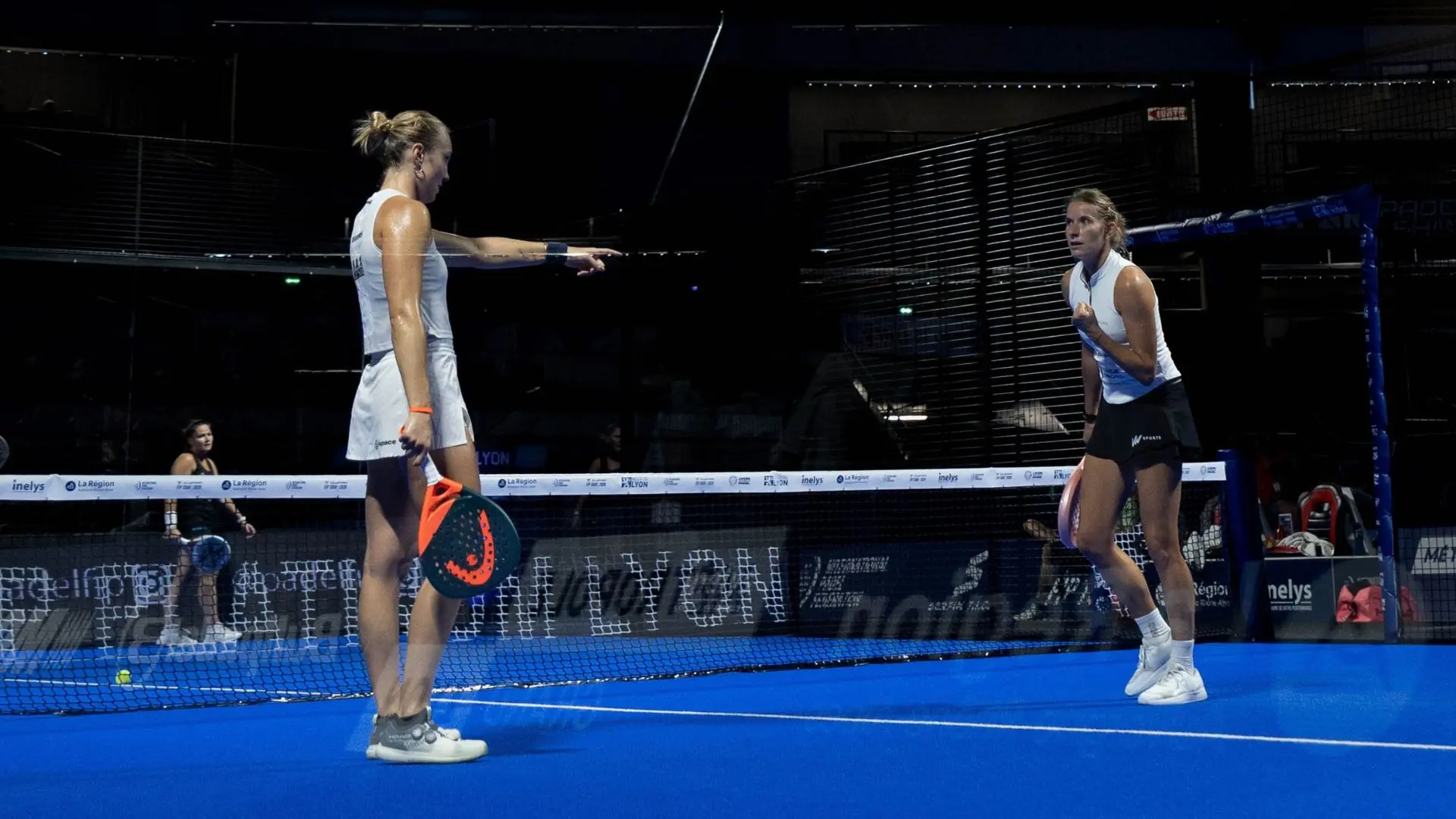
There was little in the opening scoreline to suggest a three-set defeat was coming. Collombon and Sharifova took the first set 6–2, finding enough control to make Aguilar and Escacena play from uncomfortable positions. The Spanish pair struggled with errors early, while the Franco-Russian partnership was able to establish the rhythm. For a team looking to convert its recent good moments into a more reliable Premier Padel record, that was precisely the kind of start it needed.
Yet a 6–2 set can be misleading when the opponent is still finding its timing. It tells us who won the early exchanges, not whether that advantage can survive changes in pace, shot selection or confidence. In doubles, the momentum can shift quickly when a team starts protecting its service games and forces the leaders to win points without the help of opponent mistakes. The danger is especially sharp when the favorites begin to treat their early superiority as the expected pattern of the entire contest.
Collombon entered the week as France's leading woman in the FIP rankings, listed at No. 37 in the pre-match reporting, with Sharifova around No. 43. Aguilar and Escacena were ranked around Nos. 45 and 55 respectively. That made the French-Russian pair plausible favorites, but not overwhelming ones. These were players competing in the same broad tier of the international game, where a short sequence of poor decisions can erase what looks like a comfortable ranking edge.
The context made the loss sting. At the FIP Platinum in Lyon a month earlier, Collombon and Sharifova had beaten Alejandra Salazar and Aranza Osoro 3–6, 7–5, 7–6 on their way to the semifinals. That result showed they could survive a long match against opponents with more established credentials. The lesson from Kuwait is not that the Lyon win was a fluke. It is that the standard required to reproduce that performance across tournaments is still difficult to sustain.
There is also an important distinction between a partnership's best level and its dependable level. When Collombon can construct points from the right and Sharifova can finish aggressively from the left, the pair has a credible route to upsetting stronger teams. But the system only works if both players remain effective through stretches when the other side refuses to give up easy points. The opening set showed the upside; the next two showed the fragility that still needs addressing.

Aguilar and Escacena won the match when the pressure changed sides

The second set was the hinge. After losing 6–2, Aguilar and Escacena improved their consistency and began taking better advantage of the mistakes coming from the other side of the net. Sharifova in particular had a difficult stretch, and the Spanish pair turned that opening into a 6–3 set. The change was less about one spectacular shot than about a reversal in who was being asked to play the extra ball under pressure.
That matters because the first set had created an expectation of control for Collombon and Sharifova. When the opponents stopped giving away the same opportunities, the leaders needed to generate fresh advantages. Instead, the momentum became increasingly difficult to reclaim. A pair that had looked settled now had to solve a match in which the other team was growing more confident with each service game.
The decider was tighter, which made the late breaks even more significant. Aguilar and Escacena earned an important break after the score reached 4–3 in their favor, moving ahead 5–3. Collombon and Sharifova resisted and found a way back into the set, but the Spanish pair ultimately closed it 7–5. The final score captures the difference between a comeback that merely restores parity and one that can be finished when the match is on the line.
Aguilar and Escacena deserve more than a passing mention as beneficiaries of their opponents' mistakes. Recovering from a lopsided first set requires a deliberate reset: the trailing pair has to stop chasing the scoreboard, stabilize its own service games and keep asking questions until the favorite makes a decision under stress. The available account supports a clear change in momentum and consistency, even if it does not provide a full shot-by-shot statistical breakdown.
The victory also makes sense against their broader 2026 experience. The two Spanish players had already shared the court in major Premier Padel events, including Madrid, Paris, Germany and Milan. They were not an improvised partnership suddenly discovering how to compete. Their familiarity helped make the response plausible, even though the first set suggested the match might be heading in the opposite direction.
For Collombon and Sharifova, the difficult part is the way the defeat developed. A straight-sets loss to a superior team can be explained as a gap in level. Losing after a 6–2 start to opponents in a comparable ranking bracket points instead toward the management of momentum, the ability to simplify play during a rough spell and the need to protect a lead without becoming passive. Those are correctable problems, but only if the pair can turn the disappointment into repeatable decisions in the next tournament.
Bahurel lost heavily — but her Kuwait week still moved her forward

Louise Bahurel's first main-draw match ended much more quickly. With Ivet Val López, she lost 6–3, 6–0 to Marta Caparrós and Águeda Pérez Ortiz in one hour and three minutes. The opening set offered some resistance, but the Spanish pair increasingly dictated the exchanges and finished the second without conceding a game. Judged only by that score, it was a difficult introduction to the main draw of a Major.
Judged across the entire week, it was a meaningful step. Bahurel arrived ranked No. 113, with Val López at No. 115. They did not receive a wildcard into the main competition; they earned their place by defeating two seeded qualifying teams. First came a 6–1, 6–4 win against fifth seeds Raquel Piltcher and Christina-Styliani Ntanou. Then they beat fourth seeds Catherine Rose and Rebeca López López 6–3, 6–2. Four sets won without losing one against seeded opposition is a stronger statement than simply surviving qualifying.
That sequence is important for a player trying to move toward the top 100. It demonstrated that Bahurel could manage two different pressure matches, close out a higher-ranked opponent and return the next day to do it again. Those achievements remain valid even when the level rises sharply in the main draw. The step from qualifying to established Premier Padel pairs is substantial, and the 6–0 second set against Caparrós and Pérez Ortiz is a reminder of how much more consistent the execution must become.
Bahurel leaves with 50 FIP points from the Kuwait campaign, according to the tournament reporting. That is useful ranking progress, but it should not be mistaken for proof that she has already crossed into the next competitive tier. Rankings reward repeated results. The most valuable part of this week may be the practical experience of moving from qualification pressure to a match against players accustomed to competing at this level.
There is an instructive contrast with Collombon. The more established French player had the better opening scoreline and the more disappointing finish relative to expectation. Bahurel suffered the heavier defeat but had already exceeded the expectations attached to her entry position. In both cases the scoreboard matters, yet the significance depends on what the player was trying to prove. A tournament can be a setback for one partnership and a foundation for another.
France's wider Kuwait campaign continues beyond these two results, with Léa Godallier and Timéo Fonteny also involved in the draw. It would be premature to declare the entire national showing a failure because two women's matches ended in defeat. The immediate lessons are narrower and more useful: Collombon and Sharifova need to convert strong starts into full-match control, while Bahurel and Val López need more opportunities to test themselves against main-draw opposition. Those are different paths, and both will shape what comes next.

Kuwait offered a sharp reminder that padel's rankings and early scorelines are only part of the story. Collombon and Sharifova had the opening set, a plausible route deeper into the draw and recent evidence that their partnership could win big matches. Aguilar and Escacena changed the terms of the contest and completed a three-set comeback. The 2–6, 6–3, 7–5 result will linger because it was a match the French-Russian pair had put itself in position to win.
Bahurel's exit has a different aftertaste. A 6–3, 6–0 defeat was decisive, but two seeded qualifying victories and 50 ranking points still make this a productive week in her development. For both French players, the next measure will not be the emotion of Monday's result. It will be whether they turn Kuwait's lessons into better decisions, stronger partnerships and more wins when the next opportunity arrives.
Shop GOATIFY padel products from the Padel-filtered collection scope.

















