

Susana Hit 103.8 MPH. His 13 Walks Are Washington’s Next Test.
GOATIFYJarlin Susana left the Arizona Fall League with a trophy that makes perfect sense if you have ever watched one of his fastballs, and a set of numbers that make his next assignment considerably harder to predict. The Washington Nationals right-hander was named the league's 2026 Pitcher of the Year after striking out 26 hitters in 18 2/3 regular-season innings. He held opponents to a .162 batting average, reached 103.8 mph and made almost everybody else on the circuit look like they were throwing in a different speed category.
Then comes the second line of the scouting report: 13 walks in those same 18 2/3 innings. For a 22-year-old pitcher who spent most of the season recovering from surgery, that is not a trivial footnote. It is the biggest reason Washington has to distinguish between a spectacular pitching prospect and a finished major-league starter. Susana showed that his best stuff still exists. What he has not yet demonstrated is that he can locate it, repeat it and sustain a starter's workload over a full season.
The Fall League award is a genuine achievement. It should also start the more interesting conversation: what would make all that velocity useful over six or seven innings against the best hitters in the world?
The 103.8-mph pitch was only the opening argument
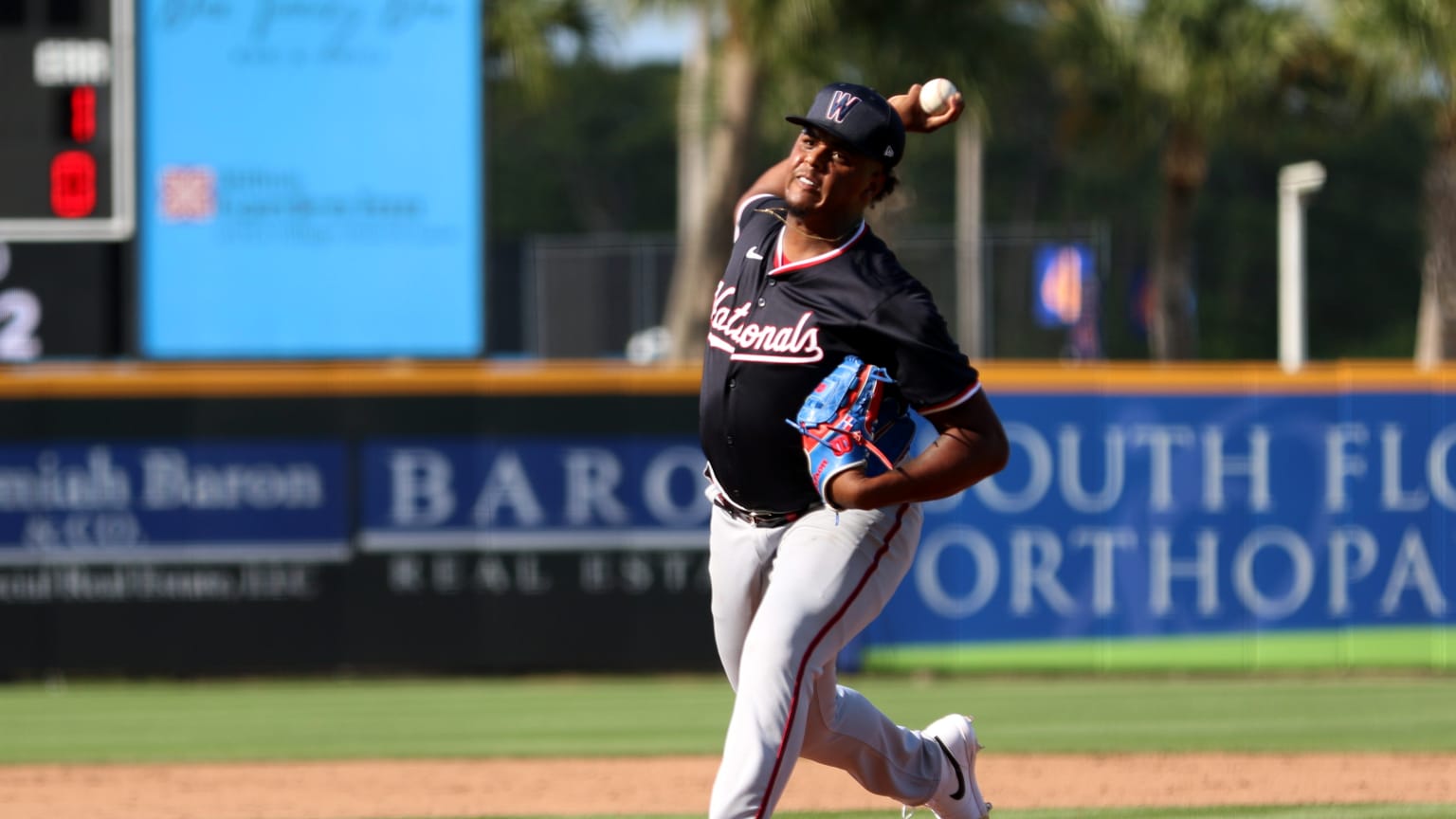
Susana's headline pitch reached 103.8 mph during his Fall League debut, but the maximum reading misses the scale of what he did over the following weeks. In a later accounting of the competition's Statcast data, 188 pitches across the league reached 100 mph. Susana supplied 165 of them. That is 87.8 percent of the entire circuit's triple-digit offerings from one arm, not one particularly dramatic clip pulled from a social feed. He also owned the league's 77 hardest fastballs, each faster than 101 mph. Averaging approximately 100.7 mph across his Fall League starts and showcase appearance is a much more revealing measure of the weapon than merely touching 103 once.
There is an important difference between throwing that hard and using the speed intelligently. A four-seam fastball can challenge a hitter above the barrel because of how it stays on its plane; a two-seamer or sinker can attack the hands and run toward the edges. Susana has worked with both shapes. When a hitter has to account for a rising-looking four-seamer and a moving, similarly fast sinker, the decision window becomes smaller. That creates an advantage before the breaking ball even enters the picture. His high-spin slider offers an additional direction of movement, and a slower sweeping variation gives him room to change a hitter's timing rather than trying to win every count with another triple-digit heater.
That mix showed itself in the Fall Stars Game. Susana opened the showcase with pitches clocked at 102.7 and 103.1 mph. He could then finish a strikeout with an off-speed breaking ball in the high 80s. The result was not simply an exhibition of power; it was a glimpse of what happens when velocity supports a changing plan of attack. A hitter geared for a 103-mph fastball has very little time to recognize something traveling fifteen miles an hour slower and moving in a different direction.
GOATIFY
GOATIFY Baseball
Susana's outrageous fastball is the latest reason to love baseball; explore GOATIFY's original baseball GOAT tees, caps and fan designs.

Gold Baseball GOAT Sweatshirt
Rep baseball’s greatest with a gold GOAT graphic sweatshirt.
Shop Now ↗


White Baseball GOAT Dad Hat
A white baseball GOAT design for ballpark days and everyday fan style.
Shop Now ↗For Washington, that pitch separation may be the foundation of a sustainable career. There are major-league hitters who can punish a poorly located 101-mph fastball, particularly when they know it is coming. The value of Susana's arm is the opportunity to make the fastball's speed, location and movement work together. In Arizona, the raw ingredients were impossible to miss. Turning them into a sequence that survives repeated meetings against the same lineup is the next test.
Twenty-six strikeouts cannot erase thirteen walks
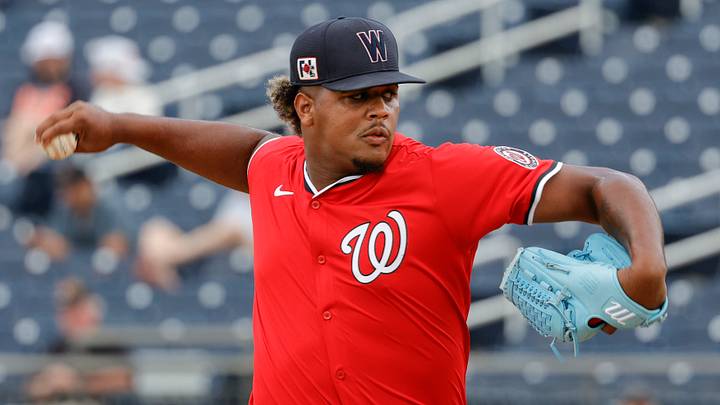
The statistic that most complicates Susana's award is not his 3.86 Fall League ERA. It is the number of pitches that never gave the hitter a realistic reason to swing. His 13 walks in 18 2/3 innings translate to roughly 6.3 walks per nine. That is too much free traffic for a pitcher trying to build longer major-league starts. He can miss bats at an extraordinary rate and still create exhausting innings if he falls behind, has to challenge hitters in predictable counts or puts himself one mistake away from a crooked number.
The contrast with his strikeouts matters. Twenty-six strikeouts in 18 2/3 innings is about 12.5 per nine, an excellent rate by any standard. Strikeouts eliminate the possibility of a ball finding a hole or a defensive mistake extending an inning. Walks do the opposite: they add another batter without requiring an opposing offense to put a ball in play. It is entirely possible for both traits to be real at the same time. Calling Susana unhittable without discussing the walks would hide the very issue that determines whether he can be trusted deep into games.
Command also is not as simple as ordering a pitcher to throw the ball down the middle. His fastball shapes behave differently, and the harder a pitch moves, the narrower the comfortable target can feel. Washington's development staff needs to know whether Susana can start counts with something competitive, locate the slider to a deliberate area and get back into the strike zone when the count turns against him. A strike on an early-count sinker may be more valuable to his growth than another outrageous velocity reading on a pitch four inches outside.
There were signs of progress in the late Fall League appearances, even if the larger sample remained uneven. During a playoff quarterfinal, he struck out five hitters over 2 2/3 scoreless innings. A separate game account credited him with 34 strikes on 58 pitches, a useful example of how he can control an outing while still generating swing-and-miss. But one cleaner start should not be used to declare a command problem solved, just as one wild first inning should not define his ceiling. The proper question is whether his release point and strike rate become more repeatable from start to start.
For a pitcher of his size and velocity, the payoff for even a modest improvement is enormous. A slightly more efficient Susana might get to the fifth inning with the same weapons instead of reaching his pitch limit in the third. That is the distinction between a one-inning nightmare for hitters and a starter capable of changing a team's rotation. Arizona made the former clear. The latter still has to be earned.
GOATIFY
GOATIFY Baseball
While Washington sharpens its strike-zone approach, celebrate your own love of the game with GOATIFY baseball shirts, hoodies and stickers.

White Baseball GOAT Sticker
A white baseball GOAT decal for your bottle, laptop or game-day gear.
Shop Now ↗


White Baseball GOAT Sweatshirt
Rep baseball’s greatest with a white GOAT graphic sweatshirt.
Shop Now ↗
The most important number might be his innings, not his velocity

It is tempting to look at a pitcher who routinely breaks 100 mph and evaluate every development by the radar gun. Susana's 2026 season requires the opposite approach. He came into Arizona after a disrupted two-year stretch that included an elbow issue in 2025 and a right lat injury requiring surgery later that year. He did not return to competitive action until August 2026. By the end of the regular minor-league season, he had managed only 20 1/3 innings. The Fall League added another 18 2/3 in its regular season, along with postseason work. The value of those extra outs is not captured by a season-ending awards list.
Rebuilding a pitcher's workload involves more than proving he can throw one hard inning. He must recover between appearances, prepare for the next start, repeat the delivery when tired and maintain enough mechanical consistency to protect his command. The AFL gave Susana scheduled outings against advanced prospects rather than a sequence of bullpen sessions without game stakes. His quarterfinal assignment, with a pitch count reaching into the high 50s, was another meaningful opportunity to demonstrate that his fastball did not vanish at the first sign of accumulated work. Those are promising indicators, not a medical certificate and certainly not proof he is ready for a full major-league season.
The difference matters because his ability to dominate for thirty pitches has never been the central uncertainty. A 6-foot-6 right-hander with a fastball averaging triple digits and a hard slider can make a two-inning appearance look unfair. The harder task is building the foundation to throw enough strikes at pitches 70, 80 and 90, recover properly and be available again five days later. Washington has to decide how to increase that burden without treating the missed development time as something to recover in one offseason.
There is another reason not to rush the conclusion. Pitch counts and innings totals are coarse measures. They do not reveal everything about a player's recovery, mechanics, arm stress or individual medical plan. An organization can feel encouraged by his late-season results while still choosing a cautious progression in spring training. That would not make the award less impressive. It would acknowledge that the minor leagues exist to improve the player, not merely to produce the fastest possible headline about his arrival.
The old footage of Susana on a mound reminds us that the physical ability predates the current trophy. The new information is that he has returned from a prolonged interruption and put that ability to work again. For his long-term career, that may be the biggest win of his entire Arizona stay.
What would actually put Susana on the Nationals' mound in 2027?

Winning the Arizona Fall League's top pitching award is a reason to update a prospect's outlook, not to write his opening-day rotation spot in ink. Washington has good reasons to be excited. Susana is only 22, has already reached Triple-A and owns a fastball that looks extraordinary even by major-league standards. He also has little recent innings volume and a strike-throwing problem that could get more expensive against experienced hitters. Those two realities should govern the Nationals' 2027 plan.
GOATIFY
GOATIFY Baseball
The prospect journey is a marathon, not one radar-gun moment; check GOATIFY's baseball fan hats, tees and accessories.


Gold Baseball GOAT Sticker
A gold baseball GOAT decal for your bottle, laptop or game-day gear.
Shop Now ↗White Baseball GOAT Dad Hat
A white baseball GOAT design for ballpark days and everyday fan style.
Shop Now ↗
The first checkpoint will be whether he enters the next development cycle healthy enough to follow a regular starter's schedule. A normal sequence of appearances, rather than one heroic outing, would tell the organization more about his readiness. The second is strike efficiency. Does he fall behind less often? Can he use either fastball variant for a called strike instead of relying on hitters to chase? Does the slider finish at-bats without requiring a lengthy battle to reach two strikes? Those questions are measurable over several starts, and their answers will matter more than whether a spring radar display shows 102 or 104.
The third checkpoint is the rest of the arsenal. Susana has the velocity to bully minor-league bats, yet major-league lineups adjust quickly to a pitcher who cannot credibly change speed or command both sides of the plate. The slower sweeping pitch seen in Arizona gives his coaches another developmental option, but one promising showcase sequence does not prove a complete third offering. His staff will have to decide which breaking-ball shapes he can repeat reliably and how they fit alongside the four-seamer and sinker. Better sequencing could reduce the pressure on the fastball without asking him to abandon his defining strength.
There are several plausible outcomes. He could build up in the upper minors, refine the strike zone and earn a starting opportunity when the numbers justify it. Washington could also limit his early workload or use a shorter role while assessing his health and command. A bullpen future should not be declared inevitable just because the walk rate remains high today, but neither should it be dismissed: a pitcher who can deliver that fastball for one or two clean innings has a valuable route to the majors if the starter's path takes longer.
Fans understandably want to see 103.8 mph on the Nationals Park board. The team has to think beyond the first glimpse. An award in November tells Washington that the talent is still rare and very much alive after surgery. A sustainable role in 2027 will require the less glamorous skills to catch up with it. If they do, Susana could be more than a radar-gun attraction. If they do not, the fastball will remain an extraordinary answer to the wrong question.
Susana's Arizona run produced the two most useful conclusions a development staff can have: his premium stuff survived a difficult recovery, and his work is not finished. Twenty-six strikeouts and the sport's fastest Fall League heater explain why he was Pitcher of the Year. Thirteen walks and the limited innings before Arizona explain why the Nationals must be deliberate with what comes next.
The smartest measure of his 2027 progress will not be one spectacular pitch shared everywhere. It will be the ordinary repeatable things: early strikes, efficient innings, reliable recovery between starts and a breaking-ball plan that works when hitters stop chasing. Washington can celebrate the award without pretending it has answered those questions. That is what makes Susana such a fascinating prospect—and why the next season of his development matters more than the trophy.
GOATIFY
GOATIFY Baseball
Shop GOATIFY baseball shirts, hoodies and stickers.

Gold Baseball GOAT Dad Hat
A gold baseball GOAT design for ballpark days and everyday fan style.
Shop Now ↗
White Baseball GOAT Sticker
A white baseball GOAT decal for your bottle, laptop or game-day gear.
Shop Now ↗Gold Baseball GOAT Sweatshirt
Rep baseball’s greatest with a gold GOAT graphic sweatshirt.
Shop Now ↗


















