Kaprizov Hit 10 Goals in Nine Games — Minnesota's 34–14 Squeeze Was Just as Loud
GOATIFYKirill Kaprizov did more than decide a one-goal game Sunday night. His sharp-angle power-play finish against Columbus was his tenth goal in Minnesota's first nine games, a pace no Wild player had ever reached. It put the NHL scoring lead in his hands and added another entry to a growing list of franchise milestones.
But the 2-1 result at Grand Casino Arena carried a second message that should matter just as much to Minnesota's season. The Wild outshot the Blue Jackets 34-14, held them to one of the smallest shot totals in franchise history and found a way to win without needing their goaltender to steal the game. Kaprizov supplied the headline; the team's territorial control supplied the explanation for why this start could last.
Ten Goals in Nine Games — and a Power Play That Keeps Creating the Moment

The winner arrived at 3:06 of the second period, with the score tied 1-1 and Minnesota on the power play. Kaprizov worked into the lower left circle, saw space above Cam Talbot's shoulder and fired from an angle that rarely looks inviting to an ordinary scorer. The puck went short side. Talbot had been excellent, but this was the kind of quick release that can beat sound positioning before a goalie has time to seal the gap.
That detail matters because the milestone was not built solely on empty-net goals or loose rebounds. Kaprizov has the balance and deception to make defenders respect the pass while preparing his shot. On a set power play, the defense has to account for the backdoor option, the bumper and the point at the same time. Even a small hesitation opens the lane for a player who does not need a generous angle. The winning sequence also delivered Joel Eriksson Ek's 200th NHL assist, a reminder that Kaprizov's finishing is connected to a functioning unit rather than an isolated individual run.
Ten goals in nine games made Kaprizov the fastest Wild player to double digits, beating Brian Rolston's 12-game mark from 2006-07. Only five other active players had reached that threshold in nine games or fewer in a season: Auston Matthews, Alex Ovechkin, David Pastrnak, Nikita Kucherov and Sidney Crosby. Those names do not guarantee anything about the rest of 2026-27, but they show how unusual the opening burst is.
His six-game point streak stood at 12 points, including seven goals and five assists. Minnesota had also scored on the power play in eight of its first nine games, converting nine of 28 opportunities. That is a much more useful supporting indicator than a single spectacular shot. A scorer can cool off; a unit that repeatedly manufactures high-quality looks gives him a platform to remain dangerous even when the percentage inevitably fluctuates.
The winner also marked Kaprizov's 78th career involvement in a game-winning goal, moving him past Marian Gaborik for third in Wild history, behind Mikko Koivu and Zach Parise. It is an early-season game, not a playoff elimination night. Still, Minnesota's best player is already deciding tight contests, and that is precisely what a team with ambitions beyond October needs from its most expensive offensive weapon.

A One-Minute Scoring Swing Hid How Much Minnesota Controlled

The final score was tight, and the end of the first period briefly suggested a much more even night. At 18:12, Yakov Trenin turned a puck into a rush chance and found Danila Yurov for a finish that put Minnesota ahead. It was Yurov's fourth goal in nine games, a meaningful return for a young center still developing the offensive confidence to complement his responsible play away from the puck.
Only 60 seconds later, Columbus was level. With an extra attacker on during a delayed Minnesota penalty, Adam Fantilli fired from the circle through traffic and beat Jesper Wallstedt. Two goals in one minute can make a game feel chaotic, but the larger shot profile told a different story. The Wild kept returning to the offensive zone, winning the next puck and forcing the visitors to defend shifts rather than trade rushes.
Columbus had already needed a remarkable stand from Talbot to survive a long early two-man disadvantage. The Blue Jackets killed 1:52 of five-on-three pressure, and Talbot ultimately stopped 32 of 34 shots. That is a .941 save percentage in a losing effort. His work kept the contest within one shot until the final horn, which makes the game an especially poor candidate for the simplistic claim that Minnesota barely escaped.
The Wild outshot Columbus 15-5 in the second period alone. Matt Boldy recorded a game-high six shots, taking his season total to 41, second-most in the league at the time. That secondary volume matters. If every Minnesota attack depended on Kaprizov taking the final shot, opposing coaches could devote their best checking resources to one threat. Boldy's willingness to attack the net and Yurov's growing finishing instinct give the Wild additional ways to force a defense to collapse.
Columbus also faced a difficult scheduling spot, playing the second half of a back-to-back after an overtime victory over the Rangers. Fatigue helps explain some of the late execution problems, but it does not erase Minnesota's work. The Blue Jackets had enough energy to defend desperately and enough goaltending to remain close; they did not generate enough clean exits or sustained possession to turn that resistance into an equal share of chances.
The distinction is important: Minnesota did not win because Talbot had a poor night. It won despite one of the stronger performances a visiting goalie could provide. The difference between a 2-1 result and a comfortable multi-goal victory was often the man in the Columbus crease, not a shortage of Wild opportunities.
Four Home Wins, Fourteen Shots Allowed — the Bigger Test Comes on the Road
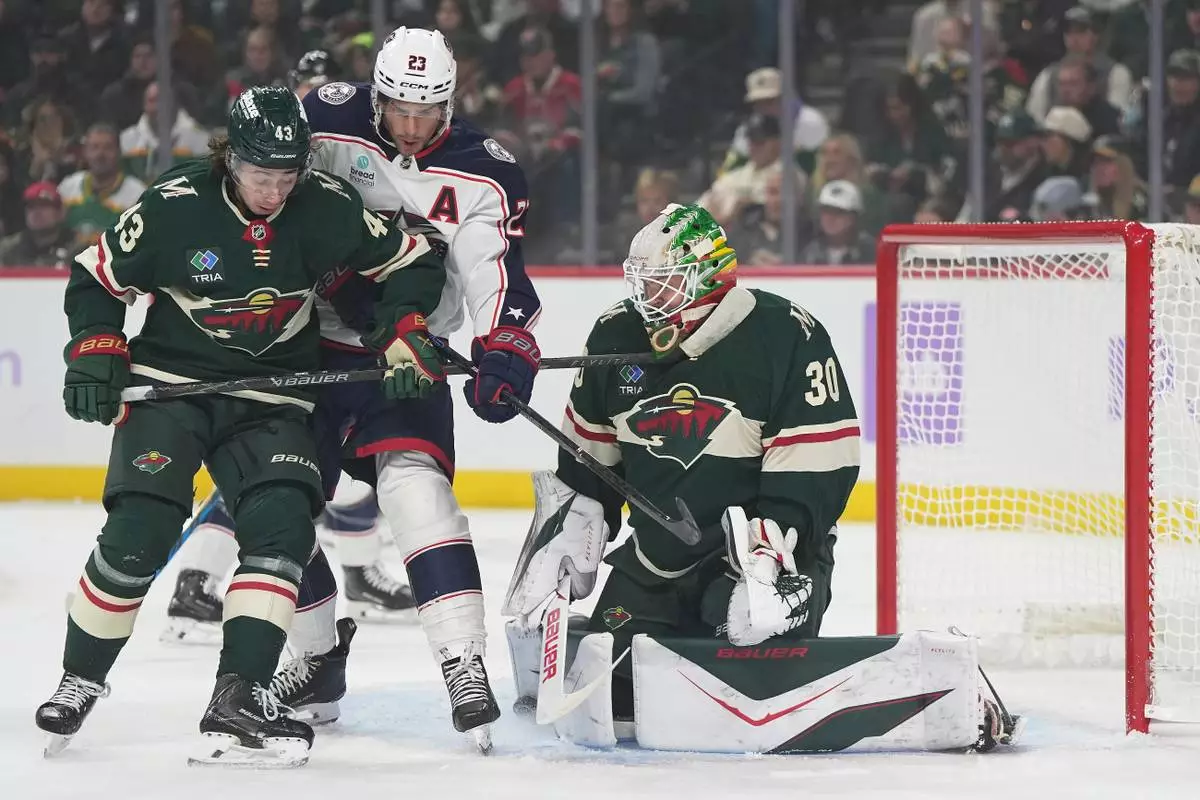
Wallstedt's line in the box score was almost modest: 13 saves on 14 shots. It would be a mistake to treat that as evidence he had no job to do. He still had to stay sharp through long stretches without work, make the early stop on a Columbus breakaway and respond after Fantilli's tying goal. A goaltender behind a dominant team often faces fewer chances but can be punished disproportionately for one lapse.
What stands out more is the environment Minnesota created around him. Fourteen shots allowed tied the second-lowest total in Wild history, with the franchise record at 13 against Anaheim in January 2003. This was not a team merely blocking its way through a frantic defensive-zone siege. Minnesota spent enough time with the puck that Columbus rarely had the sequence of controlled entries, rebounds and second attempts required to build sustained pressure.
That distinction also explains why Quinn Hughes and the rest of the blue line matter so much to the forward scoring story. A clean breakout allows Minnesota to attack with speed; an aggressive but coordinated defensive stand recovers possession before a rush turns into multiple chances against. Even with injuries testing the team's depth, the Wild were able to make their opponent work through layers rather than skate directly into high-danger looks.
At 6-2-1, Minnesota had won four of five and opened 4-0 at home for the first time since 2016. Those numbers are encouraging, but the next stretch is more revealing than the home record itself. A five-game road trip begins Tuesday in Edmonton, where the Wild will have less control over matchups and must manage a much more threatening transition attack. The road test will show whether Sunday's puck management travels as well as Kaprizov's scoring touch.
There is also a useful warning in the scoreline. Dominating 34-14 yet winning by only one leaves little margin for an unlucky bounce or a late penalty. Minnesota can improve the efficiency of its five-on-five finishing without demanding that Kaprizov maintain an unsustainable goal-per-game pace. Yurov's growth, Boldy's shot volume and a power play that has already produced consistently offer a broader answer.
For Columbus, the response is not simply to ask Talbot for another 32 saves. The Blue Jackets need cleaner first passes, better support through the neutral zone and more attacking possessions that force defenders to turn toward their own net. For Minnesota, the assignment is the reverse: keep opponents chasing, and the scoreboard is likely to become less stressful than it was Sunday.

Kaprizov's tenth goal deserves the highlight treatment. It was a precise winner, a franchise first and another reminder that Minnesota has a scorer capable of deciding a game from an improbable angle. But the 34-14 shot count is the statistic that makes the victory more interesting for the long term.
The Wild did not need an extraordinary night from Wallstedt, and they did not ask Kaprizov to rescue them from being outplayed. They built a territorial advantage, gave their power play repeated chances and made a dangerous NHL opponent work for almost every attempt. If that formula holds up away from St. Paul, Sunday's narrow 2-1 result may look less like an escape and more like an early blueprint.