

Liberty's $80M Facility Won't Be Ready for Camp. What Happens Next?
GOATIFYThe New York Liberty's $80 million waterfront practice facility is still supposed to open in 2027. But the team has acknowledged a consequential change: the Greenpoint complex will not be ready for the start of its next training camp. That makes the opening weeks of preparation a logistical challenge rather than the first chapter of an already-completed training-center upgrade.
The important distinction is between missing camp and missing the entire calendar year. There has been no definitive announcement that the 75,000-square-foot development has been pushed into 2028. What is missing instead is a confirmed temporary practice plan. The team has options, including its current Barclays Center setup and a reported discussion involving the Brooklyn Nets' HSS Training Center, but neither a relocation nor a timetable for one has been formally established. The question now is how New York protects the quality and consistency of its basketball work until the permanent site is usable.
A 2027 opening is still the plan — but camp will come first

New York has not abandoned its plan to open a purpose-built Liberty training center in 2027. What changed is the most useful early-season milestone. The $80 million project in Greenpoint will not be finished when the team begins its next training camp. That distinction matters because the start of camp is the moment when players and coaches are trying to establish habits, test lineups, and build a reliable schedule. Opening later in the calendar year might still deliver a spectacular building, but it cannot restore weeks of preparation that have already passed.
The reported update is narrower than a declaration that the entire project has slipped into 2028. Brooklyn Sports & Entertainment leadership continues to point toward completion sometime in 2027, while acknowledging that the doors will not open in time for camp. There is no confirmed substitute launch date in the public information. A reasonable reader should therefore resist both extremes: the facility is not ready on the initially hoped-for sporting timeline, but that does not mean the ownership group has canceled the investment or conceded a full-year delay.
The complex is planned for 1200 Manhattan Avenue, on the Greenpoint waterfront near Newtown Creek, with a striking view toward Manhattan. Its 75,000 square feet are meant to do substantially more than house a pair of basketball floors. The project is designed to give the franchise a dedicated workplace rather than having practices fitted around whatever else is happening in an event arena. At the center of the plan is a permanent home where training, medical treatment, film work, nutrition, recovery and ordinary daily team business can operate in one predictable place.
The building also has a distinctive physical challenge. The design incorporates an existing four-story former lightbulb factory, while adding a new two-story structure of roughly 40,000 square feet for many of the players' facilities. That adaptive-reuse approach gives the project a Brooklyn identity rather than the character of a generic warehouse. It also means there is more to deliver than open-plan courts. The original structure, new extension and specialized interior environments all have to come together before the complex can function as the team's full-time headquarters.
During the spring of 2026, the organization was still discussing the construction effort as one aimed at a 2027 opening, with foundational work and preparation at the property. Reports from visits to the site later raised questions about how much progress was visible from the street. None of those snapshots alone established a certain completion date. Construction timelines can change, and a passerby cannot reliably measure interior progress. What is now concrete, rather than speculative, is the team's acknowledgement that the building will miss the opening of next season's training camp.
GOATIFY
GOATIFY WNBA
New York's planned training center tells a story about the future of women's basketball. Explore the GOATIFY WNBA collection for basketball-inspired shirts, hoodies and accessories.


BALLERina Girl's Basketball Ballet Air Sticker
Add basketball personality to your favourite gear.
Shop Now ↗
BALLERina Girl's Basketball Ballet Air Mug
Add basketball personality to your coffee break.
Shop Now ↗

Caitlin Clark G.O.A.T. - Greatest of All Sweatshirt
A basketball fan design for everyday wear.
Shop Now ↗
BALLERina Girl's Basketball Ballet Air Sticker
Add basketball personality to your favourite gear.
Shop Now ↗There has also been no formal ceremonial groundbreaking, according to the latest reporting. That is a useful detail about the project's public presentation, not proof that work has never taken place. A ceremonial event and physical construction are different things. The real measure of progress is whether the team can occupy and operate the courts, training rooms and medical areas safely. For the 2027 Liberty, the important date is not the day of the ribbon-cutting or the first attractive photograph of a finished lobby. It is the day the basketball operation can move in without interruption.
The gap creates a communications challenge as well as a construction challenge. A broad promise of opening in 2027 can remain technically accurate even while the first basketball deadline disappears. Yet players and staff plan their years around much smaller windows. Training camp is not interchangeable with the middle of a season. That is why the next substantive update needs to make clear which capabilities will be available, when they will be available, and whether a partial move is being contemplated. A rendering tells the public what is being built; an operational plan tells the team what it can actually use.
The Liberty's investment remains notable in a league where clubs are racing to upgrade their infrastructure. There is no need to minimize a project of this scale just because it will not hit the most convenient arrival point. But the scale makes the question of delivery more pressing, not less. Ownership has advertised a high-standard, athlete-informed building. That promise will ultimately be judged on the everyday quality of the space and how smoothly the team makes the transition from its temporary arrangements, not only on the total price printed in the announcement.
Barclays or HSS? New York still needs an interim practice plan
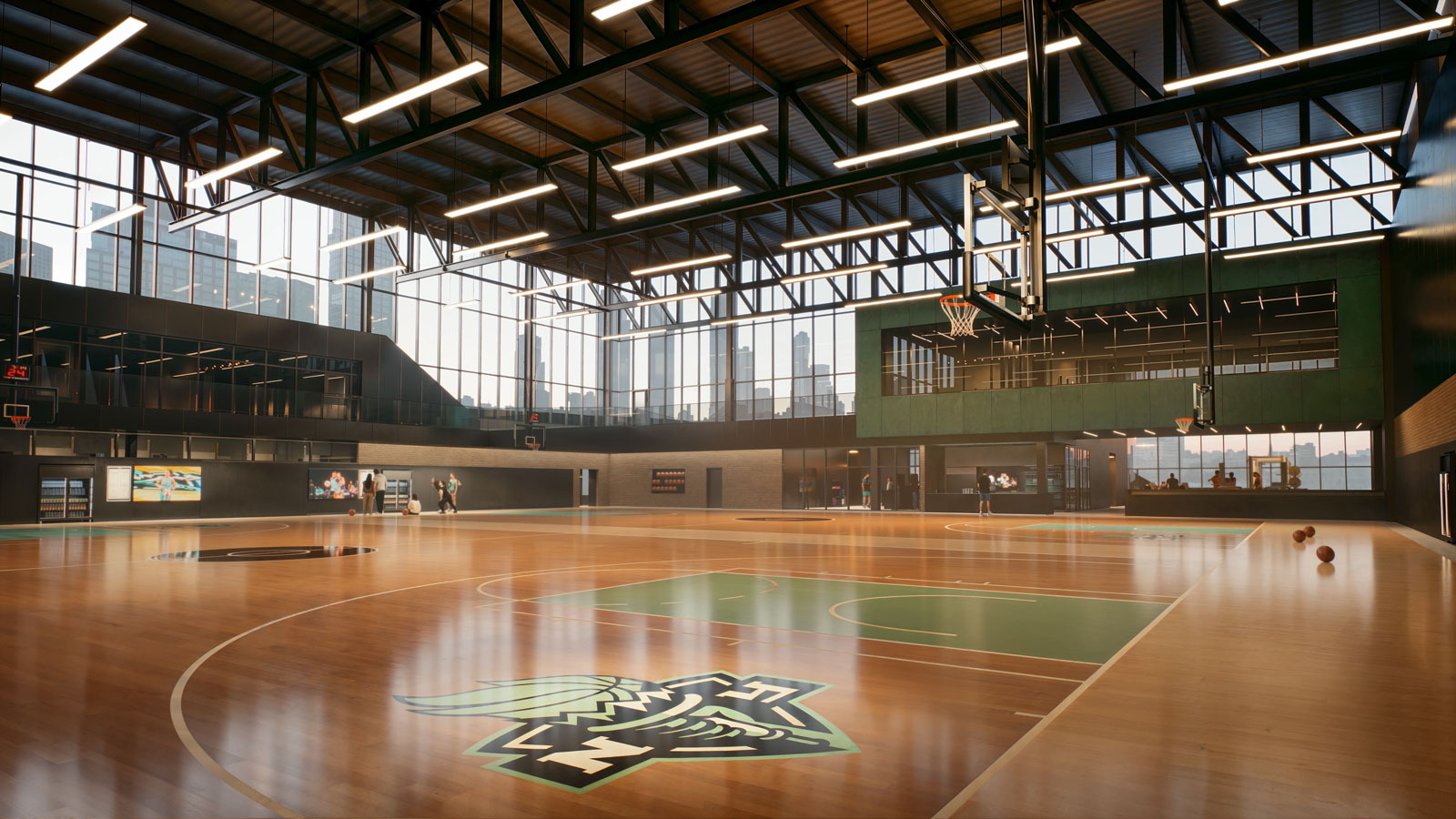
The next practical question is where the Liberty will practice while Greenpoint remains unfinished. That decision has not been publicly finalized. Brooklyn Sports & Entertainment chief operating officer Marissa Shorenstein has indicated that the organization is working toward a top-level facility, but the interim location is still an open question. The organization has reportedly discussed spending several million dollars to adapt the Brooklyn Nets' HSS Training Center for temporary use. A discussion is not a signed arrangement, a completed renovation or an official announcement that the Liberty will move there.
There is an existing option: the Liberty already practice at Barclays Center. The current arrangement meets the facility provisions of the new WNBA collective bargaining agreement, according to the latest reporting. That is an important baseline. New York is not being described as a team without a compliant place to work. The issue is whether a multipurpose arena is the best place to prepare for another season when the dedicated alternative is on the horizon but unavailable at the start. Compliance answers one question about minimum standards; it does not answer every question about consistency or convenience.
For years, arenas have been designed to transform rapidly between concerts, basketball, other sports and private events. That versatility helps a business operate, but it can make an athlete's daily schedule more complicated. Earlier reporting from Barclays Center described practices taking place near areas affected by renovations and arena activity, with changing availability for interviews and team routines. Those disruptions need not destroy a practice, and they should not be exaggerated into an injury risk without evidence. They nevertheless explain the attraction of a fixed team-only space that does not need to be worked around another calendar.
HSS would be a different proposition if the team eventually chooses it. The Brooklyn Nets' established practice center has an obvious basketball association, and adapting part of its facilities could give the Liberty access to a more dedicated training environment before Greenpoint opens. But the public discussion leaves essential questions unanswered. How much usable court time would be reserved? Would staff, athletes and equipment share the same footprint with other operations? Which areas would need renovation? And would any temporary buildout make sense if the permanent move happens later in 2027? Without answers, calling HSS a definite solution would get ahead of the facts.
GOATIFY
GOATIFY WNBA
From Barclays Center to the WNBA's new wave of team facilities, the sport keeps evolving. Browse GOATIFY WNBA merchandise for fans following the Liberty's next chapter.

Caitlin Clark Golden Goose - WNBA Indiana Sticker
Add basketball personality to your favourite gear.
Shop Now ↗


BALLERina Girl's Basketball Ballet Air Sweatshirt
A basketball fan design for everyday wear.
Shop Now ↗

Caitlin Clark G.O.A.T. - Greatest of All Hoodie
A basketball fan design for everyday wear.
Shop Now ↗The decision should start with the normal rhythm of an athlete's day. Training camp includes conditioning work, individual shooting sessions, full-team practices, scouting preparation and recovery. Coaches may need an extra half-hour on court, while a player could require a separate treatment session before or after a workout. A well-designed permanent center supports those overlapping activities without asking everyone to work through a narrow booking window. In a temporary arrangement, staff can often preserve the same standards, but it takes disciplined coordination of rooms, travel, equipment and medical schedules.
That coordination becomes more important during a season than a casual fan might think. WNBA travel creates frequent short turnarounds. Players may come back from an away game needing treatment, not an immediate high-intensity practice. Others may need an extra shooting block or video session. The value of a training center is partly the freedom to make those individualized choices. New York does not have to wait for a spectacular waterfront building to offer good preparation; it does need to avoid treating a technically acceptable temporary gym as though it automatically supplies the same flexibility and all-day access.
There is also a financial trade-off. Spending several million dollars on a temporary site, if that is what the organization ultimately decides, could improve conditions during a critical opening stretch. On the other hand, money and staff time spent on an interim setup could have a short useful life if the Greenpoint building opens promptly. The point is not that one choice is obviously right. It is that the front office should compare the real operational benefits of each option against its expected duration. A clean interim plan could be less glamorous than a construction announcement and more consequential for early-season performance.
Players should not have to decode construction headlines to understand where they will report for work. A useful plan would identify the camp venue, the training and recovery spaces available there, and how the transition to Greenpoint will be handled if the opening happens during the season. It would also avoid creating a midyear move that disrupts preparation around important games. There is still time for management to choose a workable path, but the lack of a confirmed interim site is now the most immediate unresolved issue created by the missed camp deadline.
The bigger promise is player-first design, not the $80 million price tag

When the Liberty announced the Greenpoint project in March 2025, the point was not simply to win an expensive-building contest. The team and its ownership group framed the facility as a place shaped by the people who would actually use it. Sabrina Ionescu, Jonquel Jones and Breanna Stewart contributed to the planning process with the design firm Populous. Their involvement matters to the current story because the promised benefits are unusually specific. Missing the first camp does not erase those plans, but it postpones the moment players can begin experiencing them in their daily work.
At the heart of the proposed center are two full-size practice courts with camera and data-tracking systems. That combination can support more than a full-team workout. Coaches can divide players into smaller groups, run different drills at the same time, and review sequences with immediate video context. A shooting session need not displace a tactical practice simply because the organization has only one open court. Those are practical benefits, especially for a league in which every roster spot and every preparation period can matter.
The 75,000-square-foot design extends the same idea into the physical preparation of players. The plan includes a two-story indoor and outdoor strength-training area, a cardio balcony and a recovery suite with hydrotherapy, steam, sauna, massage and other rehabilitation technologies. These amenities are not automatically proof of better results; training quality still depends on coaches, practitioners and sensible workloads. What they offer is the opportunity to coordinate strength, treatment and court work in one environment rather than sending players between locations or squeezing sessions into rooms that were designed for multiple uses.
GOATIFY
GOATIFY WNBA
The Liberty's player-first design puts WNBA athletes and fans at the center of the story. Discover GOATIFY's WNBA apparel and accessories while the league's facilities grow.

Caitlin Clark Golden Goose - WNBA Indiana Sweatshirt
A basketball fan design for everyday wear.
Shop Now ↗

BALLERina Girl's Basketball Ballet Air Mug
Add basketball personality to your coffee break.
Shop Now ↗
Caitlin Clark G.O.A.T. - Greatest of All Sticker
Add basketball personality to your favourite gear.
Shop Now ↗

One of the more distinctive elements is a set of private player suites arranged around a shared lounge instead of a conventional row of lockers. The announced concept includes wardrobes, areas for personal preparation and places to rest. The broader facility also includes dedicated family areas and nursery spaces, as well as a hair, nail and makeup studio. These details may seem less important than courts to someone watching only the final score. For athletes managing travel, training, parenting and public duties, however, thoughtful everyday spaces can help make a demanding work schedule more sustainable.
The rooftop dining concept, with indoor and outdoor seating and on-site food preparation, fits that same philosophy. Nutrition is easier to integrate into the routine when it is available at the place players already spend their days. The announced building also contains meeting and media areas, offices and a broadcast space. Those features bring basketball operations, administration and storytelling together under one roof. The effect could be less time lost to logistics and more freedom to individualize a player's day. That is the long-term value New York hopes the building will provide once it is fully operational.
The project also reaches beyond the roster. An outdoor court is intended to support community access and clinics, while the wider plan includes fan-facing hospitality and retail. The site combines a historic industrial structure with new construction, a design choice that connects the team to Greenpoint rather than putting it in an anonymous compound. Such ambitions create a bigger construction task, but they also explain why a single completion milestone has consequences for several groups. Players, staff, families, visitors and community programs are all waiting for different pieces of the same development.
For the Liberty's basketball leadership, the choice is not between caring about the grand facility and caring about the next season. It must be both. The new building can be a legitimate long-term advantage, while a rushed or unclear interim move can still produce avoidable friction. There is also no evidence that a practice venue alone will determine results on the floor. Better infrastructure can make good work easier; it cannot shoot, defend or make coaching decisions. Keeping that distinction in view makes the current situation easier to evaluate without treating every construction update as a crisis.
The fair standard for New York is a specific, credible transition plan. Supporters should expect clarity about the interim venue, player access to recovery and training resources, and whether the organization anticipates moving into Greenpoint during the 2027 season or after it. Management may reasonably want to avoid attaching a date before it can stand behind one. But the team does not need a ceremonial launch to communicate how preparation will work. Until those details arrive, the $80 million headline describes an impressive destination with a crucial opening stretch still to be organized.
The Liberty do not need to deliver a finished Greenpoint campus on the first day of camp to prove that their long-term investment is meaningful. They do need a reliable place to train, recover and meet without a disruptive change of routine. The latest update settles the first question: the permanent building will not be ready for that opening stretch. It leaves the two most useful answers outstanding — where the team will practice instead and when the move to the new facility can realistically happen.
Until management provides those details, it is premature to treat HSS as a signed deal or 2027 as a lost year. The right measure of the coming months will be the quality of the interim arrangements and the credibility of the next construction milestone.
GOATIFY
GOATIFY WNBA
Shop GOATIFY WNBA products from the WNBA-filtered basketball collection.

Caitlin Clark Golden Goose - WNBA Indiana Hoodie
A basketball fan design for everyday wear.
Shop Now ↗

BALLERina Girl's Basketball Ballet Air Sticker
Add basketball personality to your favourite gear.
Shop Now ↗
BALLERina Girl's Basketball Ballet Air Sticker
Add basketball personality to your favourite gear.
Shop Now ↗



















