

Sabalenka vs Svitolina: One Match for the Last WTA Finals Semifinal
GOATIFYA place in the WTA Finals semifinals is on the line in Indian Wells on Friday, November 13, and the equation could hardly be simpler. Aryna Sabalenka faces Elina Svitolina in the final Group 2 singles showdown. Win and reach the last four; lose and leave the tournament before its knockout round. The match follows Mirra Andreeva's commanding victory over Sabalenka and Svitolina's three-set recovery against Karolina Muchova, results that turned the final group match into a direct qualification playoff rather than a tiebreaking puzzle.
Sabalenka enters with the stronger history in this rivalry, including five straight wins over Svitolina. But the immediate evidence is more complicated than the head-to-head number. One player just endured a remarkable collapse against a teenager. The other spent Wednesday finding her game after an uncomfortable opening set. Their next meeting will test whether experience and past results carry weight when a single match decides the season-ending championship's final singles semifinal spot.
Sabalenka owns the rivalry, but Svitolina has found a way to survive
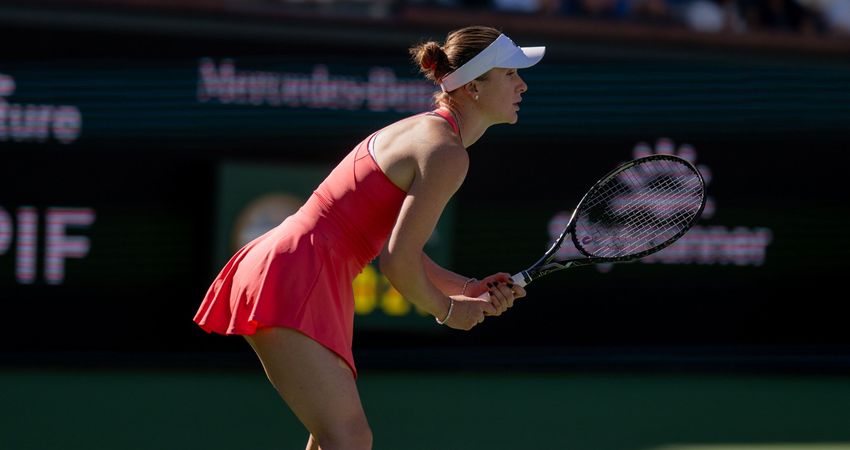
The pre-match figure that stands out is 6-1. That is Sabalenka's career record against Svitolina, and the Belarusian has won their five most recent encounters. All three previous hard-court meetings went Sabalenka's way. Their latest meeting came in the Australian Open semifinals earlier this season, when Sabalenka won 6-2, 6-3. On paper, those results suggest a player who has repeatedly found comfortable patterns against this opponent. They also make this a match about more than staying alive in a tournament: Svitolina must solve a familiar problem under a particularly unforgiving deadline.
A head-to-head record explains what happened before, not how Friday must unfold. Sabalenka's power can shorten rallies, press Svitolina behind the baseline and force defensive replies. The Ukrainian is most effective when she can extend an exchange without becoming passive, change the pace and find the point at which an opponent tries to finish too early. The first challenge will be keeping service games from becoming a series of rushed first-strike exchanges. A second is making Sabalenka construct winners rather than allowing comfortable patterns off the first two shots.
Svitolina earned the right to play for a semifinal berth by beating Muchova 3-6, 6-2, 6-2. She was initially outplayed by the Czech's changes of spin, touch and direction, but her game became more controlled as the contest progressed. Her winner-to-unforced-error line shifted from five winners and 14 errors in the opening set to 12 and 11 in the second. Of her 22 winners, 17 came in the final two sets. She made just four unforced errors in the decider. That is not merely a comeback on a scoreboard; it is evidence that she identified a workable adjustment mid-match.
The last two sets cost Svitolina only four games, although the opponent and challenge now change. Muchova created discomfort through variety, while Sabalenka can make even neutral balls feel urgent with pace and court penetration. Still, the recovery matters psychologically. Svitolina has already experienced a poor start in Indian Wells and found a way out of it. A player trying to return to the WTA Finals semifinals for the first time since 2019 may need precisely that resilience when the first momentum swing arrives.
GOATIFY
GOATIFY Tennis
Friday's Sabalenka-Svitolina decider is tennis at its sharpest. Explore GOATIFY Tennis designs while the last singles semifinal place is settled.


Tennis GOAT Golden Racket & Ball Decal Sticker
Add tennis personality to your favourite gear.
Shop Now ↗
Friday's winner finishes second in Group 2 behind Andreeva, regardless of what happens in the earlier Andreeva-Muchova match. There is no need for either contender to monitor a distant scoreline, manage a set percentage or hope for a mathematical favor. That clarity invites an aggressive approach but increases the cost of panic. Sabalenka knows her opponent's weaknesses from experience. Svitolina knows a second defeat to a power hitter is not inevitable if she can keep the contest physical, accurate and long enough to expose uncertainty.
Andreeva has already qualified; her win changed the pressure on everyone else
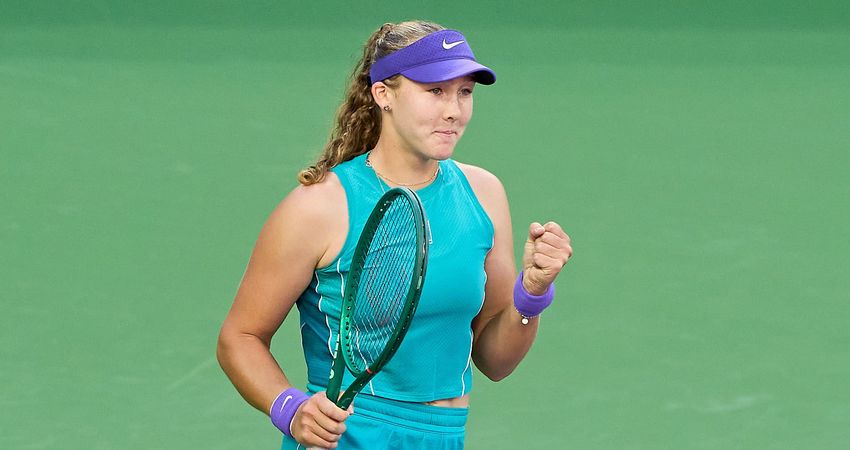
The circumstances of Friday's decisive match were created by an extraordinary Wednesday reversal. Andreeva trailed Sabalenka 4-1 in the first set, then won the final 11 games of the match. She finished with a 6-4, 6-0 victory, taking 45 of the last 55 points and closing out the contest in just 62 minutes. The numbers reveal how quickly an apparently controlled position can vanish at this level. Sabalenka did not merely lose a tight tiebreak or a series of isolated big points; the balance of almost every rally changed.
Andreeva's surge secured first place in Group 2 and a semifinal berth in her first appearance at the season-ending event. Her opening victory over Svitolina had also ended 6-4, 6-0, so she has not dropped a set in two matches. The teenager has put herself in a rare historical position, becoming the youngest WTA Finals semifinalist since Caroline Wozniacki in 2009. Those achievements are not the direct subject of Sabalenka's Friday match, but they explain the pressure surrounding it. A group that seemed likely to revolve around more experienced contenders has already produced its first qualifier.
Sabalenka has acknowledged that she needs time to recover from the loss. The tactical problem is not that she suddenly lacks a dangerous serve or baseline power. It is that Andreeva found a way to make her greatest strengths unreliable for an extended stretch. Sabalenka committed 23 unforced errors in that defeat. Facing Svitolina, she will have to establish a calmer balance between taking control and continuing to swing freely when points become uncomfortable. The lesson from Wednesday is not to abandon aggression. It is to avoid making every neutral exchange an emergency.
Before Sabalenka and Svitolina play, Andreeva meets Muchova in Friday's opening singles match, scheduled from noon Pacific time. Andreeva already owns first place in the group; Muchova has been eliminated after two defeats. That removes the qualification stake but not the professional one. The teenager can protect her rhythm before the semifinals, while the Czech can finish her tournament with a meaningful win against a player in exceptional form. Their only previous tour meeting ended in 2024 when Muchova retired with Andreeva leading 6-2, 1-0, so the matchup offers limited complete head-to-head evidence.
This order of play creates an unusual contrast on the same court. The first singles match is about momentum, recovery and the quality of the last performance in a season; the next is about survival. Watching Andreeva handle a match without qualification pressure may also show what Sabalenka no longer has. She cannot use Friday to fine-tune before the knockout stage. Every risk, error and recovery happens within a match that determines whether she reaches it at all.
GOATIFY
GOATIFY Tennis
From Andreeva's breakout to the looming knockout rounds, follow the stars with GOATIFY Tennis merchandise and fan essentials.


Tennis GOAT Golden Racket & Ball Crewneck Sweatshirt
A tennis fan design for everyday wear.
Shop Now ↗

The doubles race has its own final-day trap: three teams chasing two spots
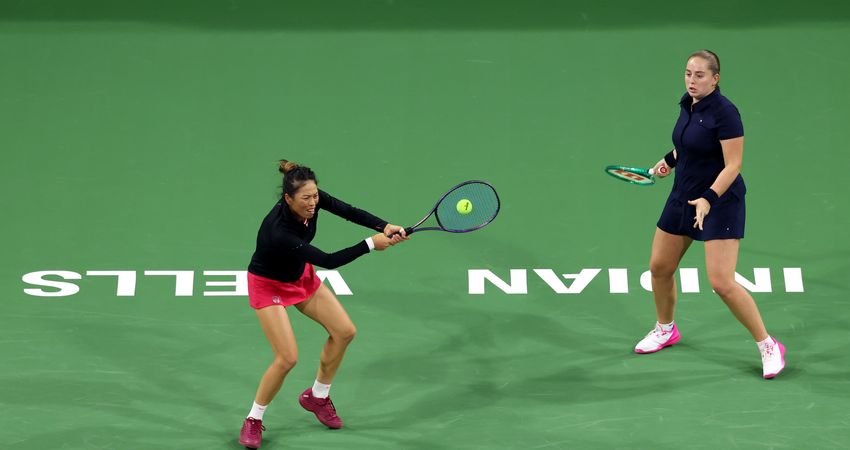
The singles winner-takes-all match is Friday's most straightforward qualification story. Doubles Group 1 is less tidy. Gabriela Dabrowski and Luisa Stefani have won both of their matches and lead the standings, yet the top seeds have not officially sealed a semifinal place. Hsieh Su-wei and Jelena Ostapenko, and Guo Hanyu and Kristina Mladenovic, each sit at 1-1. Elise Mertens and Zhang Shuai are 0-2 and already eliminated. That leaves three teams competing for two places, with the final standings determined by Friday's remaining matches and any relevant tiebreak calculations.
Dabrowski and Stefani earned their second victory in a dramatic contest against Guo and Mladenovic. They won a first-set tiebreak after trailing by an early break, conceded the second set 4-6 and then controlled the match tiebreak 10-5. The 7-6(5), 4-6, 10-5 result carried an extra dimension because Guo and Mladenovic had beaten the same partnership in the Wimbledon final earlier this year. The result did not erase that defeat, but it changed the balance of this week's group and gave the top seeds their best possible platform before the last round.
Hsieh and Ostapenko also kept their campaign alive with a comeback. Down 3-1 in the opening set against Mertens and Zhang, they recovered to win 7-5, 6-3. Their first victory of the event moved them to 1-1 and ended the opposing pair's semifinal hopes. The set records underline why Friday is not merely a formality for teams outside first place: Hsieh and Ostapenko hold a 3-2 sets-won-to-lost record, compared with 3-3 for Guo and Mladenovic. Small differences accumulated across two matches can determine the consequences of the third.
Friday's scheduled order sends Dabrowski and Stefani against Hsieh and Ostapenko first, followed by Guo and Mladenovic against Mertens and Zhang. The eliminated team still has a match to play, and that matters. A team with no chance to qualify can still influence who advances by taking a set or winning its final contest. For those on 1-1, every service game has potential consequences beyond the immediate score. There is little reason to treat the doubles as an afterthought while the singles spotlight is focused on Sabalenka.
Both races capture the distinctive tension of the WTA Finals format. A strong first two matches may not yet guarantee advancement, and a losing record does not always remove every possibility until the final round is played. By Friday night, those conditional statements should be replaced with a confirmed semifinal lineup. Sabalenka-Svitolina will produce one singles qualifier directly. Doubles Group 1 requires more patience: its last two fixtures must settle which partnerships extend their season into the knockout matches.
The most consequential match of Friday's Group 2 schedule will be the one played after Andreeva and Muchova leave the court. Sabalenka brings the heavy head-to-head advantage, but Wednesday's defeat exposed how rapidly an aggressive game can lose shape. Svitolina brings a weaker record in the matchup, but also the immediate confidence of a comeback that seemed unlikely after its first set. There will be no third chance for either player in this group.
Elsewhere on the same day, Andreeva can maintain her winning rhythm without worrying about qualification, and the doubles contenders will work through a more complicated final set of scenarios. Together, the matches decide much of the weekend's field. For Sabalenka and Svitolina, the calculation is the simplest of all: win Friday and keep the title pursuit alive.
GOATIFY
GOATIFY Tennis
Shop GOATIFY tennis products from the Tennis-filtered collection scope.


















