

Harrison's Coach Knows Nunes. He Says the Inside Edge Is Overrated.
GOATIFYThere is a tempting way to sell Kayla Harrison versus Amanda Nunes: the champion and the returning legend know each other's secrets because they once trained under the same roof. Mike Brown, the coach standing in Harrison's corner at UFC 334, is not buying the premise. He has worked with both women at American Top Team, yet insists that shared history is less important than what each fighter actually does when the cage door closes.
That is a more interesting challenge than a story about leaked sparring-room intelligence. Nunes has the striking pedigree to punish a reckless entry; Harrison has the judo and positional pressure to turn a close-range exchange into a very different fight. On November 14 at Madison Square Garden, their title meeting will test which athlete can force the bout into her preferred geography. Brown's latest comments make one thing clear: he does not expect familiarity alone to decide it.
The American Top Team history is real, but the 'secret' is exaggerated
Mike Brown has unusually clear access to both sides of the backstory. He has guided Kayla Harrison since her transition from elite judo into mixed martial arts, and he also worked with Amanda Nunes during parts of her championship career. That overlap is undeniable. What Brown rejects is the leap from sharing a gym to having an instruction manual for beating an old teammate. His description of American Top Team is of a large workplace with many coaches and athletes, not two fighters spending every day rehearsing this exact future matchup.
Brown has made an important distinction about his personal role. Harrison is the athlete he has led throughout her MMA development. He did assist Nunes for several fights, but he says he was never her official head coach. Those are different kinds of working relationships. Being present for preparation can supply useful knowledge of habits and personalities; it does not mean the trainer can predict the choices a high-level opponent will make years later under different coaches and a different game plan.
The history also looks different depending on who tells it. Nunes acknowledged after Harrison's rise that the prospect of facing someone under the same roof influenced her decision to leave American Top Team. Brown has previously argued that Nunes was looking for a change after her loss to Julianna Peña and that her departure should not be reduced to one teammate. Both perspectives can coexist: a fighter may need a new environment and may also prefer to avoid a future opponent who knows the same coaches. Neither version proves that Harrison gained a unique map of Nunes' weaknesses.
That distinction matters because training footage and competitive film are not private property of a single gym. Opponents can study Nunes' timing, the punches she favors when an opponent backs straight up, and the positions from which Harrison most efficiently closes distance. A coach with first-hand experience might offer finer details about temperament or reactions to certain training situations. But whatever that knowledge is worth has to survive a changing opponent, a full training camp and the unpredictable first exchange in the cage.
Brown's insistence that the shared-gym story is overplayed should not be mistaken for a claim that emotions have disappeared. The former champion built a dynasty while associated with the same camp now preparing the reigning titleholder. Harrison represents a newer era of the gym's success. For the people who remember both, November 14 carries an obvious personal dimension. The smart way to read Brown's comments is not that history means nothing; it is that he refuses to let history become a substitute for preparation.
Ultimately the question is narrower than the headlines suggest. Can Harrison's corner find a detail that changes an exchange, or can Nunes' new team anticipate the champion's approach just as well? Familiarity is only meaningful if it becomes an actionable adjustment. No amount of old shared mat time is worth a round on the scorecards without that translation.
GOATIFY
GOATIFY UFC & MMA
A gym can shape two great careers, but fans still choose their side. Explore GOATIFY UFC and MMA shirts, hoodies and fight-fan gear.


UFC GOAT Gold Middle Finger Fight Decal Sticker
Add MMA personality to your favourite gear.
Shop Now ↗The harder question: can Nunes keep Harrison from the clinch?

Brown's more persuasive point is tactical. The contrast between the athletes is clear enough to sketch without confidential gym notes. Nunes became one of MMA's defining champions through potent, committed striking combined with the ability to operate across phases. Harrison made her reputation as a two-time Olympic judo gold medalist before developing the striking and cage experience necessary to reach a UFC title. Knowing those strengths is easy. Preventing the other athlete from using them at exactly the wrong moment is much harder.
For Nunes, the valuable real estate should be the space where she can see Harrison advancing, set her feet and make the champion pay for an entry. That does not mean Nunes needs to throw recklessly. The most efficient shots may be the ones that interrupt Harrison's rhythm and discourage her from reaching the hips or linking her hands. If a challenger can create uncertainty about the cost of each approach, she can make the grappler hesitate long enough to find another combination.
Harrison's challenge is almost the mirror image. She does not have to win a conventional boxing match to win an MMA fight, but she cannot treat the route to a takedown as free. A committed level change or body-lock attempt is less effective if the opponent has already stepped away, turned the angle or punished the entry. Harrison's judo can become especially valuable once she secures contact: changing an opponent's balance, dragging an exchange toward the fence and making a sequence of positions matter more than a single explosive lift.
The champion has already shown how dangerous her ground game can be under UFC rules. She submitted Julianna Peña by kimura in the second round at UFC 316 in June 2025 to win the bantamweight belt. That result is significant not because Peña and Nunes are the same fighter—they are not—but because it illustrates the kind of finish that can emerge when Harrison is allowed to progress from control to an isolated limb. Nunes will understand the risk even without Brown whispering a detail about it.
An overlooked part of the equation is what happens between the clean scenarios. Not every clinch produces a takedown; not every successful disengagement yields a damaging counter. There can be long stretches of hand fighting against the fence, forced resets, failed entries and small changes of direction. Those exchanges consume energy and influence how a fighter makes decisions late in a round. If Harrison keeps making Nunes work to escape, the cumulative tax may help even when the first attempt fails. If Nunes makes Harrison reset repeatedly, the challenger can create the opposite pressure.
The preparation questions are sharper because neither fighter enters a perfectly ordinary title defense. Nunes is returning after retirement, while Harrison's previously scheduled meeting with her was postponed after a neck operation earlier in 2026. It would be irresponsible to declare either athlete physically compromised from those facts alone. They do make conditioning, timing and the ability to adjust in live action relevant unknowns that a pre-fight training story cannot settle.
Brown calls the matchup a question of who executes. That may sound obvious, but it rules out the comforting notion of a single hidden trick. Success will likely depend on several decisions repeated under stress: where a fighter places her feet after throwing, when she commits to the cage, whether she can defend the second attack after escaping the first, and how quickly her corner identifies which moments are producing results.
GOATIFY
GOATIFY UFC & MMA
Power punching, takedowns, and five-round adjustments are what make MMA compelling. Find fight-night gear in the GOATIFY UFC collection.


Rogainz Joe Rogan UFC MMA Martial Arts Sticker
Add MMA personality to your favourite gear.
Shop Now ↗
MMA GOAT Gold Middle Finger Fight Crewneck Sweatshirt
A MMA fan design for everyday wear.
Shop Now ↗
The GOAT argument will be decided by the result, not by a shared gym
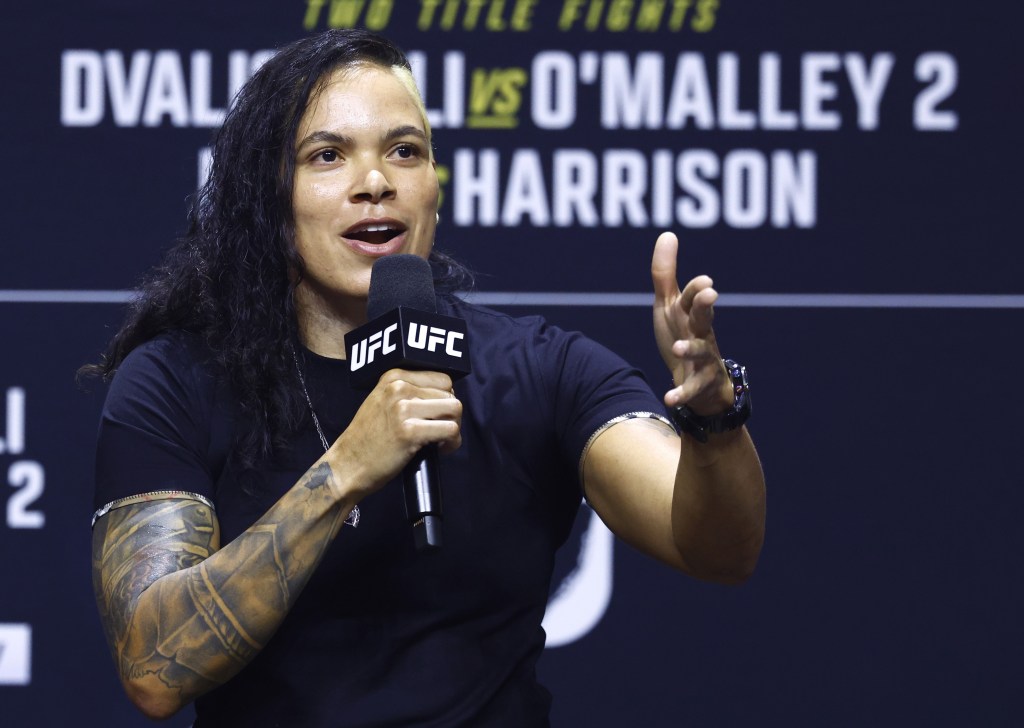
The championship is only one layer of the Harrison-Nunes matchup. Brown has argued that beating Nunes would make Harrison a powerful candidate for the greatest combat sports athlete conversation. It is a striking claim because the two competitors bring unlike résumés. Harrison won Olympic judo gold in 2012 and 2016 before establishing herself as an MMA champion in the PFL and then the UFC. Nunes accumulated the sort of championship victories that made her the dominant measuring stick in women's MMA for years.
Nunes' peak matters when judging the magnitude of this challenge. She held UFC belts in two weight classes and defeated a succession of elite names, including many women who had themselves been champions. A comeback against the current 135-pound titleholder would not merely add another win to her record. It would give the retired legend a chance to connect her earlier reign with a new generation of the division and make a direct claim that her skills still translate to its highest level.
Harrison's trajectory has been different. She arrived in professional MMA with an extraordinary judo foundation, then had to prove that those skills could survive striking, smaller gloves and rounds governed by a broader rule set. Her PFL championships established one level of success; taking the UFC belt from Peña provided another. Brown also points to her nearly unblemished MMA résumé. Her loss to Larissa Pacheco came after she had defeated Pacheco twice, a reminder that even the most decorated athlete can be solved on a particular night.
But a cross-sport 'greatest ever' label is a judgment, not a result automatically produced by one scorecard. Olympic judo and UFC championship MMA reward different competitive demands. A Harrison victory would be a remarkable bridge between the two, especially against an opponent who long defined the MMA side of the argument. A Nunes victory would reinforce the strength of a career built within MMA itself. There is no need to diminish either set of achievements to see what is at stake.
The long break adds another layer to Nunes' opportunity. She last competed in the UFC in June 2023 against Irene Aldana before retiring as a champion. The passage of time makes assumptions dangerous in both directions. A returning athlete can look refreshed and tactically evolved, but preparation cannot fully replicate the timing of a championship fight. Harrison's own road to this event was interrupted by the neck injury that postponed their earlier booking, making their eventual meeting a long-delayed test rather than a routine defense.
At Madison Square Garden on November 14, their bout sits on a card headlined by Ciryl Gane and Josh Hokit. Yet the women's bantamweight contest has a separate historical weight. It features the sport's former two-division standard-bearer against an Olympic great who now owns a UFC belt. That is why Brown can both downplay the value of his past work with Nunes and treat the opponent as uniquely meaningful. He knows what the challenger has achieved. He also knows that knowledge alone cannot win the fight.
Whatever the result, the honest way to assess the legacy question is to watch the contest before rewriting either career. A Nunes win after retirement would be remarkable, but it would not erase Harrison's Olympic and PFL accomplishments. A Harrison win against Nunes would strengthen her claim to an unprecedented combat-sports résumé, but it would not undo Nunes' earlier dominance. A great fight can sharpen the argument without delivering a universally accepted answer.
GOATIFY
GOATIFY UFC & MMA
Two legends, one championship, and a fight that could reshape MMA history. Browse GOATIFY UFC designs ahead of the title showdown.

MMA GOAT Gold Middle Finger Fight Crewneck Sweatshirt
A MMA fan design for everyday wear.
Shop Now ↗UFC GOAT Gold Middle Finger Fight Decal Sticker
Add MMA personality to your favourite gear.
Shop Now ↗Brown is right about one part of the conversation: the broad outlines of this matchup are visible to anyone who has watched either fighter. The uncertainty is not whether Nunes can punch or Harrison can grapple. It is whether the returning former champion can keep enough exchanges in open space, and whether the reigning titleholder can make repeated clinch attempts pay off without taking costly shots on the way in.
The old American Top Team connection adds human stakes, not a guaranteed tactical shortcut. A victory on November 14 would give either woman a defining chapter. Until then, the most useful clue is Brown's refusal to pretend he has a secret answer.


















