

Landeskog Took 51 Seconds to Undo Toronto's Comeback. The Leafs Still Have No Answer.
GOATIFYToronto had completed the difficult part. After trailing Colorado by two goals, the Maple Leafs finally caught the Avalanche when Jack Roslovic broke through 4:11 into the third period. A 3-3 score gave the home crowd a reason to believe the night might end differently from Toronto's recent defeats. Fifty-one seconds later, Gabriel Landeskog was waiting at the far post, Nazem Kadri found him, and that hard-earned reset had disappeared.
The Avalanche captain's second goal put Colorado back ahead for good in a 6-3 victory Tuesday night at Scotiabank Arena. It was the sharpest moment of a game that also featured a first-period Landeskog goal, two Cale Makar assists, strong stretches from goaltender Mackenzie Blackwood and points from 13 different Colorado skaters. The scoreline looks emphatic, but the real difference was how the visitors responded when Toronto finally threatened to take control.
Gabriel Landeskog and the art of answering a comeback

Landeskog's two goals came from different situations but told a similar story about what makes his line difficult to defend. In the first period, Nicolas Roy drove the puck into a dangerous area and forced a rebound that the captain collected at the right doorstep. The finish, at 17:26, arrived only 77 seconds after Brock Nelson had pulled Colorado level. Toronto had scored first; before the intermission, the Avalanche had already transformed the direction of the game.
The second was more revealing because of what preceded it. Roslovic had just finished a breakaway through the middle to tie the score at three. That should have been the cue for Toronto to settle into the next shift, protect the middle of the ice and make Colorado earn another chance. Instead, Kadri worked from below the goal line and moved the puck across the slot to an uncovered Landeskog at the back post. The captain needed little time or space to redirect it home.
That play was not simply a lucky bounce near the crease. The Leafs' attention followed the puck carrier, with several defenders moving toward Kadri. The dangerous scorer was left on the weak side, in the area that becomes most difficult for a goaltender to protect when a pass travels laterally across the crease. Landeskog's job was to arrive early enough to be available and patient enough not to skate himself out of the scoring lane.
Colorado's coaching staff can be encouraged by the way Landeskog, Kadri and Roy are beginning to complement one another. Kadri can attract defenders while carrying the puck through tight areas. Roy can create contact at the net and turn a contested entry into a second chance. Landeskog supplies the timing, positioning and finishing touch that makes those possessions expensive for opponents. Their strengths do not have to look spectacular in isolation to produce a high-value opportunity together.
Landeskog has always been more than a player whose worth can be reduced to one goal total. He is Colorado's captain, a winger who gives the forward group a physical presence and an experienced voice for difficult shifts. Against Toronto, those qualities showed up in the box score as his sixth and seventh goals of the season. More importantly, they appeared at the exact moments a road team needed to prevent the building from changing the game's momentum.
The 51-second turnaround is the central lesson. Toronto's equalizer erased the numerical advantage on the scoreboard but did not automatically erase the habits that had given Colorado chances. The Avalanche kept their next possession purposeful, attacked a vulnerable coverage decision and turned one efficient shift into a restored lead. That is a measurable difference between surviving a comeback and answering it.
GOATIFY
GOATIFY Hockey
Landeskog, Kadri and Roy converted net-front pressure into the game's decisive response. Discover GOATIFY hockey designs for fans who love timely goals and hard shifts.


The Leafs came back from 3-1, then lost the next shift
Toronto's night began with evidence that it could match Colorado. Darren Raddysh opened the scoring at 3:33 of the first period after Auston Matthews supplied the puck for a shot from the left side. The goal gave the Maple Leafs an early foothold and offered something positive for a team trying to interrupt a losing run. It was also Raddysh's first goal with Toronto, a personal milestone that deserved a better final result.
The Avalanche did not panic after conceding. T.J. Hughes moved the puck ahead to Nelson, who finished a rush at 16:09 to make it 1-1. Landeskog's rebound goal followed, and Colorado entered the first break ahead. Devon Toews then struck through traffic from the blue line at 3:31 of the second. A one-goal deficit had become a two-goal problem without Toronto completely disappearing from the contest.
The Leafs found a path back through younger skill and urgency. Easton Cowan converted a power-play opportunity late in the second period, cutting the score to 3-2 with only 29 seconds left before intermission. That changed the third-period equation: a single successful attack could pull the hosts level. Roslovic then carried through a Colorado challenge and finished his breakaway at 4:11 of the final frame, delivering precisely that equalizer.
What followed exposed the difference between finding an equalizing goal and controlling the phase after it. The Leafs' coverage around Kadri was drawn toward the puck. Landeskog remained open on the far side, close enough to goal that Bobrovsky had almost no chance once the pass arrived. Toronto's defensive mistake was not the comeback itself; it was failing to protect its most vulnerable area during the very next sequence.
Toronto still produced 31 shots, and not all of the night was a defensive failure. Blackwood had to make 28 saves, including an important stop on Matthews from close range while Colorado was trying to maintain its lead. Cowan and Roslovic supplied useful attacking moments, and Raddysh registered both a goal and an assist. Those contributions are real, but a team struggling for results cannot allow the best of its work to be erased by an avoidable breakdown seconds later.
The wider numbers make the loss more concerning. Toronto fell to 8-10-2 after a fourth consecutive defeat and a sixth loss in seven games. Bobrovsky stopped 22 shots and has allowed at least three goals in 12 of his first 13 starts since joining in free agency, according to contemporaneous game reporting. Goaltending can absorb too much criticism when skaters concede clear back-post opportunities, but the overall defensive record leaves little room for the Leafs to waste another strong offensive recovery.
Roster health complicates that evaluation, too. Toronto was dealing with a group of injured players, including defenseman Morgan Rielly, while Roslovic and Chris Tanev were back in the lineup after missing the previous game. Injuries help explain changing combinations and difficult matchups; they do not remove the need for clear responsibilities when the puck moves behind the net. For the Leafs, the fix has to be collective rather than a search for one convenient culprit.
Colorado's depth carried the result beyond two Landeskog goals

The result was built on more than the captain's two finishes. Thirteen different Avalanche players recorded a point, which matters because it meant Toronto could not solve the contest by focusing solely on Colorado's most recognizable stars. Nelson supplied the first equalizer, Toews added the early second-period goal and an assist, Makar created opportunities from the back end, and the final minutes featured contributions from Lehkonen and Martin Necas.
Toews's point shot was a reminder that a dangerous offense can originate far from the crease. Traffic in front of Bobrovsky complicated the goaltender's sight line, allowing Colorado's defenseman to extend the lead to 3-1. This is one of the simplest but most persistent ways an attack gains value from its positioning: the skater taking the shot does not have to beat a set goalie cleanly if teammates are making the puck difficult to track.
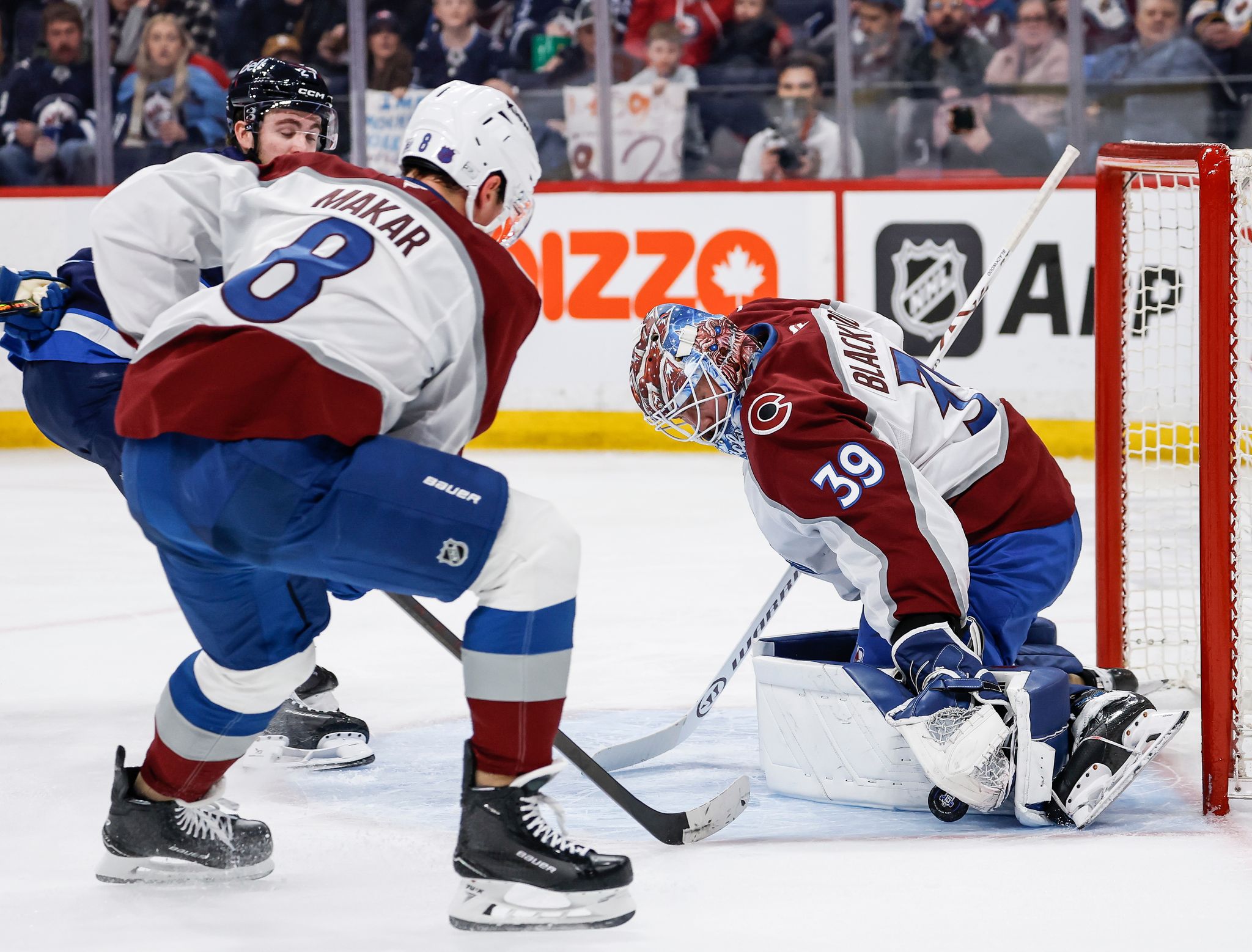
Makar's two assists illustrate another dimension of Colorado's attack. His movement and ability to recognize a developing rush allow chances to emerge before an opponent has reset its shape. In the third period, he helped release Lehkonen for an insurance goal shortly after Toronto had spent much of its energy chasing the game. The goal did not happen in isolation; it was the payoff for keeping another route to offense available after the tightest moments had passed.
Blackwood's contribution can be lost beneath six Colorado goals. He faced 31 shots and stopped 28, giving his teammates room to recover from the early deficit and preserving the lead through important stretches of the second period. His close-range save on Matthews, with Colorado up 3-1, prevented the home side from reducing the deficit earlier. If that puck goes in, the entire tempo before the second intermission could look different.
At the other end, Colorado did not mistake a 4-3 edge for a reason to stop attacking. Lehkonen scored with less than three minutes remaining, making the task significantly harder for Toronto, and Necas added an empty-net goal shortly afterward. The late pair of goals turned a fragile one-goal lead into a final margin that better reflected the visitors' finishing efficiency than the tension that had existed moments earlier.
The Avalanche improved to 11-6-2 and have taken points in six of their previous seven games, going 5-1-1 in that stretch. Those numbers do not guarantee anything over the remaining schedule, but they describe a club collecting results in more than one way. Some nights require a goaltender to carry most of the load; this one was won by a captain's timely finishing, productive supporting lines and a defense that helped generate offense.
Colorado's next stop is Ottawa as its road trip continues Thursday. Toronto, meanwhile, hosts Minnesota on the same day with a much less comfortable question to answer. The Maple Leafs have demonstrated they can fight back against a quality opponent. The immediate challenge is proving they can defend the first shift after doing so, because against a team as clinical as Colorado, a comeback that lasts only 51 seconds is barely a comeback at all.
GOATIFY
GOATIFY Hockey
From Makar's playmaking to Blackwood's saves, Colorado relied on contributions throughout the lineup. Browse GOATIFY hockey apparel and accessories for fans of a complete team game.
Landeskog's two-goal performance will rightly lead the highlights, especially the back-post finish that interrupted Toronto's comeback almost as soon as it began. Yet the deeper story is a team that had answers at every stage: Nelson after the opening goal, Landeskog after the equalizer, Blackwood when Toronto pressed, and a long list of skaters contributing to the final result.
The Maple Leafs did enough offensively to make this a contest. Their next step is learning to preserve those gains. Colorado left Toronto with two points because it treated the pivotal shift after a setback as an opportunity, not a moment to wait for the game to settle.


















