

Michkov Says He's Happy. Brière Says the Flyers Exit Story Was Wrong.
GOATIFYPhiladelphia spent Wednesday trying to put a rumor back in its box. After a report suggested Matvei Michkov might prefer a fresh start away from the Flyers, the 21-year-old winger said he was happy where he was, coach Rick Tocchet rejected the premise, and general manager Danny Brière went further: he said conversations with the player and his agent had not supported the account. This was not a trade announcement, nor was it evidence that the Flyers were taking calls on their most exciting young scorer.
There is, however, a reason the story caught fire. Philadelphia entered its November 11 game in Edmonton at 5–10–5, a jarring record for a club that reached the playoffs last spring. A televised argument between Michkov and veteran defenseman Nick Seeler became a convenient image for a team running short of wins. The more interesting question is not whether one argument proves a breakup. It is whether a front office can keep a prized talent developing while the team around him searches for answers.
The report suggested a fresh start. Brière says it did not come from Michkov.

The distinction starts with the wording. The November 10 report attributed to league sources suggested that Michkov would probably welcome a new beginning elsewhere because of Philadelphia's poor opening and alleged internal tension. That was a claim about a possible preference, not public evidence of a filed trade demand. By the next day, though, the suggestion had been shortened into a much louder question: does the Flyers' best young forward want out?
The club's responses came in layers. Michkov spoke before Wednesday's road game at Edmonton and said he was not spending his day reading the headlines. His priority, he explained, was preparing to play. When reporters asked whether he was happy in Philadelphia, his answer was affirmative. That was a personal response, not a prediction about every decision he or the club might make in the future, but it directly challenged the impression that he had publicly broken with the organization.
Tocchet also rejected the story. His job as coach involves handling a demanding young forward, managing ice time and holding everyone to the same standards. He did not present a competing theory about how the report arose; he said the premise was inaccurate. A denial from a coach alone might leave fans debating whether the team was simply attempting to quiet a distraction. The general manager's later comments supplied a more specific test.
After meetings in Toronto, Brière addressed the media and described speaking separately with Michkov and his agent, Paul Theofanous. According to the GM, both denied that the trade story had originated with them. Brière said he did not know where the assertion came from. He also stressed that the Flyers expected Michkov to be an important part of their long-term solution. That does not mean a professional sports club can promise any player will never be moved. It does mean the people who would be central to such a decision publicly pushed back against the particular claim being circulated.
There is a difference between assessing a player's possible frustration, reporting an explicit trade request and confirming that a transaction is being negotiated. None of those descriptions can safely be substituted for another. The rumor generated interest partly because it involved a former seventh-overall pick at an important stage of his contract, but interest and verification are not interchangeable. At the time of these statements, there was no confirmed request from Michkov and no announced plan by Philadelphia to trade him.
GOATIFY
GOATIFY Hockey
From the Michkov rumor to the conversations in Philadelphia's front office, explore GOATIFY Hockey designs for fans following the NHL's biggest personalities.


The handling of the message also matters. Brière could have issued a one-line reassurance and moved on. Instead, he explained the conversations he had made, acknowledged the broader frustration and restated the player's role in the organization's future. That is a firmer position than merely saying the club does not comment on rumors. It also creates a practical expectation: if the Flyers intend to build around Michkov, their choices about linemates, responsibilities, development and roster support must reflect that belief.
Fans do not need to choose between treating every anonymous-source report as a settled fact and pretending tension never exists on a losing team. Philadelphia can have real problems without the most dramatic version of the rumor being true. This is the narrow but important lesson of Wednesday's denials. The organization answered the allegation about Michkov's intentions; it still has to deal with the circumstances that made it plausible to so many observers.
A 5–10–5 start turned a bench disagreement into a franchise crisis

The Flyers did not begin 2026–27 from a position of anonymity. Their previous season ended with a return to the Stanley Cup Playoffs, followed by a run to the Eastern Conference Second Round. That raised expectations beyond simply seeing progress from a rebuilding lineup. A team that believes it is finally ascending will experience a five-win start through 20 games differently from one expected to lose while collecting draft picks. The same result can look like growing pains in one year and regression the next.
Philadelphia's start was difficult even before the trade speculation. The club lost its first nine games, taking some points in overtime but failing to collect a regulation or overtime win until its tenth outing. It eventually found moments of life, including an October win over Colorado in which Michkov scored twice, but those flashes did not quickly change the larger picture. At 5–10–5 before visiting Edmonton, the Flyers had collected only 15 of a possible 40 points. That points percentage is .375, an unforgiving backdrop for a team that entered the season expecting to be more competitive.
Then came the bench exchange. During a November 9 victory at Vancouver, cameras caught Michkov and defenseman Nick Seeler in an animated discussion. Other Flyers, including Noel Acciari and Porter Martone, appeared to help calm the scene, and the moment became a ready-made symbol for reports about internal discord. A bench argument looks especially ominous when seen without the minutes before and after it. Yet the footage alone does not reveal whether the dispute was about a shift, a missed assignment, effort, accountability or something far more routine.
Veteran teammates and the head coach urged people not to treat every visible disagreement as proof of a divided locker room. Michkov explained that emotions can run high because everyone wants to win; he also indicated that the issue with Seeler had been settled. That answer should neither be inflated into a claim that every relationship is perfect nor dismissed because it is less sensational than the alternative. On-ice competitors sometimes argue. What matters is whether they can return to a shared standard of play and work together on the next shift.
Brière's explanation of the phrase internal turmoil was revealing for the same reason. He acknowledged meetings, criticism and general unhappiness with results rather than denying that anyone was frustrated. In his view, the tension was connected to a team underperforming its own expectations. There is an important distinction between players being angry at losing and an organization being unable to function. The former can motivate an improved response; the latter would require more substantial evidence than one public exchange.
GOATIFY
GOATIFY Hockey
A tense Flyers bench moment shows how quickly a losing streak can fuel debate. Browse GOATIFY Hockey hats, hoodies and fan gear for your next game day.
For Tocchet, the challenge is to turn that energy into a reliable identity. Veterans need to hold teammates accountable without alienating the youngest players. Young scorers need room to make offensive plays while accepting defensive responsibilities and tactical adjustments. Coaches need to keep corrections proportional rather than allowing every mistake or tense moment to become a referendum on one star's attitude. Those balances are difficult enough privately. On a struggling team, they take place beneath a spotlight.
Wednesday's 3–2 overtime loss to Edmonton added another reminder that public statements do not repair a season. The result was competitive, and an overtime point has some value, but the standings did not suddenly become comfortable. The Oilers were one of the league's stronger early-season teams, which made a close game a potential platform for improvement. Philadelphia now has to turn individual examples of fight into sustained point collection. Otherwise every frustrated gesture will keep being interpreted through the team's record.
The argument over whether Michkov wants to leave is, in that sense, partly a debate over how to interpret failure. An emotional bench conversation is not a signed divorce paper. Equally, a press conference cannot make 15 losses in 20 games disappear. Brière and Tocchet can reject an unverified exit narrative while accepting that repeated poor performances will create questions about the club's direction. The burden of proof belongs to anyone claiming a specific rift. The burden of improvement belongs to the Flyers.
Ten goals, a contract question and the future Philadelphia can't afford to mishandle
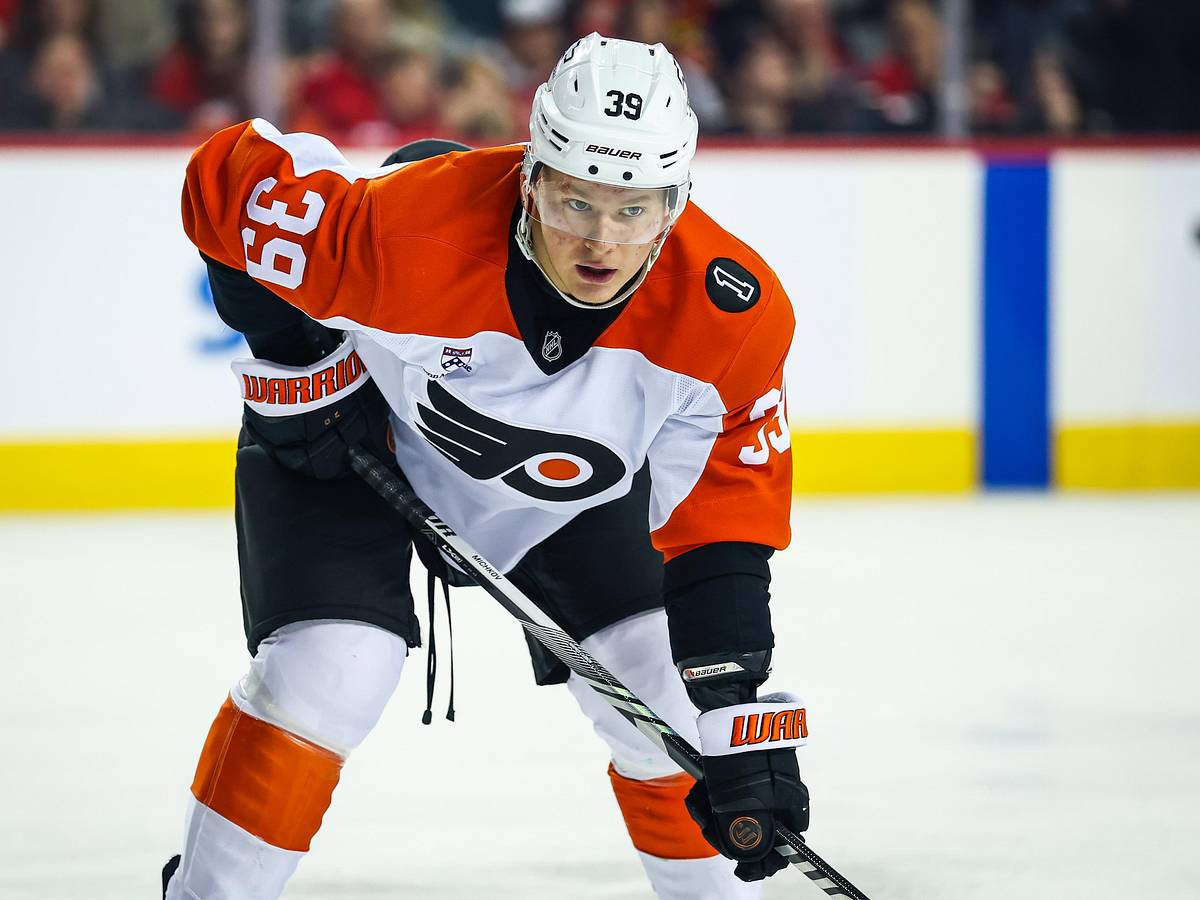
Michkov's production helps explain why this story carried more weight than a routine November trade rumor. The Flyers selected him seventh overall in the 2023 draft because of his finishing ability, hockey sense and potential to become a top-line difference-maker. He delivered 26 goals and 63 points in his 2024–25 rookie season. His sophomore campaign was less explosive overall, with 20 goals and 51 points, though he produced strongly after the 2026 Olympic break as Philadelphia surged into the postseason.
The new season has offered a different picture. Entering the November 11 game, Michkov had 10 goals and 14 points in 20 appearances. After the overtime loss at Edmonton, the league's updated November 12 account listed him with 10 goals and 15 points in 21 games, including a team lead in points and goals. The one-point difference between the pregame and postgame reports reflects a new game being played, not a disagreement about his performance. Even while his team has struggled, his ability to finish chances has remained evident.
Ten goals in 21 games is a pace that demands attention, but it does not make him responsible for solving every offensive or defensive problem on the roster. Philadelphia needs others to create high-value looks, transition the puck out of danger and finish opportunities of their own. Trevor Zegras, among the players closest to Michkov in team scoring entering the night, represents one of those additional offensive outlets. For a young forward, consistent support can influence not only immediate numbers but also the quality of the decisions he learns to make under pressure.
GOATIFY
GOATIFY Hockey
Michkov's development could shape Philadelphia's future. Celebrate the next generation of hockey stars with the GOATIFY NHL fan collection.
There was reason for optimism in September. After an offseason focused on conditioning, Michkov reported to Flyers camp lighter and stronger, and Tocchet praised improvements in his skating. The organization wanted a bigger contribution from the player who had been so effective down the stretch the previous year. That context matters because current frustrations cannot be reduced to a question of commitment or preparation. The club itself acknowledged that he had worked to address the areas it wanted improved.
His development is not linear, and it never was likely to be. A young scorer can have nights when the shot is there but defensive reads lag behind. A coach can restrict a shift or change a line combination without signaling that the player is no longer wanted. Michkov was also a healthy scratch for four postseason games in the previous spring's run, a decision that understandably fueled debate about how his strengths fit Tocchet's standards. Such choices deserve scrutiny for whether they help the player grow, not automatic interpretation as proof of an irreparable relationship.
The contract calendar adds stakes but should not be distorted. Michkov can become a restricted free agent after the 2026–27 season. Restricted free agency is not the same as unrestricted free agency: it generally leaves the current club with negotiating rights and potential matching protections, depending on the qualifying offer and the player's circumstances. It does not automatically give him a simple walk-away option in July. Any extension discussions, cap decisions or potential transactions would be a separate matter from whether Wednesday's rumor was accurate.
Brière has said he does not publicly discuss individual contract negotiations. That stance leaves the exact financial path unresolved, but the broader team-building challenge is visible. A front office expecting to keep a promising forward for years should provide a coherent role, communicate expectations and build enough competitive depth that one scorer's hot streak is not asked to rescue a season. These are not guarantees that every player will be satisfied. They are the conditions that make keeping an emerging star both more achievable and more attractive.
The numbers cut both ways. Michkov has already shown the kind of offensive talent the Flyers would find difficult to replace, particularly while other parts of the roster are inconsistent. On the other hand, the team needs wins, not only individual goals, to change the mood around the club. It would be a mistake to frame the choice as Michkov versus everyone else. Philadelphia's challenge is to help him become a more complete player while surrounding him with enough structure that his scoring actually moves the team forward.
For now, the most credible reading is the least dramatic one. Michkov says he wants to compete for Philadelphia. Brière says the report that prompted all the speculation was not supported by his conversations. Tocchet wants more from the team, as he should. The future will be judged less by a moment on a Vancouver bench than by how the Flyers handle the next stretch of games, the player's continued development and the decision-making that follows this difficult November.
Brière's denial answers the immediate question more clearly than the initial rumor did: no departure request was corroborated by the player or his agent, and Philadelphia says Michkov remains central to its plans. It does not erase the record, the frustrations or the pressure facing Tocchet. The quickest way to make the story disappear is not another carefully worded statement. It is a run of better hockey that gives Michkov and his teammates a credible reason to believe their progress is being matched by the club's results.
GOATIFY
GOATIFY Hockey
Shop GOATIFY NHL and hockey shirts, hoodies and stickers.


















