

Andreeva Beat Pegula 6–3, 6–4. Now World No. 2 Is Hers.
GOATIFYTwo days after Jessica Pegula survived a match point simply to remain in the WTA Finals, her season ended against a teenager who has made narrow escapes almost irrelevant. Mirra Andreeva beat Pegula 6–3, 6–4 in Saturday's semifinal at Indian Wells, preserving her perfect, set-free run through the event and booking a place in Sunday's championship match.
The score suggests control throughout. The individual games tell a more revealing story. Pegula broke first in each set, yet on both occasions Andreeva erased the advantage immediately. The 19-year-old did not win by removing every problem from the contest. She won by making problems short-lived, then finding enough depth and variety to force the next mistake.
The result guarantees that Andreeva, already a French Open champion this season, will rise to world No. 2 for the first time when the rankings update on Monday. It also moves an awkward pre-tournament microphone incident involving the two players firmly into the background. What matters now is the tennis: four matches, no sets lost, only 18 games conceded, and one final still to play.
Pegula broke first twice. Andreeva kept taking the initiative back.
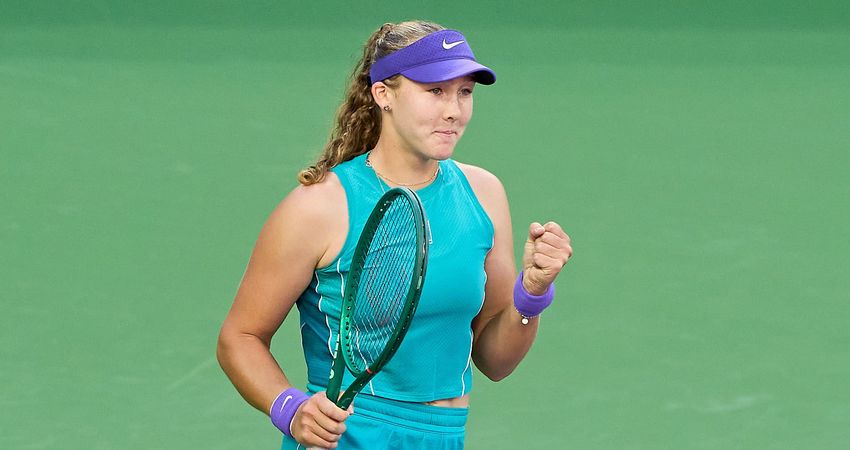
The semifinal started with the kind of uncertainty that should have favored the more experienced player. Winds around the Indian Wells Tennis Garden made tosses, first strikes and clean contact harder to reproduce from one point to the next. Pegula, at 32, has built a long career around recognizing patterns early and keeping her positioning economical. Andreeva, 19, had entered the afternoon playing as though the court were much larger for the opponent than for herself. For several opening games, neither player looked fully comfortable.
Pegula earned the first break when Andreeva double-faulted to trail 2–1 in the opening set. That was a genuine opening rather than a cosmetic scoreboard blip. A veteran with Pegula's return instincts can turn an early break into a series of short service games, particularly when a younger opponent starts forcing her second serve. What followed established the tactical shape of the match: Andreeva broke straight back for 2–2, using a crosscourt forehand winner to complete her recovery after several chances.
That immediate response mattered because it denied Pegula an opportunity to settle into front-running tennis. With each lost opening, the American had to manufacture another. Andreeva then saved two break points in the fifth game and struck again on return to lead 5–3. Serving out the set was not automatic. Pegula reached another break opportunity but sent a backhand beyond the baseline, and Andreeva held. The winner did not need to dominate every rally; she needed to make the highest-leverage points uncomfortable.
The second set repeated the warning with different numbers. Pegula converted another Andreeva double-fault-induced opportunity and built a 3–1 lead. She had finally created something resembling separation. Again the response was immediate. Andreeva broke back, then broke once more to move ahead 4–3. Pegula's advantage had lasted only long enough to make the turnaround visible.
GOATIFY
GOATIFY Tennis
Browse GOATIFY Tennis styles as Andreeva and Pegula's first meeting turned on rapid service-break recoveries.


Tennis GOAT Golden Racket & Ball Decal Sticker
Add tennis personality to your favourite gear.
Shop Now ↗After one hour and 25 minutes, Andreeva brought up match point with an overhead winner and watched Pegula's backhand travel long. The 6–3, 6–4 score was decisive, but not because Andreeva never trailed. It was decisive because Pegula's two best patches produced no lasting control of either set.
The contrast was clearest whenever Pegula tried to end a point with her first heavy groundstroke. Andreeva's defensive movement absorbed pace without turning the exchange into a passive scramble. She could return the ball deep, change direction or step inside the baseline when the next shot landed short. That mix makes her particularly difficult to rush: the opponent may strike first, but the teenager is often the player deciding where the rally goes next.
Wind also gives a player an excuse to swing more cautiously, yet Andreeva still found timely power on serve. She was not faultless, as the two double-fault sequences show. Her advantage lay in refusing to let a single poor service game define the next one. Pegula's unusually high level of first-serving against Linda Noskova earlier in the week had saved her tournament; she could not reproduce enough of that sharpness against Andreeva's return pressure. The lesson was technical as much as psychological. A break matters only if a player can protect it against an opponent who changes angles and resets instantly.
A hot microphone supplied the subplot, not the explanation
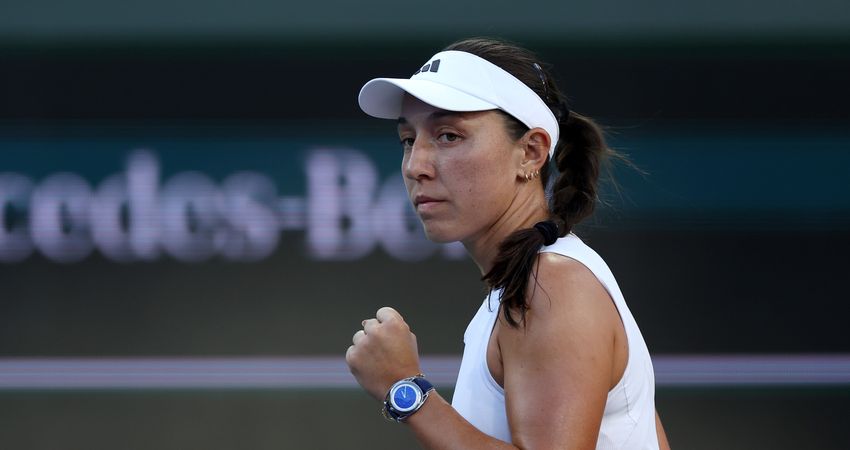
The first official meeting between two established top-five players already had sufficient sporting appeal. The extra intrigue arrived before the tournament, when a microphone picked up Pegula discussing Andreeva during what she understood to be a private practice conversation. Her description of the teenager as a diva spread quickly once the audio reached viewers. It was the kind of clip that becomes a social-media storyline before anyone has established the circumstances of the recording.
Pegula subsequently apologized to Andreeva, and the players treated the episode as settled rather than carrying on a public feud. The distinction matters. A stray remark can be unkind while the decision to broadcast an unsuspecting athlete's practice conversation can still raise a separate question about consent. The WTA acknowledged that the players had not been properly informed about the microphone. Turning the whole affair into an intentional pre-match confrontation would give a production error more significance than the people involved did.
The on-court collision provided a much sturdier test than a few seconds of audio. Pegula had survived a remarkable passage through her round-robin group: in the final group match against Noskova, she saved match point and came through 7–6(2), 4–6, 7–5. Her 16 aces in that contest represented a career high. One swing could have sent her home without a semifinal appearance. Instead, the American earned another meaningful match and a first competitive look at Andreeva from the opposite baseline.
Andreeva arrived by a very different route. She had won her group before its final round and was playing with the assurance of someone who had not needed a last-day rescue. The pairing offered a simple and compelling contrast: Pegula's resilience under constant jeopardy against Andreeva's ability to prevent jeopardy from lasting.
GOATIFY
GOATIFY Tennis
Explore tennis-inspired designs while the WTA Finals' much-discussed off-court episode gives way to on-court competition.


Neither style deserved to be treated as a character judgment. Pegula's loss did not make her earlier escape meaningless, nor did Andreeva's victory prove that a contentious private description had been psychologically important. The available evidence points to a tennis explanation: the teenager returned Pegula's serve deep enough to keep pressing, recovered breaks immediately, defended the first blow and was cleaner when sets turned.
That is why the apology should remain part of the context, not the headline of the performance. Fans can debate whether practice conversations should ever be broadcast, and athletes can be accountable for what they say about peers, without pretending a viral clip determined the score. The semifinal was played by two professionals whose shot-making, adjustments and mistakes were far more revealing than an off-court soundbite.
Pegula will leave Indian Wells without a chance at the season-ending trophy, but having shown once again that she can grind out a result on the edge of elimination. Andreeva leaves the semifinal carrying something even more substantial: another win over a highly ranked opponent, achieved after repeatedly conceding and reclaiming the lead. Their shared story now has a result as well as a repaired misunderstanding.
Eighteen games lost in four matches. One final remains.
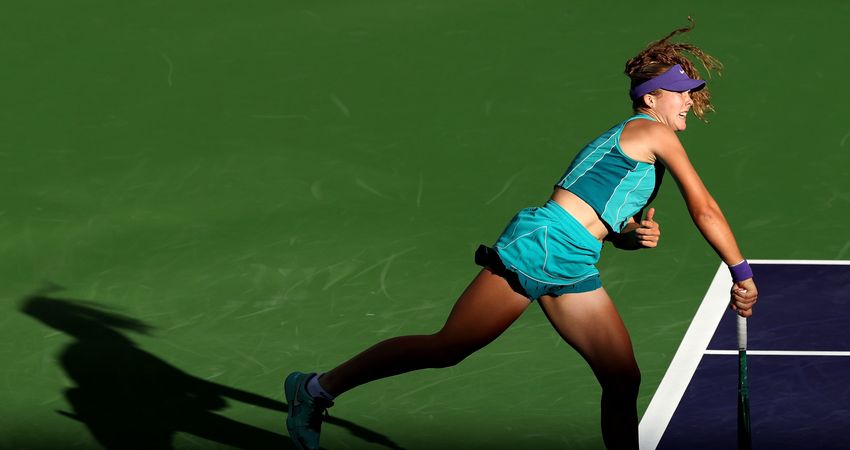
The Pegula semifinal is striking enough by itself. The wider four-match sequence makes it difficult to dismiss as a favorable draw. Andreeva opened her WTA Finals singles debut by beating Elina Svitolina 6–4, 6–0, a match in which she took the final seven games. Next she faced Aryna Sabalenka, a player whose power can typically prevent younger opponents from establishing any rhythm. Andreeva fell behind 4–1 and then produced an extraordinary reversal: the last 11 games and 45 of the final 55 points went her way in a 6–4, 6–0 win.
That Sabalenka result was not merely a comeback from a break. It was an extended demonstration of how completely a match can change when return positioning, second-serve targeting and rally length begin to align. Sabalenka had built the early lead with aggressive tennis. Andreeva then made her opponent hit the extra shot often enough that the momentum became one-directional. A young player who can adjust that profoundly during a match poses a different problem from one who is dangerous only when everything starts perfectly.
With Group 2 already won, Andreeva closed the round robin against alternate Diana Shnaider in straight sets. Karolina Muchova's withdrawal had changed the final opponent but not the group winner's obligation to keep her level. Across the three round-robin matches, Andreeva conceded just 11 games. Official tournament notes place that figure alongside Justine Henin's 2007 mark as the fewest games surrendered in a round-robin group since the format began in 2003.
Then came Pegula, who had earned her semifinal the hard way and would not be expected to disappear without resistance. Adding the 6–3, 6–4 result brings Andreeva's total to just 18 games lost in four wins. Four consecutive straight-set victories against an elite year-end field do not guarantee a fifth; they do show that she has solved different types of problems without needing a deciding set.
GOATIFY
GOATIFY Tennis
Find GOATIFY Tennis gear as Andreeva heads toward the championship match and a career-high world ranking.

Tennis GOAT Golden Racket & Ball Crewneck Sweatshirt
A tennis fan design for everyday wear.
Shop Now ↗
There is historical context too. Reaching the last four had already made Andreeva the youngest WTA Finals semifinalist since Caroline Wozniacki in 2009. Making the final extends that achievement and continues a year that included her maiden Grand Slam title at Roland Garros. She has moved from having the tools to trouble established champions to collecting the results that put her beside them in the ranking table.
The No. 2 ranking on Monday is assured regardless of what happens in the championship match. It is an important distinction: a title would strengthen the season-ending statement, but the climb itself no longer depends on one more afternoon. The final, scheduled for Sunday, will be against the winner of the other semifinal between Wimbledon champion Linda Noskova and former WTA Finals winner Elina Svitolina. At the time of this report, that opponent is not being assumed.
Looking beyond Sunday requires more restraint than the current form might invite. Elena Rybakina holds the top ranking, and both she and Sabalenka have major points to defend at the Australian Open early in 2027. That opens a credible route for Andreeva to challenge for No. 1. It does not make the next ranking move automatic: points defense, tournament choices, fitness and the strongest rivals' performances will still determine the standings.
The prize at Indian Wells is meaningful on its own. Official event information puts an undefeated singles champion's potential haul at $3.37 million, including participation fees, and awards 1,500 ranking points for an undefeated run. Those figures add practical weight to the moment without explaining why Andreeva has been so hard to play this week. The source of that difficulty lies in the details opponents experience first: the depth of the neutral rally ball, the speed of the transition to attack and the refusal to let an early lost service game take over an entire set.
One more victory would make this an undefeated championship run. A defeat would not erase the ranking jump or the astonishing lack of games conceded through Saturday. Either way, Andreeva has already advanced the conversation about her career from how soon she might break through to how consistently she can challenge the very top of the women's game.
Pegula twice had a break in hand and twice watched it vanish in the following game. That is the most useful shorthand for Saturday's semifinal. Andreeva was not operating without errors; she was operating with an answer whenever the match started to tilt away from her.
The outside drama is now a footnote. The real consequences are a place in Sunday's WTA Finals championship, a guaranteed climb to world No. 2 and a legitimate opening in the 2027 race for No. 1. Whether or not she takes the trophy, the 19-year-old has turned a breakthrough season into a warning to every player above and below her: a small lead against Andreeva is no longer much security.
GOATIFY
GOATIFY Tennis
Shop GOATIFY tennis products from the Tennis-filtered collection scope.
Tennis GOAT Golden Racket & Ball Crewneck Sweatshirt
A tennis fan design for everyday wear.
Shop Now ↗


















