

Jones and Hokit Went to War Online. Gane Still Owns the Heavyweight Belt.
GOATIFYJon Jones and Josh Hokit are having the kind of feud that fills a fight fan's feed without producing a single new fight announcement. After Ciryl Gane defended the UFC heavyweight championship against Hokit at Madison Square Garden on November 14, Jones mocked his former training partner's first professional loss. Hokit responded with increasingly personal attacks. By November 16, their social-media exchange had become almost as prominent as the result that started it.
That is a strange outcome for one of the most competitive heavyweight title fights of the year. Gane retained his belt by three identical 48–47 scorecards, with Hokit demonstrating genuine danger before the champion pulled away late. Jones, who defeated Gane quickly in 2023 and retired in 2025, is not the division's reigning champion and has no announced fight with Hokit. The distinction matters. One story is a public argument between fighters; the other is an active title picture with a real champion, serious challengers and tactical lessons that can change the next bout.
How a Close Title Loss Became a Personal Jon Jones Feud

Jon Jones did not fight at Madison Square Garden on Saturday. He still managed to become part of the loudest argument after the heavyweight main event. Josh Hokit had just lost his first professional MMA fight, a five-round title challenge against Ciryl Gane, when his former training partner began mocking the outcome on social media. Jones celebrated Gane's victory and compared it with his own brief 2023 win over the Frenchman. Hokit fired back, and a disagreement about performance grew into a stream of deeply personal attacks. By Monday the exchange had spread far beyond questions about what happened inside the cage.
The history makes the dispute more pointed than the ordinary post-fight pile-on. Hokit and Jones have worked within the Jackson-Wink training orbit in Albuquerque, with Jones saying that he opened his camp to the younger heavyweight. The same coaching connection became one of Jones's arguments: similar preparation, common opponent, radically different results. Hokit, a former college wrestler and professional football prospect who powered through a rapid UFC rise, has hardly built his public persona around restraint. He talked boldly before facing Gane, and a bruising first defeat did not make him quiet. That combustible combination gave the online clash its fuel.
On Sunday and Monday, both fighters shifted between discussing their skills and criticizing one another's character. Jones repeatedly suggested that he would beat Hokit and claimed the challenger had disrespected him despite their previous training relationship. Hokit answered with references to Jones's documented past controversies and then made a serious allegation concerning another person. Jones and a longtime associate disputed that allegation. No independently established evidence in the reporting resolves the conflicting claims, and it would be irresponsible to present social-media accusations about a third party as verified fact. Their argument can be reported without turning that other person's private circumstances into entertainment.
Jones appeared to sign off on the feud on Monday, saying he was done addressing Hokit until the younger man reached a higher level. Almost immediately, he added another jab about Hokit's performance late in the fight. That contradiction is revealing: neither participant appears eager to give up the last word, even when promising to do so. It also makes the idea of a definitive ending premature. Online exchanges can be deleted, revised or reignited without any contractual consequence. A nasty series of posts is not a fight agreement, and the UFC has announced no Jones-Hokit booking.
GOATIFY
GOATIFY UFC & MMA
The Jones-Hokit rivalry has fans talking about the UFC's biggest personalities. Browse GOATIFY UFC and MMA fan apparel while the debate continues.


Rogainz Joe Rogan UFC MMA Martial Arts Sticker
Add MMA personality to your favourite gear.
Shop Now ↗


The bigger question is why this particular opponent draws so much energy from the retired former champion. Jones has personal history with the training group and a very public victory over Gane to defend rhetorically. Hokit has the profile of an unpredictable new contender with a powerful wrestling base and the confidence to argue with an established great. Their disagreement creates a compelling story, but it has also obscured something more consequential: a current champion defended his belt over five rounds, and a challenger discovered exactly where his game needs work.
Gane Won 48–47 Three Times. The Championship Rounds Explain Why

Those scorecards are a more useful starting point than the insults. At UFC 334 on November 14, Gane defeated Hokit by unanimous decision, with all three judges scoring the heavyweight title fight 48–47. The identical margins suggest a competitive contest, not a champion running away with every round. Hokit entered undefeated in ten professional MMA fights and had won his first four UFC appearances. He left New York with his first defeat, but also with evidence that his aggression and wrestling threat can put an elite heavyweight under uncomfortable pressure.
The opening stretch demonstrated why Hokit rose so quickly. He closed distance with urgency, forced Gane to react and looked for physical exchanges rather than spending whole rounds admiring the champion's movement. His approach was not subtle. It tried to deny a polished distance striker the time and room to dictate every exchange. That tactical ambition matters more than an internet debate about which man looked tougher in a photograph. Against a tall, mobile opponent, pressure is a legitimate way to make the bout ugly and produce opportunities to wrestle. Hokit found some of those opportunities.
The pivotal difference was the amount of energy that approach demanded. A five-round championship fight is not simply an ordinary three-round contest with ten extra minutes attached. It changes how a fighter must budget sprinting entries, wrestling pressure, defensive reactions and recovery. By the official breakdown of the contest, Hokit had taken two of the first three rounds on all three cards before Gane won the fourth and fifth. The champion's ability to remain useful as the fight grew longer, to land cleaner shots and to stop Hokit from imposing his preferred sequences became decisive. It was an adjustment in workload as much as a display of technique.
Gane entered this fight with substantially more five-round experience. His movement is most dangerous when an opponent must repeatedly reset before attacking again. A challenger who bursts forward can make him retreat, but each missed entry can carry a fatigue cost. Late in the bout Gane was better positioned to pick his moments and score; Hokit had fewer ways to keep the pace explosive without exposing himself. Describing that as a simple failure of courage would miss the mechanics. The challenge was not whether Hokit wanted the belt enough. It was whether he could make his best tools sustainable against a champion whose experience extended into the final ten minutes.
Some fans disliked the 48–47 verdict, and closely scored rounds naturally invite disagreement. Yet all three officials reached the same winner, and there is no need to invent a robbery to make the fight interesting. The outcome actually poses a richer question for Hokit: if he has enough ability to force a competitive title fight at this stage, how much can he improve his pacing, positioning and decision-making with a full camp devoted to lessons from the defeat? Gane answered the immediate competitive question on the night. Hokit's development remains open.
GOATIFY
GOATIFY UFC & MMA
Gane and Hokit delivered a five-round title fight worthy of a closer look. Explore GOATIFY UFC shirts, hoodies and fight fan gear.

UFC GOAT Gold Middle Finger Fight Decal Sticker
Add MMA personality to your favourite gear.
Shop Now ↗


MMA GOAT Gold Middle Finger Fight Crewneck Sweatshirt
A MMA fan design for everyday wear.
Shop Now ↗Jones Finished Gane in 2023. That Is Not a Jones–Hokit Booking
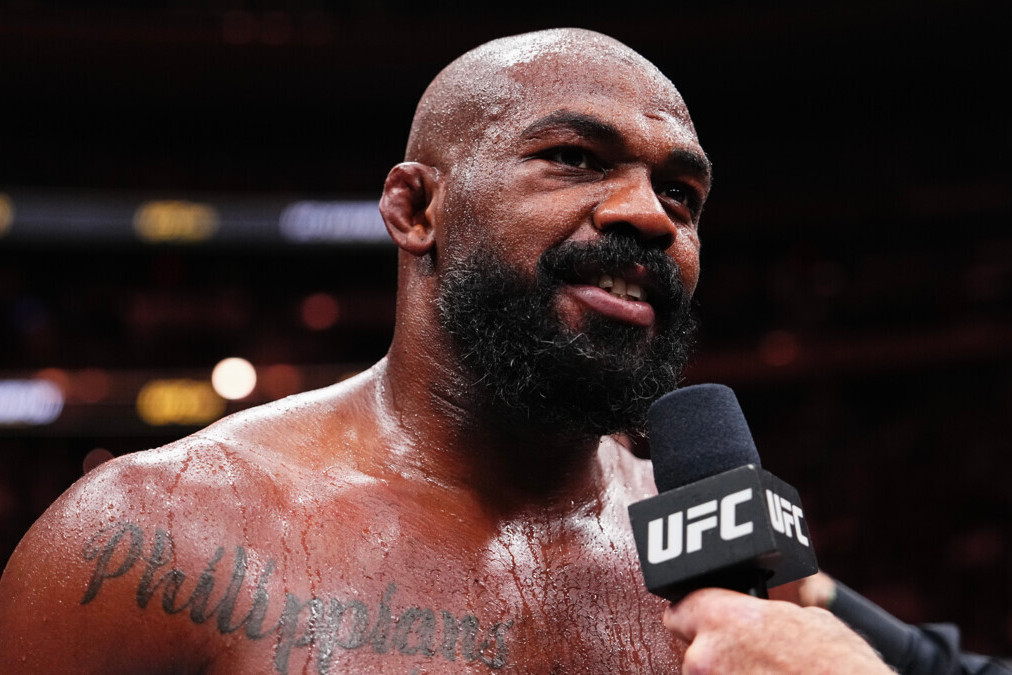
Jones has a straightforward talking point that is difficult to ignore: he submitted Gane in the first round of their March 2023 meeting, while Hokit went five rounds and lost a decision. For a fighter whose career was built on defeating elite opponents in different ways, that comparison is irresistible. It also happens to be a poor shortcut for predicting a fight between Jones and Hokit. MMA is not a transitive equation in which beating an opponent quicker automatically proves superiority against everyone else who faces that opponent.
The contests occurred in different years, under different competitive circumstances and against versions of Gane carrying different experience. Jones used his elite grappling to finish an opening almost immediately. Hokit pressured Gane in a prolonged fight, created difficult moments, but could not sustain his preferred control and striking rhythm through the last two rounds. Both results tell a story about the matchup that actually took place. Neither establishes what would happen if Jones and Hokit entered the cage together now, and no such matchup has been formally scheduled.
Style differences explain the limit of the comparison. Jones is unusually adept at changing range, mixing threats, manipulating opponent expectations and moving from a striking exchange to dominant grappling. Hokit brings different physical habits: an urgent pace, direct entries and a willingness to fight through contact. Against a high-level distance striker, Jones's ability to make a single opening decisive produced a quick finish. Hokit's method created a longer, higher-volume conflict. That might reveal something about their relative experiences, but it does not provide a reliable head-to-head measurement. A fighter can have the better performance against a shared opponent and still face difficult stylistic problems elsewhere.
The social exchange also creates a scheduling illusion. A retired legend and an outspoken contender can trade insults indefinitely without becoming active opponents. Jones announced his retirement in 2025, and as of this reporting no verified fight contract, return date or official matchup with Hokit had been made public. A desire to see the argument settled is a fan preference, not evidence that a promotion is negotiating a deal. Rumors can spread especially quickly when a provocative post sounds like a challenge. That is why reported facts should remain separate from hypothetical matchmaking.
Jones's standing in MMA history does not require agreement with everything he posts, and Hokit's competitive future does not depend on winning an argument with a former champion. Each man can be evaluated independently. Jones owns the actual win over Gane from 2023; Gane owns the current heavyweight belt after UFC 334; Hokit owns the task of improving after his first loss. Those are concrete competitive facts. Most of what the fighters have said to each other since Saturday is noise unless it leads to an official change in their careers.
Hokit's Real Next Fight Is With the Heavyweight Contender Queue

Josh Hokit has already made clear what he wants next: another opportunity against Ciryl Gane. Shortly after his defeat he called for an immediate rematch and subsequently promised to study the film, train more intelligently and avoid allowing judges to decide the outcome next time. Those comments are far more useful for assessing his future than another round of insults toward Jones. They accept that a title loss contains work to be done, even when the challenger believes the decision could have gone differently.
GOATIFY
GOATIFY UFC & MMA
Jon Jones's 2023 submission of Gane is still debated whenever heavyweight greats come up. Browse GOATIFY designs for MMA fans.

UFC GOAT Gold Middle Finger Fight Decal Sticker
Add MMA personality to your favourite gear.
Shop Now ↗A repeat booking, however, is not automatically the fairest or most likely outcome. The heavyweight division has other claims. Tom Aspinall's recovery from the eye problems associated with his earlier Gane fight remains a major uncertainty; if he returns in appropriate condition, his place in the title conversation would be difficult to dismiss. Alexander Volkov has rebuilt his case through recent victories, while the scheduled UFC 335 meeting between Sergei Pavlovich and Alex Pereira could introduce another contender. None of those names represents a confirmed next challenger for Gane. They do show why the reigning champion's calendar cannot be decided by Hokit's social-media reach alone.
The immediate priorities for Hokit are technical. The tape should show when his forward pressure was genuinely productive and when it became motion without enough control. He can ask whether he attacked after changing angles, used his wrestling to slow the champion or simply chased a moving target. He can examine how efficiently he defended while exiting exchanges, whether he allowed too much clean contact and how often he had to restart from distance. A good adjustment is not to stop being aggressive. It is to make the aggression selective enough to remain dangerous in rounds four and five.
That distinction can shape his next opponent selection. A rematch with Gane would be attractive because the first fight was competitive and earned attention. It could also repeat the same weaknesses if Hokit returns too quickly without changing the way he allocates energy. A different high-level heavyweight might give him the rounds and stylistic tests needed to prove he has developed. There is no disgrace in taking the harder development route. He reached a title fight rapidly; after a loss, the challenge is to build a game that can win several different kinds of heavyweight contests instead of relying on one exhausting approach.
The promotion and the fans also have a choice about what to reward. A sharp headline and vicious online rivalry can increase attention, but championships still turn on performance, eligibility and matchmaking. Gane now has a successful defense to build on. Hokit has valuable evidence about his ceiling and his limits. Jones, for the moment, remains an outside commentator with extraordinary credentials and an argument he seems unable to leave alone. If Hokit learns more from the last ten minutes against Gane than from any of Jones's posts, the loss may become the most useful fight of his career.
The social-media feud has plenty of energy but no sporting outcome yet. Jones can point to his remarkable history and his submission of Gane; Hokit can point to a competitive, punishing five-round attempt to take a belt from the present champion. Neither argument changes the UFC 334 scorecards, and neither creates a Jones-Hokit fight. Any personal allegations beyond established public facts remain claims, not proven findings.
For Hokit, the practical route forward runs through smarter pacing, sharper defense and enough high-level rounds to show that his best weapons survive a championship distance. For Gane, it runs through the next legitimate challenger. Jones may continue commenting, or he may finally leave the argument where it is. The next time the heavyweight division moves, its most important development should happen in an Octagon rather than in a reply thread.
GOATIFY
GOATIFY UFC & MMA
Shop GOATIFY UFC and MMA shirts, hoodies and fight fan gear.
MMA GOAT Gold Middle Finger Fight Crewneck Sweatshirt
A MMA fan design for everyday wear.
Shop Now ↗Rogainz Joe Rogan UFC MMA Martial Arts Sticker
Add MMA personality to your favourite gear.
Shop Now ↗


















