Foden Scored Three With Haaland Watching — City Found Another Way to Win
GOATIFYErling Haaland did not have to leave Manchester City's bench for the club to score five goals. Phil Foden supplied three of them, Rayan Cherki added another and Elliot Anderson opened the scoring in a 5–1 Champions League win over AEK Athens on Tuesday, October 20. The result was comfortable; the more interesting development was how many different ways City found to attack without their usual focal point.
Foden's first Champions League hat-trick came only days after he ended a lengthy scoring drought against Ipswich. He began against AEK on the right, moved into central areas and finished the night looking like a player rediscovering the instincts that made him so difficult to defend. This was a useful answer to a difficult selection question for Enzo Maresca, although one emphatic result against overmatched opposition does not settle what City should do against Europe's best.
Foden and Lewis turned the right flank into City's best weapon

Foden's first goal arrived in the 34th minute, after Rico Lewis combined with him down the right and helped create space for a decisive finish. That made it 2–0, but the partnership mattered beyond one scoring move. Lewis repeatedly advanced into positions where he could offer a passing option, then feed Foden as the winger drifted inside. It was a familiar academy connection deployed in a system that has changed significantly under Maresca.
The second Foden goal was the clearest demonstration of that understanding. Lewis helped move the ball into the attacking channel again and Foden finished first time, sending the ball into the top corner in the 65th minute. AEK had briefly made the score 2–1 after the interval, but City's response showed how quickly they could restore control when their combinations clicked. Lewis's involvement in both of Foden's first two goals gave the defender a substantial role in the attacking story rather than merely a supporting cameo.
The third goal in the 76th minute required a different kind of movement. Substitute Ryan McAidoo delivered a cross and Foden arrived to finish from close range. Three goals, three different moments: a sharp connection with Lewis, a composed strike after another combination and a striker's arrival at the right spot. Foden's versatility is often described as the ability to occupy several positions; against AEK it became the ability to score from them.
There is an important limit to the conclusion. AEK struggled to close the spaces City created, and a stronger defence would have challenged both the build-up and the final passes. Nevertheless, the speed of Foden's decisions and the variety of his finishing were genuine positives, independent of the opponent's level.

Anderson's opener set the rhythm before City briefly switched off
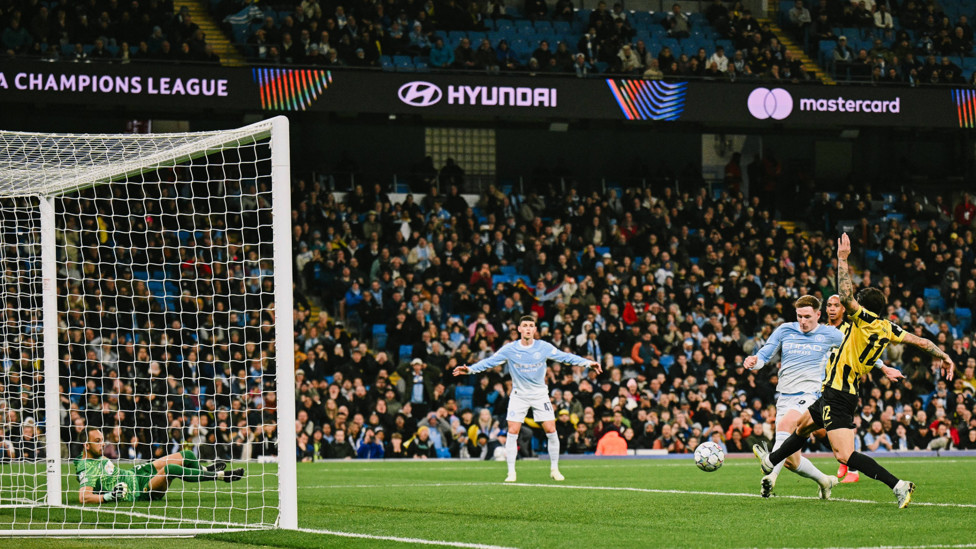
City's lead started with an unlikely sequence in the 12th minute. Enzo Fernández struck a free kick against the crossbar, and Elliot Anderson reacted first to the rebound, putting away his first goal for the club. Anderson's anticipation was as significant as the finish. With the goalkeeper and defenders recovering from the initial effort, the midfielder attacked the loose ball before AEK could reorganise.
That early advantage allowed City to settle into long periods of possession. The hosts could move the ball across the pitch and wait for openings rather than force every attack through one central striker. The approach produced chances for Foden, Cherki and the wider attacking group, while AEK found it difficult to sustain pressure at the other end. City's dominance was not complete, however, and the first minutes of the second half exposed a lapse in concentration.
Stavros Pilios scored in the 52nd minute after AEK advanced into space and finished beyond Gianluigi Donnarumma. At 2–1, the match briefly looked more complicated than City's first-half control had suggested. A single concession was not evidence of a wholesale defensive collapse, but it was a reminder that a rotated side still has to manage transitions and stay connected when possession changes hands.
City's response mattered more than the temporary scare. Instead of retreating into conservative possession, they continued to attack the areas where AEK had been vulnerable. Cherki restored the two-goal cushion five minutes later, and Foden's final two goals removed any lingering doubt. The pattern showed the benefit of having several confident ball carriers and finishers: a momentary mistake did not have to dictate the rest of the game.
Cherki supplied the flair — and made the Haaland absence less obvious

Rayan Cherki's goal was the turning point after AEK cut the deficit. Receiving the ball from Foden inside the penalty area, he shifted it onto his stronger foot and finished into the corner. It was an individual action within a coordinated attack: Foden found the pass, Cherki created the shooting angle and City immediately re-established a margin that better reflected their control of the match.
Cherki is valuable in this kind of game because he can change the angle of an attack without requiring the entire structure to reset. A quick drag-back, a disguised touch or an early shot can punish defenders who have spent most of the match tracking the ball. His combination with Foden also gave City two players capable of being the creator or the finisher on consecutive possessions. That flexibility is harder to defend than a single predictable route to goal.
Haaland watched from the bench and did not feature. His presence normally changes the opposition's priorities: centre-backs must account for his runs behind them and the threat of a direct ball into the box. Without him, City spread the danger across the front line. Foden moved centrally when useful, Cherki found pockets and the full-backs contributed to the final pass. The five-goal total did not prove City are better without their Norwegian striker, but it did demonstrate that the attack does not have to become static when he is unavailable.
The distinction matters for Maresca's selection decisions. Against a deep, disciplined opponent, Haaland's penalty-box presence could still be essential. Against a team that leaves room for combination play, Foden and Cherki can make that space count. The strongest version of City may be the one that can switch between both approaches rather than choose one permanently.

A 17-year-old starter showed why City's rotation is more than a gamble

Maresca made eight changes from the weekend win over Ipswich and started 17-year-old Floyd Samba, a significant show of trust in a player with limited senior experience. Samba did not need to dominate the scoring to make the experiment useful. His movement occupied defenders and created room for more established teammates to operate between the lines. The first goal also came from a free kick awarded after Samba was brought down near the area.
Other young players contributed to the final picture. Ryan McAidoo came off the bench and provided the cross for Foden's third goal, while Allan offered direct running and energy on the left. Those moments were not enough to declare every prospect ready for a demanding run of Premier League and Champions League matches, but they gave the manager evidence that the squad has more solutions than its headline names suggest.
The rotation came at a meaningful point in City's schedule. Antoine Semenyo's injury had already reduced attacking options, and a recent European defeat to Paris Saint-Germain showed the cost of being second-best against elite opposition. The 5–1 win over AEK moved City to six points from three league-phase games, restoring momentum without needing Haaland to play. It also offered Foden a platform to build confidence after a period in which goals had been unusually scarce.
There is still a gap between a successful home match against AEK and a reliable formula for the biggest fixtures. City travel to Aston Villa in the Premier League before their next Champions League assignment against RB Leipzig on November 4. Those games will test whether the passing combinations, central movement and bench contributions can hold up against stronger pressing and better-organised defences. For now, Maresca can take a practical lesson: Foden's form has returned at a moment when his team needs more than one route to goal.
Foden's hat-trick was the headline, but the most encouraging feature of the night was the number of players involved in creating it. Lewis supplied combinations, Anderson attacked the rebound, Cherki punished the moment AEK threatened a comeback and McAidoo added the final cross. Samba's start gave the manager another glimpse of what his academy can offer.
Manchester City will still lean heavily on Haaland when the opposition and occasion demand it. Yet Tuesday's 5–1 win showed a different attacking shape can work — with Foden at its centre. The next question is whether that freedom survives when the spaces are smaller and the stakes are higher.