

Galán and Lebrón Meet Again in Milan — Their Old Partnership Is the Real Semifinal Story
GOATIFYThe Milan P1 has delivered the semifinal the men's draw seemed to be building toward: Alejandro Galán and Federico Chingotto against Juan Lebrón and Leo Augsburger. For Galán and Lebrón, it is another meeting across the net after a partnership that once dominated professional padel. For their current teammates, it is a chance to show that the rivalry is about what the new pairs can do, not only what the old pair achieved.
Both teams earned their places on Friday, October 16. Galán and Chingotto survived an inspired challenge from Gonzalo Alfonso and Tino Libaak, while Lebrón and Augsburger navigated a tense opening set against Javi Garrido and Juan Ignacio De Pascual. The women's draw added its own drama with Tamara Icardo's injury retirement and another emphatic win for Claudia Fernández and Martina Calvo. Saturday's four semifinals at the Allianz Cloud now carry the full weight of a P1 weekend.
Galán and Chingotto Survived the Pair That Had Become Everyone's Problem

Alejandro Galán and Federico Chingotto reached the Milan semifinals by doing something more valuable than cruising: they handled a pair that had been disrupting the established order. Gonzalo Alfonso and Tino Libaak arrived with momentum from successive deep runs, enough confidence to attack early, and little reason to be intimidated by the defending champions. The 6-3, 7-6 result tells a cleaner story than the contest itself. Alfonso repeatedly found aggressive positions and Libaak gave the underdogs a route back into exchanges that looked lost.
Galán gradually imposed himself in the attacking phases, while Chingotto supplied the retrieving, court coverage and low-error discipline that make the partnership so difficult to rush. Their advantage was not simply that they struck more spectacular winners. They forced the challengers to build another good shot after the first one, and then another. In a semifinal against a more explosive pair, that habit becomes even more important: the first defensive block cannot be the end of the point.
The quarterfinal numbers sharpen that picture. Galán and Chingotto won 69 percent of points behind their first serve, against 61 percent for Alfonso and Libaak, and took 40 percent of return points compared with their opponents' 32 percent. Those gaps are not enormous, but over a two-set match they provide the small cushion needed to control the scoreboard. The second-set tiebreak was still close enough to expose how thin that cushion can become when an opponent strings together clean attacks.
Milan also carries unusual significance for Galán. He has been a regular finalist at this venue, winning the event alongside Lebrón in their former partnership and returning to the title with Chingotto in 2025. That history does not win Saturday's semifinal for him. It does make this a test of whether the newer partnership can impose its identity against the man who once helped define his game.

Lebrón and Augsburger Earned the Reunion by Winning the Tight Moments

Juan Lebrón and Leo Augsburger booked the other place in the semifinal by beating Javi Garrido and Juan Ignacio De Pascual 7-6, 6-3. It was a useful test of the pair's composure because their opponents had already produced one of the week's notable upsets by removing Paquito Navarro and Martín Di Nenno from the draw. Garrido and De Pascual were not simply waiting to be beaten by a higher seed; they had already shown they could change the expected bracket.
The opening set went to a tiebreak, where Lebrón and Augsburger found the separation that had eluded them in the preceding games. Once that set was secured, the second became more manageable. The scoreline suggests a partnership that can live through an awkward phase without letting it become a crisis. That matters because Galán and Chingotto specialize in making powerful opponents play extra balls, extending points until the first attacking idea is no longer available.
Augsburger's most obvious weapon is his ability to finish points explosively, especially when he can establish himself high in the court. Lebrón offers a different dimension: he can change pace, choose when to accelerate, and use his familiarity with Galán's habits to recognize opportunities before they fully develop. Those are tactical possibilities rather than guarantees. The risk is that chasing spectacular finishes too early gives Chingotto precisely the defensive rhythm he wants.
For Lebrón, the semifinal is not just another appearance in the last four. It brings him across the net from a former partner with whom he won major titles and spent years setting the standard for the men's game. A reunion like that creates an obvious emotional storyline, but the more interesting question is practical. Can Lebrón and Augsburger build enough patient, repeatable points to make their power count against a pair that rarely gives away the same opening twice?
The Old Galán–Lebrón Partnership Changes Every Tactical Decision
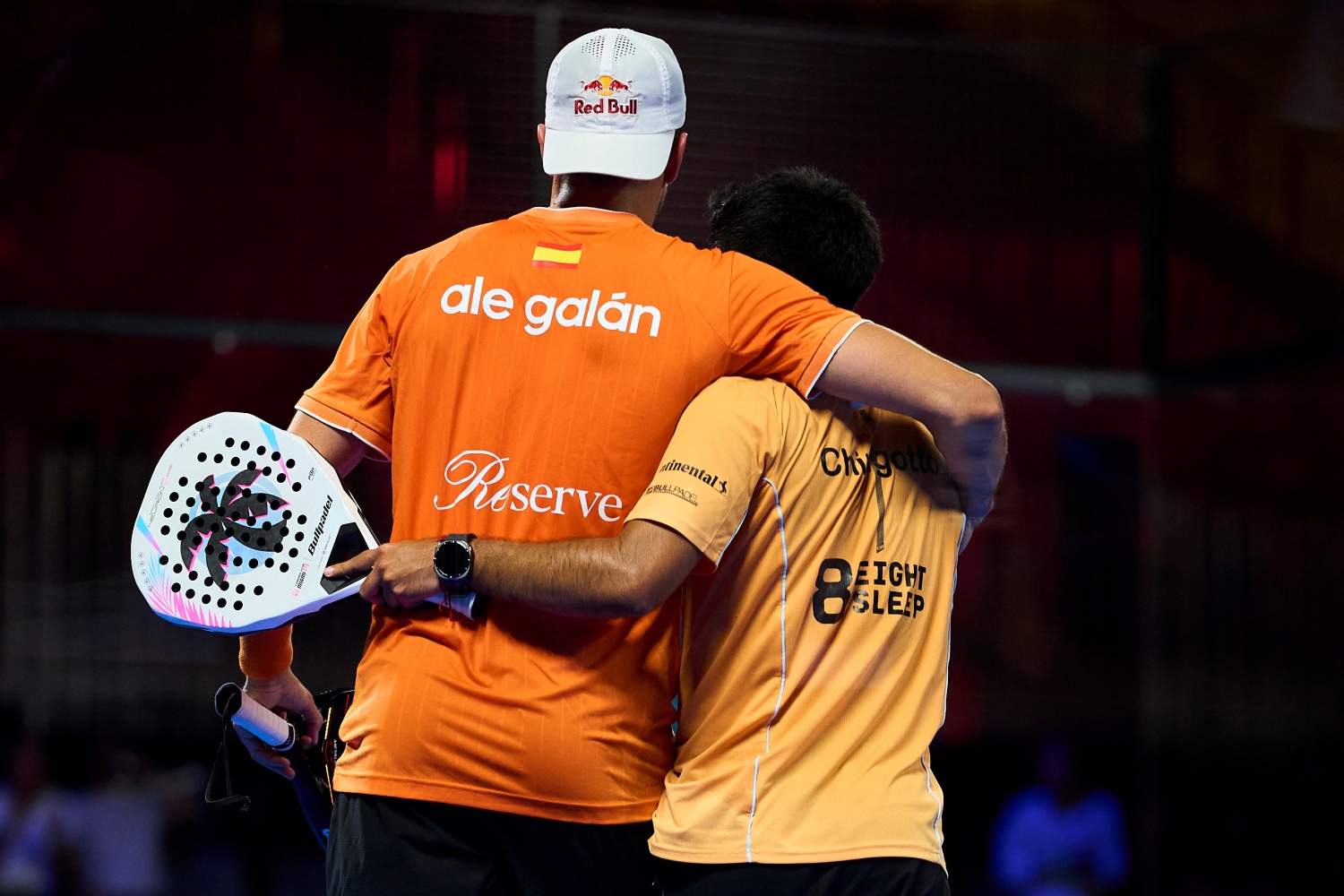
The most revealing part of this matchup may be the first ten minutes, when each pair decides which risks are worth taking. Galán and Chingotto will want to make Lebrón and Augsburger hit from uncomfortable positions rather than from a settled attacking platform. Their ideal point is one in which Chingotto keeps the ball alive, Galán earns space through pressure, and the final attack comes after the defense has already shifted.
Lebrón and Augsburger will try to shorten that sequence. When Augsburger can reach the ball early and strike from above net height, the geometry changes: there is less time for Chingotto to reset and fewer safe places for Galán to defend. The challenge is deciding when the opening is genuine. Too much patience can surrender initiative; too little can feed a defender who is happy to retrieve aggressive but predictable balls.
There is also a specific psychological wrinkle. Galán and Lebrón once solved these problems together. Both know the other's preferred patterns, movement habits and responses under pressure. Yet the players beside them now alter the calculation. Chingotto is a different type of partner from Lebrón, prioritizing continuity and precision; Augsburger offers a different kind of attacking ceiling from Galán. Familiarity between the former teammates therefore does not mean the old solutions still work.
Their meeting in Málaga earlier this season showed how quickly the balance can turn. Lebrón and Augsburger won that encounter in a deciding-set tiebreak, a reminder that neither partnership has a monopoly on the decisive moments. Galán and Chingotto's more recent form and Milan title defense give them a strong platform, but a semifinal is not a season-long ranking exercise. One poor service game or one sustained spell of pressure on the glass can rewrite the tactical picture.
The winner earns a place in Sunday's final, potentially against world number ones Agustín Tapia and Arturo Coello or the increasingly dangerous Franco Stupaczuk and Jon Sanz. That is why the reunion is bigger than the history between two stars: it determines which style gets another chance to challenge the top of the men's game.

Icardo's Retirement and Fernández–Calvo's Surge Reshape Saturday's Women's Draw

The men's reunion will attract most of the attention, but the women's semifinals were shaped by two contrasting quarterfinals. Tamara Icardo's return to competition ended early against Paula Josemaría and Bea González. After losing the opening set 6-1, Icardo could not continue. Josemaría and González advanced, although their abbreviated match offered less preparation than a full contest against a fit opponent would have provided.
Claudia Fernández and Martina Calvo, meanwhile, produced an emphatic 6-1, 6-2 victory over Sofía Araújo and Marta Ortega in just over an hour. The young partnership was facing former partners, but that personal history did not appear to disrupt its rhythm. Fernández and Calvo took charge of rallies early and made it difficult for their opponents to establish any sustained pressure. They will now face Josemaría and González, whose quarterfinal ended without the usual amount of match play.
In the other semifinal, top seeds Gemma Triay and Delfi Brea meet Ariana Sánchez and Andrea Ustero. Triay and Brea beat Jimena Velasco and Raquel Eugenio 6-2, 7-6, while Sánchez and Ustero defeated Alejandra Salazar and Aranza Osoro 6-4, 6-3. Triay and Brea have experienced an unusual run without reaching a final, adding urgency to a meeting with opponents whose recent performances have been increasingly convincing.
Friday's results therefore created four high-stakes semifinals rather than a single headline act. The men's draw has the Galán–Lebrón reunion and another meeting between Tapia–Coello and Stupaczuk–Sanz. The women's draw has a powerful young pairing testing established contenders and top seeds trying to end a frustrating stretch. Milan's Saturday schedule offers several different versions of the same question: whose game will survive when the margins become smallest?
Galán and Lebrón know each other's strengths better than almost anyone, but Saturday will be decided by the pairs they have built since separating. Galán and Chingotto bring a stable, relentless system; Lebrón and Augsburger bring enough pace and shot-making to break that system if they choose their moments well. The quarterfinals showed that both partnerships can survive pressure. The semifinal will show which one can impose it.
Milan has also given the women's draw a compelling contrast between an injury-shortened path, a surging young partnership and established contenders searching for a statement result. Four strong matches, and especially the Galán–Lebrón reunion, could still be decided by a handful of high-pressure points.
Shop GOATIFY padel products from the Padel-filtered collection scope.
















