Arribagé and Olivetti Won 10 Straight Points. Then Turin Was Theirs.
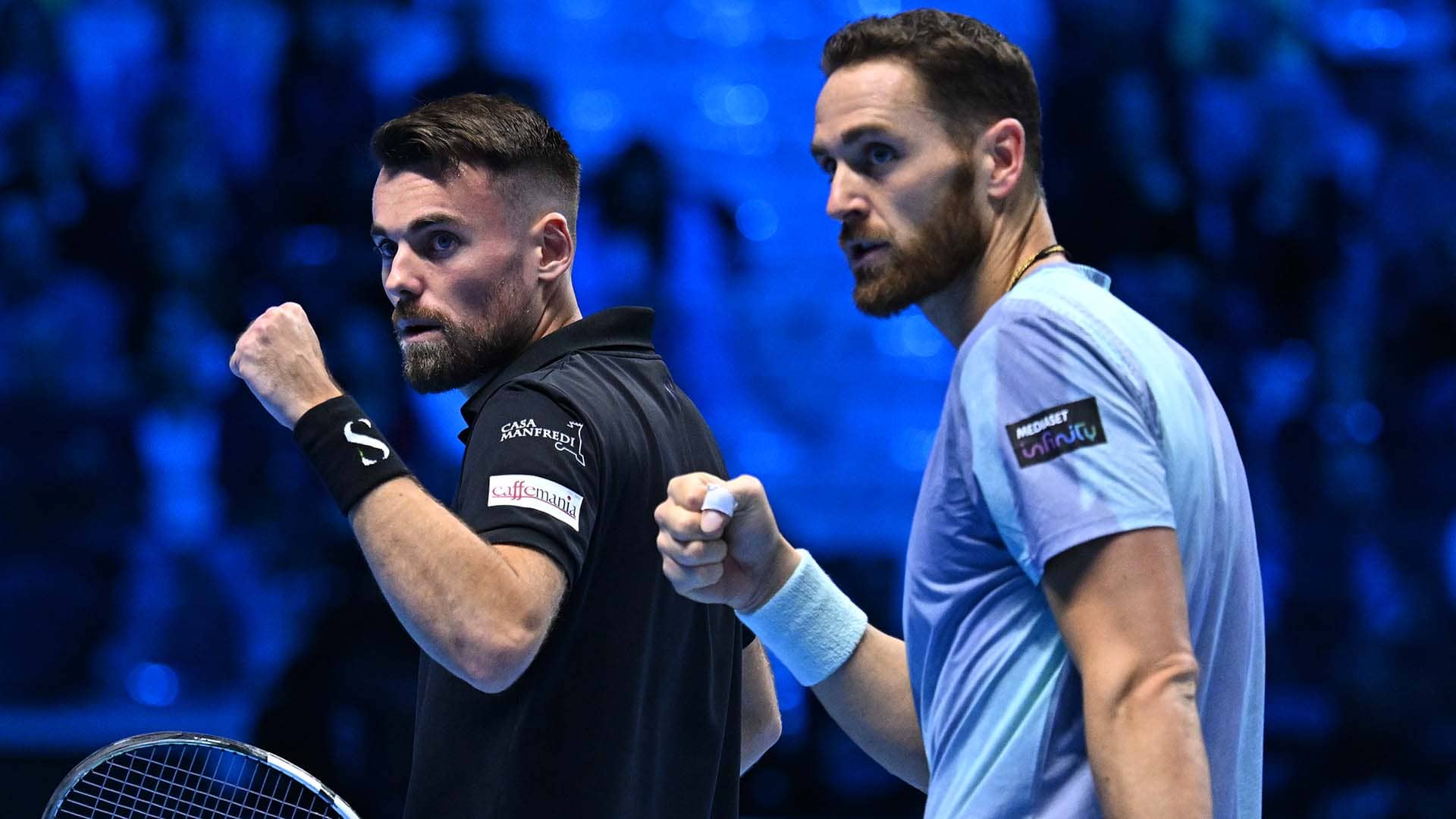
GOATIFYA championship can turn on a few points. In Turin on November 22, the decisive sequence was unusually brutal: Théo Arribagé and Albano Olivetti lost the opening set to Marcelo Arévalo and Mate Pavić, then seized ten consecutive points during the second-set tie-break and the beginning of the deciding breaker before completing a 3–6, 7–6(2), 10–6 victory. The sixth-seeded French duo, newcomers to the Nitto ATP Finals, walked away with the biggest trophy of their partnership.
The score tells a sharper story than a routine comeback. Arévalo and Pavić had beaten the Frenchmen earlier in the tournament's group stage. The eventual champions had already escaped three match points against Kevin Krawietz and Tim Pütz in Saturday's semifinal. On Sunday they faced a team experienced in the most demanding doubles matches, on a fast indoor court where one missed return or low volley can determine an entire service game.
The title was their seventh of 2026, a remarkable return for a combination established only in late 2025. But the lasting lesson is not simply mental toughness. It is how an aggressive doubles partnership can keep finding small improvements in positioning, serving, returning and communication even when the match initially favors the other side.
Ten Straight Points Flipped the ATP Finals Final
Arévalo and Pavić took the first set 6–3, and at that stage the match seemed to favor the more established combination. In modern doubles, comfortable holds are difficult to disrupt. The server is looking for a free point or a weak return, the partner closes toward the net, and the opposition is forced to strike a low, precise reply before it has time to settle into a rally. When the returning pair misses by inches, a service game can vanish in a minute.
The Frenchmen did not need a radical reinvention in order to survive the second set. They needed holds, a manageable number of returns in play and enough patience to reach a tie-break. That happened. At 2–1 in the breaker, Arévalo and Pavić were still ahead, but the next sequence turned a competitive final into something extraordinary. Arribagé and Olivetti won ten points in a row across the end of the set and the start of the deciding Match Tie-break.
There is a temptation to credit a single technical adjustment for a streak like that. Unless every rally is reviewed, doing so would confuse tactical interpretation with documented fact. Doubles momentum can come from several small changes at once: returning lower toward a player's feet, forcing the first volley away from the open court, avoiding an adventurous poach on a marginal ball, or choosing a more reliable serving location. The players on the other side must then respond under increasing pressure.
A ten-point streak also affects the psychology of risk. The pair that was ahead can become tempted to force an ace or put-away volley to halt the run. The pair scoring freely can suddenly trust its standard patterns rather than searching for hero shots. That does not mean the leading team necessarily loses courage or the trailing team becomes unbeatable. It means the scoreboard can magnify a handful of precise decisions into a dramatic reversal.
GOATIFY
GOATIFY Tennis
Tennis rewards teamwork. Discover GOATIFY Tennis apparel and designs for the biggest doubles moments.


Tennis GOAT Golden Racket & Ball Crewneck Sweatshirt
A tennis fan design for everyday wear.
Shop Now ↗

The deciding Match Tie-break ended 10–6. It is not a conventional third set played to six games, where an early lapse can be recovered during several more service rotations. The race to ten points sharply increases the value of each clean return and first-volley decision. A two-point swing can rewrite the championship odds. Arribagé and Olivetti finished their rescue in roughly 90 minutes of total match play, proof that emotional intensity in doubles has little relationship to the clock.
The most convincing aspect of their comeback was therefore not one breathtaking winner. It was remaining close enough after the first set to make a tie-break possible, then producing a sustained concentration of quality when the title moved into the narrowest format the sport offers.
Three Saved Match Points Made the Final Possible

Sunday's comeback was not a one-off. Twenty-four hours earlier, Arribagé and Olivetti had nearly been eliminated by Kevin Krawietz and Tim Pütz. They won the first set of their semifinal 7–6(4), then held three match points in the second-set breaker. The Germans won five points in succession from 3–6, rescued that set 7–6(6) and forced a deciding Match Tie-break. The Frenchmen had gone from almost winning to having to begin again.
The situation worsened at 6–9 in the Match Tie-break. Krawietz and Pütz had three consecutive match points, any one of which would have ended the French pair's season-ending run. Arribagé and Olivetti saved all three, reached 9–9 and eventually prevailed 12–10. Nothing about that finish was comfortable. The winners themselves had failed to convert earlier opportunities, then had to resist their opponents' own closing sequence.
The important distinction is between luck in a short format and habits that create another chance. A player facing match point cannot afford to treat every shot as a desperate attempt at a spectacular winner. A good first serve, a return through the middle or a volley to the safe half of the court may be enough to keep the point alive. Teams also need a simple communication routine so the partner recovering from an error receives practical information rather than blame.
The road to the semifinal made the escape even more meaningful. Arévalo and Pavić beat the French duo in their first round-robin match 7–6(7), 6–4. Arribagé and Olivetti answered by beating Orlando Luz and Rafael Matos. They then defeated defending champions Harri Heliövaara and Henry Patten 7–6(1), 7–6(3) in a decisive group encounter, eliminating a heavily fancied pairing and advancing to the knockout stage.
That format gives a team the opportunity to rebound after one defeat, but it is not a free pass. Every round-robin match carries qualification consequences, and tie-breaks can define the week. The Frenchmen had to master two tight breakers against Heliövaara and Patten, survive a Match Tie-break in the semifinal after three match points against them, and then engineer another rescue in the final. Their title was a sequence of earned second chances, not an uninterrupted stretch of easy victories.
The mental story has a tactical side. Once a pair has repeatedly survived tense finishes, it has a clearer shared vocabulary for the next one. The players know who takes the middle ball, when to guard the alley and how to settle after the opponent hits a brilliant return. Those small routines do not guarantee victory, but they reduce the chance that a single emotional mistake becomes two.
GOATIFY
GOATIFY Tennis
Every pressure point matters. Explore tennis tees, hoodies and court-day gifts in the filtered GOATIFY Tennis collection.


Tennis GOAT Golden Racket & Ball Decal Sticker
Add tennis personality to your favourite gear.
Shop Now ↗
Arévalo and Pavić Had Already Found Ways to Beat Them
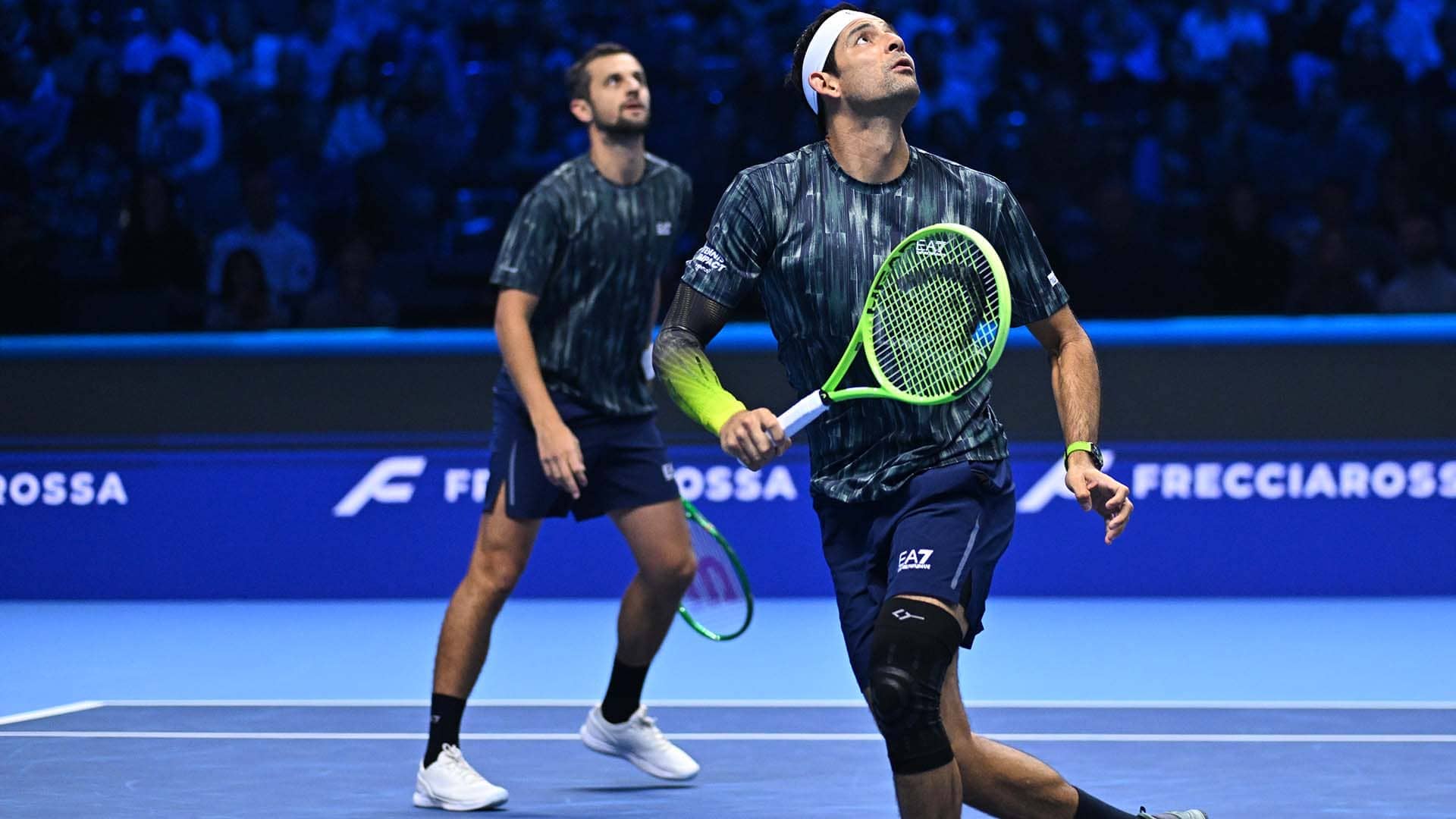
The losing finalists were not accidental opponents. Marcelo Arévalo and Mate Pavić have played major doubles finals together and had already appeared in the ATP Finals championship match as a pair in 2024. Their understanding of first-volley patterns, net movement and when to attack a second serve made them a formidable obstacle. They had the additional confidence of beating Arribagé and Olivetti in Turin's round-robin stage just a week earlier.
That November 15 group meeting ended 7–6(7), 6–4 for Arévalo and Pavić. The opener was a narrow breaker, yet they converted it into control of the match. The final initially looked familiar: the more experienced pair won the opening set 6–3 and seemed positioned to take the trophy. The difference was that the Frenchmen protected their second-set service games and finally created a breaker in which their own successful patterns could take over.
The 2026 head-to-head adds perspective. Arévalo and Pavić defeated the Frenchmen 6–4, 6–4 at the Canadian Masters in Montreal in August. Arribagé and Olivetti also beat them at Cincinnati that month in a contest decided by a Match Tie-break. These meetings do not establish a matchup in which one team simply owns the other. They point to fine competitive margins, changing conditions and the enormous importance of a handful of points at the end of a close set.
A receiver against an experienced team must solve several problems simultaneously. A return that floats above the net cord invites an immediate volley. A return struck too sharply can miss the intended narrow target. Hitting into the middle sometimes reduces the opponent's angle but also means the return has to be low. The best choice depends on the server's location, the net player's movement and the two partners' communication, not a universal instruction to hit harder.
This is where tactical analysis needs restraint. The Sunday report verifies the result and the spectacular run of points; it does not provide a complete chart of every serve direction and net exchange. It would be unfair to say Arévalo and Pavić simply forgot how to play or that one specific poaching scheme destroyed them. More likely, the French pair became better at sustaining neutral or slightly favorable exchanges, then capitalized when the scoring format offered a sudden opportunity.
Arévalo and Pavić still deserve credit for taking a set from opponents enjoying the season of their lives. Their first-round victory over the Frenchmen and previous deep runs are part of the context. Sunday's result does not erase those achievements; it gives the rivalry a defining reversal. The tournament's two meetings produced opposite winners, and the last one came with the biggest title at stake.
Seven Titles in 2026, but This Was the One That Changed Their Standing
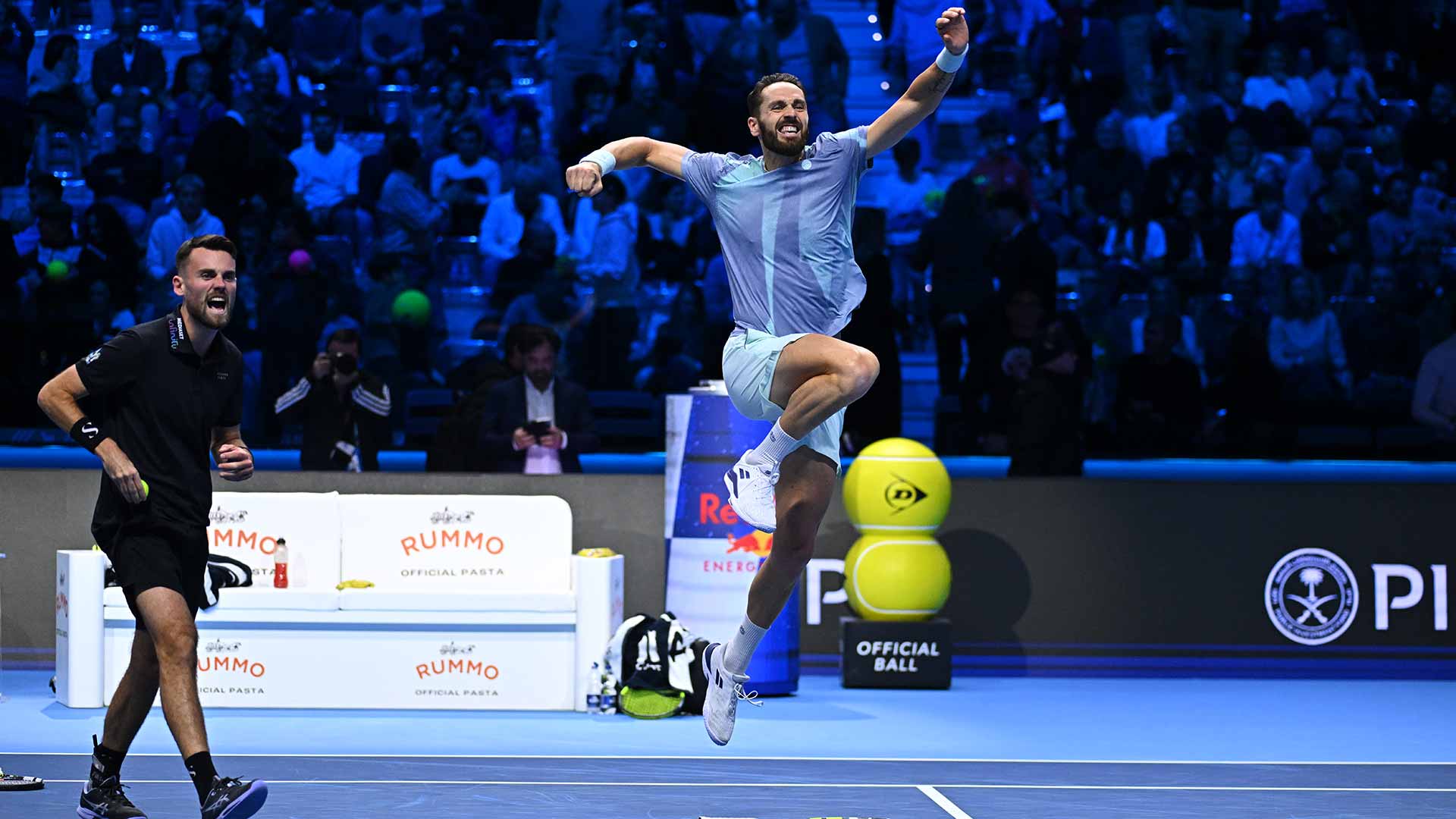
Arribagé and Olivetti had barely been a team for a year when they lifted the trophy in Turin. They began playing together in the latter part of 2025, capturing a title in Almaty soon afterward. What happened next in 2026 was not the typical slow assembly of a doubles partnership. Auckland came in January, Montpellier in early February and Dallas shortly afterward. The duo then won on grass in Halle and Mallorca, added a Basel trophy in the autumn and completed the sequence at the ATP Finals.
GOATIFY
GOATIFY Tennis
From Auckland to Turin, support the game. Shop GOATIFY Tennis designs and sport-inspired gifts.


The number seven matters because it represents repeated success across different settings, not a single fortunate draw. Indoor hard courts emphasize return position and fast first exchanges. Grass rewards accurate serving and anticipation at the net. A long season forces partners to manage scheduling, recovery, changing opponents and the pressure of a ranking race. A combination that wins repeatedly under several conditions has stronger evidence of a functional partnership than one that peaks for a weekend.
Olivetti is a particularly tall doubles specialist with the reach and service potential to complicate an opponent's returns. Arribagé has his own aggressive skills and movement around the net. Still, a good doubles team is more than a large serve paired with a quick mover. Both athletes have to serve, return, volley, retrieve lobs and decide whether the player at the net should intercept. Their achievements suggest they have become substantially better at those joint decisions rather than relying on one unanswerable weapon.
The early titles supplied useful building blocks. In Auckland they defeated Alexander Erler and Robert Galloway 7–6(2), 6–4 in the final, using a strong service performance. Montpellier provided success on home soil. Dallas showed they could win an ATP 500 event against major doubles competition. Halle and Mallorca extended the run onto grass, with the Mallorca final itself decided by a Match Tie-break. By the time the year-end field was decided, the pair had already developed a habit of navigating close endings.
The French connection offered a separate historical milestone. Arribagé and Olivetti became the first all-French team to appear at the ATP Finals since Pierre-Hugues Herbert and Nicolas Mahut won the event in 2021. That does not mean their playing styles are identical or that a future Grand Slam title is inevitable. It places the new partnership within a successful doubles lineage while leaving them to build an identity of their own.
A seven-title season does not settle every ranking argument. Points are weighted by tournament category, other teams produce significant results elsewhere, and the next season will bring adjusted tactics from rivals. What Turin conclusively showed is that these two players can handle the biggest occasion of their partnership while trailing an experienced opponent. It transformed a brilliant run of trophies into a year-end championship that other elite teams will now have to answer.
Arribagé and Olivetti leave Turin as champions after a 3–6, 7–6(2), 10–6 turnaround against Arévalo and Pavić. The ten-point sequence belongs in every highlight reel, but the three saved semifinal match points, the recovery from a group-stage loss and the six earlier titles make it clear this was more than a moment of fortune.
For viewers who love doubles beyond the aces and spectacular reflex volleys, this final was a reminder that the team which can stay close enough to reach a deciding breaker still has a real chance. The Frenchmen seized theirs, closing 2026 with the biggest title of a remarkably young partnership.
GOATIFY
GOATIFY Tennis
Shop GOATIFY tennis products from the Tennis-filtered collection scope.
Tennis GOAT Golden Racket & Ball Decal Sticker
Add tennis personality to your favourite gear.
Shop Now ↗Tennis GOAT Golden Racket & Ball Crewneck Sweatshirt
A tennis fan design for everyday wear.
Shop Now ↗