Goldschmidt Gives Jared Young a Partner. The Mets Still Need a Plan.
GOATIFYThe biggest headlines surrounding the New York Mets this week have belonged to their rotation, but the club's reported agreement with Paul Goldschmidt on November 23 offers a different kind of window into its plans. The veteran first baseman is expected to receive $8 million for one season. The team had not announced the transaction when the report emerged, so the arrangement should still be treated as a reported agreement rather than a completed roster move.
At 39, Goldschmidt is unlikely to become the everyday centerpiece of the offense. That is not necessarily what the Mets need him to be. The interesting question is whether the front office can extract the most productive part of his game while protecting him from the situations in which he has become vulnerable. Jared Young could make that possible, but a platoon is only as strong as the availability and complementary skills of both players.
What His Yankees Seasons Reveal About His Next Role

Goldschmidt's two seasons with the Yankees offer a useful guide to the player the Mets would actually be acquiring, rather than the player remembered for his MVP season in St. Louis. In 2026, his overall offensive production remained above league average. His most striking advantage came against left-handed pitching. His .967 OPS in those matchups contrasted with a .590 mark against right-handers. That difference is too substantial to treat as a minor footnote when planning his next role.
The value of a right-handed platoon specialist depends on more than his ability to punish a left-handed starter. Managers can also use him against a left-handed reliever in a meaningful late inning, provided the opposing team cannot immediately exploit the substitution with a right-handed pitcher. Goldschmidt gives the Mets a credible option in those circumstances without requiring them to redesign the entire batting order. His familiarity with the pressure of a New York season is useful context, but the actual matchup data offers the more persuasive rationale.
There is an important limit to the approach. Opposing managers control their own bullpen choices. Even on a day when Goldschmidt starts against a southpaw, he may face right-handed relief later. The Mets therefore need to decide in advance which player they want handling those later plate appearances and which substitutions they can afford. The best platoon plan is flexible enough to respond to a pitching change without exhausting the bench before the final innings.
GOATIFY
GOATIFY Baseball
Explore GOATIFY baseball fan gear for the next season.

Gold Baseball GOAT Sticker
A gold baseball GOAT decal for your bottle, laptop or game-day gear.
Shop Now ↗


White Baseball GOAT Dad Hat
A white baseball GOAT design for ballpark days and everyday fan style.
Shop Now ↗

Another reason the veteran appeals is his defensive experience. Statcast credited him with six outs above average at first base in 2026, despite his playing only 77 games there. That is meaningful in a team that wants to convert more routine ground balls into outs. The greatest value may not come from spectacular diving stops but from positioning, receiving throws and turning playable balls into completed plays. An improving rotation can benefit from those small efficiencies over a long season.
None of this removes the aging risk. His hard-hit percentage fell below 36 percent last year, and the deterioration against right-handers has persisted across several seasons. A favorable split is not a guarantee of future production, particularly as a hitter moves through his late thirties. New York should have a realistic threshold for changing his role if his performance against lefties declines. Paying for a defined assignment is different from granting that assignment indefinitely.
Young and Vientos Make the Rest of the Roster Matter
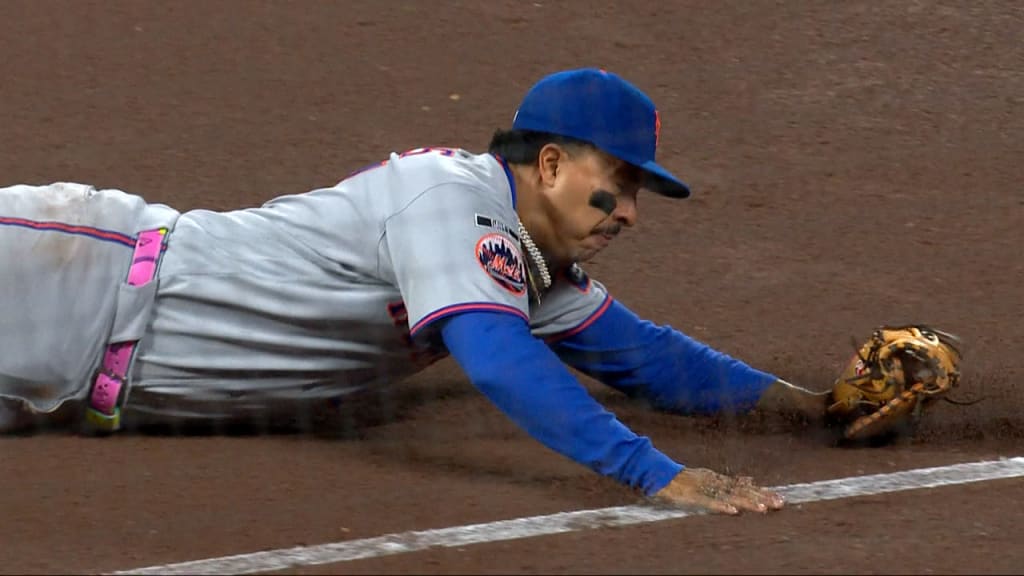
Young is the other essential half of the equation. He became an important left-handed option during a difficult 2026 season, with all nine of his home runs coming against right-handed pitchers. His emergence gave the Mets a reason to avoid paying for another full-time first baseman before assessing what they already had. Goldschmidt can help keep Young out of the least advantageous matchups without forcing the club to discard the progress Young made.
Availability is the first concern. Young lost time to knee trouble and then suffered a concussion in September. It would be premature to assume that a successful recovery and a full season of playing time are guaranteed. New York should enter spring training with a credible alternative on the depth chart, preferably someone who can provide a useful left-handed bat as well as cover another defensive position. Otherwise a single injury could undo the matchup strategy and push Goldschmidt into regular work against right-handed pitching.
GOATIFY
GOATIFY Baseball
Browse baseball shirts, hoodies and stickers for MLB fans.

White Baseball GOAT Sticker
A white baseball GOAT decal for your bottle, laptop or game-day gear.
Shop Now ↗


White Baseball GOAT Sweatshirt
Rep baseball’s greatest with a white GOAT graphic sweatshirt.
Shop Now ↗
Mark Vientos is where the roster calculation becomes especially interesting. His breakout in 2024 demonstrated real power, including during the playoffs, but his subsequent seasons have been less productive. He also missed a substantial stretch of 2026 with a fractured hand. The Mets tendered him a contract in November, preserving the option to keep him, but that decision does not settle where he will play or whether he remains with the club.
The problem is overlap. A bench containing multiple right-handed hitters with similar defensive destinations limits the manager's ability to cover other positions, replace a runner or change the outfield alignment. Keeping Vientos makes more sense if the Mets have a clear plan to help his bat recover or can give him meaningful opportunities elsewhere. Simply retaining him as insurance for another right-handed first baseman would not fully address the shortage of left-handed coverage.
There is also Jorge Polanco, whose injury-disrupted year left the team with little return on the initial plan to replace Pete Alonso. A healthy Polanco could broaden the options at designated hitter, but his recovery should be evaluated on its own merits. Brett Baty, meanwhile, is expected to matter at second base, so assuming he can regularly rescue first base risks moving the problem to a different part of the infield.
For a team reportedly committing $450 million to Tarik Skubal, first-base stability has a purpose beyond producing an impressive lineup on paper. A strong starting pitcher benefits when the defense completes ordinary plays and when the offense creates enough opportunities to win close games. A modest positional improvement does not have to rival the impact of a headline signing to be valuable. It only needs to reduce a weakness without creating a more expensive one somewhere else.
The reported Goldschmidt agreement is a sensible attempt to buy a specific skill rather than a famous name at his former peak. Young's complementary bat provides a plausible starting point, and the veteran's experience in the field gives the partnership additional appeal. The remaining decisions concern the bench, health and whether Vientos has a meaningful role. If the Mets can solve those questions, they may have a workable first-base arrangement for 2027 without pretending that either half of the platoon is a permanent solution.
GOATIFY
GOATIFY Baseball
Shop GOATIFY baseball shirts, hoodies and stickers.


Gold Baseball GOAT Sweatshirt
Rep baseball’s greatest with a gold GOAT graphic sweatshirt.
Shop Now ↗
White Baseball GOAT Dad Hat
A white baseball GOAT design for ballpark days and everyday fan style.
Shop Now ↗