

Scheifele Made History. Barbashev Took the Win.
GOATIFYMark Scheifele owns Winnipeg's franchise goals record. Ivan Barbashev owns the moment that decided Saturday's game. Those two facts are not in conflict, but the contrast captures everything uncomfortable about the Jets' 5-4 shootout loss to the Vegas Golden Knights on November 21, 2026.
Scheifele's 380th career goal passed Dale Hawerchuk and drew a standing ovation at Canada Life Centre. Kyle Connor later put Winnipeg ahead in the third period. Yet Vegas answered with 3:35 remaining, when Tomas Hertl won a puck battle and found Barbashev open in the middle. William Karlsson finished the job in the shootout. The Golden Knights stopped a four-game winless slide; Winnipeg's most memorable individual night ended with one standings point rather than two.
There was also a disputed Vegas power-play goal involving a displaced net, and an exceptional collection of smaller performances hidden underneath the headline. The useful way to assess the evening is not to declare one star a winner and another a loser. It is to ask why a team with a record-setting centerpiece and a third-period lead could not finish, and whether Vegas has truly fixed the late-game management that had cost it points.
Scheifele's 380th Was a Franchise Milestone, Not a Consolation Prize

Mark Scheifele's 380th NHL goal did more than level the score at 3-3. It moved him past Dale Hawerchuk's 379 and put him alone atop the Jets/Thrashers franchise's goal-scoring list. The crowd in Winnipeg understood exactly what had happened. The timing felt particularly cruel only after the final result: a player who had just made team history watched his club lose a game it had led in the third period.
That sequence should not be treated as a footnote to a shootout defeat. Scheifele arrived at this weekend already carrying another extraordinary milestone, having moved past Hawerchuk's franchise points total on November 14. Adding the goal record one week later means the same player now leads the organization in goals, assists and points. Those categories reward different skills. Goals require finishing; assists require creating opportunities; points require sustained involvement across every version of an attack. Holding all three records makes the achievement about completeness as much as durability.
The record goal itself was an example of that completeness within Winnipeg's top line. Kyle Connor received the puck at the left faceoff dot, shaped as though he might shoot and instead delivered a pass toward the middle. Scheifele redirected it over Carter Hart's glove. The movement worked because Connor threatened the goaltender enough to draw attention and Scheifele occupied the space that opened. Neither could have created the same chance alone.
There is an important distinction between a franchise record and a single great season. Hawerchuk's name carries weight across different generations of Jets history; Scheifele's mark was not achieved by a hot November but through years of being asked to create and finish against top NHL opposition. The fact that the record arrived at home, before a standing crowd, is part of why it deserves to survive in the memory independently of the loss.
Yet the game illustrates the limits of one star's influence. Scheifele could provide the goal that made the building erupt, and Connor could put Winnipeg ahead early in the third, but neither could guarantee that Vegas would stop producing chances. The final few minutes did not erase the milestone. They did reveal how difficult it remains to convert individual excellence into a result when the defensive structure briefly opens.
GOATIFY
GOATIFY Hockey
Celebrate the NHL record books with GOATIFY hockey shirts, hoodies and stickers.


For the Jets, the productive response is to celebrate the player without pretending the team did enough to win. For Scheifele, the record is already secure. For Winnipeg's coaches, the assignment is less romantic: keep a lead when the best player has done his part.
Hertl's Retrieval and Barbashev's Finish Changed the Ending
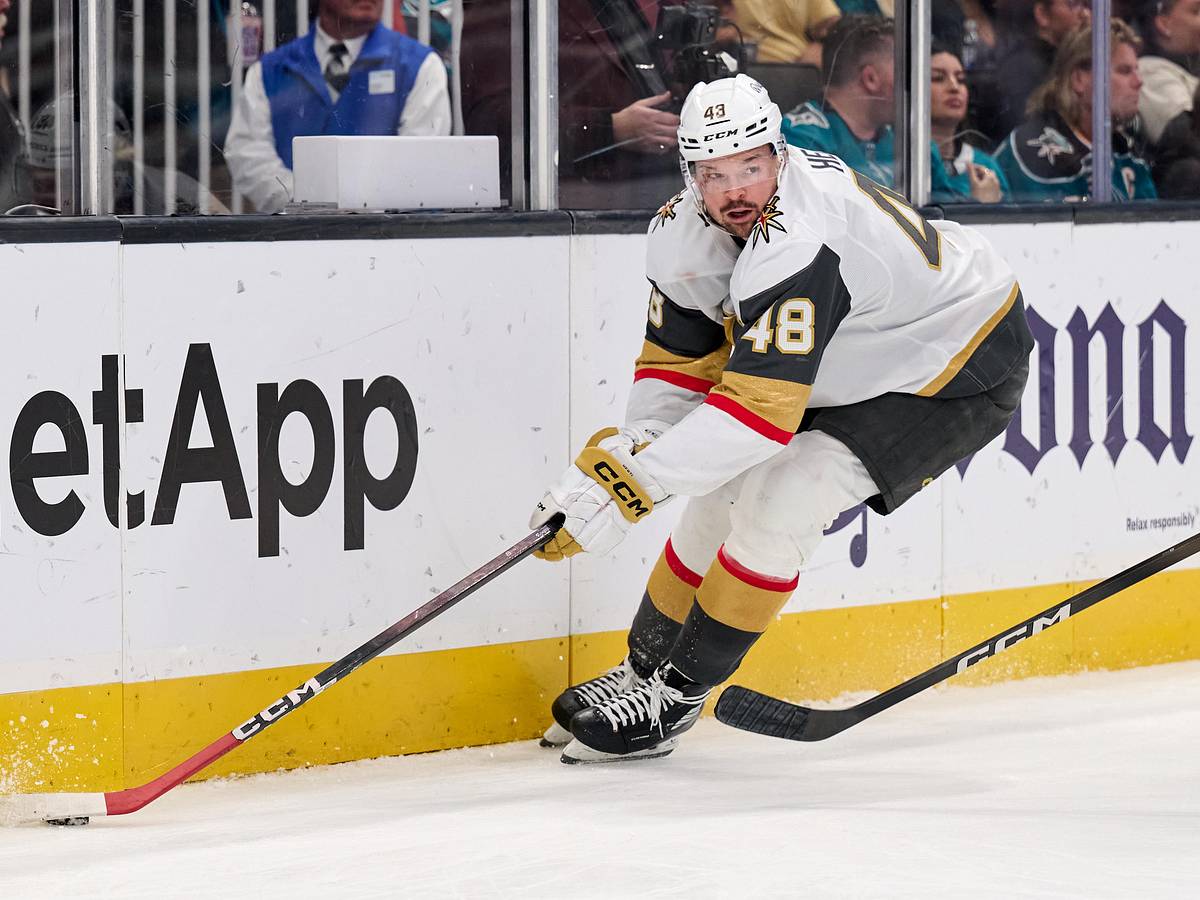
Vegas did not win because it spent the entire evening dictating play. The Golden Knights led 2-1 in the first period, trailed again in the third and needed a precise intervention with only 3:35 left. That is precisely why the tying goal matters. When a team has failed to convert good stretches into wins over several games, the next positive result often turns on whether its forwards can create one more clean chance after the opponent has begun defending its lead.
With Winnipeg ahead 4-3, Tomas Hertl got to a puck in the right corner and kept the play alive. Rather than treating the retrieval as a routine dump-and-chase success, look at what happened next. Hertl turned with the puck and found Ivan Barbashev arriving in a dangerous central area. The pass bypassed the defensive shape that had been pulled toward the boards. Barbashev, with space to choose his finish, drove a wrist shot high past Stuart Skinner. It was a two-player solution to a problem that cannot be solved by effort alone.
The retrieval deserves as much credit as the shot. A winger who wins a race toward the boards buys his line another offensive possession; a winger or center who immediately sees the next pass turns that possession into a chance before defenders reset. Hertl created the second part of the play. Barbashev supplied the first-time recognition and finish. Even a goaltender who has been playing well has little margin when the shooter gets a clean look through moving coverage.
The goal also gave the Golden Knights a different ending from their recent defeats. Vegas entered after a four-game winless sequence, with its coaching staff and players talking about late mistakes in close games. Their results had been undermining strong individual stretches. This time, the decisive late exchange happened at the other end. That is not proof every defensive issue has disappeared, but it changes the emotional and tactical postgame conversation from missed opportunities to a recoverable blueprint.
William Karlsson then finished the job in the shootout as the only player to score in the tiebreaker. The 5-4 final does not count a shootout winner as a fifth regulation goal, so the scoring ledger remains four goals apiece before the extra competition. The distinction matters: this game was extraordinarily close rather than a clean five-goal offensive victory by Vegas.
There was still substantial contribution elsewhere. Brett Howden finished with a goal and an assist. Mitch Marner scored, Jack Eichel created two assists, and Carter Hart stopped 26 shots. Vegas ended the night 14-6-5. Those details support a more useful interpretation than saying Barbashev rescued an otherwise passive group. The Golden Knights had enough contributions to stay in the contest; the Hertl-to-Barbashev sequence was simply the possession that turned those contributions into two standings points.
Now comes the test that a single comeback cannot answer: whether Vegas can protect leads with the same urgency it showed chasing one. Good teams need both habits, and this season has already supplied evidence that a win can be hard-earned without being entirely convincing.
The Dislodged-Net Ruling Cannot Explain Winnipeg's Late Mistake

The most contentious episode unfolded midway through the second period, when Tomas Hertl pushed Vegas ahead 3-2 on the power play. The puck crossed the goal line after the net had come loose. Officials initially waved the goal off, then awarded it following review, determining that Winnipeg's Alex Iafallo had pushed Victor Olofsson into the net and caused the displacement. It was the kind of decision that can become the entire story if analysis stops at whether supporters liked the ruling.
GOATIFY
GOATIFY Hockey
Shop hockey fan favorites while exploring the Golden Knights' late-game comeback.
The ruling is worth describing accurately. It was not simply a case of the league ignoring a loose net, nor is the replay a reason to declare the goal obviously fair to every observer. The officials' reasoning turned on how the net became dislodged and the continuity of the attacking play. Winnipeg coach Scott Arniel disagreed with the outcome, while the Vegas side believed the review had followed the correct logic. Both responses are understandable; neither changes the recorded sequence or permits a reporter to invent an alternative result.
Most importantly, Winnipeg did respond on the scoreboard. Scheifele tied it 3-3 later in the second period, and Connor gave the Jets a 4-3 advantage just over four minutes into the third. That means the disputed goal did not leave Winnipeg chasing a deficit at the final horn. The Jets regained control of the score and were in position to finish the night with two points. A team that wants to learn from this game should not allow the review to obscure the later breakdown.
The disputed score also revealed something constructive about the Golden Knights: after taking the lead, they did not maintain it easily. Winnipeg established its own pressure, creating the Scheifele milestone and Connor's go-ahead chance. The game moved through multiple momentum changes. That matters for evaluating a supposed comeback, because Vegas was not the only team capable of responding to an adverse moment. Both sides managed one.
What separated them was the last significant regulation exchange. Winnipeg's defenders moved toward the boards on Hertl's late retrieval, and the middle opened for Barbashev. Arniel's description afterward focused on the one costly mistake rather than on the referee's earlier ruling. That distinction is where the coaching value lies. A marginal call is difficult to control. Supporting the corner, covering a slot receiver and tracking the third attacking option are repeatable decisions.
For Vegas, it would also be a mistake to overstate the power-play goal as some kind of unanswerable tactical trick. The sequence involved a disrupted net and a particular ruling, not a standard scoring method to manufacture again next week. What is repeatable is Hertl's composure, the team's faceoff support, the ability to reach scoring space and the willingness to stay engaged when the score turns against them.
For Winnipeg, the best lesson is not to suppress the frustration. It is to separate frustration from evidence. The Jets scored four times, got a record performance from a franchise cornerstone, recovered a lead after the controversial decision and still conceded an equalizer. The late defensive coverage is both more actionable and less comforting than assigning the night to one ruling.
Skinner, Connor and Björck Show Why Winnipeg Should Not Panic

Winnipeg's defeat becomes easier to understand when the supporting performances are placed next to Scheifele's record. Adam Lowry scored just 29 seconds after the opening faceoff, redirecting Elias Salomonsson's shot. Rookie Viggo Björck equalized late in the first period after a pass from Morgan Barron. Connor finished with a goal and an assist, while Barron supplied two assists. A side that can draw production from different lines is not automatically in crisis because its record-setting center's celebration ends in a loss.
GOATIFY
GOATIFY Hockey
Bring hockey fandom to everyday gear with the GOATIFY Hockey collection.
There are, however, tactical warning signs. The Jets allowed Howden to answer Lowry's early goal and then Marner to move Vegas ahead in the first period. They eventually regained territory, but the defensive performance moved from recovery to vulnerability more than once. When Barbashev tied it late, the problem was not that Winnipeg could not score. It was that the group could not close the space the most dangerous Vegas forward wanted to occupy.
Stuart Skinner's 29 saves should be evaluated in that context. The fourth Vegas goal came from a shooter with time and access to a central lane, and the third involved a reviewed net-displacement play. Goalies always receive scrutiny after a four-goal regulation result, but a reasonable examination separates the quality of each chance from the final number on the scoreboard. The goaltender is the last defender; he is not the only defender.
The lineup also helps explain why the Jets have been negotiating imperfect stretches. Winnipeg entered with a plan to use 11 forwards and seven defensemen, and Salomonsson returned after missing seven games for personal reasons. That does not excuse mistakes, but it can alter line rotations, puck support and familiar defensive pairings. The challenge for the coaching staff is to build coverages that survive an uneven deployment rather than assume a familiar five-man unit is always available.
Björck's involvement is a promising counterweight to that uncertainty. The 18-year-old did not merely sit on the bench watching the veteran core. He got into position for a meaningful goal, highlighting the value of young players who can add goals rather than simply preserve a shift. It is still too early to frame one performance as a transformation, but production outside the Scheifele-Connor partnership is the type of development that can make Winnipeg harder to defend over a long season.
The broader story is that Winnipeg came off a six-game winning streak before losing two of three. A short uneven patch after a strong run is not proof that the earlier progress was illusion. It is a reminder that NHL standings can be shaped by one uncovered slot, one rebound and one shootout attempt. The Jets leave this game 11-9-4, with reason to be dissatisfied about the final minutes and equally strong reason not to reduce every problem to their most famous player or their goalie.
For Vegas, the next step is a road trip meeting with Edmonton; Winnipeg is scheduled to host Utah. The immediate question for both coaching staffs is whether they can prevent the same late-game patterns from recurring. The Golden Knights got a reset. The Jets got a record and an avoidable wound. Those are very different emotional outcomes from one tightly contested night.
Scheifele's records belong in Winnipeg history regardless of the score against Vegas. They describe years of offense, creativity and resilience, not the last five minutes of a single November contest. The Jets can honor that achievement without overlooking the slot coverage that allowed Barbashev to erase Connor's go-ahead goal.
Vegas deserves credit for finding another answer after failing to finish close games earlier in the week. Hertl's corner work, Barbashev's positioning and Karlsson's shootout finish were different ways of creating the same result. The team now has to show that late discipline works when it is protecting a lead, too.
The final margin was one shootout goal, but the evaluation should be broader. Winnipeg saw what its most important forward can achieve and what the group must protect. Vegas saw how depth scoring can turn a difficult road night into momentum. The record will last. Whether either team learns from the final minutes is still to be decided.
GOATIFY
GOATIFY Hockey
Shop GOATIFY NHL and hockey shirts, hoodies and stickers.


















