

Shesterkin Is Out. The Rangers' 89.7% Kill Is Their New Identity.
GOATIFYNo Igor Shesterkin, no guaranteed safety net, and almost no room for defensive passengers. That was supposed to be the New York Rangers' biggest problem when their franchise goalie suffered a season-ending right knee injury on October 9. Six weeks later, the more revealing statistic is not a replacement goalie's save percentage. It is an 89.7% penalty kill, the best in the NHL as of November 20, and the outline of a different kind of Rangers team.
At 13-8-1 through 22 games, New York had won nine of its first 11 home games and six of its past seven. Those figures matter because last season Madison Square Garden offered little protection: the Rangers managed only 14 home wins across 41 games and finished last in the Eastern Conference with 77 points. The start to 2026-27 is a genuine reversal rather than a small improvement in presentation.
Coach Mike Sullivan has found a model that does not ask his replacement goalies to manufacture a miracle every night. Faster pressure, contact that wins possession rather than merely makes noise, disciplined shifts and an ability to score when opponents overcommit have given New York a recognizable identity. The question ahead of Sunday's November 22 meeting with Carolina is whether that identity is strong enough to remain competitive when the opponent is built to expose every loose detail.
Sullivan's system is making defense the Rangers' first option
A team can say it wants to defend well without changing how the puck travels through its own zone. Sullivan's improvement is more concrete. His Rangers are trying to end opponents' possessions earlier: close the gap before a forward can settle, support the first checker, recover loose pucks with numbers and move up ice before a rival can reset. That is how physical play becomes an offensive tool rather than a parade to the penalty box.
Captain J.T. Miller's role is especially important. The standard for him is not merely producing points or collecting an impressive hit count. It is setting the speed of the collective response after New York loses possession. If one player presses and his line mates arrive late, that aggressive first step creates space for the opponent. If all three converge with sensible angles, the same move creates a turnover and an immediate transition chance.
The defensive numbers indicate that the structure is affecting results. At the November 20 checkpoint, the Rangers allowed 2.64 goals per game, sixth fewest in the league, and 26.4 shots per game, tenth fewest. Those measures are not perfect descriptions of chance quality, but they establish that opponents are finding fewer uncomplicated opportunities to test the crease. Just as crucial, New York was 11-1-0 when scoring first. A team that establishes a lead and then protects the useful areas of the ice has a completely different path to victory from one that exchanges rushes all night.
The contrast with 2025-26 is uncomfortable but necessary. The previous team could feature elite individual talent and still force its goalies into too many recoveries after chaotic neutral-zone passes and unprotected slot entries. The disastrous home record was not simply a run of unfavorable bounces. It suggested a structure that disappeared too often when games became difficult.
GOATIFY
GOATIFY Hockey
The Rangers have made physical, disciplined defending their game plan. Explore original GOATIFY hockey shirts, hoodies and accessories for fans who appreciate the hard shifts.


Sullivan cannot guarantee that every bounce will favor New York. His more realistic objective is to make the team's response recognizable in a bad period as well as a good one. A controlled exit after conceding a goal, a backcheck that arrives on time and a defenseman resisting the temptation to gamble at the offensive blue line are not glamorous moments. They are precisely the moments that separate a durable turnaround from a hot stretch.
Garand and Korpisalo turned a crisis into a working tandem

The injury problem was unusually severe. Shesterkin went down during the October 9 game in Washington, and the veteran who might ordinarily have steadied the transition, Joonas Korpisalo, was himself unavailable because of a foot infection. New York turned to Dylan Garand, a rookie who had been waived before the season. There was no clean handover from an established No. 1 to an obvious No. 2.
The rough patch that followed could easily have defined the year. Between October 15 and November 1, New York went 1-5-1 and surrendered 4.57 goals a game. It would have been convenient to call the collapse a goaltending problem. That explanation also would have excused the skaters for their slower reads, missed pressure and inability to regain control. Shesterkin could have stolen individual games; he could not have fixed the habits of every forward and defenseman.
Garand's response has made the early panic look less inevitable. Over his most recent four starts entering the November 20 report, he posted a 1.51 goals-against average and a .943 save percentage, stopping 99 of 105 shots. Those are short-run figures, and they will not automatically survive another month against stronger attacks. They nevertheless prove that a replacement can look composed when he is not being asked to defend every mistake alone.
Korpisalo's return changed the workload calculation. He made 25 saves in his November 7 Rangers debut in Seattle, a 4-3 victory that still contained a warning when New York allowed a late rally after building a four-goal lead. Across his first three starts back, all wins, the veteran had a 1.67 goals-against average and a .940 save percentage. On November 16 against Montreal he stopped 24 of 25 shots in a 3-1 win at the Garden. Those are reassuring performances, not a promise that the starter debate has been solved forever.
Having two usable options matters as much as identifying the marginally hotter goalie. Garand was forced into 12 straight appearances, including ten starts, during the injury squeeze. Giving him days to recover and separating a bad outing from his next assignment is part of protecting a young player's development. Korpisalo, meanwhile, is no longer a name on the injured list: he can handle a meaningful share of NHL starts.
None of this means Shesterkin's absence has become irrelevant. His ceiling is considerably higher, and a playoff team would be foolish to treat two strong weeks as a permanent replacement for an elite franchise player. The intriguing development is that the group in front of the goaltenders finally seems to understand the difference between relying on an outstanding save and building a sequence of play that reduces the need for one.
GOATIFY
GOATIFY Hockey
Garand and Korpisalo are making the most of their chance. Find six GOATIFY hockey fan designs while following New York's unpredictable goalie story.
An 89.7% penalty kill is generating more than stops

Penalty-killing percentage can be deceptive if treated as a permanent talent rating. One power-play goal allowed can move the figure sharply early in a season. Still, New York's 89.7% mark through November 20 is more informative when paired with the rest of its profile. The Rangers have also suppressed overall shots and goals at an impressive rate. Their best special-teams work therefore looks like an intensified version of their five-on-five habits, not a completely separate trick.
The November 16 win over Montreal was the cleanest illustration. The Canadiens went ahead in the second period, but Will Cuylle tied the game by driving into the scoring area on a Marcus Pettersson attempt. Later in the period, with New York a man short, Adam Fox recovered a loose puck and moved it toward Cuylle. The forward accelerated into open ice and beat Jacob Fowler to put the Rangers ahead 2-1. Rather than merely surviving the disadvantage, New York turned it into the game's decisive scoring opportunity.
A short-handed breakaway is not the normal expected return from killing a penalty. It is the high-upside result of multiple smaller successes: protect the middle, force a decision under pressure, identify when the puck is available and release a skater with enough speed to punish the opponent's aggressive positioning. Those details appear in the same conversations as the Rangers' general defensive improvement for a reason.
The special-teams story did not end with Cuylle's goal. New York finished four-for-four on the kill against Montreal and had to handle uncomfortable late situations with the Canadiens pushing for an equalizer. Scott Morrow's third-period goal gave the Rangers additional breathing room, while Korpisalo did his part behind a group that stayed focused on protecting dangerous ice. Winning the difficult minutes is more meaningful than celebrating one spectacular counterattack.
There is an important distinction between playing with edge and chasing contact. The former shrinks an opponent's passing options and makes recoveries difficult. The latter leaves the slot available to a skilled power play. New York's useful aggression is organized: players work in connected lanes, not in isolated sprints. That is why the same team can be both physical and difficult to penetrate.
The uncomfortable statistical caveat remains. An 89.7% penalty kill is an exceptional rate; opponents will adapt, and a handful of deflections may narrow the gap with the field. The sustainable element is the decision-making beneath it. If the Rangers keep denying clean middle-lane access, recovering pucks first and refusing to turn every blocked shot into an uncontrolled scramble, they can remain an excellent defensive team even when the headline percentage becomes less spectacular.
Carolina will test whether the Rangers' structure survives real pressure
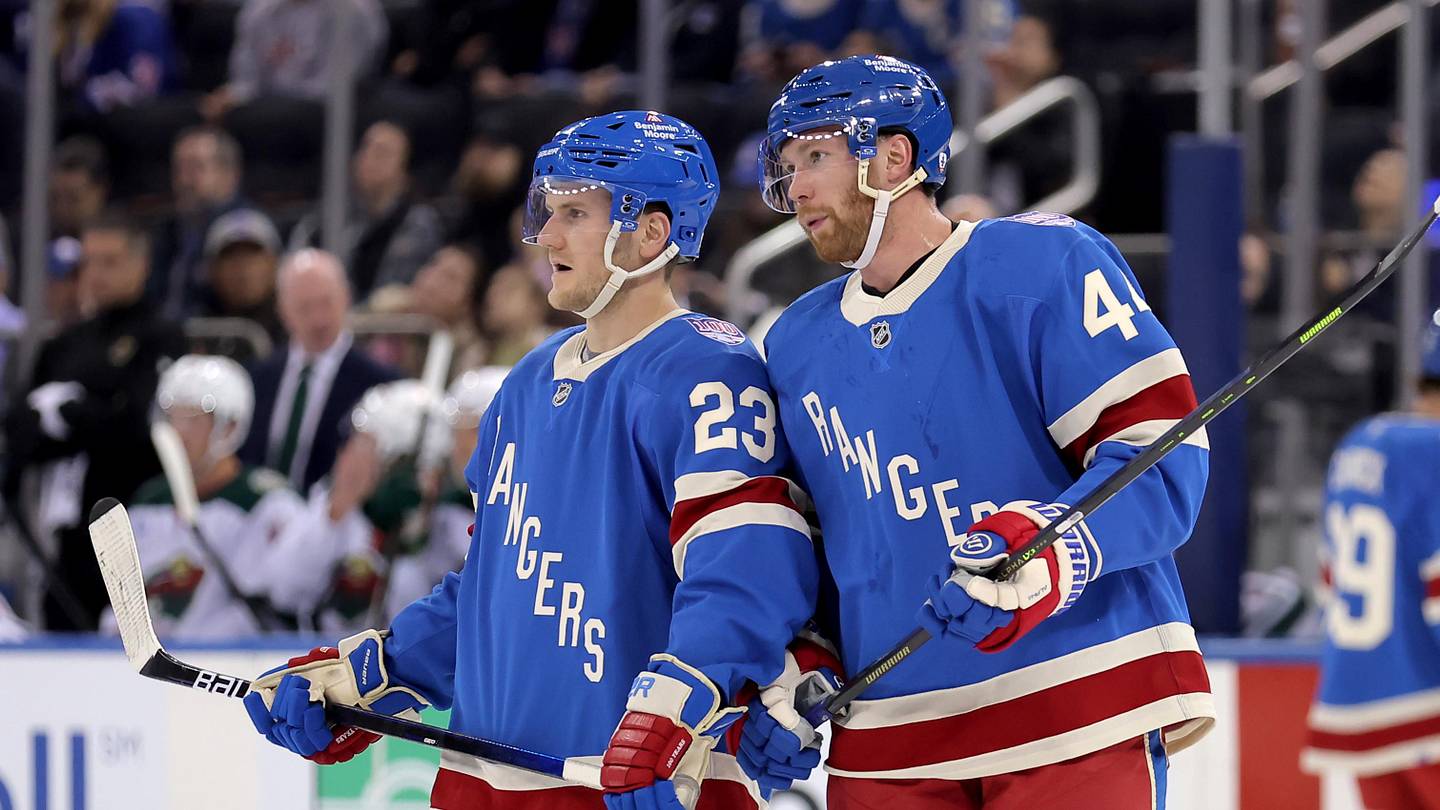
The danger of a seven-game winning trend is believing that a short stretch has already answered a season-long question. New York outscored opponents 22-12 across its most recent seven games before the November 20 break, and its only defeat in that span was a 3-1 loss in Edmonton on November 9. It is an encouraging sequence. It does not yet establish that the Rangers can impose the same defensive terms on every style of opponent.
GOATIFY
GOATIFY Hockey
Cuylle's short-handed winner captures the value of pressure and teamwork. Browse the GOATIFY Hockey collection for the next game-day watch.
Carolina's visit to Madison Square Garden on Sunday, November 22 is a particularly useful test. The Hurricanes are not a team New York can rely on to spend entire shifts passing slowly around the outside. Carolina's forecheck, puck retrieval and willingness to extend offensive-zone possessions demand quick decisions under pressure. Even a club that generally defends well can become pinned deep if the first exit fails and the next two skaters are not in position to help.
That puts Adam Fox and his defensive partners at the center of the question. Fox can create offense with a controlled first pass, but his most valuable work in this matchup may come before a highlight begins. A stick that disrupts an entry, a shoulder check before retrieving a rimmed puck and a short outlet to a supporting forward all prevent a shift from becoming an emergency. Vladislav Gavrikov's positioning and recovery work can make those choices safer. Neither defenseman needs to win a game with a risky end-to-end rush.
Up front, Miller's line must give the defense options that do not involve blindly clearing the puck. The first forward back can open a short passing lane; the second can provide the wall outlet; the third can stretch the next defensive layer once New York gains control. Against a disciplined forecheck, that support chain has to arrive on time. A missed connection can turn a routine breakout into two more chances against the goalie.
The Rangers' 11-1-0 record when scoring first also creates a tactical question. They have become good at defending a lead, but the best opponents will not always give them the opening goal. Their six-of-seven surge included a comeback against Montreal, and that flexibility matters. A team needs enough patient offense to recover from falling behind without returning to the open-ice chaos that undermined its previous season.
By spring, no one will care that the Rangers led the November penalty-kill rankings if their defensive identity collapses during a prolonged injury or a run of difficult matchups. Conversely, if they can lose Shesterkin, absorb a poor October stretch and still earn wins by repeating their structure against quality opponents, New York will have solved a more important problem than a single hot goalie. It will have built habits that can travel from November into meaningful late-season hockey.
New York has not replaced Igor Shesterkin's talent. It has, for the first time in a while, made that talent less central to every possession. Sullivan's team is defending early, buying its goalies clearer looks and converting pressure into scoring chances without needing to win a track meet. The 89.7% penalty kill is the most striking number, but the combination of a 2.64 goals-against average and nine home wins in eleven attempts gives it context.
Garand and Korpisalo deserve credit for meeting a very difficult assignment. Cuylle's short-handed winner against Montreal shows what happens when the rest of the roster joins them in the response. Carolina is a useful next opponent precisely because it will not offer easy exits or a comfortable script.
The Rangers are no longer asking whether they can survive Shesterkin's absence for one week. They are asking whether a defense-first identity can carry them through an entire season. That is a far more promising question—and a harder one to answer.
GOATIFY
GOATIFY Hockey
Shop GOATIFY NHL and hockey shirts, hoodies and stickers.


















