

Swiatek Pulls Out of Ningbo — Even a Tokyo Title Can't Save Her Finals Bid
GOATIFYIga Swiatek's last direct route into the 2026 WTA Finals has closed without another ball being struck. The six-time Grand Slam champion withdrew from the Ningbo Open on Tuesday, October 20, citing a lingering problem with her left thigh. The decision follows the injury-hit Wuhan semifinal that ended her title hopes three days earlier, but the larger consequence is mathematical: even winning the remaining WTA 500 tournament in Tokyo would leave her short of the points needed to catch Karolina Muchova.
That is a dramatic turn for a player who won the year-end championship in 2023 and has spent much of the decade near the top of women's tennis. It is also not quite the end of the WTA Finals story. Muchova still has to watch Marta Kostyuk's results, Swiatek could be considered for an alternate place, and the question of whether the Polish star should play again this season is now bigger than any individual draw.
From two set points in Wuhan to a Ningbo withdrawal
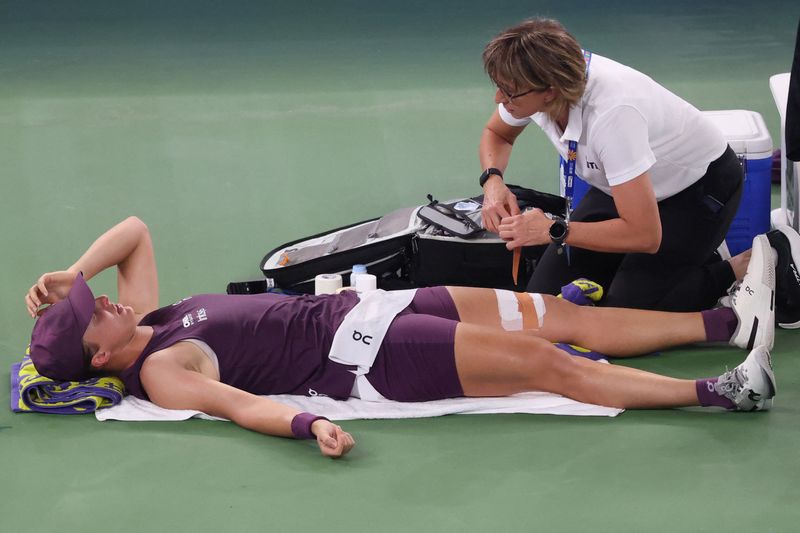
The immediate trigger was visible in Wuhan on October 17. Swiatek had led compatriot Maja Chwalinska 5-3 in the opening set of their semifinal and held two set points. Instead of taking that opener, she watched Chwalinska turn the set around, then needed medical attention with her left thigh visibly troubling her. She returned to court with the leg bandaged, but the difference in her movement was hard to miss. Chwalinska won 7-5, 6-1, taking ten of the final eleven games after the momentum shifted.
Swiatek's decision to finish that match showed the competitive instinct that has defined so many of her biggest performances. It did not, however, mean she had recovered. Her physiotherapist subsequently described advising her more than once to stop because continuing carried a risk. That account matters because the subsequent withdrawal was not simply a precaution after a disappointing defeat. The injury had already affected how she could push off, change direction and chase balls at the end of a demanding tournament week.
On October 20, Swiatek withdrew from the BNB Ningbo Open, where she had been seeded second. She explained that the thigh problem had been ongoing for weeks and that rest and recovery were now the appropriate priorities. Anastasia Zakharova took her place in the draw as a lucky loser. The move eliminated the opportunity to earn points in Ningbo before the final Asian hard-court event in Tokyo.
There is an important distinction between what is known and what is not. A left-thigh problem is confirmed; the exact medical diagnosis, recovery timetable and likelihood of her playing Tokyo have not been established publicly. It would be premature to call this a season-ending injury. Equally, it would be a mistake to treat her absence as a minor scheduling choice when the race consequences are this substantial.
What makes the timing so cruel is that Wuhan had also provided evidence of strong tennis. Before the semifinal, Swiatek beat Magdalena Frech, Ashlyn Krueger and Ann Li in straight sets. She reached the semifinals of a WTA 1000 tournament for the fourth time in 2026 and recorded her 40th tour-level win of the year during that run. The form was improving just as her body stopped cooperating.

The points equation: why Tokyo alone cannot rescue her

There is a difference between being high in the weekly world rankings and earning a place at the season-ending WTA Finals. The Finals field is determined through the season's Race standings, subject to the tour's qualification rules, not simply by a player's reputation or past titles. Seven women have already secured their places for Indian Wells: Elena Rybakina, Aryna Sabalenka, Mirra Andreeva, Jessica Pegula, Coco Gauff, Elina Svitolina and Linda Noskova. That leaves one singles berth still being contested.
Immediately before Ningbo, the published Race snapshot had Muchova on 4,735 points and Swiatek on 4,189, a gap of 546 points in that snapshot. Another report described the live deficit as approximately 545. The difference is immaterial to the outcome. The Pan Pacific Open in Tokyo is a WTA 500 tournament, so its champion can earn at most 500 points from that event. Add 500 to 4,189 and the total reaches 4,689, still about 45 points behind Muchova's current mark even before considering any ranking-point replacement rules.
Ningbo was therefore not an optional warm-up for Swiatek. It was the first of two remaining opportunities to bridge a deficit too large for Tokyo alone. Even a modest result there could have preserved a mathematical route, while a deeper run would have changed the pressure on Muchova. By withdrawing before playing, Swiatek lost that first opportunity entirely. A perfect Tokyo week would no longer be enough to move ahead of the Czech on the available figures.
That is why the phrase out of the Finals race needs a qualifier. Swiatek is out of contention for the final direct qualifying position through the remaining scheduled events. She has not been barred from Indian Wells. The tournament uses alternates who can replace a qualified player who withdraws, and Swiatek remains a plausible candidate for such a place depending on the final standings and availability. Being an alternate, though, is not the same as having a guaranteed singles place or a guaranteed match.
It also changes the incentive to travel to Tokyo. Playing could still offer competitive rhythm, ranking points and a chance to finish the season positively. But it can no longer accomplish the specific goal that made the Asian swing so urgent. With an unresolved thigh problem, Swiatek and her team must weigh those potential benefits against the risk of extending an injury into the offseason.
Muchova holds the advantage; Kostyuk still has a route
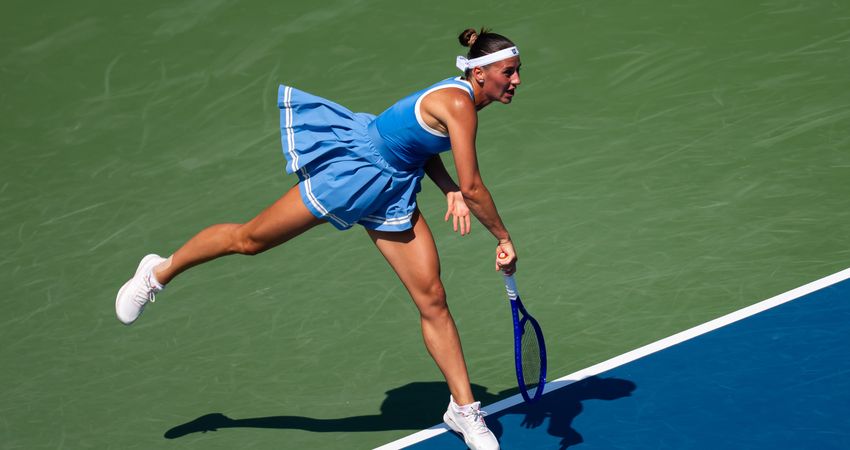
Muchova's position is unusual because she is not playing in Ningbo. She has to wait while her challengers attempt to close the gap, but Swiatek's withdrawal has already removed one of the most credible threats. The Czech has assembled a strong 2026 season, including her first WTA 1000 title in Doha and a run to the Stuttgart final. Those results did not guarantee a Finals berth months ago; now the accumulated points are a substantial cushion.
Muchova's career also gives this race a useful contrast. She has dealt with significant injury interruptions of her own, including wrist trouble that disrupted 2025, and her return to consistent deep runs has been one of the season's more significant recoveries. Her standing is not the product of a single lucky draw. She has earned it through wins across surfaces and sustained performance against high-ranked opponents. That does not mean the final place is hers automatically, but it helps explain why an idle player can still be the favorite.
The remaining serious challenge comes from Marta Kostyuk. The Ukrainian was on 3,920 Race points in the published October 19 snapshot, 815 behind Muchova. Unlike Swiatek, she is competing in Ningbo and can still add points there before the Pan Pacific Open in Tokyo. She is seeded third in Ningbo, and her season already includes a breakthrough Madrid WTA 1000 title and deep Grand Slam runs. The ability to win a major event is not theoretical for her.
Yet 815 points is a demanding target. Two WTA 500 tournaments together offer a maximum of 1,000 points to a player who wins both, before any applicable points-replacement effects. That leaves little room for an early loss, especially if Kostyuk needs results at both stops. The scenario can change with each round, and the final qualification calculation must reflect the Race's counting rules rather than simply adding every point on offer. For now, the basic picture is clear: Kostyuk still has a live path, while Swiatek no longer does.
The emotional pressure is different for both contenders. Muchova can protect her advantage without stepping on court this week, but must wait on results she cannot control. Kostyuk has the opposite problem: she controls whether the chase survives, but must win repeatedly under an increasingly unforgiving deadline. Ningbo is not merely a regular late-season WTA 500 for her; it is the opening act of a two-week qualification test.

What the setback reveals about Swiatek's 2026 season
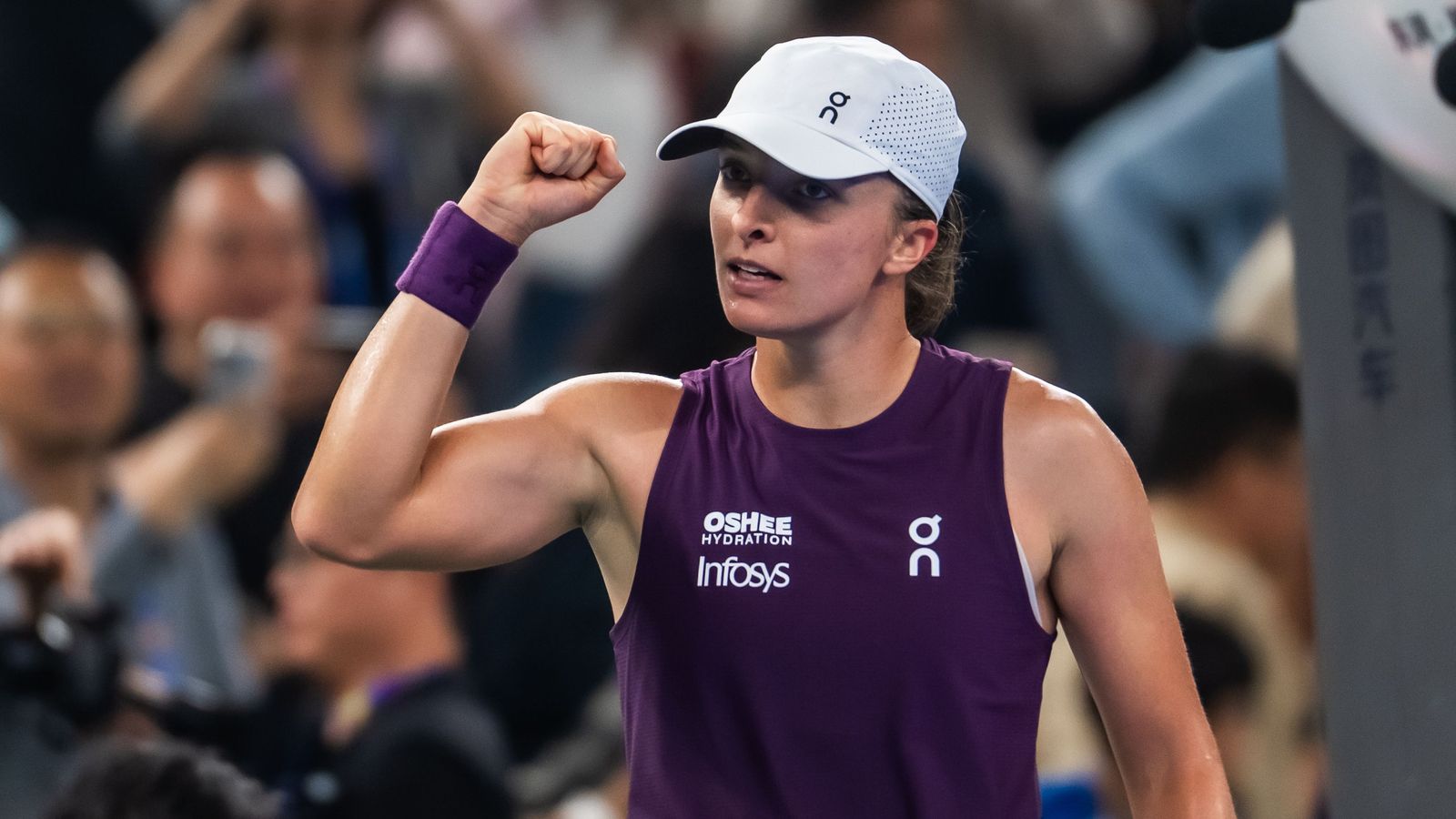
For a six-time Grand Slam champion, missing direct qualification for the year-end Finals is not a routine inconvenience. Swiatek won the event in 2023, defeating Jessica Pegula in the final, and has become accustomed to treating the final weeks of a season as a chance to chase the biggest prizes rather than as a fight simply to make the field. The current campaign has not followed that script. She has won one singles title in 2026 and has not advanced beyond the quarterfinals at any of the four Grand Slam tournaments.
That record should not be flattened into a claim that she suddenly forgot how to win. Forty tour-level victories and a Wuhan semifinal still represent a level most players would consider excellent. The problem is the gap between respectable results and the extraordinary standards Swiatek established for herself. A season with frequent wins but fewer titles and no major semifinal produces a much smaller Race cushion than her best years, leaving the final weeks vulnerable to one physical setback.
Wuhan offered a compressed version of that contradiction. She played some of her best tennis of the Asian swing against Frech, Krueger and Li. Then the Chwalinska semifinal changed in a matter of games. A 5-3 first-set lead and two set points were not enough to secure the opener; an injury made recovery harder; and the points available in a final disappeared. What looked like an opportunity to turn the season around became another narrow escape route closed.
There is also a longer-term strategic issue. Swiatek's most productive tennis depends on explosive movement, court coverage and the ability to sustain high-intensity rallies. A thigh problem can interfere with precisely those strengths, although the public information does not support a specific diagnosis or recovery forecast. If the next tournament cannot restore direct Finals qualification, the sensible question is not whether she can force one more appearance. It is whether doing so improves her position for the next competitive block.
Her next public decision may be as informative as another match result. She could test the leg and compete in Tokyo, she could focus on rehabilitation, or she could remain available for an alternate role at Indian Wells if healthy enough. None of those outcomes has been confirmed. What is confirmed is that the direct route has ended and that the priorities of her final weeks have shifted from qualification arithmetic to managing the body that must carry her into 2027.

The bottom line: Swiatek's Ningbo withdrawal is a confirmed injury decision with an unusually clear competitive consequence. The remaining Tokyo title is worth too few points to close her deficit to Muchova, so her direct WTA Finals qualification hopes are over. Muchova has the strongest position, Kostyuk retains a difficult two-tournament route, and Swiatek's possible alternate role remains separate from both.
For Swiatek, the important unanswered question is no longer whether she can manufacture enough Race points. It is how quickly her left thigh can recover, whether another October match is worthwhile, and what changes can turn a frustrating but still productive 2026 into a stronger 2027.
Shop GOATIFY tennis products from the Tennis-filtered collection scope.

















